
Caregiver decision guide
What's the back surgery recovery time for elderly parents?
Back surgery recovery time for an older parent varies widely by procedure — from about two to six weeks of limited activity after minimally invasive decompression to six to twelve months for fusion. This guide maps the hospital-to-home milestones and bone-healing timeline so adult children can plan with realistic expectations instead of one generic 'six weeks' answer.
The short answer is that an older parent's back surgery recovery may take roughly two to six weeks after minimally invasive decompression, but six to twelve months after spinal fusion before improvement is complete. Those are not interchangeable timelines, and age can make the same milestones take longer. The useful question is not “How many weeks until recovery?” It is “Which procedure did my parent have, which milestone are we measuring, and what does the written discharge plan say?”

For family planning, separate four points on the calendar: the hospital stay, returning to simple daily activities, moving toward fuller activity, and bone healing or complete improvement. A parent may be able to stand, wash, eat, and walk short distances well before the spine has finished healing.
The recovery timeline depends on the procedure
| Procedure | Hospital stay | Simple daily activities | Return toward fuller activity | Bone healing or complete improvement |
|---|---|---|---|---|
| Discectomy | Often a short stay; the exact plan varies | About 2–3 weeks to limited activity | About 6–8 weeks | The available range describes functional recovery rather than a separate fusion-healing period [1] |
| Laminectomy or decompression | Many lumbar laminectomies are same-day or 1–2 nights; some lumbar decompression stays are roughly 2–5 days [4][5][6] | About 4–6 weeks to partial activity | Up to about 12 weeks | The timeline depends on the operation and the surgeon's restrictions [1] |
| Kyphoplasty | The stay varies with the patient's condition and the hospital's protocol | About 2–3 weeks to resume ordinary function | About 4–6 weeks | This is not the same bone-healing timeline as a spinal fusion [1] |
| Spinal fusion | The length of stay varies by the levels fused, approach, health status, and hospital plan [7] | About 4–6 weeks for simple activities | Fuller activity may take substantially longer | At least 3–4 months for the bones to heal well; healing may continue for at least a year [2]. Complete improvement is commonly framed as about 6 months to a year [3] |
The ranges in this table come from procedure-specific patient guidance, hospital information, and aftercare instructions. Healthline's medically reviewed overview places discectomy, decompression, kyphoplasty, and fusion on notably different schedules: discectomy may reach fuller activity in six to eight weeks, decompression can take up to twelve weeks, and fusion may require six months to a year for complete improvement.[1] That is why “back surgery” is too broad a label to use when arranging care.
A decompression procedure may relieve pressure on a nerve without creating the same bone-healing obligation as a fusion. A discectomy removes the part of a disc causing pressure. A laminectomy or other decompression removes or reshapes material to create more room. Kyphoplasty follows a different path again, often addressing a vertebral compression fracture. Fusion joins vertebrae, so the parent can appear much more capable before the underlying repair is finished.
Why “six weeks” is an unreliable answer
Six weeks can be a meaningful point for one milestone and a misleading endpoint for another. After fusion, a parent may be allowed to handle basic activities around four to six weeks, while the bones still need at least three to four months to heal well. MedlinePlus notes that healing can continue for at least a year.[2] Alberta Health's aftercare guidance uses a longer frame for complete improvement: six months to a year.[3]
Those statements are not necessarily contradictory. “Can do simple activities” describes day-to-day function. “Bones have healed well” describes biological healing. “Complete improvement” is a broader outcome that may include pain, strength, endurance, balance, and the original nerve symptoms. A family member who hears “six weeks” should ask which of those meanings the clinician intends.
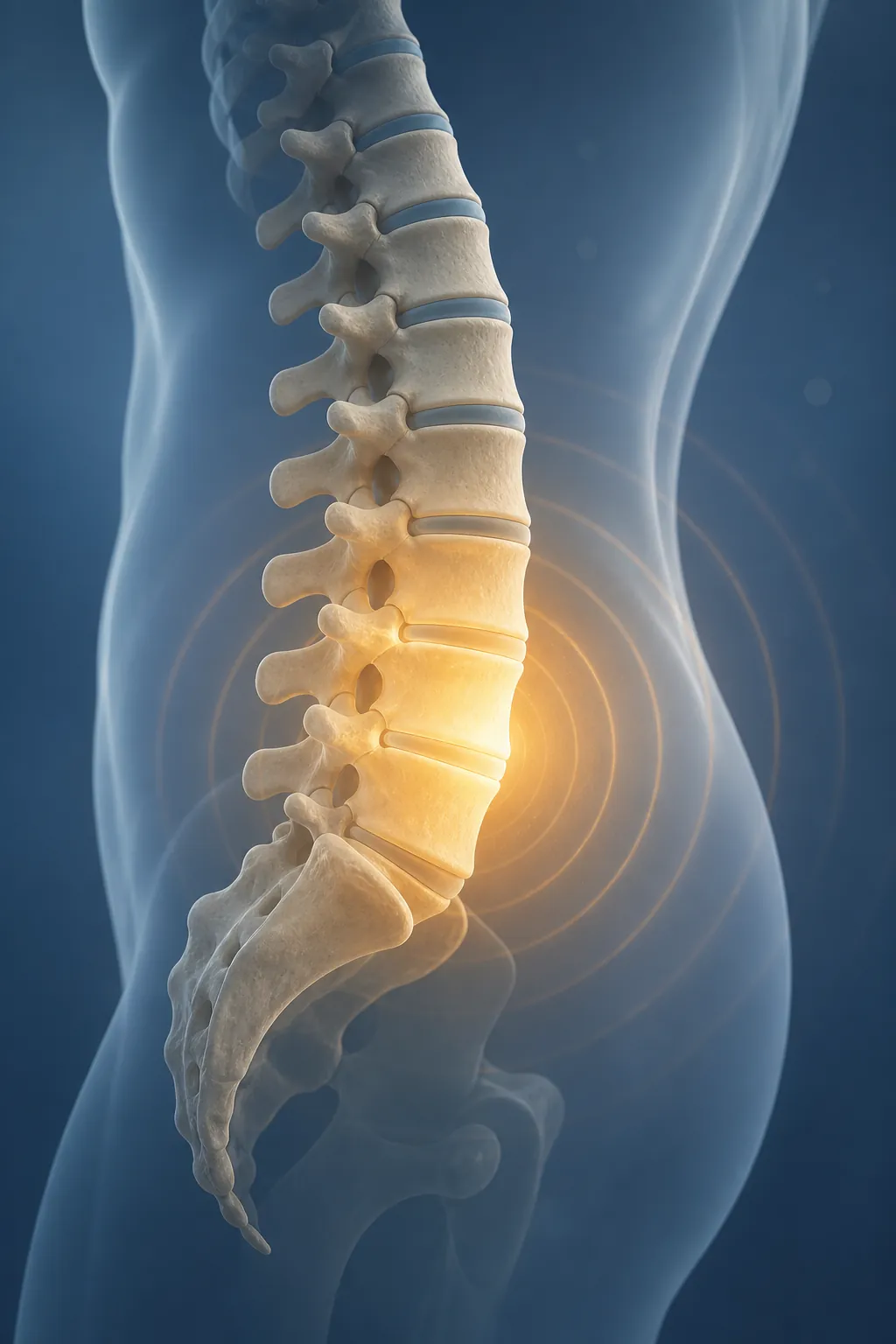
Older age can lengthen the recovery curve because walking tolerance, strength, other medical conditions, and the ability to manage restrictions all affect how quickly a person moves between milestones. Healthline also notes that older adults generally recover more slowly and are more likely to need a rehabilitation-facility stay before going home.[1] That possibility belongs on the discharge calendar rather than being treated as evidence that the surgery has failed.
Age alone does not determine whether a fusion will succeed. In a study of patients aged 80 and older, the one-year fusion rate was 90.0%, compared with 90.8% among patients in their 70s.[8] This is one study, not a promise for an individual parent, but it supports a more accurate expectation: older adults may need more planning and time without being automatically destined for a poor fusion outcome.
The hospital-to-home part of recovery
Hospital discharge is a transfer of responsibility, not proof that recovery is over. The parent may still need help getting in and out of bed, walking to the bathroom, preparing food, managing medications, and following movement restrictions. A short rehabilitation stay may come between the hospital and home, particularly when the parent cannot yet move safely or lacks enough support at home.
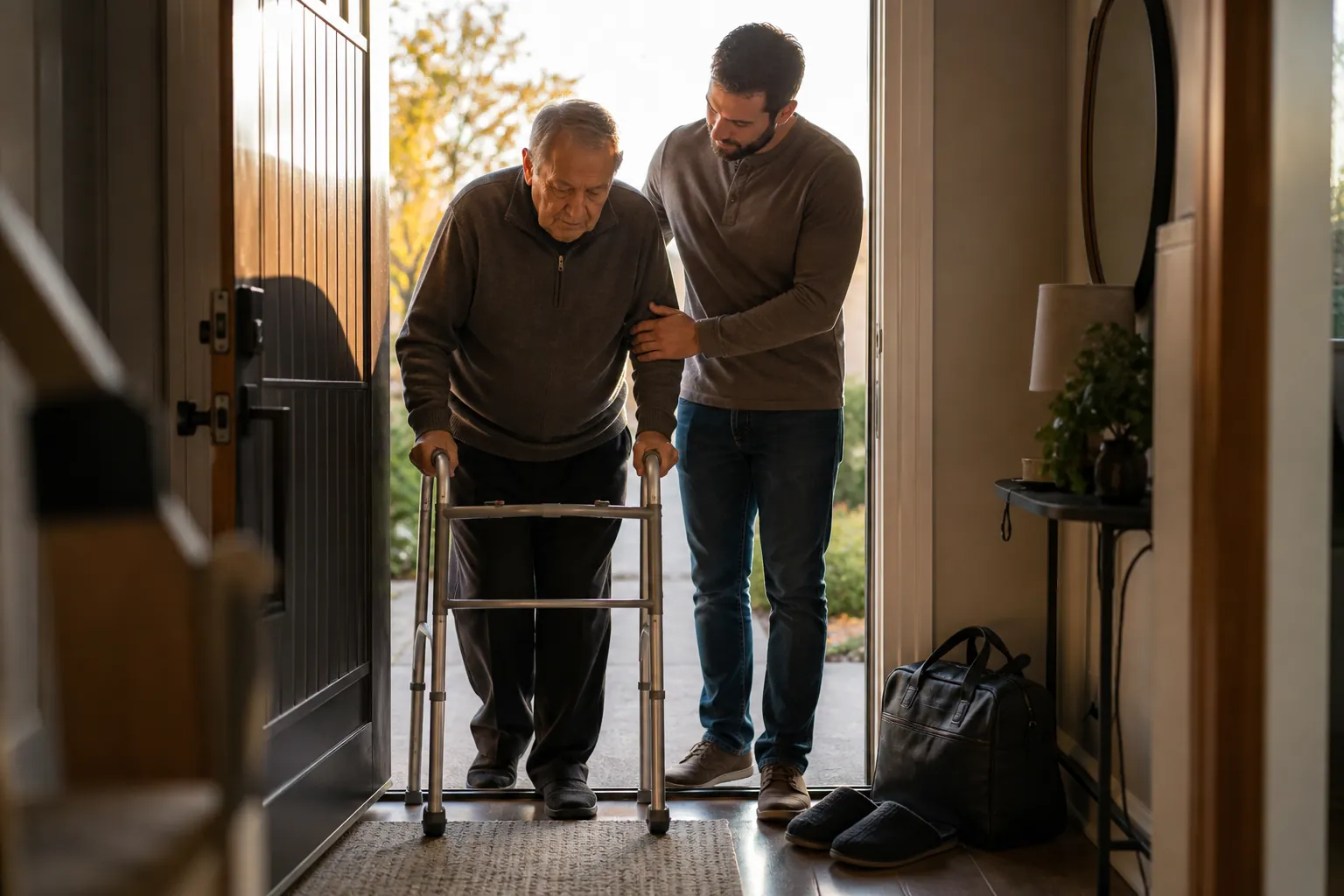
The first weeks at home deserve practical attention because a fall, missed medication, or unsafe transfer can interrupt an otherwise ordinary recovery. Before discharge, establish who will provide transportation, who can stay nearby, and who will handle the first shower, meals, laundry, and nighttime needs. Keep the route between the bed, bathroom, and main sitting area clear. The parent may improve unevenly: a better morning does not necessarily mean that a longer walk or a full household task is appropriate that afternoon.
Fall-prevention changes are especially relevant while the parent is using a walker, feeling weak, or adjusting to pain medication. The site's Fall Prevention resources can help with that part of the home plan. For families who cannot be present continuously, a fall-detection smartwatch for seniors may provide monitoring support, but it does not replace supervision, a clear emergency plan, or the clinical team's instructions.
Questions to take to the surgical team
The most useful discharge conversation turns a broad recovery estimate into observable milestones. Ask:
- Which procedure was performed, and which restrictions apply specifically to it?
- How long does the team expect the hospital stay or rehabilitation-facility stay to last?
- When may the parent shower, walk outside, climb stairs, and resume simple household activities?
- Which milestone refers to basic function, and which refers to bone healing or complete improvement?
- Who should the family call about worsening pain, weakness, a fall, medication problems, or a change in the incision?
- What would make the team change the current recovery plan?
Write the answers down and share them with everyone providing care. The surgeon's written discharge plan outranks a general timeline because it reflects the actual operation, the parent's health, and the team's assessment of mobility and safety. Plan for a range rather than a deadline, and expect the schedule to be revised as recovery becomes clearer.
This article is educational guidance, not medical advice. A parent with new or worsening symptoms should follow the discharge instructions and contact the surgical team or seek urgent care as directed.
References
- Recovery Time for Back Surgery Healthline
- Spinal Fusion - discharge MedlinePlus
- Spinal Fusion: What to Expect at Home Alberta Health Services
- Lumbar Laminectomy Spine Surgery Hospital for Special Surgery
- Laminectomy Cleveland Clinic
- Lumbar decompression surgery NHS
- Spinal Fusion Cleveland Clinic
- Comparison of Clinical and Radiological Outcomes after Spine Surgery in Patients Older Than 80 Years versus Those Aged 65-79 Years Medicine, 2021
Questions to bring to a clinician or OT
This is not medical, legal, or a family's final decision — only a framework. Bring these questions to a clinician, occupational therapist, or your local Area Agency on Aging.
Find Local HelpRelated reading
Noticed something outdated or inaccurate on this page? Flag a correction. We review every report against CDC, NIA, and AARP HomeFit guidance before updating a page.