
When Does an Aging Parent Need In-Home Services? A Practical Decision Guide
A structured, five-domain assessment framework for adult children who are unsure if their parent's struggles signal a need for formal help versus normal aging. This guide helps families distinguish between 'they're managing okay' and 'they need help now' using the ADL/iADL framework, a 10-signs checklist, a home safety audit, and conversation scripts.

Reframing the Question: 'Can They Manage' vs. 'Are They Thriving Safely'
You notice things. The stack of unopened mail on the counter. The dent on the car door that your parent can't explain. The way they've stopped inviting you over for dinner. Each observation, on its own, seems minor — maybe even normal aging. But together, they form a pattern that keeps you awake at night, wondering: Is this the moment I need to step in?
You are not alone in that uncertainty. According to a 2026 poll by U.S. News & World Report, 93% of adults aged 55 and over want to age in place. That overwhelming preference makes it harder to know when the balance tips from 'managing okay' to 'needs help now.' The Department of Health and Human Services estimates that someone turning 65 today has a nearly 70% chance of needing some type of long-term care in their remaining years — so the question is not if help might be needed, but when.
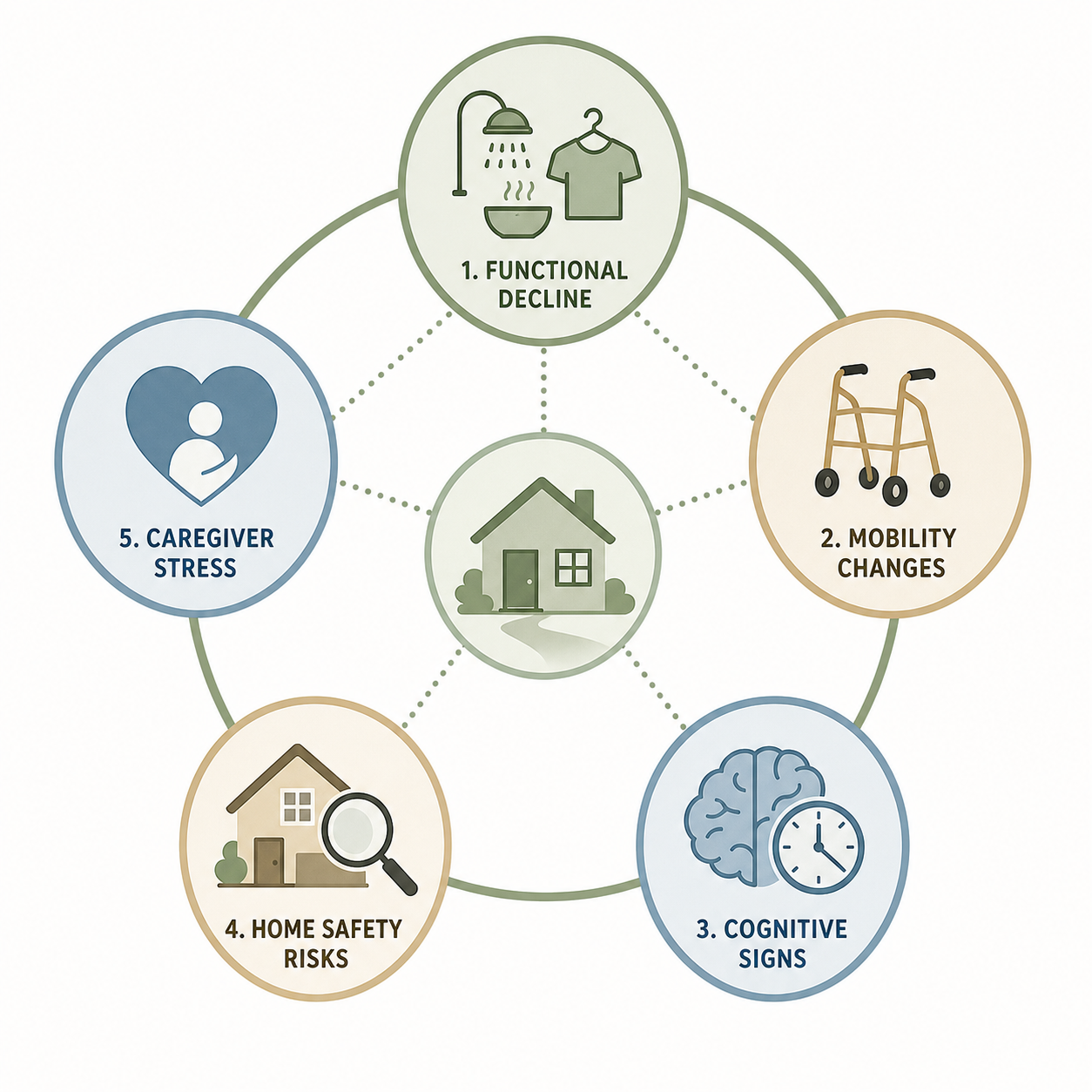
The core thesis of this guide is simple: the threshold for needing in-home services is a pattern of observable changes across five domains, not a single event. A fall is a crisis. A missed medication is a warning. But a constellation of small changes — weight loss, social withdrawal, unpaid bills, a cluttered home — is a signal that the current setup is no longer working. This guide will give you a structured way to assess that pattern, distinguish normal aging from actionable decline, and decide what kind of help makes sense for your parent's specific situation.
The ADL and IADL Framework: A Structured Way to Assess Functional Decline
Before you can decide what kind of help your parent needs, you need a common language to describe what they can and cannot do. Healthcare professionals use two standardized frameworks — Activities of Daily Living (ADLs) and Instrumental Activities of Daily Living (IADLs) — to assess functional status. Understanding these will help you communicate clearly with doctors, home care agencies, and family members.
Activities of Daily Living (ADLs): The Basics of Personal Care
ADLs are the fundamental self-care tasks that a person must be able to perform to live independently. Difficulty with one or more ADLs typically signals a need for hands-on personal care assistance, not just homemaker services.
| ADL | What to Look For | What It Suggests |
|---|---|---|
| Bathing | Avoiding showers, visible body odor, fear of getting in/out of the tub | May need a shower chair, grab bars, or help with bathing |
| Dressing | Wearing the same clothes repeatedly, difficulty with buttons or zippers, dressing inappropriately for weather | May need help with dressing or adaptive clothing |
| Toileting | Frequent accidents, soiled clothing, difficulty getting on/off the toilet | May need a raised toilet seat, incontinence products, or hands-on assistance |
| Transferring | Using furniture to push themselves up, difficulty getting out of bed or a chair | May need a walker, transfer aid, or physical therapy |
| Continence | Frequent accidents, not making it to the bathroom in time, hiding soiled laundry | May need incontinence evaluation and management plan |
| Feeding | Weight loss, difficulty swallowing, leaving food untouched, spilling frequently | May need meal preparation assistance, adaptive utensils, or swallowing evaluation |
Instrumental Activities of Daily Living (IADLs): The Skills for Independent Living
IADLs are more complex tasks that require cognitive function, planning, and organization. Difficulty with IADLs often appears first — sometimes years before ADL decline — and signals a need for nonmedical support services like homemaking, transportation, or medication management.
| IADL | What to Look For | What It Suggests |
|---|---|---|
| Medication management | Missed doses, expired prescriptions, mixing up pills, running out early | May need medication organizer, pill dispenser, or medication management service |
| Transportation | Giving up driving, getting lost in familiar areas, dents on the car, cancelled appointments | May need ride services, family transport, or driving evaluation |
| Meal preparation | Expired food in fridge, burned pots, weight loss, relying on snacks | May need meal delivery, meal prep service, or grocery assistance |
| Housekeeping | Clutter, dirty dishes, unwashed laundry, pest problems, unrepaired damage | May need light housekeeping or homemaker services |
| Finances | Unpaid bills, unusual spending, collection notices, missing bank statements | May need bill-pay assistance, financial POA, or money management service |
| Phone use | Missed calls, inability to use a smartphone, confusion with voicemail | May need simplified phone, emergency response system, or communication device |
| Shopping | Empty refrigerator, expired food, inability to get to the store | May need grocery delivery or shopping assistance |
| Laundry | Wearing dirty clothes, running out of clean clothes, unwashed bedding | May need laundry service or homemaker help |
The key insight: IADL difficulty is the early warning system. If your parent is struggling with medications, meals, or finances but still bathing and dressing independently, they likely need nonmedical support — not full personal care. If ADL difficulty is present, the need is more urgent and likely requires hands-on assistance from a home health aide or personal care attendant.
10 Signs It's Time to Consider In-Home Services
The following checklist is organized under the five-domain framework. Each sign is an observable behavior or condition — not a judgment. If you see three or more of these signs, it is time to have a conversation about bringing in help.
Domain 1: Functional Decline (ADL/IADL Signs)
- Unexplained weight loss or poor nutrition: Losing weight without trying, an empty refrigerator, expired food, or reliance on shelf-stable snacks. This often indicates difficulty with meal preparation, reduced appetite, or forgetting to eat.
- Missed or mismanaged medications: Pill bottles that are full when they should be empty, missed refills, or confusion about which pills to take. Medication errors are one of the most common — and most dangerous — early signs of IADL decline.
- Unpaid bills or unusual financial activity: Collection notices, late fees, duplicate payments, or donations to unfamiliar organizations. Financial mismanagement is a classic early sign of cognitive decline.
- Declining personal hygiene: Body odor, unwashed hair, wearing the same clothes repeatedly, or an unkempt appearance. This is an ADL sign and indicates a need for personal care assistance.
Domain 2: Mobility Changes
- A fall — or a near-fall: Even one fall doubles the risk of falling again. If your parent has fallen, even if they say they're fine, it is a medical event that warrants a fall risk assessment. See our detailed guide: When a Fall Signals It's Time for Help.
- Driving incidents or avoidance: New dents on the car, getting lost on familiar routes, near-misses, or voluntarily giving up driving. Loss of driving is a major IADL loss that often triggers a cascade of other needs.
- Difficulty with transfers: Using furniture to push up from a chair, holding walls while walking, or struggling to get in and out of bed or the car.
Domain 3: Cognitive Signs
- Social withdrawal and isolation: Declining invitations, no longer attending church or community events, spending most days alone. Recent data from the University of Michigan indicates that one in three older adults (34%) reported feeling isolated from others in the past year. Loneliness is both a risk factor for decline and a sign that current social supports are insufficient.
- Missed appointments or confusion about time: Forgetting doctor's appointments, showing up on the wrong day, or losing track of time. This can be an early sign of cognitive impairment.
Domain 4: Home Safety Risks
- Burns, scorch marks, or fire damage in the kitchen: Burned pots, scorch marks on the stove, or a smoke alarm that has been disabled. This is a red flag for cognitive or physical decline that makes cooking unsafe.
- Home disrepair and clutter: Unrepaired damage, overflowing trash, cluttered pathways, loose rugs, or poor lighting. The condition of the home often reflects the occupant's functional status.
Domain 5: Caregiver Stress
- You are feeling overwhelmed, anxious, or resentful: Your parent's needs are affecting your work, your marriage, your health, or your sleep. According to the Family Caregiver Alliance, approximately 43.5 million Americans provide unpaid care, spending an average of 24.4 hours per week. If you are feeling the strain, that is a valid data point — not a sign of failure.
The Home Safety Audit: What a Quick Walkthrough Reveals
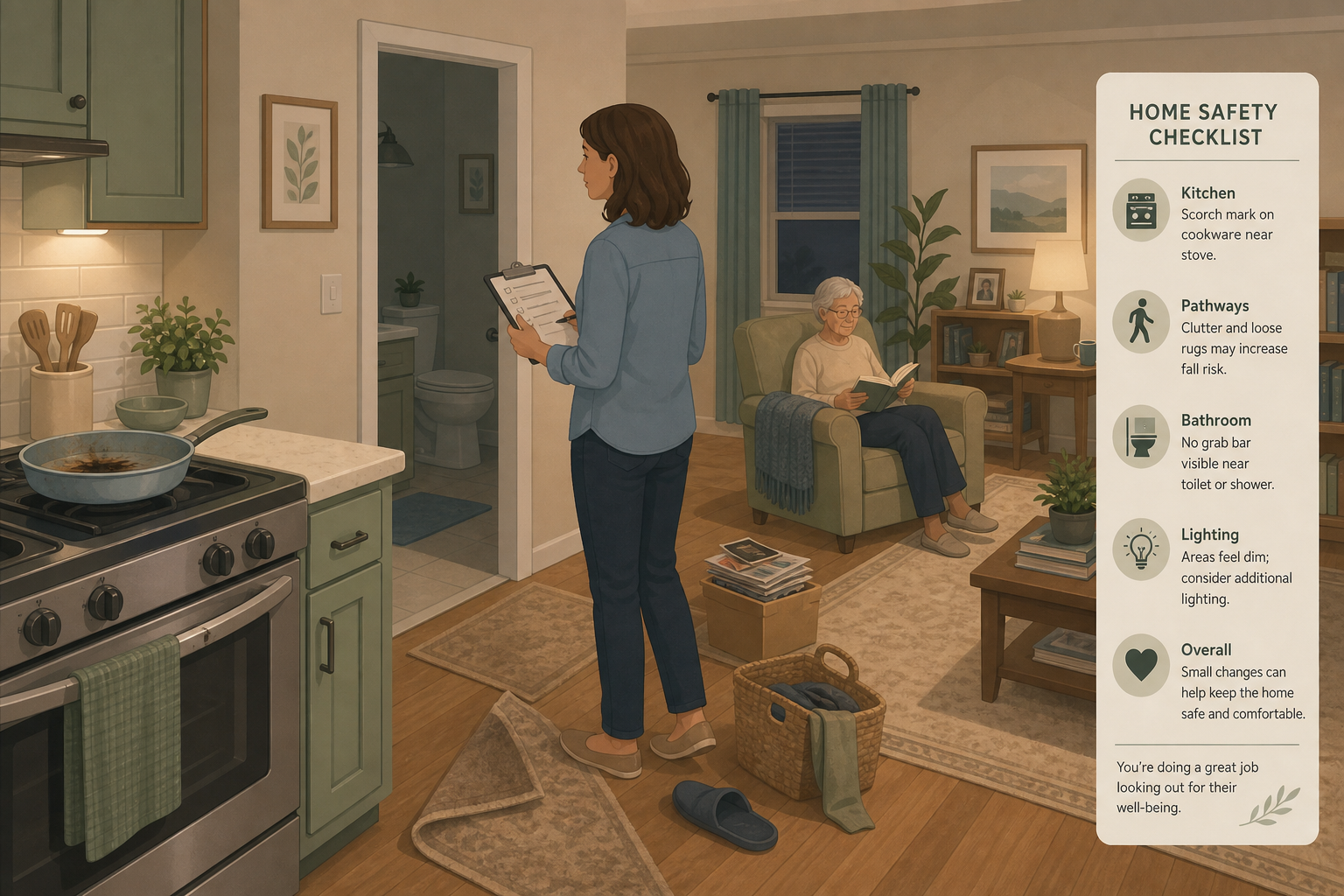
On your next visit, take 15 minutes to walk through your parent's home with fresh eyes. You are not looking for mess — you are looking for a mismatch between your parent's abilities and their environment. Each room tells a story about what is working and what is not.
| Room | What to Check | What It May Mean |
|---|---|---|
| Kitchen | Expired food, burned pots, disabled smoke alarm, empty refrigerator, unrepaired appliances | Difficulty with meal preparation, cognitive decline, or physical limitations making cooking unsafe |
| Bathroom | No grab bars near toilet or shower, loose bath mats, low toilet, difficulty stepping into tub | Fall risk; may need bathroom modifications and/or personal care assistance |
| Living areas | Cluttered pathways, loose rugs, poor lighting, furniture that is difficult to get out of | Mobility challenges; may need home modifications and/or mobility aids |
| Bedroom | Unmade bed, soiled linens, difficulty getting in/out of bed, no phone or alert system nearby | May need transfer assistance, incontinence products, or an emergency response system |
| Entryway | Steps without railings, uneven walkways, no ramp, poor outdoor lighting | Mobility barriers; may need ramp, railing, or stair lift |
| Mail area | Unopened bills, collection notices, stacks of unread mail | Financial or cognitive difficulty; may need bill-pay assistance or financial POA |
If you find multiple hazards — especially in the kitchen or bathroom — it is a strong signal that your parent's current living situation is not safe without modifications or support. For a deeper dive into fall prevention and home safety, see our When a Fall Signals It's Time for Help guide.
The Start-Small Approach: Why a Few Hours of Help Can Extend Independence
One of the most common fears families express is: 'If we start services, we'll never stop.' That fear keeps many families from getting help until a crisis forces their hand. But the evidence points in the opposite direction.
According to Vicki Demirozu, a 30-year home care veteran cited by A Place for Mom, 'there's evidence that even small amounts of in-home care, such as helping someone with meals or light housekeeping, can extend their independence.' A few hours of help per week — a homemaker to do laundry and grocery shopping, a companion to drive to appointments — can prevent the downward spiral that occurs when an older adult stops eating properly, stops socializing, or stops managing their home.
The national median cost for nonmedical home care in 2025-2026 is approximately $34 to $35 per hour, according to multiple sources including A Place for Mom and CareScout. At that rate, four hours of help per week costs roughly $140 — a fraction of the financial and emotional cost of a hospitalization or a rushed move to assisted living.
There is another reason to start small and plan ahead: the home care workforce is fragile. Industry data from the Home Care Association of America, cited by AxisCare, shows that nearly 80% of newly hired caregivers quit within their first 100 days on the job. Hiring in a panic — from a hospital discharge or after a fall — means you are more likely to accept the first available agency without vetting them, and more likely to experience a mismatch that leads to turnover. Planning ahead gives you the time to find a good fit.
How to Have the Conversation: Scripts for the 'I'm Worried About You' Talk
The hardest part of this process is not the assessment — it is the conversation. Your parent may feel defensive, ashamed, or afraid that you are trying to take away their independence. The goal of the first conversation is not to convince them to accept help. It is to open a door.
The 'I' Statement Script
Start with your own feelings, not their failings. This reduces defensiveness.
"Mom, I've been noticing that I worry about you more than I used to. I find myself checking my phone constantly to see if you've called. I love you, and I want to make sure you're safe and happy. Can we talk about what would make both of us feel better?"
The 'Independence' Script
Frame help as a tool for maintaining independence, not a surrender of it.
"Dad, I know how important it is for you to stay in this house. I want that too. But I'm worried that doing everything yourself is wearing you out. What if we got someone to help with the heavy cleaning and the yard work — just a few hours a week — so you can save your energy for the things you enjoy?"
Responding to Common Objections
| Objection | A Possible Response |
|---|---|
| "I don't need a stranger in my house." | "I understand. What if we start with someone you already know — maybe a neighbor's granddaughter who is looking for part-time work? Or we could try a companion service for just two hours to see how it feels." |
| "I'm fine. You're overreacting." | "You're right that you're managing. I'm not saying you can't do it. I'm saying I worry about you, and I would feel better if we had a little backup. This is about my peace of mind as much as your safety." |
| "I don't want to be a burden." | "You are not a burden. You raised me. Let me help you the way you helped me. This is what families do." |
| "We can't afford it." | "Let's look at what we can afford. Even two hours a week of help with groceries and cleaning might make a big difference. There may also be programs that can help with costs." |
If the conversation does not go well, do not force it. Leave the door open. Say, 'Can we talk about this again next week?' Sometimes the seed needs time to grow. For more guidance on navigating your own next steps after this conversation, see our guide: From Crisis to Confidence: A Stage-Based Guide for New Caregivers.
When to Escalate: Signs That In-Home Care Alone Isn't Enough
In-home services are a powerful tool for extending independence, but they are not the right answer for every situation. There comes a point when the level of care needed exceeds what can safely be provided at home — even with paid help. Recognizing this limit is not a failure; it is a responsible decision that protects your parent's safety and your own wellbeing.
Signs That a Higher Level of Care May Be Needed
- 24/7 supervision is required: If your parent cannot be left alone safely — due to wandering, fall risk, or cognitive impairment — in-home care becomes prohibitively expensive. Medicare does not pay for 24-hour-a-day care at home, and the cost of round-the-clock private care can exceed $250,000 per year.
- Frequent falls despite home modifications and assistance: If your parent is falling multiple times per month even with grab bars, a walker, and a caregiver present, the home environment may not be safe enough.
- Progressive cognitive decline that makes in-home care unsafe or ineffective: Wandering, aggression, or severe confusion can overwhelm even the most dedicated family caregivers and home care aides.
- Caregiver burnout that threatens your own health: If you are experiencing symptoms of burnout — exhaustion, irritability, sleep problems, or declining health — despite having paid help, the current arrangement may not be sustainable.
- Complex medical needs that require skilled nursing: Wound care, IV medications, tube feeding, or other skilled nursing needs may be better managed in a facility setting, depending on the frequency and complexity of care required.
If you are facing this decision, you are not alone. For a structured comparison of aging in place versus moving to a facility, see our decision framework: Senior Citizen Home or Aging in Place? A Step-by-Step Decision Framework for Families.
Remember: the goal is not to keep your parent at home at any cost. The goal is to find the right level of support that allows them to live with dignity, safety, and quality of life — whether that is at home with a few hours of help per week, or in a community where round-the-clock care is available.
Where this decision comes from
Suggest a correction
We keep this content strictly product-neutral and reviewed against CDC STEADI, NIA, and AARP HomeFit guidance. If something here looks outdated, unclear, or inaccurate, tell us — this page does not carry open public comments, because it touches medical urgency, cost, or capacity-adjacent decisions where a discussion thread is a trust liability rather than a trust asset.
See the correction process on our editorial standards page →