
Caregiver decision guide
From Crisis to Confidence: A Stage-Based Guide for New Caregivers of Elderly Parents
Most new caregivers start unprepared. This guide provides a progressive roadmap — from the first 72 hours through the first month and beyond — to help adult children navigate the transition from crisis to confident, sustainable caregiving.

You Are Not Alone: The Reality of Starting Caregiving in Crisis
If you are reading this in the hours or days after a parent's fall, a sudden hospitalization, or a new dementia diagnosis, you are in the exact place most new caregivers start: unprepared and overwhelmed. The data bears this out. A 2025 survey of over 1,000 family caregivers found that only 1 in 4 felt completely prepared when their caregiving role began. More than half — 54% — said they wished they had started planning sooner. And 24% reported that their need for care was immediate, leaving no time to prepare.
You are not alone in feeling disoriented. The number of family caregivers supporting older adults in the U.S. has risen sharply — a 2025 Johns Hopkins study using NHATS/NSOC data found a 32% increase, from 18.2 million to 24.1 million people between 2011 and 2022. Today, approximately 63 million U.S. adults serve as unpaid caregivers for a family member, according to the Caregiver Action Network.
The structure is simple: four phases that match the natural progression of a new caregiving journey. Each phase focuses on the most critical actions for that period, so you can focus on what matters most right now without being overwhelmed by everything that comes later.
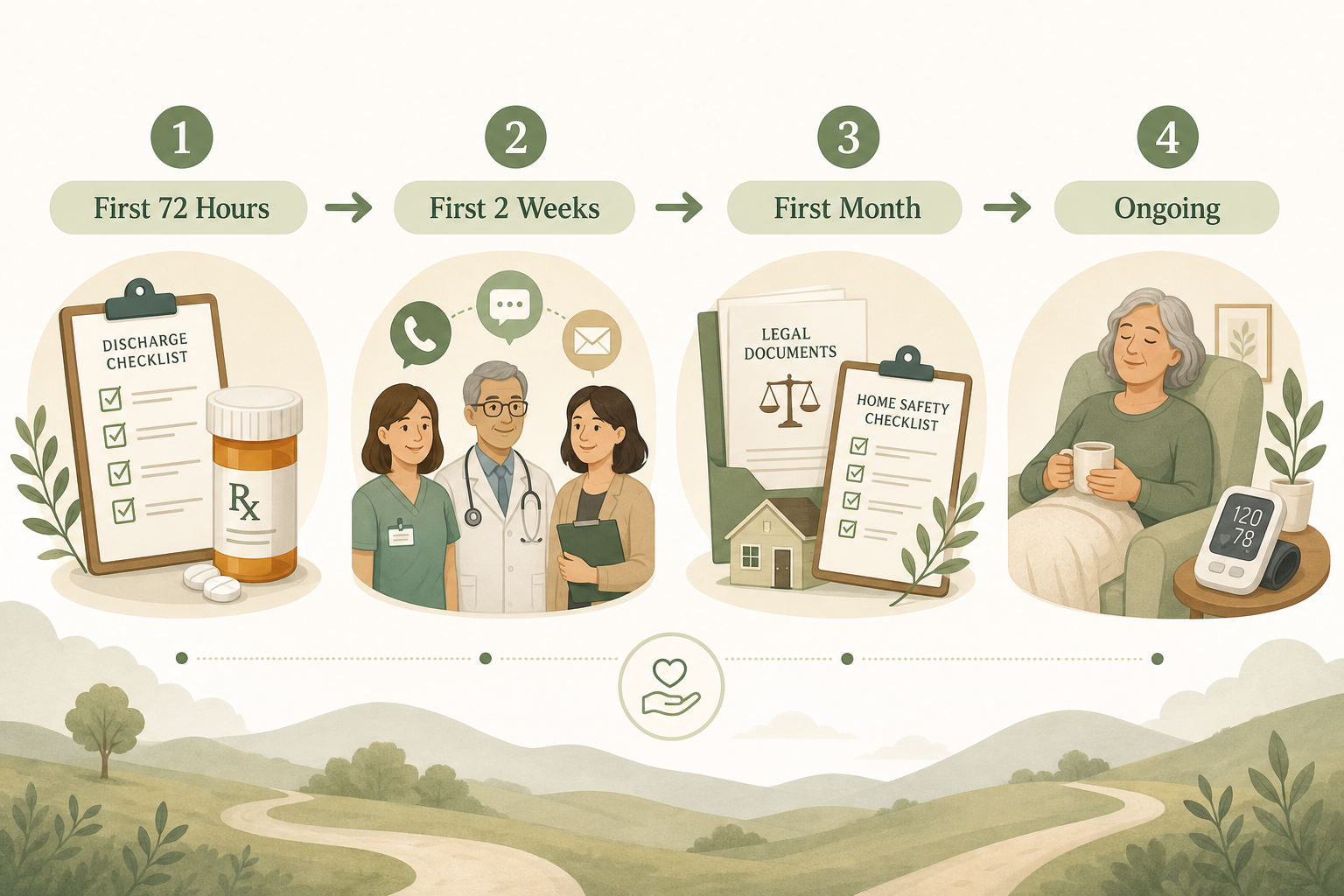
Phase 1: The First 72 Hours — Urgent Safety and Medical Coordination
The first three days are about stabilization. Your primary goals are to ensure your parent's immediate physical safety, understand their medical status, and secure the home environment against further incidents. Do not worry about long-term planning yet. Focus on the next few hours.
Immediate Safety Assessment
If your parent is still in the hospital after a fall or other event, your most important task is to understand the discharge plan before they leave. Ask the attending physician or discharge planner these questions:
- What is the immediate risk of another fall or complication?
- What medications have been changed or added, and what side effects should we watch for?
- Are there any follow-up appointments, lab tests, or home health services scheduled?
- What specific symptoms or changes should prompt a call to the doctor or a return to the hospital?
- Is a home safety evaluation recommended before discharge?
If your parent is already home, conduct a quick visual scan of their immediate environment. Clear pathways of clutter, ensure adequate lighting, and identify any obvious tripping hazards like loose rugs or cords. For a more detailed approach, see our guide on building a complete fall prevention system.
Medication Verification
Medication errors are a leading cause of hospital readmission among older adults. Gather all prescription bottles, over-the-counter medications, and supplements. Create a simple list with the drug name, dosage, frequency, and prescribing doctor. Compare this list against the discharge summary or the most recent doctor's visit notes. If anything does not match, call the prescribing physician or the hospital's discharge pharmacy before administering the first dose.
Secure the Immediate Environment
In the first 72 hours, focus on the room where your parent spends the most time — usually the bedroom and bathroom. Ensure the path from the bed to the bathroom is clear and well-lit. Place a non-slip mat in the shower or tub. If your parent uses a walker or cane, make sure it is within reach of the bed and chair. These simple adjustments can prevent a second fall while you plan more comprehensive modifications.
Phase 2: The First Two Weeks — Building Your Care Team and Communication Systems
Once the immediate crisis has stabilized, your focus shifts to building a sustainable support structure. The single most important action in this phase is to identify who is on your care team and establish how you will communicate. Caregiving is not a solo job, even if it often feels that way.
Identify Your Core Team
A care team includes more than just family members. Think broadly about who can help:
| Team Member | Typical Role | Key Questions to Ask |
|---|---|---|
| Primary caregiver (you) | Daily coordination, medical decisions, hands-on care | What tasks can I delegate? What do I need to keep doing myself? |
| Secondary family caregiver(s) | Respite coverage, transportation, errands | What days or times can they reliably commit? |
| Primary care physician or geriatrician | Medical oversight, medication management | How often should follow-ups occur? Are specialists needed? |
| Hospital discharge planner or social worker | Care coordination, community resource referrals | What home health services are available through insurance? |
| Close friend or neighbor | Meal delivery, pet care, companionship visits | What is the easiest way for them to help without overcommitting? |
A 2025 Pew Research Center survey of 8,750 U.S. adults found that 68% of parent caregivers regularly help with errands, housework, managing health care, or finances, while only 16% help with personal care. Understanding who can take on which type of task — and being explicit about it — prevents one person from carrying the entire load.
Set Up a Shared Communication System
Miscommunication is one of the fastest ways to increase stress in a caregiving situation. Choose one central tool — a shared calendar app, a group chat, or a simple shared document — where everyone on the team can see appointments, medication changes, and daily notes. This is especially critical if you are a long-distance caregiver or if multiple family members are involved in decision-making.
At a minimum, the system should track:
- Upcoming medical appointments and who will accompany your parent
- Current medication list and any recent changes
- Daily notes on mood, appetite, pain, or unusual behaviors
- A running list of questions for the next doctor's visit
- Contact information for all team members and providers
Gather Medical and Personal History
During the first two weeks, compile a single folder — physical or digital — containing:
- A complete medication list (prescriptions, over-the-counter, supplements)
- Insurance cards and Medicare/Medicaid information
- Primary care physician and specialist contact information
- A list of known allergies and chronic conditions
- Emergency contacts and any existing advance directives or living will
Having this information in one place will save you hours of frantic searching during the next medical appointment or emergency.
Phase 3: The First Month — Financial, Legal, and Home Safety Foundations
By the end of the first month, you should have the foundational structures in place that will support your parent's care for the long term. This phase covers the three areas that new caregivers most often delay — and later regret not addressing sooner.
Legal and Financial Planning
If your parent does not already have a durable power of attorney (POA) for health care and finances, this is the most urgent legal task. Without it, you may not be able to make medical decisions or manage their finances if they become incapacitated. Contact an elder law attorney to discuss:
- Durable power of attorney for health care (allows you to make medical decisions)
- Durable power of attorney for finances (allows you to manage bank accounts, pay bills, file taxes)
- Advance directives or living will (documents your parent's wishes for end-of-life care)
- Medicaid eligibility assessment (if your parent may need nursing home or long-term care in the future)
The financial picture for family caregivers is sobering. According to the Caregiver Action Network, the average out-of-pocket expense for family caregivers is $7,200 per year, and 90% of caregivers contribute financial support, averaging 26% of their income. Understanding what programs your parent may qualify for — including VA benefits for veterans, paid family leave in your state, and Medicaid waivers — can make a significant difference. Our state-by-state guide to caregiver compensation programs provides a detailed overview.
Conduct a Room-by-Room Home Safety Assessment
Falls are the leading cause of injury among older adults, and most falls happen at home. A systematic room-by-room assessment can identify hazards before they cause harm. Focus on these areas:
| Room | Common Hazards | Quick Fixes |
|---|---|---|
| Bathroom | Slippery floors, lack of grab bars, low toilet, no shower seat | Install grab bars near toilet and shower, use non-slip mats, add a raised toilet seat and shower chair |
| Bedroom | Cluttered pathways, poor lighting, bed too high or low | Clear floor paths, add nightlights, ensure bed height allows feet to touch the floor when sitting |
| Stairs and hallways | Loose handrails, poor lighting, clutter | Secure handrails on both sides, install motion-sensor lights, remove all clutter |
| Kitchen | Hard-to-reach items, slippery floors, poor lighting | Move frequently used items to waist-level cabinets, use non-slip mats, improve task lighting |
| Entryways | Uneven steps, lack of handrails, poor outdoor lighting | Repair uneven surfaces, install handrails on both sides of steps, add motion-sensor outdoor lights |
For a more comprehensive checklist and guidance on structural modifications like ramps and stair lifts, see our complete fall prevention system guide and our aging-in-place home modifications section.
Map Community Resources
Your local Area Agency on Aging (AAA) is one of the most valuable resources you may not know about. AAAs provide information and referrals for home-delivered meals, adult day care, transportation, caregiver support groups, and respite services. You can find your local AAA through the Eldercare Locator (eldercare.acl.gov) or by calling 1-800-677-1116.
Phase 4: Ongoing — Preventing Burnout, Finding Respite, and Adapting to Change
The first month is about building foundations. The months and years that follow are about sustainability. Caregivers who do not prioritize their own well-being are at high risk of burnout — and burnout does not just hurt you; it compromises the quality of care your parent receives.
Recognize the Early Signs of Burnout
The statistics on caregiver burnout are stark. A 2025 survey by A Place for Mom found that 78% of family caregivers report burnout, 87% experience stress or anxiety, and 84% feel overwhelmed. The Mayo Clinic notes that caregivers report higher stress levels than the general population, with common signs including feeling constantly tired, changes in sleep or appetite, irritability, loss of interest in activities, and withdrawing from friends and family.
If you recognize these signs in yourself, you are not failing. You are experiencing a predictable response to an extraordinarily demanding role. Our article on caregiver burnout warning signs and recovery strategies provides detailed guidance on what to do next.
Schedule Regular Respite
Respite care is not a luxury — it is a necessity for sustainable caregiving. Options include:
- In-home respite: A home health aide or volunteer stays with your parent for a few hours so you can run errands, rest, or see friends
- Adult day centers: Structured programs that provide social activities, meals, and supervision during the day
- Short-term residential care: Some nursing homes and assisted living facilities offer short stays (a few days to a few weeks) for respite purposes
- Family and friend rotation: A scheduled rotation where different family members or friends take over for set blocks of time
The Family and Medical Leave Act (FMLA) allows eligible employees to take up to 12 weeks of unpaid leave per year for family caregiving. Some states also have paid family leave programs. Check with your employer's human resources department and your state labor office for details.
Consider Monitoring Technology for Safety and Peace of Mind
As care needs evolve, technology can provide an extra layer of safety and reduce the constant worry of being away from your parent. Categories to consider include:
- Personal emergency response systems (PERS): Wearable buttons or pendants that allow your parent to call for help with the press of a button
- Passive home sensors: Motion sensors, door sensors, and stove monitors that alert you to unusual activity or potential hazards
- GPS trackers: Useful for parents with dementia who may wander; can be worn as a watch or clipped to clothing
- Wearable health monitors: Devices that track heart rate, sleep patterns, and activity levels
Our monitoring technology section provides product-neutral explainers for each category, including key features to evaluate and privacy considerations.
Adapt as Needs Change
Caregiving is not static. Your parent's needs will change over time — sometimes gradually, sometimes suddenly. The care plan you build in the first month will need regular review and adjustment. Schedule a monthly check-in with yourself (and your care team, if you have one) to ask:
- Has my parent's mobility, cognition, or health status changed?
- Are we still using the right assistive devices or home modifications?
- Is my current level of involvement sustainable, or do I need more help?
- Have any new community resources or financial programs become available?
If your parent has dementia, their needs will progress through distinct stages. Our memory care section provides stage-specific guides and behavior reference pages that you can return to as the disease advances.
Quick-Reference Checklist: Your First Month at a Glance
Use this checklist as a printable reference to track your progress through the first month. Not every item will apply to every situation, but it covers the most common and critical tasks.
| Phase | Task | Status |
|---|---|---|
| First 72 Hours | Conduct immediate safety assessment of home environment | ☐ |
| First 72 Hours | Verify all medications against discharge summary or doctor's orders | ☐ |
| First 72 Hours | Ask discharge planner or doctor the five key questions (see Phase 1) | ☐ |
| First 72 Hours | Clear pathways and secure bathroom for fall prevention | ☐ |
| First 2 Weeks | Identify primary and secondary caregivers on your team | ☐ |
| First 2 Weeks | Set up a shared communication system (calendar, chat, or document) | ☐ |
| First 2 Weeks | Compile medical and personal history in one folder | ☐ |
| First 2 Weeks | Contact your local Area Agency on Aging for resource referrals | ☐ |
| First Month | Consult an elder law attorney about POA and advance directives | ☐ |
| First Month | Assess Medicaid eligibility and explore state-specific programs | ☐ |
| First Month | Conduct room-by-room home safety assessment | ☐ |
| First Month | Research and contact potential home modification contractors if needed | ☐ |
| First Month | Identify at least one respite option (family, adult day center, or in-home) | ☐ |
| Ongoing | Schedule monthly check-in with yourself to reassess needs | ☐ |
| Ongoing | Review monitoring technology options for safety and peace of mind | ☐ |
| Ongoing | Read the caregiver burnout guide for early warning signs | ☐ |
Resource Directory: Where to Turn for Help
You do not need to navigate this alone. The following national organizations and government programs provide information, referrals, and direct support for family caregivers.
- Eldercare Locator (1-800-677-1116 / eldercare.acl.gov): Connects you to local Area Agencies on Aging for meal delivery, transportation, respite, and caregiver support
- Caregiver Action Network (caregiveraction.org): Provides education, peer support, and resources for family caregivers; operates a free help line
- USA.gov (usa.gov/disability-caregiver): Official government portal for information on Medicaid, VA benefits, paid family leave, and other federal programs
- National Council on Aging (ncoa.org): Offers benefits checkups and resources for older adults, including fall prevention and financial assistance programs
- Alzheimer's Association (alz.org / 1-800-272-3900): 24/7 helpline, support groups, and educational resources for dementia caregivers
- Your local Area Agency on Aging: Find yours through the Eldercare Locator for state-specific programs and local support services
For quick answers to common questions — including Medicare coverage for medical alert systems, fall risk medications, and home modification costs — visit our FAQ section. For definitions of common caregiving terms like ADLs, IADLs, PERS, and POA, see our Eldercare Glossary.
Questions to bring to a clinician or OT
This is not medical, legal, or a family's final decision — only a framework. Bring these questions to a clinician, occupational therapist, or your local Area Agency on Aging.
Find Local HelpRelated reading
Noticed something outdated or inaccurate on this page? Flag a correction. We review every report against CDC, NIA, and AARP HomeFit guidance before updating a page.