
Caregiver decision guide
How to Help Aging Parents Accept Monitoring Technology Without Damaging Trust or Dignity
A step-by-step conversation framework for adult children whose parent resists monitoring technology. Learn five scripts for different parent personalities, the least-invasive technology adoption ladder, and how to preserve autonomy while introducing safety net technology.
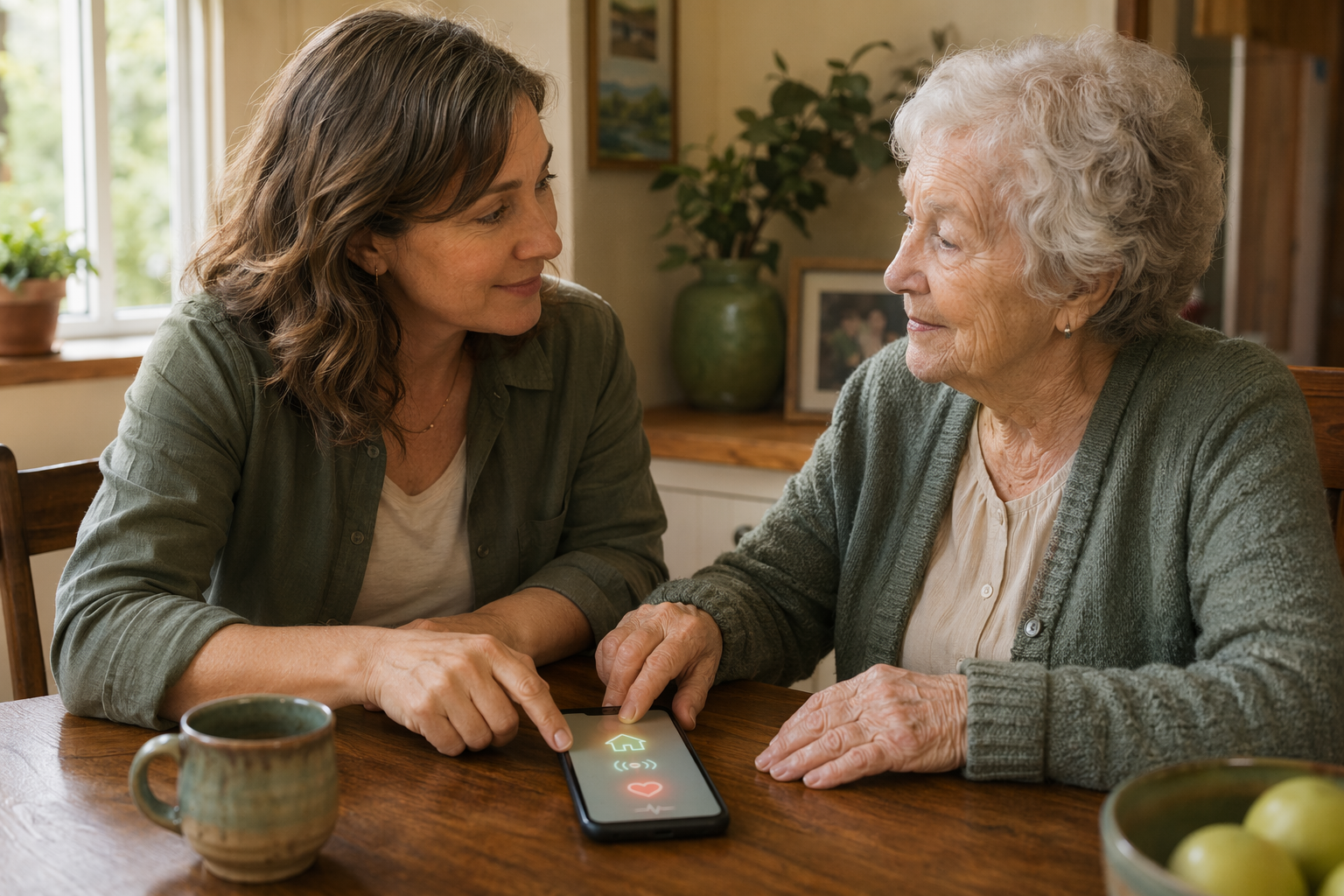
Why Resistance Is the Norm (and Why It’s Not About the Technology)
If your parent has dismissed a medical alert pendant, refused to let you install a motion sensor, or told you they "don't need to be watched," you are not alone — and your parent is not being unreasonable. The resistance you are encountering is almost never about the device itself. It is about what the device represents: a loss of autonomy, an acknowledgment of vulnerability, and the fear of being seen as frail by the people who once depended on them.
The data backs this up. A 2025 report from AARP and the Consumer Technology Association found that while 80% of older Americans already own at least one type of technology that supports aging at home, only 3% own a connected medical alert device — even though an additional 18% say they would be likely to buy one. That gap between ownership and expressed interest is not about cost or features. It is about the emotional weight of crossing the line from "aging well" to "needing help."
The same report revealed that 64% of adults aged 50 and older do not feel technology today is designed with their age in mind. When a parent looks at a wearable pendant or a home camera system, they may see a product built for someone else's idea of old age — not for their actual life. Combine that with a natural desire to maintain independence, and resistance becomes the rational response, not the irrational one.
A 2022 scoping review published in PMC analyzed 30 studies on in-home monitoring technology and found that privacy is a critical concern for many older adults. This is not a trivial worry. When a parent says "I don't want to be watched," they are expressing a legitimate concern about their private life becoming visible to others. The solution is not to dismiss that concern — it is to offer technology that respects it.
The National Institute on Aging offers a simple but powerful starting point: the best way to know what someone needs is to ask them directly. Before you buy a single device, before you research features or compare prices, you need to have a conversation that starts with listening — not with proposing solutions.
The Conversation Framework: 5 Scripts for Different Parent Personalities
One conversation script does not fit every parent. The approach that works for a pragmatic retired engineer will backfire with a fiercely independent former executive. Below are five scripts tailored to common parent personalities. Each script follows the NIA's core advice: mention your worry without sounding critical, and frame help as support for independence.
1. The Practical Parent
This parent responds to logic, data, and cost-benefit analysis. They want to understand exactly what a device does, how much it costs, and what problem it solves.
Try this: "Mom, I've been reading about some simple home sensors that can tell me if you're moving around normally during the day. They don't use cameras — just motion detection, like a porch light. If something changes in your routine, I'd get a notification so I can check in. It's not about watching you; it's about me worrying less when I'm at work. Would you be willing to look at the research with me and see what you think?"
2. The Proud Parent
This parent equates accepting help with losing independence. They need to feel that they are in control of the decision and that the technology serves their goals, not yours.
Try this: "Dad, you've always been the one who takes care of everything. I'm not trying to change that. But I've been thinking about how much longer you can keep doing all the things you love — gardening, driving to see your friends — if we don't put a few simple safety measures in place. This pendant is basically a phone you wear. If you ever need help, you press a button. It's not for me; it's for you to keep your independence longer. What do you think?"
3. The Fearful Parent
This parent may already be anxious about their health or safety. They might worry that technology will confirm their worst fears — that they are declining faster than they realize.
Try this: "I know the idea of having sensors in the house feels strange. I get it. But let me show you what I'm actually talking about — it's a small white disc that sits on a shelf. It doesn't record video or audio. It just notices when someone walks past. If you fell and couldn't get up, it would alert me. That's it. We can try it for one week. If you hate it, we take it out. No pressure."
4. The Parent with Early Cognitive Decline
When memory or judgment is already affected, the conversation needs to be simpler, more concrete, and repeated over time. The parent may not remember the discussion, so the focus should be on immediate, tangible benefits.
Try this: "Mom, I got this little button that you can wear around your neck. If you ever feel dizzy or need me, you just press it and I'll know right away. Let me show you how it works. See? You press here. Can you try it once so I know you remember?"
5. The Tech-Averse Parent
This parent has never been comfortable with technology and may actively distrust it. The key is to minimize the "tech" framing entirely and focus on the function.
Try this: "Dad, this isn't a computer. It's a light switch that works automatically. I'm going to put a couple of these in the hallway and bathroom so the lights come on when you get up at night. That way you don't have to fumble for the switch in the dark. And this little plug — it just turns off the coffee pot after two hours so you don't have to worry if you forgot. That's all. No apps, no passwords, no screens."
The Technology Adoption Ladder: Least Invasive First
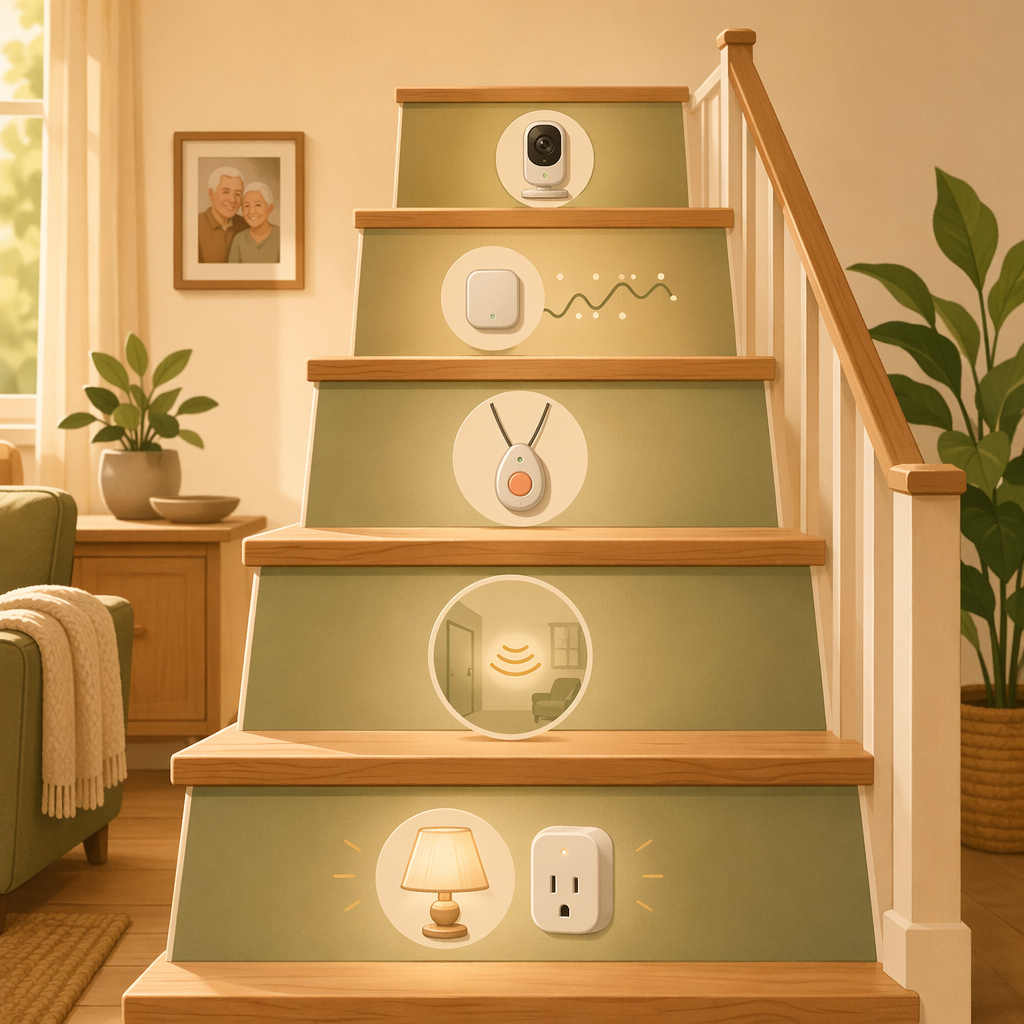
Once the conversation has opened the door, the next question is: what technology do you actually start with? The answer is almost always the least invasive option that addresses the specific concern. Think of this as a ladder — you start on the bottom rung and only move up if the current solution proves insufficient.
Wirecutter's 2026 guide on smart home devices for aging in place recommends a passive sensor system as the best balance of safety monitoring and dignity preservation. A passive remote monitor uses no cameras, no microphones, and no wearables — it simply detects motion patterns and alerts caregivers to significant changes in routine.
| Rung | Technology | What It Monitors | Invasiveness Level | Privacy Trade-off |
|---|---|---|---|---|
| 1 | Smart plugs and automated lighting | Whether lights are on/off; prevents falls in dark | Minimal | No data about activity or location — just power state |
| 2 | Motion sensors and door contact sensors | Movement patterns in key rooms; whether doors are opened | Low | Detects presence but not identity; no audio or video |
| 3 | Wearable emergency pendant (PERS) | Manual or automatic fall detection; one-button help call | Moderate | Requires wearing device; location data shared during alert |
| 4 | Passive behavior monitoring system | Aggregated activity patterns (sleep, meals, bathroom visits) | Low to moderate | No cameras or microphones; trend data only, not real-time video |
| 5 | In-home cameras (video monitoring) | Real-time video of specific rooms | High | Continuous video feed; significant privacy concern for parent |
The PMC scoping review confirms that passive infrared (PIR) motion sensors and contact sensors are the most studied technologies in this space, appearing in 21 and 19 of the 30 reviewed studies respectively. These technologies have the strongest evidence base for supporting aging in place while respecting privacy.
How to Involve Your Parent in Device Selection and Setup
The single most effective way to reduce resistance is to turn your parent from a passive subject of monitoring into an active partner in safety planning. Wirecutter's guidance is explicit on this point: the person being cared for should be fully informed about what devices are being used, where they are placed, what they do, and how they work.
Here is a practical sequence for involving your parent in the process:
- Research options together. Sit down with your parent and look at the technology categories on the adoption ladder. Let them see what a motion sensor looks like. Read the descriptions aloud. Ask: "Does this seem reasonable to you?"
- Let them handle the device before purchase. If possible, visit a store or order a single unit to test. Let your parent hold the device, see how small it is, and understand that it is not a piece of medical equipment.
- Set up the system as a shared activity. Do not install everything while your parent is out of the house. Instead, say: "Let's put this sensor in the hallway together. Where do you think it should go?" This gives your parent a sense of control over the placement.
- Establish clear consent boundaries. Before the system goes live, have an explicit conversation about what data is collected, who can see it, and how it will be used. For example: "The sensor will tell me if you haven't walked past the kitchen by 10 AM. I'll check it once a day. No one else will have access."
- Give them an off switch. If the system includes a camera or wearable, make sure there is a physical way for your parent to disable it when they want privacy. Knowing they have control reduces the feeling of being surveilled.
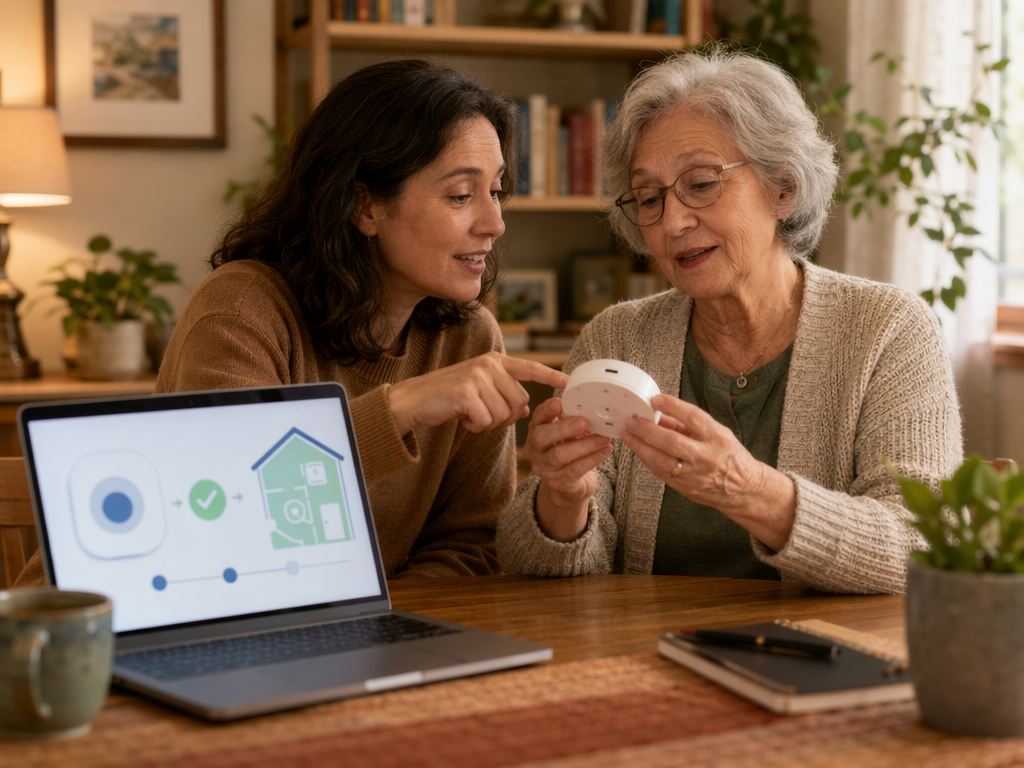
What to Do If They Still Say No: Compromise Options
Even with the best conversation and the least invasive technology, some parents will still say no. That is not a failure — it is a realistic outcome. The goal is incremental progress, not a single perfect solution. Here are compromise strategies that keep the door open.
- Offer a trial period. "Let's try the motion sensor in the hallway for one week. If you don't like it, I'll take it down and we won't talk about it again." A finite trial feels less permanent and gives your parent a chance to experience the benefits firsthand.
- Start with partial coverage. If your parent refuses whole-home monitoring, suggest covering only the most critical areas — the bathroom (highest fall risk) and the front door (wandering risk). This limits the sense of being watched while addressing the highest-priority safety concerns.
- Pair technology with a non-tech safety measure. Sometimes the resistance is to the device itself, not to the idea of safety. Offer a combination: a motion sensor in the kitchen plus a daily phone call from a neighbor. The technology handles what only technology can do; the human connection handles the rest.
- Use a doctor's or peer's recommendation. Many parents will accept a suggestion from their primary care provider that they would reject from their child. Ask the doctor to mention monitoring technology during the next visit. Alternatively, if your parent has a friend who uses a similar system, ask that friend to share their experience.
- Reframe the conversation around your worry, not their frailty. "Dad, I'm not sleeping well because I worry about you falling. This sensor would help me sleep. Would you be willing to try it for me?" Sometimes accepting help for someone else's peace of mind is easier than accepting it for oneself.
Signs It’s Time to Move from Voluntary to Necessary
There is a line between respecting your parent's autonomy and ignoring a preventable crisis. When the situation escalates beyond the point where voluntary adoption is reasonable, it is time to have a different kind of conversation — one that involves their primary care provider or a geriatric care manager.
The following warning signs suggest that the risk of not having monitoring technology in place has become greater than the risk of damaging your parent's pride:
- A fall that required medical attention — especially if your parent could not get up afterward
- Missed medications leading to a measurable health event (e.g., a hospitalization for uncontrolled blood pressure or blood sugar)
- Wandering or getting lost in familiar places — a key sign of cognitive decline that passive door sensors can detect
- Leaving the stove on or burning food — a fire risk that smart stove monitors or shut-off devices can prevent
- Significant weight loss or dehydration — indicators that basic daily activities (eating, drinking) are being missed
- Multiple missed appointments or unpaid bills — signs that executive function is declining
If any of these signs are present, the conversation shifts from "Would you like to try this?" to "We need to put something in place for your safety, and I need your help to choose what that looks like." This is not about overriding your parent's wishes — it is about acknowledging that the cost of inaction has become too high.
The ultimate goal is not to win an argument with your parent. It is to find a path forward that preserves their dignity, respects their autonomy, and keeps them safe in the place they want to be. Over 90% of older adults prefer to age in place at home, according to data from the NIH and AARP cited by ChoiceMutual. Monitoring technology, introduced thoughtfully and collaboratively, can make that preference a reality — without turning a parent's home into a surveillance zone.
Questions to bring to a clinician or OT
This is not medical, legal, or a family's final decision — only a framework. Bring these questions to a clinician, occupational therapist, or your local Area Agency on Aging.
Find Local HelpRelated reading
Noticed something outdated or inaccurate on this page? Flag a correction. We review every report against CDC, NIA, and AARP HomeFit guidance before updating a page.