
Caregiver decision guide
When a Help Button Is Not Enough: Why Passive Motion, Door, and Stove Sensors Replace Emergency Pendants for Aging Parents
If your parent has mild cognitive decline or dementia, a traditional medical alert pendant may no longer be reliable. This article explains how passive motion sensors, door alerts, and stove shut-off devices create an always-on safety net that works without requiring your parent to remember to push a button, charge a battery, or wear anything at all.
The 50-Year-Old Pendant Problem: Why Forgetting to Wear It Is the Real Failure Point
Medical alert pendants have been the default answer to aging-in-place safety for decades. The logic seems sound: if a senior falls or needs help, they press a button and a monitoring center dispatches assistance. But this model depends on a single, fragile assumption — that the person will be wearing the device at the moment they need it, and that they will have the presence of mind to press the button.
For older adults with mild cognitive decline or dementia, that assumption breaks down. A pendant left on the nightstand during a 2 AM bathroom trip is useless. A parent who doesn't recognize an emergency as an emergency won't push the button. And a person who finds the device uncomfortable, confusing, or stigmatizing may simply stop wearing it. The result is a false sense of security for the family caregiver — the pendant is in the house, but it's not doing its job.
How Cognitive Decline Changes the Safety Equation
Reactive devices — pendants, pull cords, wall-mounted emergency buttons — all share a common requirement: the user must recognize a problem and take deliberate action. As dementia progresses, several cognitive functions that support this process begin to erode.
- Memory loss: A person may forget they own a pendant, forget to put it on after a shower, or forget what the button does in a moment of panic.
- Impaired judgment: A fall may not be perceived as an emergency. The person might try to get up on their own, making the injury worse, rather than calling for help.
- Confusion and disorientation: Nighttime confusion (sundowning) can lead to wandering, during which the pendant is often left behind. The person may not know where they are or how to get help.
- Physical discomfort or resistance: Many older adults find pendants uncomfortable to sleep in, irritating to the skin, or embarrassing to wear in public. They take them off and don't put them back on.
These failure modes are not rare exceptions. They are predictable outcomes of the disease. A safety system that depends on the person with dementia to actively participate is, by design, a system that will fail when it is most needed.
Motion Sensors: Passive Fall Risk Detection That Works Before a Fall
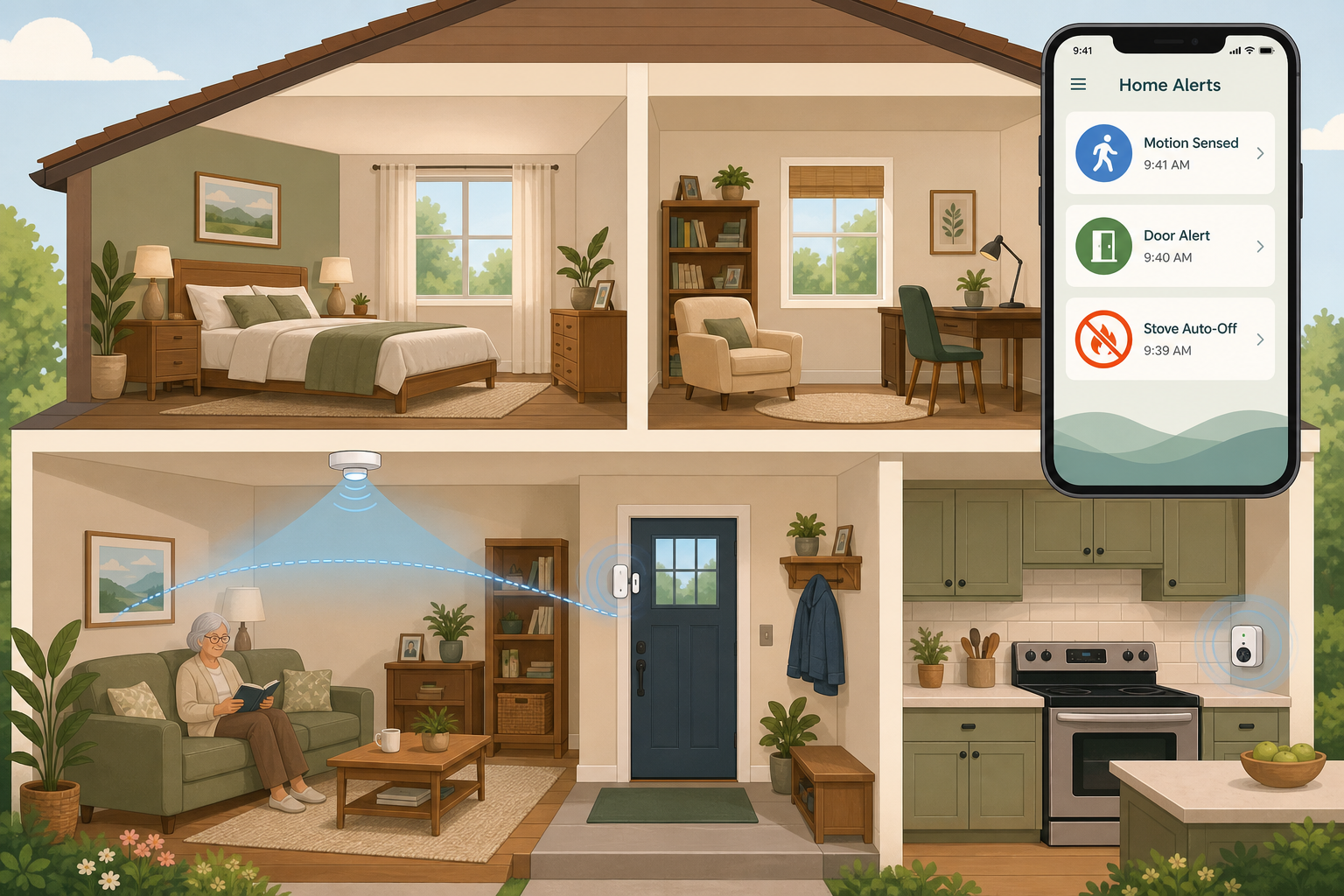
Passive infrared (PIR) motion sensors offer a fundamentally different approach. Instead of waiting for a person to press a button, these sensors monitor movement patterns throughout the home and alert caregivers to changes that may signal declining health or an increased fall risk — often days or weeks before an incident occurs.
A 2022 scoping review published in the Interactive Journal of Medical Research found that PIR motion sensors were used in 21 of 30 studies reviewed, making them the most common sensor type for monitoring older adults at home. Contact sensors, which detect door and cabinet openings, were used in 19 of the 30 studies. The review confirmed that these technologies can detect falls, cognitive impairment, and abnormal behaviors, and that they play an essential role in supporting aging in place.
What makes motion sensors particularly valuable for the cognitive decline scenario is their ability to detect subtle changes in routine that a pendant would never catch.
- Fewer trips to the kitchen or bathroom may indicate reduced mobility, dehydration, or a urinary tract infection.
- Longer-than-usual bathroom visits could signal a fall or difficulty getting up.
- Missed morning routines — no movement in the kitchen by 9 AM — can alert a caregiver that something is wrong before a full day passes.
- Increased nighttime activity may indicate sundowning, pain, or sleep disturbances that need attention.
Door Sensors: Wandering Prevention That Alerts You Before They Leave
For families dealing with dementia-related wandering, the moment of crisis is often the 2 AM phone call: your parent is not in their bed, the front door is open, and you are miles away. Magnetic contact sensors on exterior doors provide a simple, effective solution that replaces panic with a proactive alert.
These sensors use a magnetic switch — also called a reed switch — that detects when a door is opened or closed. When paired with a monitoring hub, they send an instant notification to a caregiver's phone the moment an exterior door is opened. The caregiver can then call the parent, check a live sensor status, or dispatch a neighbor or responder.
The cost difference between door alarms and facility-based care is dramatic.
| Option | Typical Cost | What You Get |
|---|---|---|
| Anti-wandering door alarm system (Smart Caregiver) | ~$169 (one-time, DIY) | Door monitor alarm + resident wristband; alerts when door is opened; no professional installation needed |
| envoyAtHome passive sensor system | $99/month + $399 equipment fee | Motion, door, and cabinet sensors; 35 behavioral pattern detections; unlimited family caregiver access |
| Assisted living facility (AARP average) | $7,756/month | 24/7 staffing, meals, activities, and supervision |
A single month of assisted living costs more than 45 times the one-time price of a basic door alarm system. For families who are not yet ready for facility placement — or who want to delay it as long as possible — door sensors offer a practical, affordable bridge.
Stove Safety Sensors: Preventing the Most Common Kitchen Fire Risk
Kitchen fires are the leading cause of home fires and fire-related injuries among older adults. According to FEMA data cited by iGuard, adults over 65 face a 2.5 times greater risk of injury or death in a kitchen fire than the general population. That risk rises to 3 times by age 75 and 4 times by age 85. For someone with cognitive decline, a forgotten burner is not a rare event — it is a recurring hazard.
Automatic stove shut-off devices address this risk directly by cutting power or gas to the stove when certain conditions are met. Two of the most widely used products in this category are iGuard and FireAvert.
- iGuard uses radar and motion sensing to detect whether someone is in the kitchen. If no motion is detected for a set period, it automatically shuts off power to the stove's heating elements. The company reports preventing over 1 million potential forgotten cooking fires with no reported incidents across a decade of use.
- FireAvert takes a different approach: it cuts power to gas or electric stoves the moment a smoke alarm sounds. The device costs $249.99 and works with both gas and electric stoves. The gas version uses a solenoid valve to shut off the gas flow. FireAvert reports it is trusted by over 1 million homes.
Both devices offer remote monitoring via mobile apps, allowing family caregivers to check stove status, receive alerts, and even reset the device remotely. This is particularly valuable for long-distance caregivers who cannot be present to verify that the stove is off.
Real-World Data: What the Numbers Tell Us About Passive Monitoring
The evidence supporting passive monitoring is not theoretical. Multiple sources with large-scale deployment data demonstrate that these technologies are proven, not experimental.
| Source | Claim | Scope |
|---|---|---|
| iGuard | Prevented over 1 million potential forgotten cooking fires | No reported incidents across a decade of use |
| FireAvert | Trusted by over 1 million homes | Works with gas and electric stoves; built by firefighters |
| 2022 Scoping Review (Interactive Journal of Medical Research) | PIR motion sensors used in 21 of 30 studies; contact sensors in 19 of 30 studies | Most common sensor types for monitoring older adults at home |
| AARP (via Smart Caregiver) | Average cost of care facility: $7,756/month | Baseline for cost comparison with passive monitoring |
The 2022 scoping review is particularly important because it establishes that the academic and clinical communities have been studying these sensors for years. The review found that in-home monitoring technologies can detect falls, cognitive impairment, and abnormal behaviors, and that they play an essential role in aging in place. This is not a new or unproven category — it is a mature field with a growing evidence base.
Cost Comparison: Passive Sensors vs. Assisted Living
For many families, the decision to install passive monitoring is driven as much by economics as by safety. The cost of a comprehensive passive sensor system is a fraction of the cost of facility-based care, and it can delay or prevent the need for placement.
| Option | One-Time Cost | Monthly Cost | Annual Cost (Year 1) |
|---|---|---|---|
| Basic door alarm system (Smart Caregiver) | ~$169 | $0 | ~$169 |
| Stove shut-off device (FireAvert) | $249.99 | $0 | ~$250 |
| Comprehensive passive sensor system (envoyAtHome) | $399 (equipment fee) | $99 | ~$1,587 |
| Assisted living facility (AARP average) | N/A | $7,756 | ~$93,072 |
The math is stark. A comprehensive passive sensor system costs roughly $1,587 in the first year — less than a single week in an assisted living facility. For families who can combine a few well-chosen sensors (a door alarm, a stove shut-off, and a motion sensor hub), the total investment is often under $1,000. That is not a cost; it is a savings compared to the alternative.
How to Transition from a Pendant to Passive Monitoring as Cognitive Decline Progresses
Making the switch from a pendant to passive sensors is not just a technical change — it is an emotional one. For the parent, removing the pendant can feel like an admission that they are no longer capable. For the adult child, it can feel like giving up on the idea that their parent can still manage independently. The key is to frame the transition as an upgrade, not a downgrade.
Here is a practical, phased approach to making the transition.
- Start with the stove shut-off. This is often the easiest sell because it addresses a concrete, well-understood danger. Frame it as a convenience: "This device will turn off the stove automatically so you never have to worry about remembering."
- Add door sensors if wandering becomes a concern. Position them as a way to keep the parent safe without restricting their freedom. "This will just let me know when you're going out for a walk so I don't worry."
- Layer in motion sensors for routine monitoring. Explain that these sensors help you understand their daily patterns so you can spot potential health issues early. "If you're not moving around as much, it might mean you're not feeling well, and I want to know so I can help."
- Keep the pendant as a backup initially. There is no need to remove it immediately. Let the parent adjust to the new system while the pendant remains available. Over time, as the passive system proves itself, the pendant will naturally fall out of use.
The transition from a pendant to passive monitoring is not an all-or-nothing decision. You can start with one sensor, see how it works, and add more as needs evolve. The beauty of passive monitoring is that it scales with the disease — what works for early-stage cognitive decline can be expanded to meet the challenges of moderate and late-stage dementia without requiring your parent to learn anything new.
The pendant served its purpose for decades. But for families navigating dementia, it is time to recognize that the old solution no longer fits the new problem. Passive motion, door, and stove sensors offer something the pendant never could: a safety net that works even when your parent cannot remember to use it.
Questions to bring to a clinician or OT
This is not medical, legal, or a family's final decision — only a framework. Bring these questions to a clinician, occupational therapist, or your local Area Agency on Aging.
Find Local HelpRelated reading
- Wearable vs. Passive Senior Monitoring: What Each Approach Misses — and How to Cover Both
- Why Wearable Help Buttons Fail and What Actually Works: A Caregiver's Guide to Passive Monitoring
- The Privacy Trade-Off in Elderly Monitoring: Camera-Free Systems, Data Security, and Gaining Your Parent's Acceptance
Noticed something outdated or inaccurate on this page? Flag a correction. We review every report against CDC, NIA, and AARP HomeFit guidance before updating a page.