
Caregiver decision guide
When Home Care Costs More Than Assisted Living: The Break-Even Point Families Need to Know
Many families assume home care is always cheaper than a facility. This guide reveals the counterintuitive truth: at higher care hours, home care can cost more than assisted living or even a nursing home. We break down the national cost data, show you how to find your break-even point, and provide a decision framework for choosing between home and facility care.

The Counterintuitive Truth About Home Care Costs
Most families begin their caregiving journey with a straightforward assumption: keeping Mom or Dad at home must be cheaper than moving them into a facility. It feels intuitive — you're paying for a few hours of help each day, not a full monthly rent. But the data tells a more complicated story, and for many families, the assumption turns out to be wrong.
The national median cost of a home health aide in 2026 is $35 per hour, according to CareScout's 2025 Cost of Care Survey. That figure rises to roughly $6,478 per month if you need 44 hours of care per week — the equivalent of a full-time job with overtime. Compare that to the national median monthly cost of assisted living at $6,200, and the picture shifts. At higher levels of need, home care is not the budget-friendly option families expect it to be.
This guide is designed for families who are actively comparing home care and facility options. Rather than presenting a simple list of costs, we walk through the break-even analysis — the point at which home care becomes more expensive than assisted living or a nursing home — and show how that point shifts depending on where you live, how many hours of care you need, and what hidden expenses you might be overlooking.
National Cost Comparison: Home Care vs. Assisted Living vs. Nursing Home (2026)
Before we can find the break-even point, we need a clear picture of the baseline costs. The table below presents the national median monthly costs for the four most common care settings, using the most current 2026 data available.
| Care Setting | National Median Monthly Cost (2026) | Source |
|---|---|---|
| Home care (7 hrs/week) | $1,031 | A Place for Mom (2026) |
| Home care (15 hrs/week) | $2,208 | A Place for Mom (2026) |
| Home care (30 hrs/week) | $4,416 | A Place for Mom (2026) |
| Home care (44 hrs/week) | $6,478 | A Place for Mom (2026) |
| Assisted living | $6,200 | CareScout (2025) |
| Memory care | $7,500 – $8,000 | A Place for Mom (2026) |
| Nursing home (semi-private room) | $9,581 | CareScout (2025) |
| Nursing home (private room) | $10,798 | CareScout (2025) |
The table reveals the central tension: at low care hours (7–15 per week), home care is dramatically cheaper than any facility option. But as hours increase, the gap narrows quickly. At 30 hours per week, home care costs $4,416 — already approaching the assisted living median. At 44 hours per week, home care at $6,478 actually exceeds the assisted living median of $6,200.
For a deeper look at how these settings compare across multiple dimensions — including level of care, socialization, and medical oversight — see our full guide: Home Care vs. Assisted Living vs. Nursing Home: Which Is Actually Cheaper in 2026?.
The Break-Even Analysis: At What Point Does Home Care Cost More?
The break-even point is the number of weekly care hours at which the monthly cost of home care equals the monthly cost of a facility. For assisted living, that crossover occurs at approximately 35 to 44 hours per week — roughly the equivalent of a full-time job with some overtime.
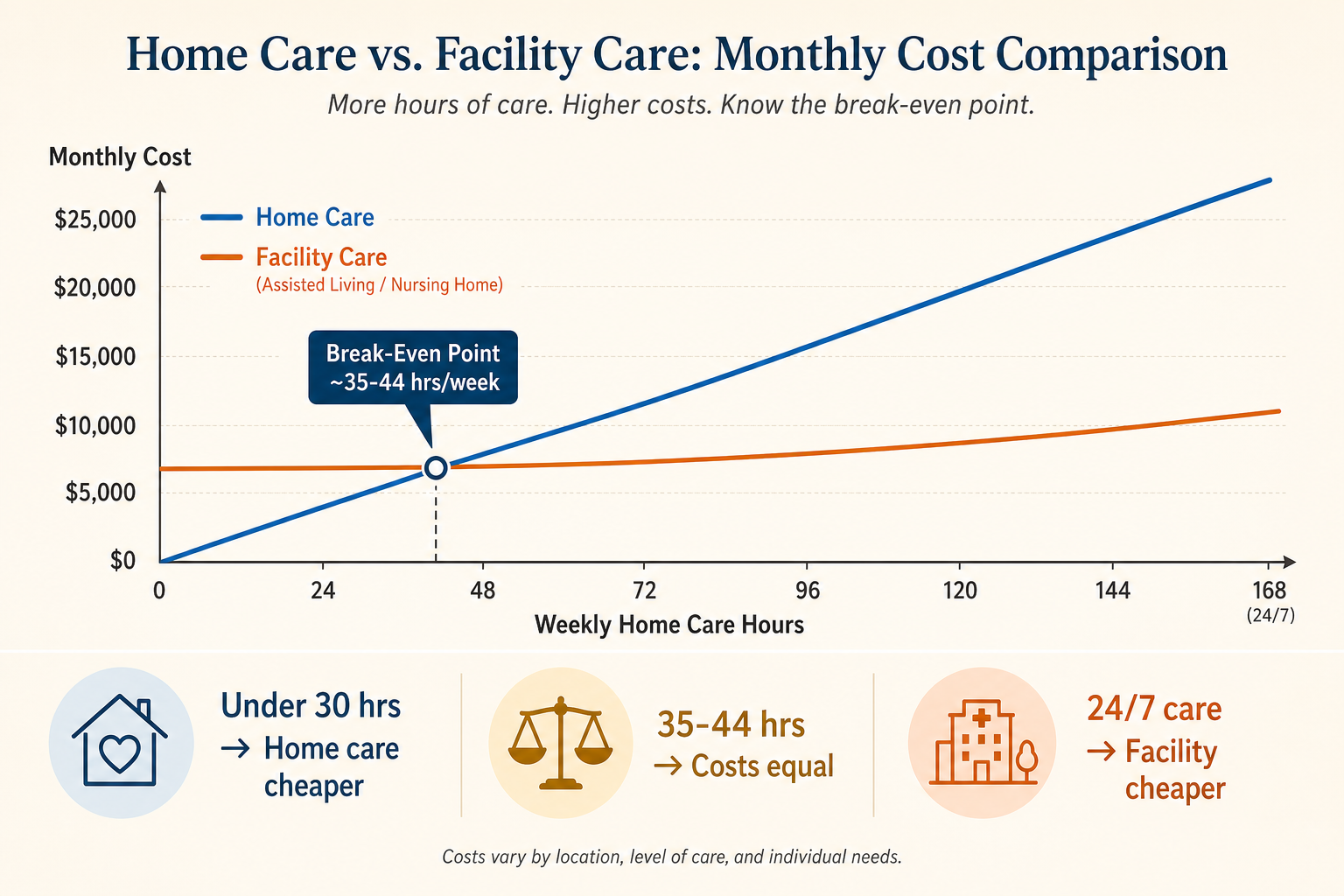
Here is how the math works out at the national median rate of $34 per hour:
| Weekly Home Care Hours | Monthly Home Care Cost ($34/hr) | vs. Assisted Living ($6,200/mo) | vs. Nursing Home Semi-Private ($9,581/mo) |
|---|---|---|---|
| 7 hours | $1,031 | $5,169 cheaper | $8,550 cheaper |
| 15 hours | $2,208 | $3,992 cheaper | $7,373 cheaper |
| 30 hours | $4,416 | $1,784 cheaper | $5,165 cheaper |
| 40 hours | $5,888 | $312 cheaper | $3,693 cheaper |
| 44 hours | $6,478 | $278 more expensive | $3,103 cheaper |
| 24/7 care (168 hours) | $17,000 – $25,000 | $10,800 – $18,800 more expensive | $7,419 – $15,419 more expensive |
The 24/7 home care figures deserve special attention. Estimates vary across sources: A Place for Mom projects a range of $17,000 to $25,000 per month, HomeCare.org estimates $17,472 per month at $26 per hour, and Senioridy estimates $20,000 to $24,000 per month. Even at the low end, 24/7 home care costs roughly double the rate of a private nursing home room ($10,798 per month).
For a more detailed breakdown of how care needs map to different settings, see our guide: Senior Care Options by Hours of Need: A Decision Framework for Family Caregivers.
How State-Level Cost Differences Shift Your Break-Even Point
The national median is a useful starting point, but it can be misleading. Home care hourly rates vary so dramatically by state that the break-even point can shift by 10 to 15 hours per week depending on where you live.
According to A Place for Mom's 2026 state-by-state data, the range is striking:
| State | Median Hourly Home Care Rate (2026) | Monthly Cost at 44 hrs/week | Break-Even vs. Assisted Living ($6,200/mo) |
|---|---|---|---|
| Mississippi | $25/hr | $4,775 | Home care cheaper by $1,425 |
| Louisiana | $23/hr | $4,391 | Home care cheaper by $1,809 |
| National Median | $34/hr | $6,478 | Home care more expensive by $278 |
| Washington | $42/hr | $8,008 | Home care more expensive by $1,808 |
| Minnesota | $42/hr | $8,008 | Home care more expensive by $1,808 |
| South Dakota | $44/hr | $8,382 | Home care more expensive by $2,182 |
In Mississippi, where the median hourly rate is $25, home care at 44 hours per week costs $4,775 — still well below the assisted living median. A family in Mississippi could theoretically receive 44 hours of home care per week and still save over $1,400 per month compared to assisted living.
But in South Dakota, where the rate is $44 per hour, the same 44 hours of weekly care costs $8,382 — more than $2,100 above the assisted living median. The break-even point in South Dakota occurs at roughly 32 hours per week, not 35–44. In Washington and Minnesota, it occurs at roughly 34 hours per week.
For a complete state-by-state breakdown of home care rates, see our companion guide: In-Home Senior Care Cost in 2026: Hourly Rates, Monthly Projections, and State-by-State Guide.
The Hidden Costs That Narrow the Gap Further
The hourly rate of a home care aide is only part of the financial picture. Families who choose home care often encounter a range of additional expenses that are not included in the agency's invoice — and these hidden costs can narrow the gap between home care and facility care even further.
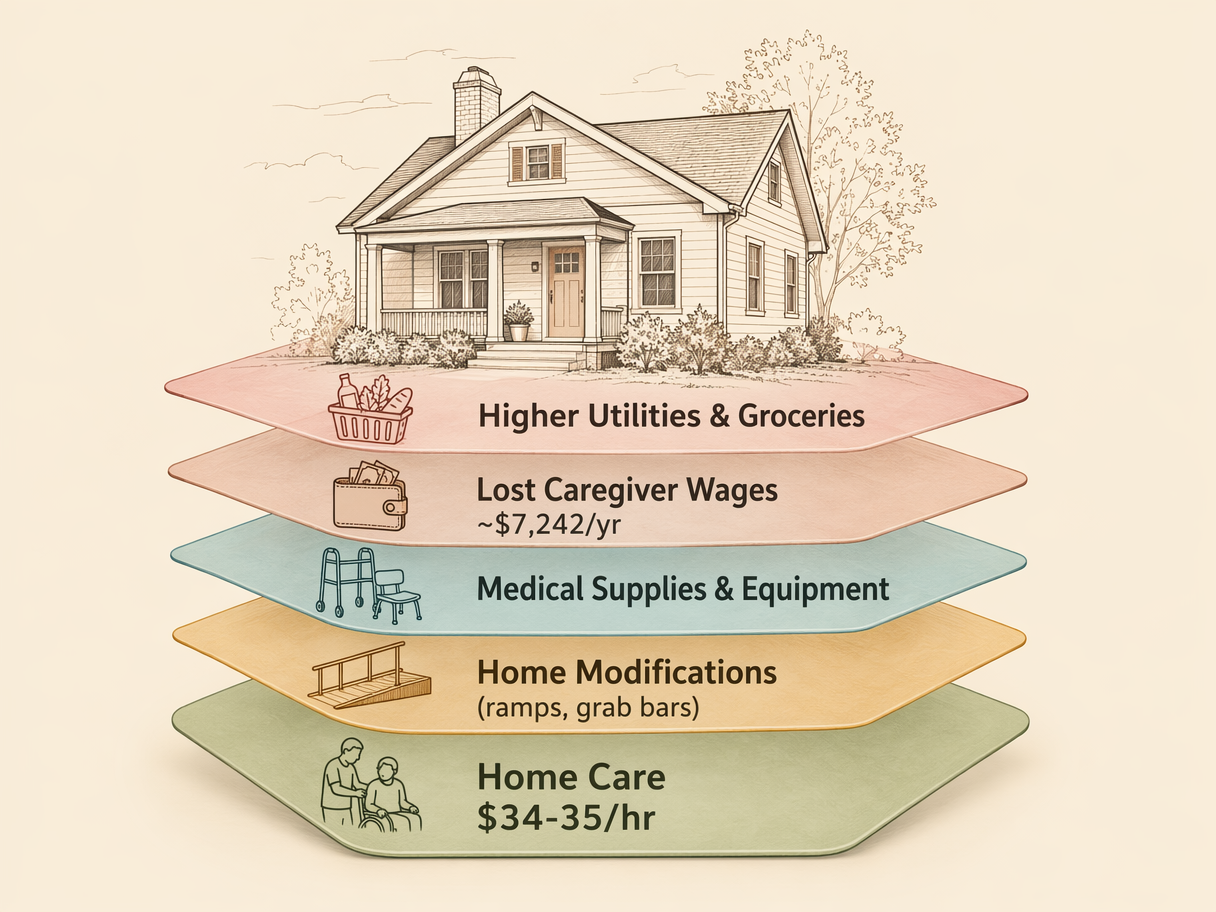
Here are the most significant hidden costs families should account for:
- Home modifications and safety renovations: Grab bars, ramps, stair lifts, walk-in tubs, widened doorways, and improved lighting. According to Bickford Senior Living, home modifications account for just over 20% of out-of-pocket household expenses for family caregivers. Care.com reports that these renovations can range from a few hundred dollars for basic grab bars to several thousand for structural changes.
- Medical supplies and equipment: Incontinence products, gloves, wound dressings, hospital beds, and mobility aids. Care.com notes these can add hundreds of dollars per month to the household budget.
- Higher utility and grocery costs: Having someone at home all day increases heating, cooling, electricity, and food costs. Bickford cites an AARP survey showing that family caregivers spend an average of $1,500 per year on utilities and upkeep alone.
- Lost caregiver wages: Many family caregivers reduce their work hours or leave the workforce entirely. Bickford reports that 39% of caregivers have to stop working. The financial impact is substantial: the same AARP survey found that family caregivers spend an average of $7,242 per year out-of-pocket on caregiving expenses, with just over half going to household expenses.
- Agency markup: Home care agencies typically charge 20 to 30% more than independent caregivers, according to SeniorLiving.org. This markup covers background checks, training, insurance, and scheduling — but it also means that families using an agency pay significantly more per hour than the caregiver's actual wage.
- Overtime pay: Most states require time-and-a-half pay for caregivers working more than 40 hours per week, as noted by Care.com. This can substantially increase the effective hourly rate for families needing extensive care.
When these hidden costs are added to the base hourly rate, the break-even point shifts even further in favor of facility care. A family paying $34 per hour for 30 hours of weekly care might see their total monthly outlay rise from $4,416 to $5,000 or more once modifications, supplies, and lost wages are factored in — bringing them much closer to the assisted living median of $6,200.
Beyond the Dollar Sign: Quality-of-Life Factors in the Home vs. Facility Decision
Cost is a critical factor, but it is not the only factor. The decision between home care and facility care involves deeply personal trade-offs that no spreadsheet can fully capture.
On one side of the scale is the comfort and familiarity of home. For many older adults, remaining in their own home — surrounded by decades of memories, a familiar neighborhood, and the independence of setting their own schedule — is a powerful emotional priority. The psychological benefits of staying in a known environment should not be underestimated.
On the other side is the social and medical infrastructure of a facility. A University of Michigan study cited by SeniorLiving.org found that one in three older adults (34%) report feeling isolated from others. Facilities offer built-in social opportunities — communal dining, group activities, and peer interaction — that can be difficult to replicate at home, even with regular caregiver visits.
Consider these quality-of-life factors when making your decision:
- Social engagement: Does your loved one thrive on social interaction, or do they prefer solitude? Facilities provide structured social opportunities; home care requires intentional effort to arrange social contact.
- Medical oversight: Does your loved one need regular nursing or medical monitoring? Facilities have staff available 24/7; home care requires scheduling medical visits or hiring skilled nursing separately.
- Safety and supervision: Is wandering, falling, or forgetting to take medication a concern? Facilities offer continuous supervision; home care provides supervision only during scheduled hours.
- Emotional well-being: How does your loved one feel about each option? Forcing someone into a facility against their will can cause significant emotional distress, but so can the isolation of being alone at home.
- Caregiver sustainability: Can you, as the family caregiver, sustain the emotional and physical demands of coordinating home care? The Bickford article notes that 40–70% of caregivers exhibit clinically significant signs of depression, and caregivers over 66 with caregiving stress have a nearly two-thirds higher mortality rate.
For a more comprehensive exploration of these trade-offs, see our guide: Aging in Place vs. Assisted Living: A Family Decision Framework for 2026.
A Decision Framework: Questions to Ask Before Choosing Home or Facility Care
Every family's situation is unique. The following questions are designed to help you find your own break-even point and make an informed decision that balances cost, care needs, and quality of life.
Questions About Current and Projected Care Hours
- How many hours of care does your loved one actually need per week? Be honest about the current level — and consider how it might change over the next 6 to 12 months.
- Is the need for care likely to increase? Many conditions — dementia, Parkinson's, post-stroke recovery — are progressive. A decision that makes financial sense today may not make sense next year.
- Can care hours be reduced by combining family caregiving with paid care? If you can provide 10–15 hours of care yourself, the paid hours may stay below the break-even point.
Questions About State-Specific Costs
- What is the median hourly home care rate in your state? Use the A Place for Mom state-by-state data or contact your local Area Agency on Aging for the most current figures.
- What is the median monthly cost of assisted living and nursing homes in your area? Facility costs also vary by region, so use local data rather than national averages.
- Does your state have a Medicaid Home and Community-Based Services (HCBS) waiver? These waivers can cover 20–40 hours per week of personal care, but availability and waiting lists vary significantly by state.
Questions About Hidden Expenses and Funding
- What home modifications are needed to make the home safe? Get quotes for grab bars, ramps, stair lifts, and any other structural changes before making your decision.
- What is the financial impact of lost caregiver wages? If you or another family member will need to reduce work hours or leave a job, factor that lost income into the home care budget.
- What funding sources are available? Check VA Aid & Attendance benefits (up to $1,936/month for a veteran, $2,295/month for a veteran with a spouse, or $1,244/month for a surviving spouse, per Senioridy), long-term care insurance (typical daily benefit of $100–$250/day, per CareScout), and Medicaid HCBS waivers.
Questions About Quality of Life
- How does your loved one feel about each option? Their emotional response matters — and it may change over time as they adjust to new circumstances.
- What is the social environment like at home vs. in a facility? If your loved one is already isolated, a facility may offer meaningful social connection that home care cannot provide.
- Can you, as the caregiver, sustain this arrangement? Be honest about your own physical and emotional limits. The cost of caregiver burnout — in health, relationships, and quality of life — is a real factor in this decision.
For families who determine that home care is the right choice, our guide on Elderly Care Cost Per Hour: How to Afford $34–$35/hr Care with a Layered Funding Strategy provides a practical approach to combining multiple funding sources to make home care affordable.
And if you are considering round-the-clock care, see our guide: When Is It Time for 24-Hour Home Care? A Decision Framework for Family Caregivers.
Questions to bring to a clinician or OT
This is not medical, legal, or a family's final decision — only a framework. Bring these questions to a clinician, occupational therapist, or your local Area Agency on Aging.
Find Local HelpRelated reading
Noticed something outdated or inaccurate on this page? Flag a correction. We review every report against CDC, NIA, and AARP HomeFit guidance before updating a page.