What to Do After an Elderly Parent Falls at Home: A Caregiver's Action Plan
For: adult child10 minutesReviewed: 2026-07-05
What to Do After an Elderly Parent Falls at Home: A Caregiver's Action Plan
When your parent falls, the first hours matter most. This guide walks you through how to assess for injury, decide whether to call 911, help them up safely when appropriate, and monitor for hidden complications over the next several days.
By Editorial Team
new caregiver
experienced caregiver
long-distance caregiving
spousal caregiver
working caregiver
daily routines
medication management
personal hygiene
care coordination
first steps
ADLs
IADLs
If your elderly parent has fallen at home, start at floor level: pause, keep them still, and do not pull them up just because they are embarrassed or insisting they are fine. A fall can look minor in the first minute and still involve a head injury, hip injury, bleeding, medication-related complication, or a delayed symptom that only appears later. About 37% of older adults who fall have an injury that requires medical treatment or limits activity, and one fall doubles the chance of another fall. [1]
First: make the floor safe before you make the fall smaller
The first job is not to get your parent standing. It is to decide whether moving them could make the injury worse. Speak calmly, ask them to stay still, and look for danger around them: broken glass, a wet floor, a hot appliance, a pet underfoot, or a walker tipped across their legs. If you must move an object away, move the object, not your parent.
Then check the basics in order. Are they awake? Are they breathing normally? Can they answer simple questions, such as their name and what happened? Do they know where they are? Is there obvious bleeding, a visible deformity, severe pain, or a new inability to move an arm or leg? If they hit their head, even lightly, treat that as important information, especially if they take a blood thinner.
What you see or hear
What to do
Unconsciousness, trouble breathing, chest pain, stroke-like symptoms, seizure, or severe confusion
Call 911 now.
Possible head, neck, or spine injury
Do not move them. Call 911.
Severe pain, hip pain, visible deformity, or inability to bear weight
Do not help them up. Call 911.
Bleeding that does not stop with direct pressure
Call 911 while applying steady pressure if you can do so safely.
They are alert, pain is mild, no head/neck/spine injury is suspected, no deformity or uncontrolled bleeding is present, and they can participate
Only then consider a slow assisted rise.
AARP’s fall-recovery guidance draws the line clearly: stay put and seek emergency help when there is severe pain, suspected head, neck, or spine injury, inability to bear weight, visible deformity, or bleeding that does not stop with direct pressure. [2] That order matters. The assisted-rise technique belongs after the emergency decision, not before it.
If it is safe to help them up, do less lifting than you think
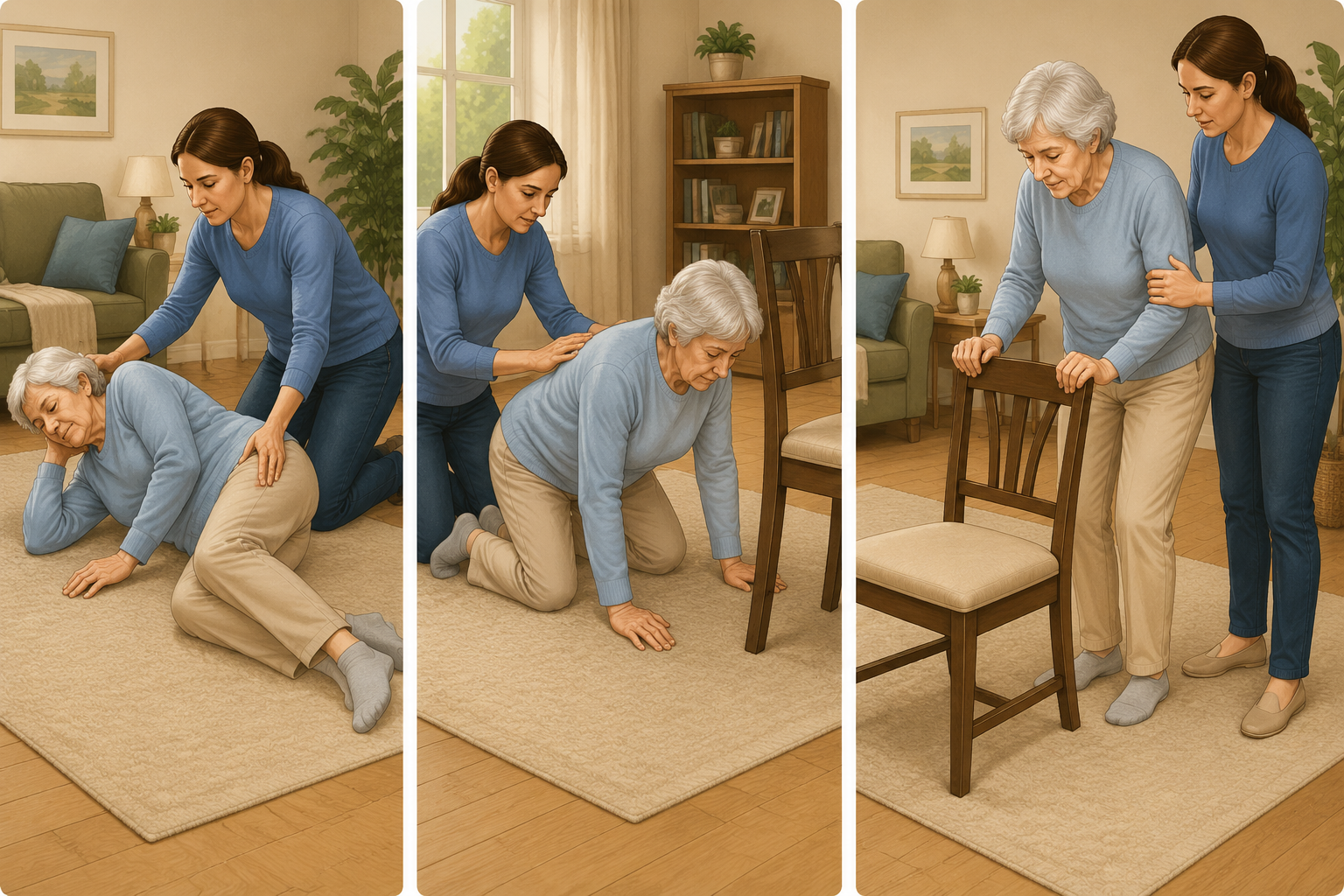
If your parent is conscious, alert, able to follow instructions, not in severe pain, and has no signs that require 911, you can help them get up without hauling them by the arms. Pulling from the shoulders can injure both of you, and it can turn a stable situation into a second fall.
Have them roll onto their side first, moving slowly and stopping if pain increases.
Help them move onto hands and knees only if they can do that without sharp pain or dizziness.
Bring a sturdy chair close to them. Do not use a rolling chair, a light side table, or anything that can slide.
Have them place their hands on the chair seat and bring one foot forward into a kneeling position.
Let them push with their own arms and legs while you steady from the side. Your role is balance support, not lifting.
Once seated, pause. Do not send them straight back to walking, showering, or the stairs.
This roll-to-side, hands-and-knees, sturdy-chair method is the basic sequence AARP recommends for getting up after a fall when it is safe to do so. [2] If your parent cannot complete a step, becomes dizzy, develops worse pain, or seems newly confused, stop. The failed attempt is information, not a reason to try harder.
Write down what happened before the story changes
After the immediate decision is made — 911, urgent care, or safe assisted rise — start a short record. Memory gets soft fast after an adrenaline spike, and a useful doctor visit depends on details that are easy to lose.
Time of the fall, or the best estimate if no one saw it.
Where they were found and what position they were in.
What they were doing just before the fall: getting out of bed, turning, reaching, toileting, carrying laundry, walking after a medication dose.
Symptoms before the fall: dizziness, weakness, chest discomfort, shortness of breath, lightheadedness, tripping, rushing, or no warning.
Possible impact points: head, hip, shoulder, wrist, back, knees.
Medication clues: blood thinners, sedatives, sleep medications, blood pressure medications, or any recent medication change.
If you are not on-site, ask the person with your parent to send a photo of the area after urgent care decisions are handled. A rug edge, poor lighting, missing walker, wet bathroom floor, or chair pulled too far from the bed can explain more than a vague report that they “just went down.” Long-distance caregivers may need a separate first-hour emergency plan so the person closest to the home knows when to call 911 instead of waiting for family consensus.
Call the primary care physician within 24 hours, even if your parent seems fine
If 911 was not needed, the next handoff is still medical. Call your parent’s primary care physician within 24 hours and report the fall. This is not tattling on your parent, and it is not making drama out of a stumble. The CDC notes that less than half of older adults who fall tell their doctor. [1] That silence matters because the first fall changes the risk picture for the next one.
A useful call is brief and concrete: “My mother fell at home yesterday at about 7 p.m. She was walking from the bathroom to the bedroom. She says she felt lightheaded. She did not lose consciousness. She has new soreness in her left hip but can bear weight. She takes a blood thinner. What should we do today, and do you want to see her?”
Ask for a fall-focused review, not only a quick injury check. Better Health While Aging describes a geriatric approach that includes orthostatic blood pressure, blood work such as CBC, electrolytes, and kidney function, medication review, gait and balance evaluation, cardiac or neurological concerns, osteoporosis risk, and referrals related to vision, podiatry, or home safety. [3] You are not expected to perform those assessments at home. Your job is to bring the fall to the clinician’s attention and ask that the right causes be considered.
What to ask about
Why it belongs in the conversation
Orthostatic blood pressure
A parent may fall when blood pressure drops after standing.
Medication review
Sedatives, blood pressure drugs, anticholinergics, and recent medication changes can affect balance, alertness, or dizziness.
Gait and balance
The fall may reveal a mobility decline that was easy to miss at home.
Vision and feet
Poor vision, painful feet, or unsafe footwear can change how someone walks through familiar rooms.
Blood work
Anemia, electrolyte problems, or kidney-function changes may contribute to weakness or lightheadedness.
Cardiac or neurological symptoms
Fainting, new weakness, irregular rhythm concerns, or neurological signs need medical judgment.
Osteoporosis risk
A fracture risk discussion matters after a fall, especially if pain or height-loss history raises concern.
If you already track medications, bring the current list and note any recent additions, dose changes, missed doses, or double doses. A focused medication review can also help you prepare better questions before the appointment.
Monitor for 72 hours without pretending you are a nurse
The Agency for Healthcare Research and Quality’s Falls Management Program was written for nursing facilities, where staff monitor residents after a fall and review body systems across a 72-hour window. [4] A home caregiver cannot and should not try to conduct nursing assessments. But the timing is useful: the fall is not “over” just because your parent is back in a chair.
For the next three days, check for change. You are watching for a pattern that is new, worsening, or hard to explain. If something changes, call the doctor’s office, urgent care, or 911 depending on severity.
What to watch
What should trigger follow-up
Pain
New pain, worsening pain, pain with weight-bearing, or pain that moves from soreness to sharp limitation.
Mobility
New limping, needing more help than usual, refusing to stand, or becoming unable to use the walker safely.
Alertness
New sleepiness, confusion, agitation, repeated questions, or not acting like themselves.
Head symptoms
Headache, dizziness, vomiting, vision change, or any decline after a head impact.
Bruising or swelling
Expanding bruising, swelling over a joint, or tenderness that was not obvious at first.
Eating, drinking, and urination
Poor intake, less urination, new incontinence, or signs they are avoiding movement because of pain.
Sleep
Unusual sleepiness, restlessness, or waking because pain is increasing.
Delayed symptoms deserve particular respect after a head hit or when your parent takes anticoagulants. Home-care guidance warns that subdural hematomas and hairline fractures may not produce obvious symptoms for hours or days, especially in older adults on blood thinners. [5] That does not mean every bruise is an emergency. It means a new headache, new confusion, worsening pain, new weakness, dizziness, or symptoms that appear after the first calm hour should not be explained away.
A simple home log works better than trying to remember everything: morning, afternoon, and bedtime notes for pain, walking, alertness, food and fluids, bathroom changes, and any new bruising. If another sibling, aide, or neighbor takes over, the log prevents the handoff from becoming “she seemed okay when I left.”
Do a same-night safety scan only after the medical decisions are handled
Fall prevention matters, but not before you know whether your parent is injured. Once the immediate response is settled, look for the hazard that could cause a repeat fall tonight. This is not the moment for a full weekend renovation. It is the moment to remove the obvious next risk.
Clear the route from bed to bathroom.
Turn on nightlights or add temporary lighting where the fall happened.
Remove loose rugs, cords, clutter, and low objects from the walking path.
Put the walker, cane, glasses, hearing aids, and phone within reach before bedtime.
Check whether shoes, slippers, or socks contributed to the fall.
If toileting was involved, consider whether a bedside commode, grab bar discussion, or nighttime assistance plan is needed.
A fuller room-by-room prevention review can wait until your parent is stable and the first follow-up calls are made. Tonight’s scan has one narrower job: reduce the chance that the same thing happens again before morning. Broader planning can come after the urgent fix.
When your parent resists help
Embarrassment can sound like certainty. “I’m fine,” “Don’t call anyone,” and “Help me up before someone sees” may be pride talking before pain has had time to report in. You do not have to argue about independence in that moment. Stay with the observable facts: whether they hit their head, whether they can bear weight, whether pain is getting worse, whether they are acting like themselves, and whether a clinician needs to know.
If your parent refuses 911 despite red flags, call anyway and explain what you are seeing. If they refuse a primary-care call after a non-emergency fall, you can still notify the office and ask what the safest next step is. The physician cannot always discuss everything with you without permission, but you can provide information.
Caregiver adrenaline has its own aftershock. Once the urgent work is done, it is normal to replay every decision. Your own recovery can wait until the first ten minutes are over, but it should not disappear. The person who keeps the fall log, makes the appointment, watches overnight, and gets blamed for “making a fuss” is doing real work.
The action plan in one pass
Pause and keep your parent still while you check consciousness, breathing, pain, bleeding, deformity, head impact, and ability to move.
Call 911 for red flags, including suspected head, neck, or spine injury; severe pain; inability to bear weight; visible deformity; uncontrolled bleeding; unconsciousness; severe confusion; breathing problems; chest pain; seizure; or stroke-like symptoms.
Help them up only if they are alert, can follow instructions, have no emergency signs, and can participate in a slow chair-assisted rise.
Write down the time, place, activity before the fall, symptoms, impact points, medications, and any changes afterward.
Notify the primary care physician within 24 hours and ask for a fall-focused review rather than only reassurance.
Monitor for 72 hours for worsening pain, mobility changes, confusion, headache, dizziness, bruising, appetite or urination changes, unusual sleepiness, or any symptom that appears later.
After medical decisions are settled, remove the most immediate home hazard that could cause another fall tonight.
Treating a fall as a medical event is not overreacting. It is the organized way to protect a parent after a moment that may look small but can carry delayed consequences.


Comments
Join the discussion with an anonymous comment.