Companion Care vs. Home Health Aide vs. Personal Care vs. Skilled Nursing: How to Choose What Your Parent Actually Needs
Adult children often confuse companion care, personal care, home health aide, and skilled nursing — leading to overpaying or missing critical support. This guide explains the legal and functional differences across all four categories, provides a decision matrix, and includes an ADL/IADL assessment tool to match your parent's needs to the right service.
By Editorial Team
new caregiver
ADLs
IADLs
home health aide
companion care
care coordination
📄
A printable version of this guide is available. Use your browser's print function (Ctrl+P / ⌘P) to save or print.
Why Families Get It Wrong: The Confusion Problem
When an aging parent begins to struggle, families start searching for help. They encounter a tangle of labels — companion care, personal care, homemaker services, home health aide, skilled nursing — that marketing materials often treat as interchangeable. They are not. Each term describes a legally and functionally distinct category of support, and the differences matter far more than most people realize.
Choosing the wrong category has real consequences. Hiring a companion caregiver when your parent needs hands-on bathing assistance leaves a critical need unmet and puts your parent at risk. Hiring a home health aide when only companionship and light housekeeping are needed means paying for a higher level of certification and training that isn't being used — at a national median of $35.02 per hour instead of $33.99. Over a year of part-time care, that narrow gap adds up to thousands of dollars spent on services your parent doesn't actually require.
This guide draws clear lines between the four main categories of in-home senior care. It provides a decision matrix, a cost comparison table, and an ADL/IADL assessment tool so you can match your parent's actual needs to the right service — without relying on marketing language that blurs the distinctions.
If you are earlier in your research and want a broader decision framework for whether companion care is the right fit at all, see our separate guide: Is Companion Care Right for Your Aging Parent?. This article assumes you have already decided that some form of in-home support is needed and are now trying to determine which type.
Companion care focuses on social engagement and IADL support — not hands-on medical or personal care.
Companion Care: Social Support and IADLs (No Hands-On Care)
Companion care is a non-medical service designed for older adults who are generally healthy and independent but need help with the tasks that keep daily life running smoothly. These tasks fall under what professionals call Instrumental Activities of Daily Living (IADLs) — the higher-order skills needed to live independently.
What Companion Caregivers Do
Light housekeeping and laundry
Meal preparation and grocery shopping
Transportation to appointments, errands, and social outings
Conversation, games, reading, and other social engagement
Medication reminders (not administration)
Scheduling appointments and managing correspondence
Providing a regular set of eyes on your parent's wellbeing
What Companion Caregivers Do NOT Do
This is the most important boundary to understand. Companion caregivers do not provide hands-on personal care. They do not assist with bathing, dressing, toileting, incontinence care, catheter care, oral hygiene, or feeding. They do not perform any medical procedures, take vital signs, or administer medications. As Care.com states explicitly, companion caregivers do not provide personal care such as toileting, bathing, dressing, incontinence care, catheter care, or oral hygiene.
Training and Certification Requirements
Companion caregivers do not require certification or medical training. They may be hired through a certified home care agency, a non-certified agency, as independent contractors, or through volunteer programs. This lack of a standardized training requirement is one reason companion care costs less than personal care — but it also means you must vet candidates carefully on your own.
Who Benefits Most from Companion Care
Companion care is ideal for seniors who are physically capable of managing their own personal care but are socially isolated, lonely, or struggling with the organizational demands of independent living. Nearly 25% of adults age 65 and older are socially isolated, according to the Merck Manual, and about 27% of adults aged 60 and older live alone (Pew Research Center). For these individuals, a companion caregiver provides both practical support and a critical social connection that can reduce the health risks associated with isolation.
Personal Care and Home Health Aide: ADL Support with Certification
Personal care — often delivered by a home health aide (HHA) or certified nursing assistant (CNA) — involves hands-on assistance with Activities of Daily Living (ADLs). These are the fundamental self-care tasks that a person must be able to perform to live independently.
What Personal Care and Home Health Aides Do
Bathing, showering, and grooming
Dressing and undressing
Toileting and incontinence care
Feeding assistance
Mobility and transfer assistance (getting in and out of bed, chairs, wheelchairs)
Medication reminders (same as companion care — reminders only, not administration)
Light housekeeping and meal preparation (as time permits)
The key distinction from companion care is the hands-on component. As Corewood Care explains, personal care services assist with ADLs such as toileting, bathing, dressing, mobility and transfer assistance, and feeding, while companion care assists with IADLs only.
Training and Certification Requirements
Unlike companion caregivers, personal care aides and home health aides typically require certification. Most states regulate these roles and require completion of a state-approved training program, a competency exam, and ongoing continuing education. The specific credential varies by state — CNA (Certified Nursing Assistant) and HHA (Home Health Aide) are the most common. This training ensures they can safely assist with transfers, bathing, and other hands-on tasks that carry injury risk for both the caregiver and the senior.
Medicare Coverage: A Critical Distinction
Original Medicare does cover home health aide services — but only under specific conditions. The aide services must be part-time or intermittent and must be paired with skilled care such as nursing, physical therapy, speech therapy, or occupational therapy. Medicare never covers stand-alone personal care, 24-hour care at home, or homemaker services like shopping, cleaning, and laundry. This is a common point of confusion: families assume that because their parent needs help bathing, Medicare will pay for it. In most cases, it will not unless the parent is also receiving skilled care.
Skilled Nursing: Medical Care from Licensed Professionals
Skilled nursing is the only category in this comparison that is inherently medical. Services are provided by registered nurses (RNs) or licensed practical nurses (LPNs) under a physician's order. This is not a service you arrange directly — it requires a doctor's prescription and is typically covered by Medicare, Medicaid, or private insurance when deemed medically necessary.
What Skilled Nursing Includes
Wound care and dressing changes
Injections and IV therapy
Vital signs monitoring and health assessment
Medication administration (not just reminders)
Physical, occupational, and speech therapy (provided by licensed therapists)
Patient and family education about medical conditions and treatments
Care coordination with physicians and other healthcare providers
Skilled nursing is appropriate for post-hospital recovery, chronic disease management that requires professional monitoring, and situations where the senior's medical needs exceed what a family caregiver or home health aide can safely handle. The cost reflects the professional training involved: skilled nursing visits average $100 to $150 per visit, and ongoing care can range from $5,000 to $10,000 per month.
Decision Matrix: Compare Services by Need, Cost, Coverage, and Training
The following matrix provides a side-by-side comparison of all four service types across the dimensions that matter most for decision-making: care focus, cost, training requirements, and insurance coverage.
Comparison of companion care, personal care/home health aide, and skilled nursing across key decision dimensions.
Dimension
Companion Care
Personal Care / Home Health Aide
Skilled Nursing
Care Focus
IADLs: housekeeping, errands, transportation, social engagement, medication reminders
Medical care: wound care, injections, vitals, therapy, medication administration
Hands-On Personal Care
No
Yes
Yes (plus medical procedures)
National Median Cost (2025)
$33.99/hr (Genworth)
$35.02/hr (Genworth)
$100–$150/visit or $5,000–$10,000/month
Independent Hire Cost
$20–$29/hr (Care.com, Jan 2026)
$20–$35/hr (Care.com)
N/A — requires licensed professional
Training / Certification
None required
CNA/HHA certification required in most states
RN or LPN license required
Medicare Coverage
Not covered (stand-alone)
Covered only when paired with skilled care
Covered when medically necessary (physician order required)
Medicaid / State Programs
May be covered via HCBS waivers (varies by state)
May be covered via HCBS waivers (varies by state)
Covered when medically necessary
Typical Use Case
Socially isolated senior who needs help with errands and company
Senior who needs help bathing, dressing, or toileting but is medically stable
Post-hospital recovery, chronic disease management, complex medical needs
Cost Comparison: What You'll Actually Pay for Each Service Type
The national median costs from Genworth's 2025 Cost of Care Survey tell a surprising story: the gap between companion care ($33.99/hr) and home health aide ($35.02/hr) is only about one dollar per hour. This narrow spread leads many families to assume the services are essentially the same. They are not — and the cost figures mask significant variation depending on where you live, how you hire, and how many hours you need.
State-by-State Variation
According to A Place for Mom's 2026 proprietary data (published June 3, 2026), the national median cost of private nonmedical in-home care is $34 per hour. But state medians range from $25 per hour in Mississippi to $44 per hour in South Dakota. Here are selected state medians:
Selected state median costs for private nonmedical in-home care (A Place for Mom, 2026 proprietary data).
State
Median Hourly Cost (2026)
Mississippi
$25
Alabama
$26
Texas
$30
Florida
$31
New York
$35
California
$38.50
Alaska
$37.50
South Dakota
$44
Agency vs. Independent Hire Costs
The Genworth and A Place for Mom figures reflect agency rates, which include overhead for screening, training, scheduling, insurance, and backup coverage. If you hire a companion caregiver independently — through a platform like Care.com, word of mouth, or a local community network — the cost drops significantly. Care.com's posted marketplace rates for companion care average $20 to $29 per hour (based on January 7, 2026 data), with city-level examples ranging from $19.59/hr in Atlanta to $27.33/hr in San Francisco.
The 4-Hour Minimum Trap
Most agencies require a minimum visit of four hours. At the national median of $34/hr, that means each visit costs approximately $136 before any additional fees. If your parent only needs two hours of companionship and light housekeeping three times a week, you are paying for four hours each time — doubling your weekly cost. This is one reason many families choose independent hires for low-hour companion care and reserve agencies for higher-hour or personal care needs.
Monthly Cost Estimates at National Median ($34/hr)
Monthly cost estimates based on A Place for Mom's 2026 national median of $34/hr for private nonmedical in-home care.
Level of Care
Hours per Week
Estimated Monthly Cost
Occasional help
7 hrs/week
~$1,031/month
Part-time
15 hrs/week
~$2,208/month
Regular weekday
30 hrs/week
~$4,416/month
Extensive
44 hrs/week
~$6,478/month
When to Start with Companion Care and When to Escalate
The most cost-effective approach is to match the service level to the current need and escalate only when the need changes. Here is a practical framework for when to start with companion care and when to move to a higher level of support.
Start with Companion Care When
Your parent is generally independent with personal care (bathing, dressing, toileting) but struggles with IADLs like shopping, cooking, housekeeping, or transportation
Your parent is socially isolated, lonely, or spends most days alone — and you want to reduce the health risks of isolation
Your parent needs medication reminders but can manage the actual administration independently
You live far away and need someone to check in regularly and report back on your parent's condition
Your parent is resistant to the idea of a caregiver and is more likely to accept a "visitor" or "helper" than a medical professional
Escalate to Personal Care / Home Health Aide When
Your parent begins to struggle with bathing — this is often the first ADL to become difficult and is a common escalation trigger
Dressing becomes challenging due to physical limitations, cognitive decline, or both
Toileting accidents or incontinence become frequent
Your parent needs help getting in and out of bed, chairs, or the bathtub safely
A fall has occurred and your parent now needs transfer assistance to reduce fall risk
Escalate to Skilled Nursing When
Your parent is discharged from the hospital and needs wound care, IV therapy, or medication management that exceeds what a family caregiver can safely provide
A chronic condition (diabetes, heart failure, COPD) requires regular professional monitoring and adjustment
Your parent's physician orders skilled nursing or therapy services as part of a treatment plan
Your parent's condition is unstable and requires assessment by a licensed professional to determine the next level of care
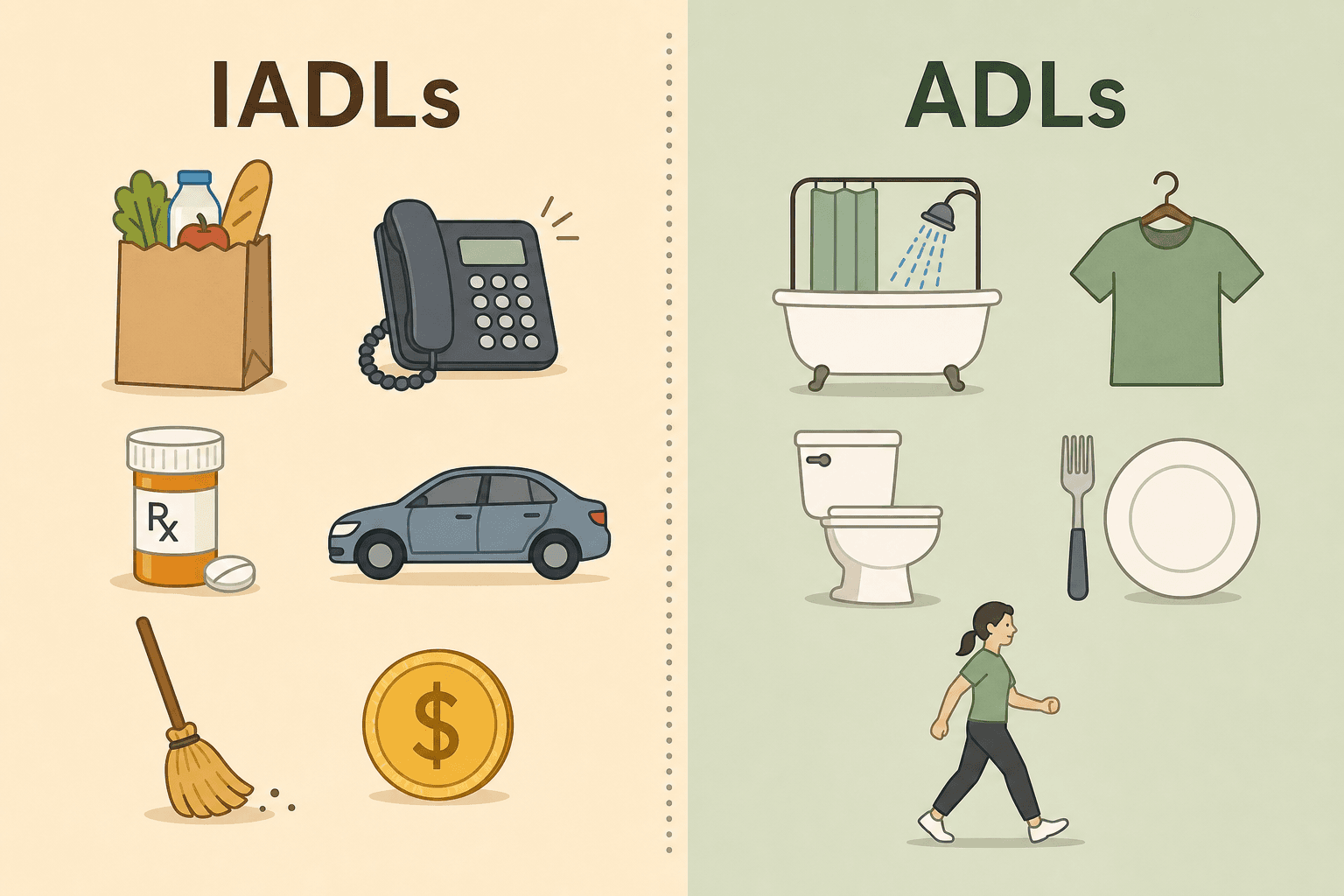
IADLs (left) are higher-order skills needed for independent living. ADLs (right) are fundamental self-care tasks. The distinction between these two categories determines whether your parent needs companion care or personal care.
How to Assess Your Parent's Needs: ADL/IADL Checklist
The most reliable way to determine which service type your parent needs is to assess their functional level using the standardized ADL and IADL frameworks. This checklist is designed to be used as a printable reference tool. Work through it honestly, noting not just whether your parent can do each task, but whether they do it safely and consistently.
IADL Assessment: Instrumental Activities of Daily Living
IADL deficits indicate a need for companion care or homemaker services. For each item, mark whether your parent can perform the task independently, needs reminders or supervision, or cannot perform it at all.
IADL Assessment Checklist. If your parent needs reminders, supervision, or full assistance with two or more IADLs, companion care is likely appropriate.
ADL deficits indicate a need for personal care or home health aide services. These are the non-negotiable self-care tasks. If your parent cannot perform one or more of these safely, companion care alone is insufficient.
ADL Assessment Checklist. If your parent needs assistance with one or more ADLs, you need personal care or home health aide services — not companion care alone.
ADL
Independent
Needs Assistance
Fully Dependent
Bathing (getting in/out of tub or shower, washing)
Dressing (selecting clothes, putting them on, fastening)
Toileting (using the toilet, cleaning, managing incontinence)
Eating (feeding self, cutting food, bringing food to mouth)
Walking or transferring (getting in/out of bed or chairs)
How to Interpret the Results
IADL deficits only (no ADL deficits): Companion care is likely sufficient. Your parent needs help with the organizational and logistical tasks of daily life but can manage personal care independently.
One or more ADL deficits: You need personal care or home health aide services. Companion care can supplement but cannot replace the hands-on assistance your parent requires.
ADL deficits plus complex medical needs (wound care, injections, unstable vital signs): You need skilled nursing. A home health aide can assist with ADLs, but a licensed professional must handle the medical component.
Mixed picture: It is common for a senior to need help with some ADLs (e.g., bathing) while remaining independent with others (e.g., eating). In these cases, a home health aide can provide targeted ADL support while also handling IADLs. You do not need to hire separate people for each category.



Comments
Join the discussion with an anonymous comment.