How to Choose AI Home Monitoring Without Sacrificing Privacy: A Guide to the Four Privacy Models
This guide breaks down the privacy trade-offs of camera-based, audio-only, radar/sensor-based, and wearable monitoring systems, helping families select the least-invasive option that still meets their parent's safety needs.
By Editorial Team
new caregiver
experienced caregiver
long-distance caregiving
spousal caregiver
working caregiver
daily routines
medication management
personal hygiene
care coordination
first steps
ADLs
IADLs
The hard part of choosing AI monitoring for elderly parents is rarely the gadget. It is the kitchen-table argument underneath it: one person wants proof that Mom got up this morning, another person hears “monitoring” and imagines being watched while making coffee, napping, or talking to a friend.
Both fears deserve to be taken seriously. Falls, wandering, missed medication, and isolation are not imaginary risks. Neither is the humiliation of turning an ordinary home into a place where private moments are captured, interpreted, stored, or shared. The better starting question is not whether AI monitoring is good or bad. It is: what is the smallest amount of data collection that addresses the specific risk, and who gets to see it?
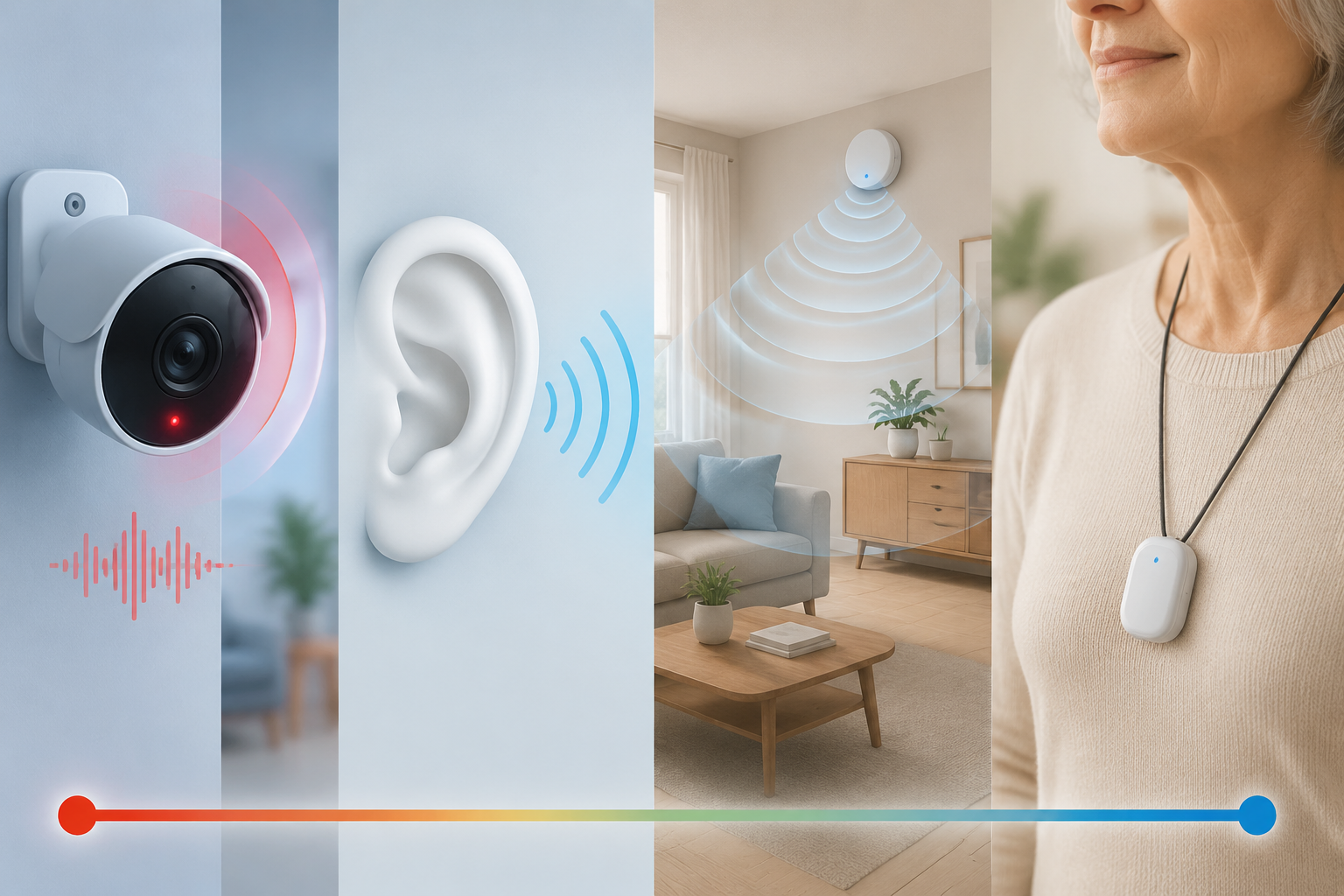
That question matters because “AI monitoring” is not one privacy model. A camera in the living room, an always-listening audio system, a radar sensor that detects motion without recording images or speech, and a pendant that only works if someone wears it all create very different bargains.
Start With the Risk, Not the Device
Families often shop backward. A frightening call leads to a search for “best elderly monitoring system,” and the products with the most dramatic promises rise to the top. But a parent who has fallen twice in the bathroom does not necessarily need the same monitoring as a parent who leaves the house at night, forgets medication, or goes several days without meaningful contact.
Use the need to narrow the data. If the need can be met by detecting presence, movement, or routine changes, there is no reason to begin with a camera or always-on microphone.
Care need
Least-invasive model to consider first
Why it may be enough
Where it may fall short
Fall risk inside the home
Radar or passive motion/presence sensors
Can detect falls, lack of movement, room presence, or unusual activity without capturing video or speech.
May not show exactly what happened before or after the event; placement and system design matter.
Wandering or leaving home unexpectedly
Door sensors, motion sensors, or GPS wearable depending on the pattern
Can alert when a door opens, when movement occurs at unusual times, or when the person leaves a defined area.
GPS wearables depend on charging and willingness to wear the device; door alerts do not explain intent.
Medication adherence
Medication dispenser alerts or task-specific sensors
Collects data about one care task instead of turning the whole home into a monitoring zone.
Does not address falls, wandering, or broader changes in daily functioning.
Isolation or major routine change
Passive activity sensors before audio or video
Can show whether someone is up, moving, or following a typical routine without listening to conversations.
Cannot tell whether the person feels lonely, confused, or depressed; human follow-up still matters.
Emergency confirmation when no one responds
Escalation model: passive alert first, more invasive check only when needed
Keeps routine monitoring limited while allowing a family member or responder to act during a real concern.
Requires clear rules about who is contacted and when.
This is also where the parent’s resistance belongs in the decision, not after it. “I don’t want a camera” is not a technology objection to overcome with better sales language. It is information about what kind of monitoring may be acceptable, sustainable, and respectful enough to remain in use.
The Four Privacy Models
Camera-based monitoring: the most visible privacy trade-off
Camera-based monitoring gives families and care teams the kind of evidence that feels reassuring: a visual view of what happened. That is also why it is the hardest model to justify as a default. It can capture clothing, visitors, habits, clutter, agitation, rest, and all the unremarkable private behavior that makes a home feel like home.
A 2026 Cambridge scoping review found that 44% of studies on passive home monitoring involved cameras, while older adults consistently preferred non-visual sensors. The review covered literature indexed up to March 2024, so it should not be read as a verdict on every newer product, but the preference pattern is not subtle: visual monitoring is often the line older adults do not want crossed first.[1]
That does not make cameras automatically wrong. In some homes, there may be a specific safety reason for visual confirmation: repeated unexplained falls, a high-risk recovery period, or a care arrangement where a parent knowingly accepts a camera in a limited location. The burden of proof should be higher, though. A camera in a hallway is different from a camera in a bedroom. A camera activated only after an alert is different from routine viewing. A short trial with review is different from an indefinite installation no one revisits.
Audio-only monitoring: less visible, not necessarily less intimate
Audio-only monitoring can sound like a gentler compromise because there is no lens. It may flag falls, distress, or changes in speech patterns. But private conversation is not a minor data type. An always-listening system may capture arguments, financial discussions, medical details, visitors’ voices, or ordinary remarks never meant for a company, a caregiver, or an algorithm.
WIRED’s 2026 reporting on Sensi.ai is useful precisely because it shows how quickly “no camera” can be mistaken for “low privacy risk.” In the reported family case, the father did not remember being told that the system was eavesdropping. Sensi.ai’s model was described as always-on audio with optional video, and the company said it had raised $100 million, claimed 90% accuracy, and said it had “1,000 years” of audio data. Those are company-reported claims, not independent proof that the system is accurate enough for every family or appropriate for every home.[2]
Audio monitoring also raises a transparency problem. If an AI system is interpreting tone, speech patterns, agitation, silence, or behavior, the person being monitored should not have to guess what is being inferred. The Future of Privacy Forum warned in 2025 that AI explainability remains a challenge in AgeTech: users may not be told when AI is interpreting voice, gestures, or behavior, or whether data is used to train predictive models.[3]
Radar and passive sensors: unfamiliar, but often the better privacy fit
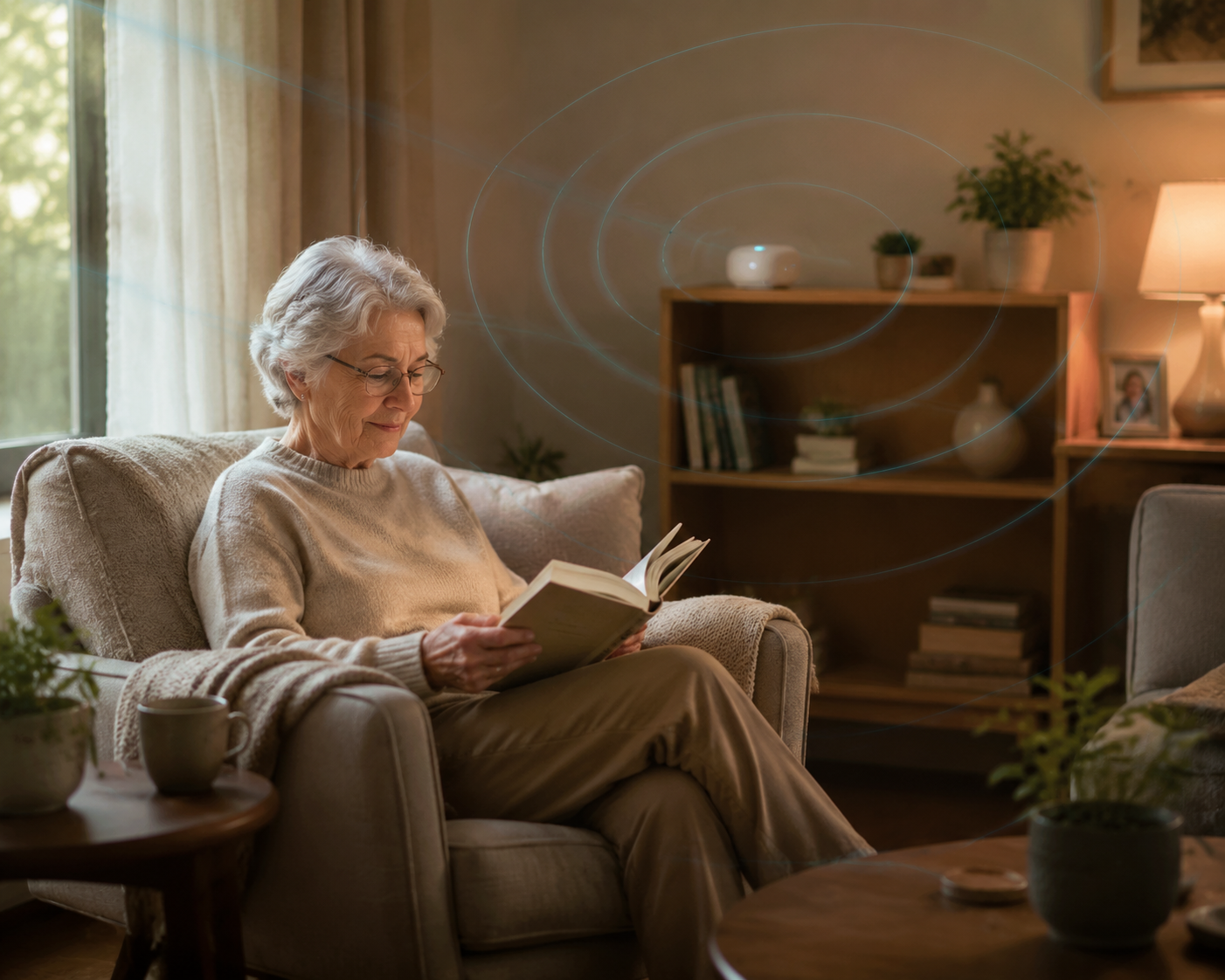
Radar and passive sensor systems deserve more attention than they usually get because their privacy advantage is easy to miss. They can detect presence, motion, falls, and activity patterns without producing a video feed or recording speech. To a family used to cameras and phones, that can feel almost too abstract. But for many monitoring needs, abstract is the point.
A radar sensor does not need to know what your parent is wearing, what book is on the table, or who stopped by. It may only need to know that a person is present, moving normally, has fallen, or has not moved for a concerning period. Passive sensors can also help families notice routine changes: no kitchen activity by late morning, repeated nighttime movement, or a door opening at an unusual hour.
Examples in this category include Pontosense Silver Shield and Cherish Serenity. The Globe and Mail reported in May 2026 that Pontosense Silver Shield was priced at $380 CAD and described radar-based detection of falls, motion, and presence without video or audio, with data processed locally. That price and availability may vary by region, and a product example should not be treated as a recommendation.[4]
The practical question is whether the system’s alerts match the actual care need. If a parent falls and cannot call for help, the family needs a reliable alert pathway. They may not need a live view. If a parent’s risk is wandering, a door sensor or location-aware approach may be more relevant than whole-home activity monitoring. The privacy benefit of radar is strongest when the family resists the temptation to add cameras “just in case.”
Wearables: low ambient monitoring, high dependence on cooperation
Wearables, including fall-detection pendants and GPS trackers, usually collect less ambient household data than room-based systems. They do not listen to the kitchen or watch the sofa. For a parent who accepts the device and remembers to wear and charge it, that can be a clean privacy bargain.
The weakness is obvious to anyone who has watched an older relative reject an uncomfortable necklace, leave a device on the nightstand, or forget to charge it. Wearables are not just technology; they are daily behavior change. If the person will not wear it, the privacy advantage becomes irrelevant.
The Access Question Families Usually Ask Too Late
Once a family chooses a monitoring model, the next privacy question is not only “What does it collect?” It is “Who can see it, and what can they do with it?” The Cambridge review’s distinction between horizontal and vertical privacy is useful here. Horizontal privacy is privacy from people nearby in the relationship: adult children, siblings, spouses, aides, neighbors, or other caregivers. Vertical privacy is privacy from institutions and platforms: companies, service providers, insurers, data processors, or future systems that may use the data in ways the family never discussed.[1]
Privacy layer
The family question
What to decide before installation
Horizontal privacy
Which relatives or caregivers can see alerts, trends, recordings, transcripts, or location?
Limit access to the people who need it; separate emergency alerts from routine browsing; avoid giving every sibling full visibility by default.
Vertical privacy
What does the company collect, store, analyze, share, or use to improve AI models?
Read retention, training, sharing, deletion, and breach-notification terms; ask what happens if the subscription ends or the company is sold.
Interpretive privacy
What is the AI inferring from behavior, voice, movement, or routine?
Ask whether the user can see, challenge, or disable inferences; do not accept vague labels like “wellness insights” without explanation.
Horizontal privacy is the issue families tend to recognize first. A daughter getting a fall alert may be acceptable. That same daughter casually checking wake-up times, bathroom-adjacent movement, or visitor patterns every day may feel invasive. The difference should be discussed before anyone has access to a dashboard.
Vertical privacy is easier to neglect because it is buried in product terms. Many commercial monitoring devices may operate outside HIPAA, leaving families in a patchier consumer privacy world than they may assume. The Future of Privacy Forum reviewed 50 AgeTech products in 2025 and described protections as patchy, while a Duke Bass Connections project running in 2026–2027 is examining informed-consent challenges for people with dementia. The Duke project is evidence that the problem is receiving current research attention, not yet a source of published empirical findings.[3][5]
A small IEEE Spectrum-reported study also points to the kind of gap families can run into. In a study involving 22 older adults and an audit of 28 health apps commonly used by older adults, only 25% of the apps explicitly stated HIPAA compliance, and 79% lacked breach-notification protocols. That is a modest sample, not an industry-wide measurement, but it is enough to justify reading the privacy policy before installing a device in someone else’s home.[6]
Consent Is Not a Box Checked During a Crisis
Monitoring decisions often happen after something scary: a fall, a neighbor’s call, a stove left on, a parent found confused outside. That is exactly when families are most likely to overcorrect. A system that would have been rejected in a calmer conversation starts to look reasonable because everyone is frightened.
The imbalance between adult children and parents is documented, not just anecdotal. A BMC Geriatrics study reported that adult children preferred in-home monitoring significantly more than elderly parents did, citing earlier work by Berridge and Wetle. That gap should slow the decision down, because the person receiving the reassurance is often not the person surrendering the privacy.[7]
Clara Berridge of the University of Washington has criticized the way monitoring can be presented as a constrained choice: accept this, or face something worse, such as a nursing home. In WIRED’s reporting, she argued that framing the decision as “nursing home or this” does not create truly ethical consent.[2]
That does not mean every parent has an absolute veto over every safety measure in every circumstance. Dementia, repeated emergencies, and shared household risk can complicate consent. But even then, the family should still ask whether the system is proportionate: limited to the risk, limited in access, limited in duration, and reviewed as conditions change.
What to Ask Before Anyone Installs Anything
The questions below are deliberately plain. If a vendor, sibling, or care agency cannot answer them clearly, that is not a small paperwork problem. It is part of the privacy risk.
What specific risk are we addressing: falls, wandering, medication, isolation, or caregiver reassurance?
Can that risk be addressed without video or audio?
What data is collected continuously, and what is collected only after an event?
Who receives alerts, who can open a dashboard, and who can review history?
Does the company store raw audio, video, location, or behavioral data, and for how long?
Is the data used to train AI models or create predictions beyond the immediate safety function?
Can the parent pause, disable, or review what the system collects?
When will the family reassess whether this level of monitoring is still necessary?
Privacy concern is not a fringe objection. Nearly 40% of consumers named privacy as their top concern with remote patient monitoring in a Best Buy/Current Health survey of about 1,000 adults reported by McKnight’s, even though more than 80% of users were satisfied once they adopted the technology. That contrast should not be used to wave away privacy worries. It says adoption and satisfaction are different questions, and people may feel better about monitoring after use only when the arrangement feels useful, understandable, and bounded.[8]
Older adults are also not too confused to care about security. IEEE Spectrum reported that 34% of adults over 50 cited privacy as a primary barrier to adopting health tech, while 82% understood basic security concepts. The problem is often poor design and poor explanation, not a lack of concern or intelligence among older users.[6]
A Practical Standard for Choosing
If the primary concern is a fall, lack of movement, or a major change in routine, radar or passive sensors should usually be considered before cameras or always-on audio. They are not magic, and families still need to examine accuracy claims, alert routing, data retention, and support. But they begin from a better privacy position because they do not make visual or conversational access the price of basic safety.
If the need is location outside the home, a wearable or GPS-based option may be more fitting, provided the parent will actually use it. If the need is medication, use a medication-specific tool before expanding monitoring to the whole home. If the need is loneliness, do not pretend a dashboard is a relationship; use monitoring only to notice concerning absence or routine change, then have a person follow up.
Camera or audio monitoring may still have a place, but it should earn that place. The family should be able to say why a less-invasive model will not address the risk, where the device will and will not operate, who can access the data, how long data is kept, and when the arrangement will be revisited. If those answers are vague, the system is not ready for the home.
The point is not to preserve privacy so perfectly that no one gets help. It is to stop treating an older adult’s privacy as the easiest thing to spend. Safety technology should narrow the emergency, not widen the surveillance.
References
Passive home monitoring for older adults: A scoping review — Cambridge University Press, May 2026. link
The AI Was Supposed to Help Care for His Father. It Was Listening All Along — WIRED, 2026. link
AgeTech and Privacy: Reviewing Consumer Protections in AI-Enabled Aging Products — Future of Privacy Forum, 2025. link
Pontosense Silver Shield coverage — The Globe and Mail, May 2026. link
Informed Consent Challenges for Persons with Dementia in AgeTech — Duke Bass Connections, 2026–2027. link
Older Adults Know More About Digital Privacy Than App Designers Think — IEEE Spectrum, December 2025. link
Consumer preferences for in-home monitoring technology in older adults — BMC Geriatrics, 2020. link
Best Buy Health and Current Health remote patient monitoring survey coverage — McKnight’s, date not provided. link
Comments
Join the discussion with an anonymous comment.