What to Do in the First 60 Seconds of a Dementia Aggression Episode
For: family caregiverReviewed: 2026-07-05
What to Do in the First 60 Seconds of a Dementia Aggression Episode
This quick-reference guide provides family caregivers with a step-by-step protocol to follow during the first 60 seconds of a dementia aggression episode, focusing on safety, de-escalation through calming your own nervous system, and effective redirection techniques.
By Editorial Team
new caregiver
experienced caregiver
long-distance caregiving
spousal caregiver
working caregiver
daily routines
medication management
personal hygiene
care coordination
first steps
ADLs
IADLs
If there is a weapon, a serious risk of injury, a blocked exit, or anyone is in immediate danger, leave if you can and call 911. Tell the dispatcher and responders: “This person has dementia. This is a behavior change/aggression episode. Please send help prepared for dementia.” Emergency help is not a failure of caregiving; it is the safety boundary.
The first 60 seconds
Time
What you do
What you are trying to change
0-10 seconds
Stop moving toward them. Check exits, weapons, pets, children, and other people.
Immediate injury risk
10-20 seconds
Step back. Turn your body slightly sideways. Give them a clear path away from you.
The feeling of being trapped
20-30 seconds
Lower your shoulders, unclench your hands, breathe out slowly, and slow your voice before you speak.
Your own threat signal
30-45 seconds
Validate the feeling in a short sentence from the side, not head-on.
Fear, anger, embarrassment, or confusion
45-60 seconds
Offer one simple exit: a chair, a drink, a familiar object, a quiet room, or a pause.
The need to keep fighting
Use that sequence as your dementia aggression caregiver response steps: safety first, then distance, then your body, then their feeling, then a way out. Do not start with a lecture, a correction, or a demand for an apology. In the first minute, your job is not to win the facts. Your job is to make the room less dangerous.
0-10 seconds: make the room safer before you make it logical
Pause where you are. Scan the room with your eyes before you speak. Is there a cane, kitchen knife, glass, lamp, walker, belt, or heavy object within reach? Is a doorway blocked by your body? Is a grandchild still standing there frozen? Is a dog barking? Is another family member arguing from behind you?
Move people out before you move furniture. Ask one person, quietly and without debate, “Take the kids to the bedroom.” If there are extra adults in the room, reduce the audience. A person with dementia who already feels threatened may experience multiple faces, voices, and instructions as pressure. Alzheimer’s Society guidance on aggressive behavior specifically emphasizes stepping back, giving space, and reducing other people around the person when aggression escalates.[1]
If you are between the person and the door, shift away from the exit. Do not trap them against a counter, bed, recliner, or bathroom wall. Even if you mean to protect them from falling, a blocked path can feel like capture.
Say less: “I’m stepping back.”
Move slowly enough that they can track you.
Keep your hands open and visible.
Angle your body instead of squaring up chest-to-chest.
Leave a clear path to a safe space, not a path toward stairs, traffic, or sharp objects.
10-30 seconds: calm the body they are reading
This is the part most advice compresses into “stay calm,” which is true and almost useless when your heart is pounding. So make it physical.
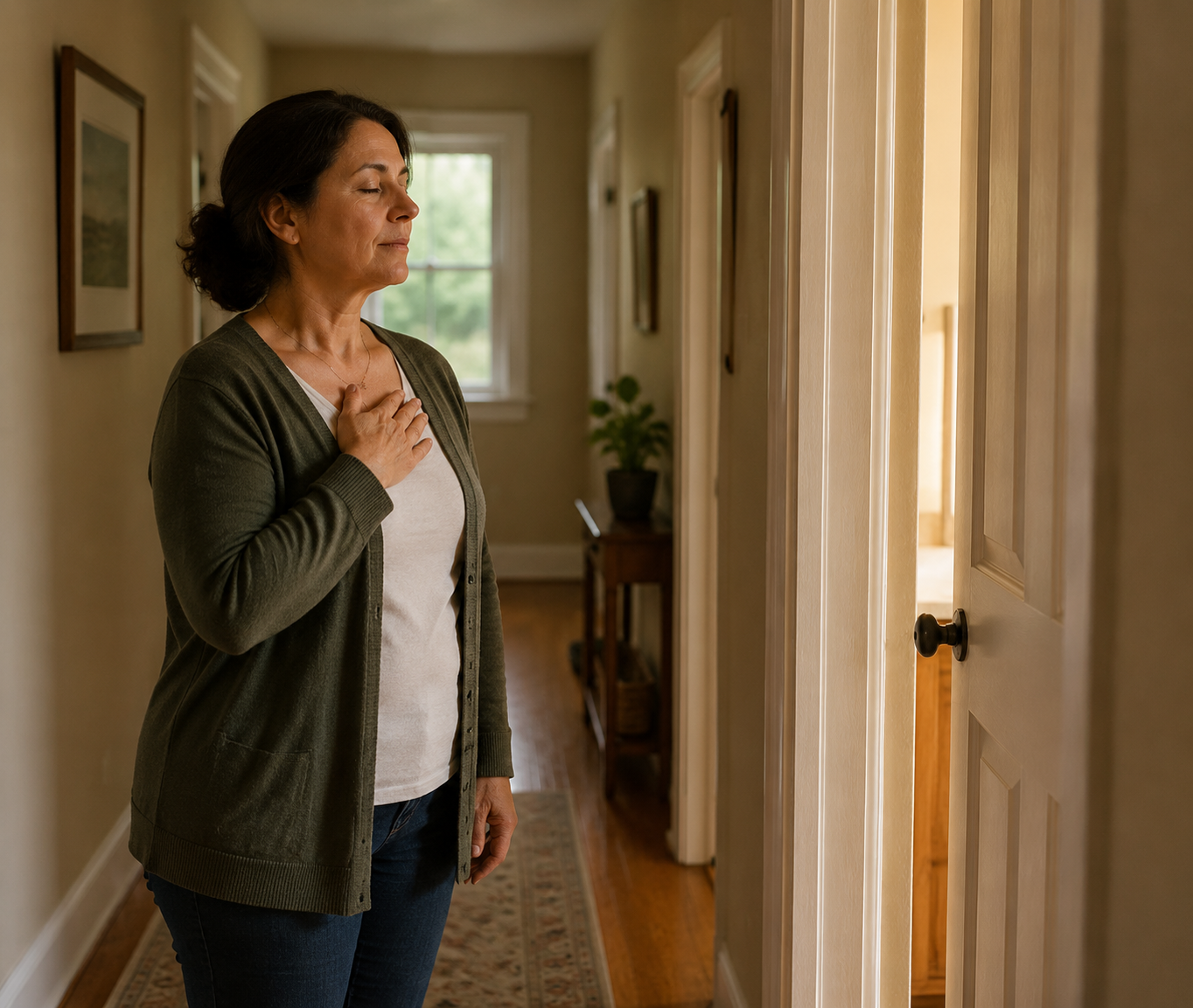
Drop your shoulders. Unclench your jaw. Open your hands. Put both feet on the floor. Breathe out longer than you breathe in. If you can do it without sounding theatrical, let the exhale be audible. You are not doing this to perform serenity. You are changing what your loved one sees, hears, and feels coming from you.
A frightened person with dementia may not be able to process your explanation, but they can still register speed, volume, facial tension, and whether you are advancing. The National Institute on Aging describes agitation and aggression in Alzheimer’s as often linked to fear, confusion, discomfort, pain, or an overwhelming environment rather than intentional meanness.[2] That distinction matters in the room. If the behavior is fear-based, your urgent correcting voice can become one more thing to fear.
Before you say anything important, silently check four signals:
Distance: Am I at least a few steps away unless they are about to fall?
Angle: Is my body turned partly sideways rather than squared off like a confrontation?
Height: Can I get at or below their eye level without blocking them?
Voice: Can I speak slower, lower, and shorter than I want to?
If the answer is no, do not compensate by talking more. Take another step back. Let the room quiet down. The Alzheimer’s Association recommends staying calm, avoiding confrontation, making sure the person can see you before you approach, using a calm voice, and avoiding sudden movements during aggression or anger episodes.[3]
30-45 seconds: validate the feeling, not the accusation
Validation does not mean pretending the false belief is true. It means answering the emotional emergency first.
If your mother shouts, “You stole my purse,” the useful first sentence is not, “No I didn’t, you hid it again.” It is closer to: “You’re worried about your purse. I’ll help.” If your husband swings his arm away during bathing, the useful first sentence is not, “We have to get this done.” It is: “This feels too fast. I’m stopping.”
Keep the sentence short enough to survive stress:
“You’re scared. I’m backing up.”
“That hurt your feelings. I’m sorry.”
“You want to go home. You miss feeling safe.”
“This is too much noise. I’ll make it quieter.”
“You don’t want help right now. I’ll wait.”
Do not add the second paragraph your nervous system wants to add. “You’re scared” is useful. “You’re scared, but I’ve told you three times that this is your house and I’m your daughter and you can’t keep accusing me” is gasoline.
Where to stand while you validate
The words work better when your body agrees with them. Stand slightly to the side, not directly in front of them. If they are seated and it is safe, lower yourself so you are not looming. Keep your face soft. Avoid pointing. Do not grab their wrist to “calm them down.”
Teepa Snow’s Positive Approach to Care training teaches a structured de-escalation approach that includes awareness of personal space, visual approach, supportive stance, and hand-under-hand support when appropriate; Hand-under-Hand® is a registered trademark of Positive Approach to Care.[4] In a family home, the practical takeaway is simple: do not make your loved one fight your body position before they can hear your words.
45-60 seconds: offer one way out
Redirection is not distraction thrown over panic. It works best after you have made the room safer, lowered your intensity, and named the feeling. Then offer one concrete next move.
For accusation: “Let’s look for it together after we sit for a minute.”
For bathing resistance: “We’re done for now. Here’s your robe.”
For wanting to leave: “Let’s get your sweater and sit by the door.”
For striking during care: “I’m moving my hands away. We can try later.”
For late-day agitation: “Let’s turn the TV off and have tea in the quiet room.”
Give one option, not five. A brain already overloaded by noise, pain, fatigue, or confusion may not manage a menu. Offer a familiar object, a familiar rhythm, or a familiar place: a blanket, a chair, a photo album, folding towels, music they know, a snack, a walk to the window.
If aggression often appears in the late afternoon or evening, keep a separate late-day plan nearby. The Sundowning Behavior Response Card for Dementia Caregivers can sit next to this first-minute sequence so you are not inventing a plan at the hardest hour.
If the first minute does not settle it
Do less, not more. More explaining, more family members, more bargaining, and more physical guidance usually raise the pressure.
Back away if you can do so safely. Stay where you can observe without cornering. Let silence do some of the work. If they pace, do not block the pacing path unless it leads to immediate danger. If they curse, do not answer the insult. If they throw something and you can leave, leave the room and call for help from a safer place.
Call emergency services if there is a weapon, serious injury, a threat to kill or seriously harm themselves or someone else, a fall or head injury, sudden severe confusion that could be medical, or you cannot keep yourself or others safe. Alzheimer’s Society guidance on preventing aggression advises seeking urgent help when there is immediate danger and making clear that the person has dementia so responders understand the context.[5]
Why this happens more often than families expect
Aggression can feel so personal that families assume they are the only ones seeing it. They are not. A 2019 systematic review and meta-analysis by Yu and colleagues, covering 17 studies and 6,399 people with Alzheimer’s disease, estimated aggression prevalence at about 28% in population-based studies. The same review found that people with Alzheimer’s disease had nearly five times higher odds of aggression than healthy older adults, with an odds ratio of 4.9 and a 95% confidence interval of 1.8 to 13.2.[6]
That number does not make the episode harmless. It does mean the outburst is not proof that you have failed as a daughter, husband, son, or caregiver. Dementia changes how the brain reads the room, the body, and other people’s intentions. Pain, hunger, constipation, infection, fatigue, overstimulation, a rushed task, a frightening hallucination, or embarrassment during personal care can all look like “anger” from the outside.
The person may still be responsible for harm in the practical sense that harm has to be stopped. But during the episode, treating aggression as willful bad behavior usually leads caregivers toward arguing, shaming, restraining, or demanding insight the person may not have access to in that moment.
Use memory aids carefully
Some caregivers like the Four R’s: Reassure, Routine, Reminisce, Redirect. The National Council of Certified Dementia Practitioners presents it as a caregiver guide for dementia care.[7] It can be a useful pocket phrase after an episode, especially if it helps you remember to reassure before redirecting.
Do not treat a mnemonic as stronger than the situation in front of you. If there is immediate danger, “redirect” is not the first step. If your body is blocking the doorway, “reassure” may not land. If your loved one is in pain, reminiscence will not fix the pain. The sequence still starts with safety and the threat signals in the room.
Afterward: write down what the adrenaline will erase
When the room is safe, your body may start shaking. That is not weakness. It is the delayed arrival of what you had to hold back while you were making decisions. Sit down if you can. Drink water. Let someone else take the next routine task if another safe adult is available.
Then make a short record. Not a courtroom transcript. A pattern note.
Time of day and what was happening just before the outburst
Your first move and whether it helped or worsened things
Exact words or actions that seemed to lower the intensity
Any injury, near injury, weapon access, wandering risk, or blocked exit
Call the clinician if aggression is new, suddenly worse, connected with pain or possible infection, follows a medication change, includes hallucinations or severe sleep disruption, or creates injury risk. A sudden behavior change in dementia deserves a medical check before everyone assumes it is “just the disease.”
If episodes are becoming frequent, if you are changing your whole day to avoid being hit, or if other people in the home are afraid, the question may no longer be only how to respond in the first minute. It may be whether the current care setup has enough supervision. The guides Is It Time for Memory Care? and 12 Warning Signs Your Parent Can No Longer Live Alone can help you sort that threshold without pretending it is an easy decision.
If you need safe breaks before the situation reaches that point, evaluate programs for dementia-specific skill, not just willingness to accept someone with memory loss. The Dementia-Capable vs. Dementia-Tolerant Adult Day Care guide can help you ask whether a program knows how to respond to escalating behavior.
And if this was one of your first frightening episodes, do not make yourself learn everything at once. Start with the first-minute sequence, then use Your First 30 Days as a Caregiver to build the rest of the system around it.
Let yourself come down too
After aggression, caregivers often replay the moment with shame: I should have known. I should have stayed calmer. I should not have been scared of my own mother. Fear after being threatened or struck is a normal body response, even when the person who frightened you is ill and loved.
Take the recovery seriously. Wash your face. Step outside. Text one person who will not blame you. Use the caregiver wellbeing resources if the fear is lingering, your sleep is changing, or you are starting to dread every care task.
You cannot control dementia. In the first 60 seconds, you can control whether the room sends back threat or safety: the doorway open, the audience gone, your body softer, your voice slower, one clear way out.



Comments
Join the discussion with an anonymous comment.