
Caregiver decision guide
How to Assess Your Parent's Daily Living Needs and Match Them to the Right Senior Housing
A systematic, functional-assessment-first approach for adult children. Learn how to use the Katz ADL Index and Lawton-Brody IADL Scale to identify your parent's specific deficits, then match those results to the correct housing tier — from in-home care to skilled nursing — using a concrete decision matrix with state-level cost data and family conversation scripts.
Why a Functional Assessment Must Come Before Community Tours
The most common mistake families make when choosing senior housing is starting with tours. You visit a gleaming assisted living community with a chef and a fitness center, fall in love with the chandelier in the lobby, and then try to make your parent's needs fit that building. This is backward, and it is expensive.
The reliable path runs in the opposite direction: assess first, tour second. A systematic functional assessment — using the Katz Index of Independence in Activities of Daily Living (ADLs) and the Lawton-Brody Instrumental Activities of Daily Living (IADL) Scale — gives you an objective deficit profile. That profile tells you which housing tier your parent actually needs, not which one has the nicest marketing brochure.
Consider the demographics: according to the American Psychological Association, fewer than 20% of older adults between ages 65 and 74 need assistance with basic ADLs. But after age 85, the picture flips — most individuals need some level of help. The problem is that functional decline is gradual. IADL deficits — trouble managing medications, forgetting to pay bills, letting the refrigerator go empty — typically appear years before ADL deficits become obvious. If you wait until a parent cannot bathe or transfer out of a chair to start the housing conversation, you have already missed the window for proactive, low-pressure decision-making.
The ADL and IADL Checklist: What to Look For
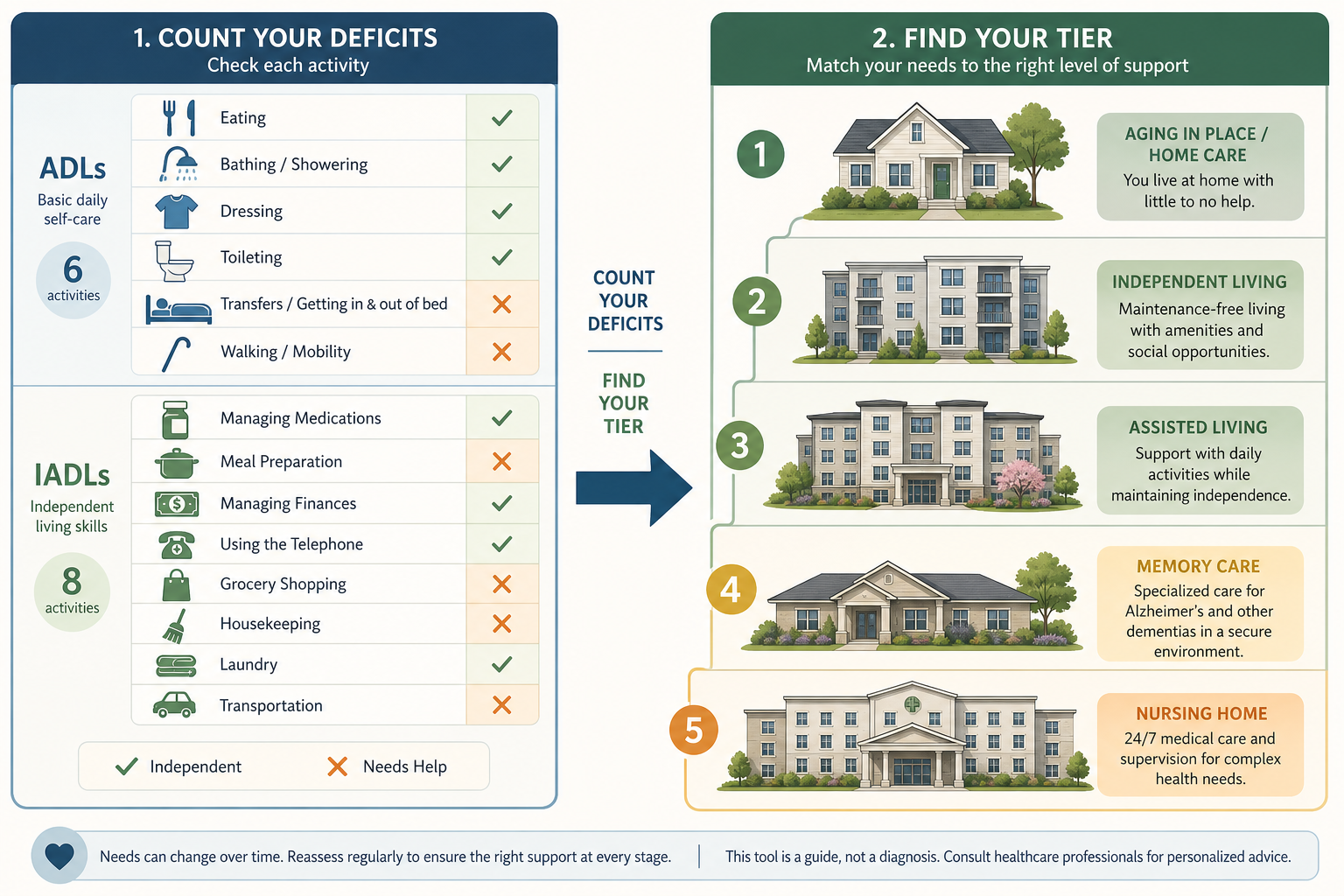
Before you can match your parent to a housing tier, you need a clear picture of what they can and cannot do independently. Two standardized tools give you that picture: the Katz ADL Index and the Lawton-Brody IADL Scale. They are the same tools that senior living communities use to determine level of care and pricing.
The 6 Katz ADLs (Basic Self-Care)
ADLs are the fundamental physical tasks required for daily survival. The Katz Index measures six functions, scoring one point for each activity the person can perform independently. A score of 6 means full function; 4 indicates moderate impairment; 2 or less signals severe functional impairment.
- Eating: Can they feed themselves without assistance, including cutting food and bringing it to the mouth?
- Bathing: Can they bathe independently, including getting in and out of the tub or shower?
- Dressing: Can they select appropriate clothing and put it on without help?
- Toileting: Can they get to and from the toilet, use it, and clean themselves without assistance?
- Continence: Can they control bladder and bowel function, or manage incontinence products independently?
- Transferring: Can they get in and out of bed or a chair without help?
The 8 Lawton-Brody IADLs (Complex Daily Living)
IADLs are the higher-order skills needed to live independently in the community. They require cognitive function, executive planning, and physical capability. Deficits here are often the earliest warning signs — especially for dementia.
- Medication management: Can they take the right doses at the right times without reminders?
- Cooking: Can they plan and prepare a balanced meal safely?
- Money management: Can they pay bills, balance a checkbook, and track expenses?
- Phone use: Can they look up numbers, dial, and communicate effectively?
- Shopping: Can they make a list and purchase groceries or household items independently?
- Housekeeping: Can they maintain a reasonably clean and safe living environment?
- Laundry: Can they wash, dry, and put away clothes?
- Transportation: Can they drive safely or use public transit to get to appointments and errands?
The Decision Matrix: Matching Deficit Counts to Housing Tiers
Once you have counted your parent's ADL and IADL deficits, the next step is matching that profile to the appropriate housing tier. The table below provides a general framework. Keep in mind that individual state Medicaid programs and specific communities may use slightly different thresholds, but this matrix reflects the industry-standard approach used by most senior living providers.
| Deficit Profile | Recommended Housing Tier | What It Includes |
|---|---|---|
| 0 ADL deficits / 0–2 IADL deficits | Independent Living | Housing, meals, housekeeping, social programs. No personal care assistance. |
| 1 ADL deficit / 3–4 IADL deficits | In-Home Care or Home Care Aide | Hourly or live-in assistance with IADLs and light ADL support while aging in place. |
| 2+ ADL deficits (especially bathing) | Assisted Living (Level 1–3) | Housing, meals, 24-hour supervision, and tiered personal care assistance. Level 1 is basic reminders; Level 3 is help with most ADLs. |
| ADL deficits plus wandering, safety risk, or significant cognitive impairment | Memory Care | Secured environment, 24-hour specialized supervision, dementia-specific programming and therapies. |
| Extensive ADL deficits plus medical complexity (e.g., skilled nursing needs) | Nursing Home (Skilled Nursing Facility) | 24-hour skilled nursing care, rehabilitation therapy, full assistance with all ADLs. |
Questions to bring to a clinician or OT
This is not medical, legal, or a family's final decision — only a framework. Bring these questions to a clinician, occupational therapist, or your local Area Agency on Aging.
Find Local HelpRelated reading
Noticed something outdated or inaccurate on this page? Flag a correction. We review every report against CDC, NIA, and AARP HomeFit guidance before updating a page.