
Caregiver decision guide
The 5-Stage Senior Care Decision Timeline: From First Concern to Move-In
A chronological, actionable guide for adult children navigating the senior care decision process. This article provides a month-by-month timeline from initial observation through needs assessment, research, touring, and the first 30 days after move-in, helping families avoid costly crisis-driven decisions.

The Crisis Trap: Why "We'll Figure It Out When We Need To" Is the Most Expensive Approach
Most families do not research senior care until a crisis forces their hand — a fall, a hospitalization, a sudden cognitive decline that makes the current living situation untenable. When that happens, the decision window collapses from months to days. You tour whatever has an opening, sign whatever contract is put in front of you, and pay whatever the market demands because there is no time to compare.
The cost of that urgency is both emotional and financial. Rushed decisions limit your options — many communities maintain waitlists, and as Grace Ferri, a senior living expert quoted by U.S. News, notes, "You might consider filling out some applications if facilities are in high demand. Many have waitlists." When you wait until a crisis, you lose the leverage of time. You also lose the ability to make a clear-headed assessment of what your parent actually needs versus what is available right now.
The alternative is a staged approach. By breaking the decision into five distinct phases — from initial observation through the first 30 days after move-in — you give yourself the one resource that crisis-mode families never have: time. Time to observe honestly. Time to assess financial reality. Time to tour multiple options. Time to let your parent adjust to the idea before the moving truck arrives.
Stage 1: Observation and Documentation (3–12 Months Before Need)
This is the phase most families skip entirely. Your parent is managing — maybe not well, but without obvious catastrophe — so there is no perceived urgency. But the subtle signs of struggle are almost always present months before a crisis makes them impossible to ignore.
What to Watch For
Start keeping a simple, private log. You are not looking for a diagnosis — you are looking for patterns. Note anything that seems off, even if it is explainable in isolation. A missed utility payment. Spoiled food in the refrigerator. A car with new dents. Weight loss that is hard to notice day to day but becomes obvious over three months.
- Changes in personal hygiene or housekeeping standards
- Unpaid bills,堆积mail, or confusion about routine financial tasks
- Difficulty with stairs, getting out of chairs, or walking usual distances
- Missed medications or confusion about dosages
- Weight loss, dehydration, or changes in eating habits
- Social withdrawal or cancelled plans with friends
The goal of this stage is not to intervene — it is to build a factual record. When you eventually need to have a conversation about help, you will have specific observations rather than a vague sense that "something is wrong." That specificity makes the conversation less accusatory and more collaborative.
Starting the Conversation
The first conversation about needing help is often the hardest. It is common for older adults to resist the idea that they cannot manage on their own. Approach it as a partnership, not an intervention. Frame it around your concern and your desire to help, not around their failings.
For detailed guidance on navigating this conversation, see our guide on When Your Aging Parent Refuses Help. If you are still in the early stages of recognizing that something may be wrong, our article on Signs Your Aging Parent Needs Home Help can help you clarify what you are seeing.
Stage 2: Needs Assessment and Financial Review (1–6 Months Before Need)
Once you have a few months of observations, it is time to get systematic. This stage has two parallel tracks: a functional assessment of what your parent can and cannot do independently, and a financial review of what you can afford and who will pay for it.
Conduct an ADL/IADL Assessment
The foundation of every good care decision is a clear understanding of your parent's functional level. The two most widely used clinical frameworks are the Katz Index of Independence in Activities of Daily Living (ADLs) and the Lawton-Brody Scale for Instrumental Activities of Daily Living (IADLs).
ADLs are the basic tasks of self-care: bathing, dressing, toileting, transferring (getting in and out of bed or a chair), continence, and feeding. IADLs are more complex tasks that support independent living: cooking, managing medications, shopping, using the telephone, managing money, housekeeping, transportation, and doing laundry.
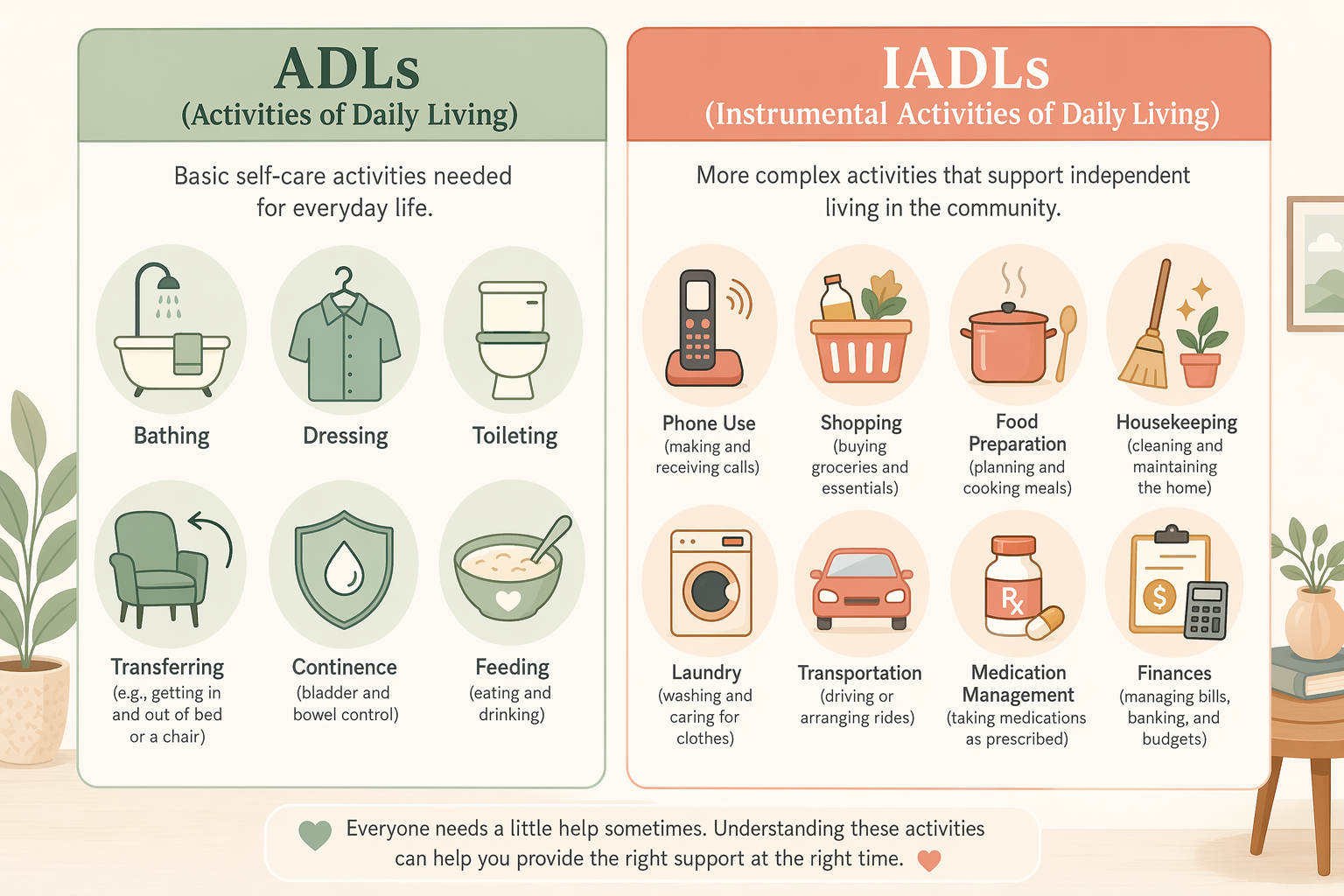
The distinction matters because IADLs typically weaken earlier in the course of illness or cognitive decline, while ADLs tend to decline in middle and later stages. An older adult who can still bathe and dress independently but cannot manage medications or balance a checkbook has a very different care profile from someone who needs help with both.
The AgingCare guide to ADLs notes a critical population-level pattern: fewer than 20% of older adults between ages 65 and 74 need assistance with ADLs, but the majority of those over 85 do require some help. This means that if your parent is in their late 70s or early 80s and showing no ADL deficits, you are in a fortunate position — but you should still assess IADLs, because those are the canary in the coal mine.
Review the Financial Picture
The financial review is where many families discover that their assumptions about paying for care are wrong. The most common misconception involves Medicare.
Medicare does not cover custodial care — the kind of long-term help with ADLs that most seniors eventually need. As the National Institute on Aging states clearly, "Medicare generally does not cover long-term stays in nursing homes." Medicare Part A will cover the first 20 days of a skilled nursing facility stay in full after a qualifying hospital stay, and days 21 through 100 with a daily copay (approximately $200 per day in 2026, per Senioridy). After day 100, Medicare pays nothing.
Medicaid may cover long-term care costs, but eligibility is income- and asset-based and varies by state. If your parent has significant assets, they may need to "spend down" to qualify — a process that requires careful planning with an elder law attorney.
Understanding these limits early — before you are standing in a facility's business office being handed a rate sheet — is essential. Our guide on Building a Sustainable Family Caregiving Plan walks through the financial review process in more detail.
Start Your Research
With a functional assessment and a financial picture in hand, you can begin researching care types that match both your parent's needs and your budget. At this stage, you are not touring facilities — you are learning the landscape. What types of care exist? What do they cost in your area? Which ones are appropriate for someone with your parent's ADL/IADL profile?
If your parent's needs are relatively modest, short-term or respite care options may serve as an interim step while you plan for the longer term. Our guide to Short-Term Care for Elderly covers the four main options.
Stage 3: Matching Care Level to Needs and Touring (1–3 Months Before Need)
By now you know what your parent needs help with and what you can afford. The next step is matching those needs to a specific care type and evaluating individual providers.
Match Care Level to Needs
The table below summarizes the major care types and what they are best suited for, based on the 2025 CareScout Cost of Care survey data reported by U.S. News and the 2026 national estimates from Senioridy.
| Care Type | Best For | National Cost Range (2025–2026) |
|---|---|---|
| Adult Day Services | Seniors who need supervision and social engagement during the day but have a caregiver at home at other times | $95 per eight-hour day (CareScout 2025); $80–$150/day (Senioridy 2026) |
| In-Home Care (Non-Medical) | Seniors who need help with ADLs or IADLs but want to remain at home; best for part-time needs under ~20 hours/week | $35/hour (CareScout 2025); $25–$34/hour (Senioridy 2026); $33/hour median (A Place for Mom 2025) |
| Independent Living | Seniors who are largely independent but want a maintenance-free lifestyle with social opportunities | $3,523/month (CareScout 2025); $1,500–$4,500/month (Senioridy 2026) |
| Assisted Living | Seniors who need help with daily activities but do not require 24/7 skilled nursing care | $6,200/month median (CareScout 2025); $5,190/month median (A Place for Mom 2025); $4,500–$5,500/month median, range $3,000–$8,000+ (Senioridy 2026) |
| Memory Care | Seniors with Alzheimer's or other dementias who need a secure, structured environment | $7,645/month (CareScout 2025); $5,000–$8,000+/month, typically 20–30% higher than assisted living (Senioridy 2026) |
| Skilled Nursing Facility | Seniors who need 24/7 medical supervision, rehabilitation, or complex nursing care | $9,581/month semi-private, $10,798/month private (CareScout 2025); ~$9,840/month semi-private, ~$11,300/month private national median (Senioridy 2026) |
| Board and Care Home | Seniors who need a small, home-like setting with personal care but not intensive medical services | $7,300/month private, $6,000/month shared (CareScout 2025) |
| Continuing Care Retirement Community (CCRC) | Seniors who want a single campus that can accommodate them from independent living through skilled nursing | Entrance fee $100,000–$2,000,000+; monthly $3,000–$8,000 (entrance-fee model) or $2,000–$6,000 (rental model) (CareScout 2025; Senioridy 2026) |
A common mistake at this stage is comparing costs across care levels without accounting for the hours of care needed. As Jacqui Clark, a senior living expert quoted by U.S. News, puts it: "Staying at home with care is the most expensive option. It's a big myth that it's cheaper to stay at home with care." This is true when a senior needs 40+ hours of home care per week — at that point, assisted living is almost always less expensive. But for someone who needs only 10–15 hours of help per week, home care is generally the more affordable choice.
For a detailed breakdown of how to match specific care needs to the right type of service, see our guide on Senior Health Services by Care Need.
Tour with a Structured Checklist
When you tour facilities, go with a written checklist. Do not rely on your impressions alone — the sales process is designed to make a good impression. What matters is what you observe systematically.
- Staff-to-resident ratio during the shift you are touring (not just the advertised ratio)
- Cleanliness and odor, especially in common areas and resident rooms
- How staff interact with residents when they think no one is watching
- Whether residents look engaged and appropriately dressed for the time of day
- The quality and variety of food (ask to see a meal being served)
- Safety features: grab bars, call systems, well-lit hallways, secure exits
- Activity calendar — is it varied and actually happening, or just posted?
Use Medicare's Care Compare tool and state inspection reports to check for violations, complaints, and quality ratings before you tour. Most families do not know these resources exist, but they provide objective data that no tour can replicate.
For a comprehensive touring and contract review framework, see our step-by-step guide on How to Evaluate Elderly Care Companies.
Stage 4: The Move-In Week — Preparation and Emotional Transition
Move-in week is the culmination of months of work — and it is often the most emotionally intense part of the entire process. Your parent is leaving a home they may have lived in for decades. You are navigating logistics, paperwork, and your own feelings of guilt and uncertainty.
What to Prepare Before Move-In Day
- Confirm the move-in date, time, and any required paperwork (medical records, financial agreements, advance directives)
- Arrange for movers or family help — and plan for multiple trips, not one
- Label every box and piece of furniture with the resident's name and room number
- Set up the new room to feel as familiar as possible: favorite chair, family photos, familiar bedding, a clock, a calendar
- Bring a week's worth of medications in their original bottles, plus a complete medication list
- Introduce yourself to the key staff members: the nurse, the activities director, the dining manager
The Emotional Transition
The National Institute on Aging advises that "it may take some time for everyone to adjust" and recommends getting to know staff before the move, being supportive during the transition, and checking in regularly afterward. There is no standard timeline for this adjustment — every person and every family is different.
What helps: visit frequently in the first week but keep visits short and positive. Let your parent complain without trying to fix everything. Acknowledge that this is hard and that you are in it together. Do not take a difficult first few days as a sign that you made the wrong decision — transition is almost always rocky.
Stage 5: The First 30 Days — Monitoring and Adjustment
The first month after a move is a settling-in period for everyone — the resident, the family, and the facility staff. Your job during this time is to monitor, support, and advocate, not to panic at every bump.
What to Watch in the First 30 Days
- Is your parent eating? Weight loss in the first few weeks is common but should stabilize.
- Are they participating in activities? Even sitting in the common area counts as engagement.
- Are they making any connections with staff or other residents? A single friendly face can make the difference.
- Is the care plan being followed? Check that medications are administered on schedule and that ADL assistance is actually happening.
- Are there any signs of neglect or poor care: unexplained bruises, soiled clothing, missed meals?
Signs of a Good Fit vs. a Poor Fit
A good fit does not mean your parent is thrilled to be there — it means they are safe, cared for, and gradually adjusting. Signs of a good fit include: staff who know your parent's name and preferences, a care plan that is actually being followed, and a gradual increase in your parent's willingness to participate in activities.
Signs of a poor fit include: rapid weight loss, new pressure sores, repeated medication errors, staff who cannot answer basic questions about your parent's care, and a pattern of your parent being left in bed or in a wheelchair for extended periods without interaction.
If you see signs of a poor fit, escalate immediately. Start with the charge nurse or the resident care director. If the issue is not resolved, contact the facility's administrator and, if necessary, your state's long-term care ombudsman.
Common Pitfalls at Each Stage and How to Avoid Them
Even with a structured timeline, families make predictable mistakes. Here are the most common ones at each stage, and how to avoid them.
Stage 1 Pitfall: Ignoring Early Signs
It is easy to explain away a missed bill or a fall that "was just a slip." But these are the signals that, if documented, give you months of lead time. The fix: keep the log. If you find yourself making excuses for three separate incidents, it is time to move to Stage 2.
Stage 2 Pitfall: Skipping the Formal Assessment
Many families rely on their gut feeling about what a parent needs. But without a structured ADL/IADL assessment, you risk choosing a care level that is either too intensive (and too expensive) or not intensive enough (leading to a second move within months). The fix: use the Katz Index and Lawton-Brody Scale, or hire a geriatric care manager to administer them.
Stage 3 Pitfall: Touring Without a Checklist
Facility tours are designed to impress. Without a written checklist, you will remember the chandelier in the lobby and forget to ask about the staff-to-resident ratio on the night shift. The fix: bring a printed checklist and take notes during the tour, not after.
Stage 4 Pitfall: Expecting a Smooth Transition
Move-in week is almost always harder than you expect. Your parent may be angry, tearful, or withdrawn. You may feel guilty and second-guess every decision. The fix: expect the transition to be difficult and plan for it. Visit frequently but briefly. Validate your parent's feelings without trying to talk them out of it. Give it time.
Stage 5 Pitfall: Stopping the Monitoring Too Soon
Once your parent seems settled, it is tempting to reduce your visits and assume everything is fine. But care quality can drift, staff can change, and your parent's needs can evolve. The fix: maintain a regular check-in schedule — weekly visits or calls for the first three months, then monthly. Keep the lines of communication open with the facility staff.
Questions to bring to a clinician or OT
This is not medical, legal, or a family's final decision — only a framework. Bring these questions to a clinician, occupational therapist, or your local Area Agency on Aging.
Find Local HelpRelated reading
Noticed something outdated or inaccurate on this page? Flag a correction. We review every report against CDC, NIA, and AARP HomeFit guidance before updating a page.