When Does an Aging Parent Need a Companion? A Family Decision Guide
For: adult childReviewed: 2026-06-27
When Does an Aging Parent Need a Companion? A Family Decision Guide
Learn how to recognize when an aging parent's social isolation and IADL-level needs warrant companion care, and how to distinguish that from the need for personal care or home health services. This guide helps adult children make the right call before needs escalate.
By Editorial Team
new caregiver
experienced caregiver
long-distance caregiving
spousal caregiver
working caregiver
daily routines
medication management
personal hygiene
care coordination
first steps
ADLs
IADLs
The hard part is often not the emergency. It is the months before the emergency, when an aging parent is still bathing, dressing, eating, and using the bathroom independently, but the life around those basics has started to loosen. The refrigerator has food that should have been thrown out. The mail is no longer opened on the day it arrives. A parent who used to say yes to church, bridge, lunch, or a neighbor’s porch now says, “Maybe next time.”
That is the point where many families start wondering whether they should look for companion care for an elderly parent — not because a parent is helpless, but because independence has become more fragile than it looks from the outside.
Loneliness and isolation are not minor background issues. A National Academies report found that about 24% of community-dwelling adults age 65 and older are socially isolated, and 43% of adults age 60 and older report loneliness.[1] Those figures do not mean every lonely parent needs paid care. They do mean that “they’re just alone a lot” is not a neutral observation. It belongs in the same family conversation as medication management, food, transportation, and safety.
Companion care fits best when the problem is still in the surrounding structure of daily life: rides, errands, meals, light housekeeping, appointments, and regular human contact. Once the parent needs hands-on help bathing, dressing, toileting, transferring, walking safely, or managing medical tasks, the family is no longer choosing simple companionship. They are looking at personal care, home health, or a professional assessment.
The decision turns on IADLs versus ADLs
The cleanest way to think about this decision is not “Does Mom seem old?” or “Is Dad lonely?” It is: which daily functions are still intact, and which ones are beginning to fail?
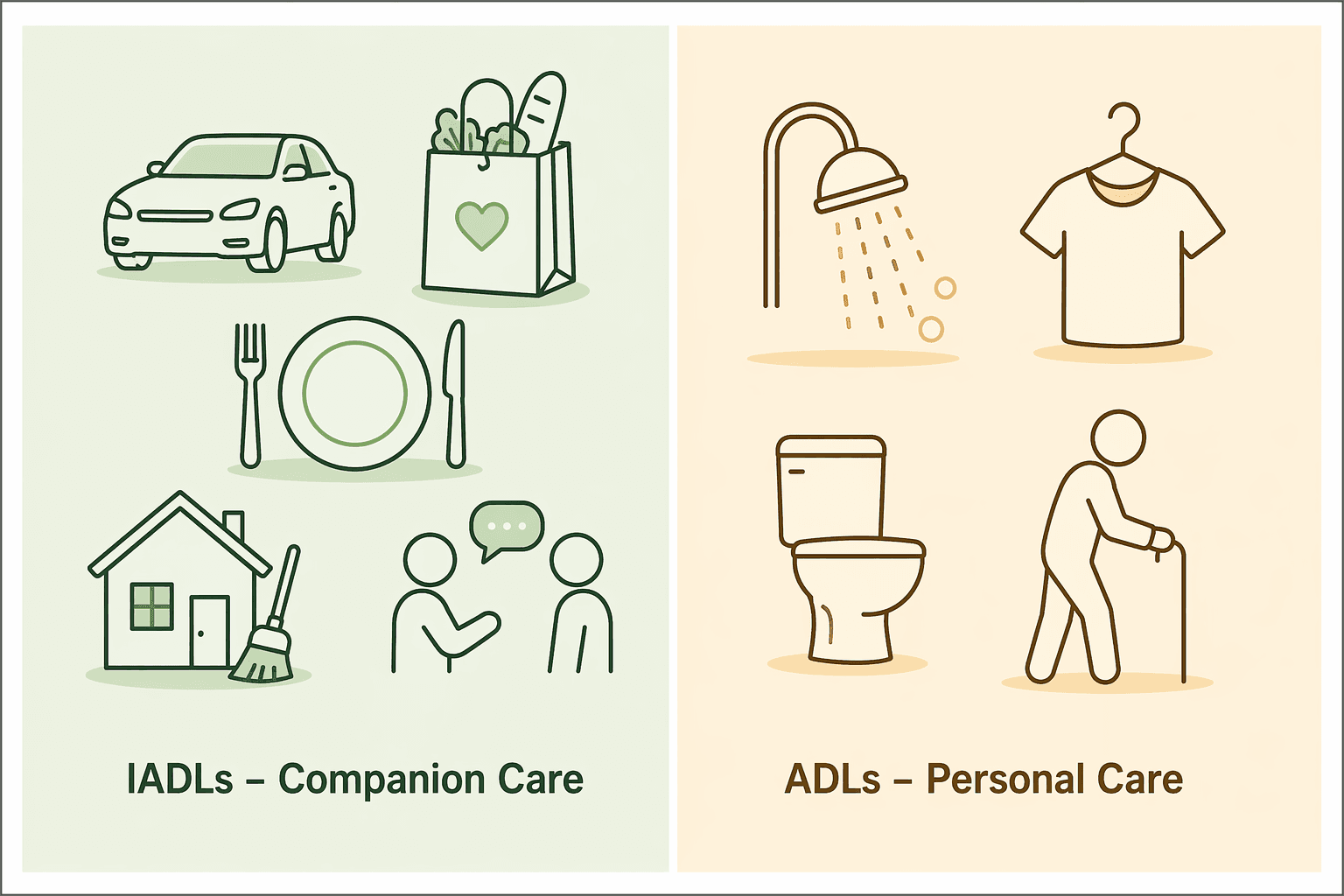
Instrumental Activities of Daily Living, or IADLs, are the tasks that let someone run a household and participate in ordinary life: transportation, shopping, preparing meals, light housekeeping, managing appointments, doing errands, and staying socially engaged. Activities of Daily Living, or ADLs, are more basic hands-on functions: bathing, dressing, toileting, eating, transferring, and moving safely. Home care providers commonly draw the companion-care line around IADL support, while ADL help moves into personal care.[2][3][4]
What you are seeing
Likely category
What it usually points toward
No longer drives at night, skips errands, has trouble getting groceries
IADL strain
Companion care may fit
House is cluttered, laundry piles up, meals are irregular
IADL strain
Companion care may fit if ADLs are intact
Few visitors, refuses invitations, spends most days alone
Social isolation risk
Companion care may help reduce isolation, but should not be the only response
Unpaid bills, missed appointments, confusion about ordinary plans
IADL strain or cognition/judgment concern
Companion care may help with structure, but patterns should be tracked and discussed with a clinician if worsening
Needs help bathing, dressing, toileting, transferring, or walking safely
ADL need
Personal care or professional assessment is more appropriate
This boundary matters because companion care can be very helpful and still be the wrong tool. A companion may keep a parent eating better by preparing simple meals and making grocery trips possible. A companion may make it easier for a parent to attend appointments, take walks, sort mail, or resume a weekly routine. But if the parent cannot get out of the shower safely, cannot manage toileting, or is falling during transfers, companionship does not solve the core risk.
Signs that companion care may be the right level of help
One odd afternoon does not make a care plan. The more useful question is whether small signs are repeating across weeks: the same stack of mail, the same empty refrigerator, the same canceled plans, the same “I’m fine” paired with a house that says otherwise.
The National Institute on Aging advises families to notice changes in an older adult’s home, self-care, mood, social life, memory, and ability to manage daily responsibilities.[5] Those observations are most useful when grouped by what they show.
The home is getting harder to maintain
Look for clutter that is new for that parent, trash that is not being taken out, spoiled food, dishes left for days, laundry that no longer gets folded or put away, and rooms that are avoided because they feel like too much work. None of these signs alone proves that paid help is necessary. Together, they suggest the parent may be spending most of their energy preserving the basics and letting the rest go.
This is often companion-care territory if the parent can still bathe, dress, toilet, eat, and move around safely. A companion can help reset the week: grocery run on Tuesday, laundry started before lunch, trash taken out, a real meal prepared, a walk after dishes. The value is not that the house looks nicer. It is that the parent no longer has to choose between eating well, getting out, and keeping up with the ordinary friction of living alone.
Food is becoming irregular
A parent may insist they are eating, and technically that may be true. The better question is what they are eating, how often, and whether meals still have any pattern. Watch for expired food, repeated snack meals, weight loss, unopened groceries, or a refrigerator that has stopped matching the parent’s old habits.
Companion care can support meal planning, grocery shopping, light meal preparation, and eating with another person. That last part matters. Many older adults eat less or eat poorly when every meal is alone, even if they are physically able to cook.
Social life has quietly narrowed
Isolation does not always look dramatic. It can look like a parent who stopped driving after dark, then stopped going to evening events, then stopped accepting lunch invitations because arranging the ride felt embarrassing. It can look like fewer phone calls, no visitors, unopened cards, or a parent who says everyone else is “busy.”
Missed appointments, unpaid bills, duplicate payments, unopened insurance letters, or confusion about the calendar deserve attention. Sometimes the issue is transportation or energy. Sometimes it is grief, depression, medication effects, or cognitive change. A companion can help with reminders, organization, rides, and mail sorting, but repeated confusion should not be brushed off as simple loneliness.
A useful distinction is whether the parent understands the task once it is in front of them. If Dad forgot the appointment because he no longer drives and hates asking for rides, companion care may be enough. If he cannot understand why the appointment matters, repeatedly misidentifies bills, or seems unable to follow familiar routines, the family should involve a clinician or appropriate professional assessment.
Mood has changed, especially with withdrawal
Irritability, flat affect, unusual suspicion, tearfulness, loss of interest, or a parent who no longer seems to take pleasure in anything should not be treated as just personality. Mood changes can have many causes, and a companion is not a substitute for medical or mental health care. Still, routine companionship can reduce the amount of time a parent spends alone with no one noticing whether the change is improving, worsening, or tied to a specific loss of function.
Personal care changes move the decision into a different category
Weight loss, body odor, dirty clothing, unwashed hair, toileting accidents, difficulty getting in and out of a chair, or fear of bathing are not the same as a messy kitchen. They may be early warning signs of ADL-level need. A companion may still be pleasant and useful, but the care plan must account for hands-on support and safety.
A strong companion-care fit usually has a cluster, not one isolated sign
The parent who is a good fit for companion care is often still proud, capable, and reasonably safe — but less connected and less able to keep the week moving. The pattern may look like this: she no longer drives at night, so she skips evening events; she eats toast for dinner more often than she admits; the house is not unsafe, but it is no longer kept the way she likes; she is still bathing and dressing, but she has fewer reasons to do either on a schedule.
That combination is different from a parent who cannot shower without help or cannot get to the bathroom safely. It is also different from a parent who is socially active but wants help with heavy cleaning. Companion care is most defensible when several IADL and social signs point in the same direction, while ADLs remain intact.
A parent is eating poorly because shopping and meal preparation have become burdensome.
Transportation limits have narrowed medical appointments, errands, worship, hobbies, or visits.
Household tasks are slipping, but the home is not yet unsafe.
The parent spends long stretches alone and has stopped initiating contact.
The parent can still bathe, dress, toilet, eat, transfer, and move about without hands-on help.
If the final point is not true, do not force the situation into companion care just because it feels more acceptable.
Companion care should not be treated as a cure for isolation. A paid visitor cannot replace family relationships, old friends, neighbors, faith communities, clubs, or medical follow-up when depression or cognitive change is suspected. The better goal is modest and realistic: reduce empty time, restore routine, support nutrition and errands, and make changes visible before they become emergencies.
It also should not be treated as personal care unless the provider explicitly says those tasks are included and the caregiver is trained and permitted to perform them. “Companion care” and “personal care” are not used consistently across every agency or market. One provider may include standby help during dressing under a broader home care plan; another may prohibit any hands-on assistance in a companion-only service. Verify the task list in writing.
Companion care is usually paid privately. Genworth/CareScout’s 2024 data reported a national median of $33 per hour for homemaker services, a category that closely overlaps with nonmedical household support.[6] Care.com’s January 2026 city data showed senior care rates ranging from $18.54 to $27.33 per hour.[7] Local prices can differ substantially based on geography, minimum shifts, agency model, caregiver experience, and whether the schedule is occasional or consistent.
Medicare does not cover companion care.[8] That is the sentence families need before they spend hours hoping the right wording will make it reimbursable. Medicare may cover certain medically necessary home health services when eligibility requirements are met, but nonmedical companionship, errands, supervision, and household support are not covered as companion care.
Other funding sources may help in some situations: long-term care insurance, VA Aid & Attendance, and state Medicaid Home- and Community-Based Services waivers. These are not automatic, and Medicaid waiver programs vary by state and may have waitlists. A local Area Agency on Aging is often the most practical first call for understanding what exists in the parent’s county.
How to raise the subject without making it sound like a takeover
The conversation goes better when it starts with a specific burden, not a verdict on the parent’s life. “You need help” invites a yes-or-no fight. “I noticed grocery shopping seems more tiring lately” gives both of you something concrete to discuss.
“I’ve noticed the house seems harder to keep up. Would having someone help with groceries and errands take some pressure off?”
“Would it help if someone drove you to appointments so you didn’t have to plan around everyone else’s schedule?”
“You’ve said cooking for one is a nuisance. Would you be open to someone coming once or twice a week to help with meals?”
“I’m not trying to change how you live. I’m trying to make the parts that are becoming annoying a little easier.”
Before hiring, track the pattern for a short period
Families often argue from impressions: one sibling saw the parent on a good day, another saw the refrigerator, another is reacting to a frightening phone call. A simple written pattern can lower the temperature. For two to four weeks, note what is actually happening.
If the notes show mostly IADL strain and social narrowing, a companion may be the right early support. If ADLs, falls, unsafe mobility, toileting, hygiene, or medical concerns appear in the notes, escalate the conversation. That may mean a primary care appointment, a geriatric care manager, personal care services, home health, or urgent safety planning depending on what is happening.
Then ask any provider the practical questions before agreeing to service: What tasks are included? What tasks are excluded? Can the caregiver prepare meals? Provide transportation? Help with bathing or not? Remind about medications or administer them? What happens if the caregiver notices a decline? Who supervises the caregiver? Who does the family call after hours?
A parent who is still independent in ADLs but losing the supports around daily life may not need a dramatic care plan. They may need a steady person who helps the week hold together. Document the pattern, talk with the parent about the specific burdens, verify exactly what a companion provider includes, and move to a higher level of care if hands-on ADL help, safety risks, or medical needs are present.



Comments
Join the discussion with an anonymous comment.