
Caregiver decision guide
How to Choose a Home Care Agency: An 8-Step Evidence-Based Framework for Family Caregivers
A structured, evidence-based 8-step guide for adult children who have decided their parent needs non-medical home care but feel overwhelmed by agency selection. Covers ADL assessment, agency vs. independent trade-offs, credential verification, interview questions, cost analysis, reputation checks, and care plan evolution.

You have crossed the hardest threshold: recognizing that your parent needs help at home and that you cannot — or should not — provide it alone. Now you face a new kind of overwhelm. A search for "home care agency" returns dozens of names, each promising compassionate caregivers, flexible schedules, and transparent pricing. Without a structured process, families end up comparing apples to oranges, missing critical red flags, and making decisions based on star ratings rather than substantive quality indicators.
This guide provides a replicable, evidence-based framework for evaluating non-medical home care agencies. Each step draws from standards established by the National Institute on Aging, Medicare, and independent senior care research organizations. Follow the steps in order. Skipping ahead — particularly the assessment phase — is the most common mistake families make.
Step 1: Determine What Care You Actually Need — A Practical ADL Assessment
The single most important step happens before you contact a single agency. You must define the scope of care your parent needs in concrete, observable terms. Without this, you will either overpay for services you do not need or underestimate the hours required — both of which lead to frustration and disrupted care.
Start with the Activities of Daily Living (ADLs) — the six basic self-care tasks that clinicians use to measure functional independence:
- Bathing and showering
- Dressing and undressing
- Eating and feeding
- Transferring (moving from bed to chair, chair to toilet)
- Toileting and continence management
- Walking or moving around the home
Then assess the Instrumental Activities of Daily Living (IADLs) — the higher-level tasks that determine whether someone can live independently:
- Medication management (remembering doses, refilling prescriptions)
- Meal preparation and safe food handling
- Housekeeping and laundry
- Transportation and errands
- Managing finances and mail
- Using the telephone or communication devices

For each task, note whether your parent can perform it independently, needs verbal reminders, needs hands-on assistance, or cannot do it at all. This assessment serves two purposes: it tells you exactly what tasks a caregiver must handle, and it gives agencies the information they need to match you with the right caregiver. Agencies that skip this assessment or proceed without asking detailed questions about ADLs are a red flag.
If you are unsure whether professional care is necessary or whether family caregiving can still suffice, our guide on when to hire professional help can help you make that determination before proceeding with agency selection.
| ADL / IADL | Independent | Needs Reminders | Needs Hands-On Help | Cannot Do |
|---|---|---|---|---|
| Bathing | ☐ | ☐ | ☐ | ☐ |
| Dressing | ☐ | ☐ | ☐ | ☐ |
| Meal preparation | ☐ | ☐ | ☐ | ☐ |
| Medication management | ☐ | ☐ | ☐ | ☐ |
| Transferring | ☐ | ☐ | ☐ | ☐ |
| Transportation | ☐ | ☐ | ☐ | ☐ |
Step 2: Agency vs. Independent Caregiver — Understanding the Trade-Offs
Once you know what care is needed, the next decision is structural: do you hire through a licensed home care agency, or do you hire an independent caregiver directly? Each path has distinct trade-offs that go far beyond hourly rate.
Agencies typically charge 20–30% more than independent caregivers for the same hourly service, according to SeniorLiving.org's 2026 analysis. That premium buys several structural protections: the agency conducts background checks, provides training, carries worker's compensation and liability insurance, handles payroll taxes, and — critically — provides backup coverage when your regular caregiver is sick or on vacation.
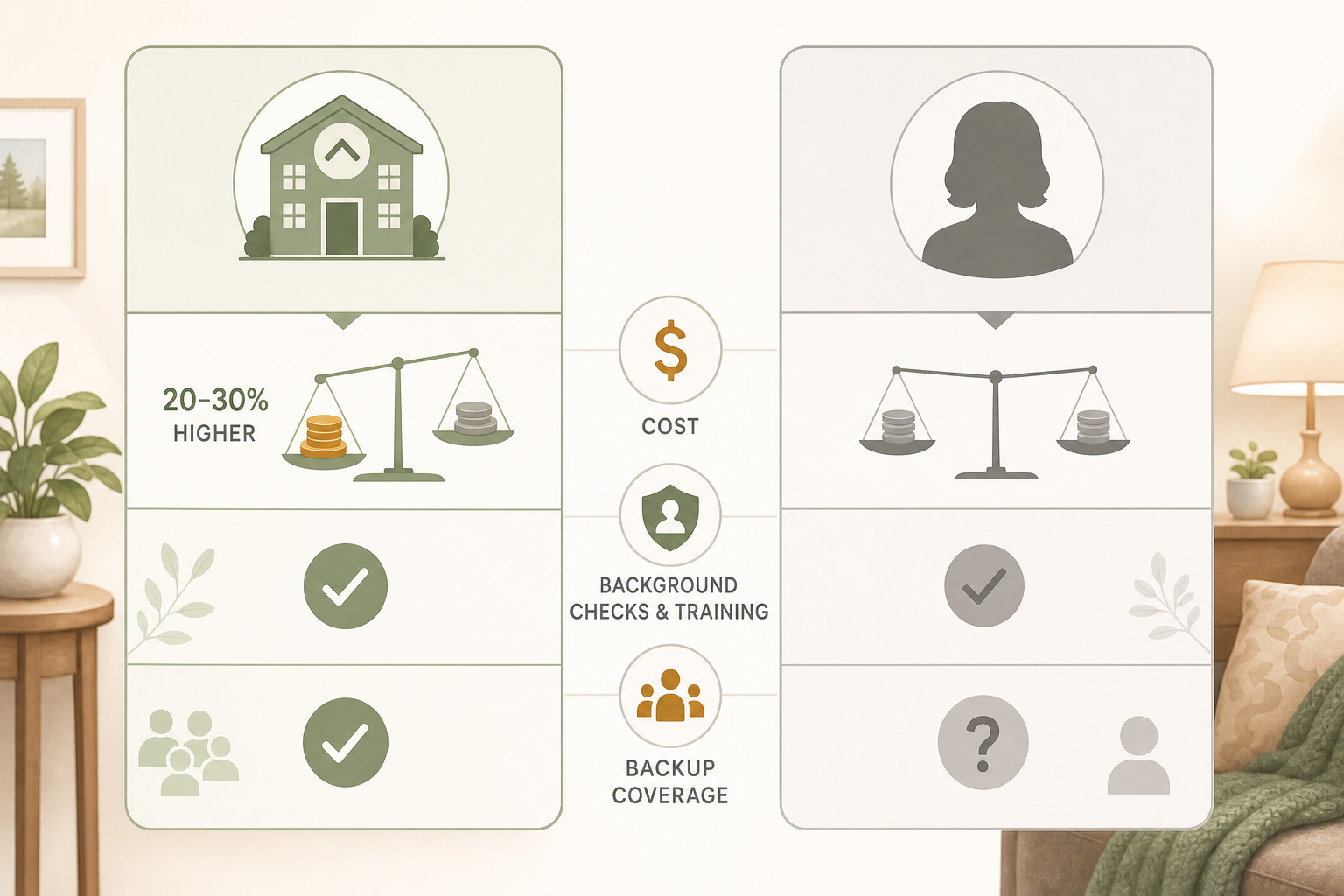
Independent caregivers — hired directly or through a registry — cost less per hour, but you become the employer. That means you are responsible for verifying credentials, conducting background checks, withholding taxes, and finding replacement coverage when the caregiver cannot make it. For families with a single, predictable care need and a trusted referral from a friend or healthcare provider, the independent route can work well. For families managing complex or escalating needs, the agency premium is usually worth the safety net.
| Factor | Licensed Agency | Independent Caregiver |
|---|---|---|
| Hourly cost | 20–30% higher | Lower (no overhead) |
| Background checks | Conducted by agency | Your responsibility |
| Training | Minimum 75 hours (federal HHA standard) | Varies; no guarantee |
| Worker's comp / liability | Carried by agency | You may be liable |
| Backup coverage | Agency provides replacement | No guarantee |
| Payroll and taxes | Handled by agency | Your responsibility |
| Care plan oversight | Agency care coordinator | You manage directly |
For the remainder of this guide, we assume you are evaluating licensed home care agencies — the most common path for families seeking structured, reliable support.
Step 3: Verify Licensing, Bonding, and Insurance — What to Ask and Why It Matters
State licensing requirements for non-medical home care agencies vary dramatically. Some states require agencies to be licensed, bonded, and inspected regularly. Others have no licensing requirements at all for non-medical personal care. This regulatory patchwork means that a clean website and friendly phone manner tell you nothing about an agency's legal standing.
Before you schedule an in-home assessment, request the following documentation from every agency on your shortlist:
- State business license and home care license (if your state requires one)
- Proof of general liability insurance (minimum $1 million coverage is standard)
- Worker's compensation insurance certificate
- Proof of bonding (protects against theft or property damage)
- HIPAA compliance documentation
An agency that hesitates to provide these documents or claims they are "not necessary" for non-medical care should be removed from your list immediately. Legitimate agencies carry these protections as a matter of routine business practice.
Step 4: What to Look for in Caregiver Hiring and Training Standards
The quality of care your parent receives depends almost entirely on the individual caregiver assigned to them. Yet most families evaluate agencies without ever asking how caregivers are hired, screened, and trained. These process indicators are far more predictive of quality than online star ratings.
Ask every agency to describe its caregiver screening process in detail. The following elements should be non-negotiable:
- Nationwide background check (not just county-level)
- Drug screening
- Reference checks from previous employers
- Verification of certification or training credentials
- In-person interview and skills assessment
Training standards are equally important. The federal minimum for home health aide training is 75 hours, but some states require more, and the best agencies exceed these minimums significantly. Ask about ongoing training requirements — not just initial orientation. Agencies that invest in continuous training tend to have higher caregiver retention rates, which means your parent is more likely to see the same familiar face each week.
| Quality Indicator | What to Look For | Red Flag |
|---|---|---|
| Background check scope | Nationwide (county + state + federal) | County-level only or vague description |
| Drug screening | Pre-employment and random | No drug screening policy |
| Minimum training hours | 75+ hours (federal HHA standard) | No stated minimum or "on-the-job training only" |
| Ongoing training | Annual continuing education | No ongoing training requirement |
| Caregiver retention rate | Above 80% year-over-year | Agency cannot provide or refuses to share |
| Voluntary accreditation | Joint Commission, CHAP, or state equivalent | No accreditation and no plan to pursue one |
One of the most revealing questions you can ask: "What is your caregiver retention rate?" Agencies with high turnover often have poor training, low pay, or inadequate support — all of which directly affect the quality and consistency of care your parent receives.
Step 5: The Interview — 12 Questions Every Family Should Ask a Home Care Agency
Once an agency has passed the licensing and training screens, schedule a phone or in-person interview. Treat this as a working session, not a casual conversation. The questions below are designed to surface the operational realities that marketing materials obscure.
- "Can you provide a written care plan that specifies tasks, schedules, and the specific caregiver(s) assigned?" A verbal description is not sufficient. You need a document.
- "What is your process for matching a caregiver to my parent?" The answer should reference your parent's personality, preferences, and specific care needs — not just availability.
- "What happens if our regular caregiver calls in sick or quits?" The agency should describe a specific backup plan, not a vague "we'll find someone."
- "Can we meet the assigned caregiver before care begins?" Agencies that refuse this request or offer only a phone introduction are hiding something.
- "How do you communicate with families about daily care?" Look for structured reporting — daily logs, weekly summaries, or a secure family portal.
- "What is your policy for requesting a different caregiver?" The answer should describe a straightforward, no-fault process — not a defensive or punitive one.
- "How do you handle complaints or concerns from families?" The agency should have a written grievance policy with clear escalation steps.
- "Are your caregivers trained in dementia care, fall prevention, or other specific conditions?" Generic training is not enough if your parent has specific needs.
- "What is your policy on scheduling flexibility? Can we increase or decrease hours with short notice?" Rigid scheduling policies are a red flag for families whose needs change frequently.
- "Do you conduct background checks on all employees, including administrative staff who may visit the home?" The scope of background checks should extend beyond direct caregivers.
- "What is your policy on overtime and holiday scheduling?" Understand how the agency handles these situations before you need them.
- "Can you provide references from at least three current or recent clients?" Agencies with happy clients will provide these readily. Be wary of agencies that offer only written testimonials.
Step 6: Understand the Full Cost Picture — Hourly Rates, Minimums, Surcharges, and Billing
Cost is the dimension where families are most vulnerable to surprise. The advertised hourly rate is rarely the full story. Here is what you need to understand before signing any agreement.
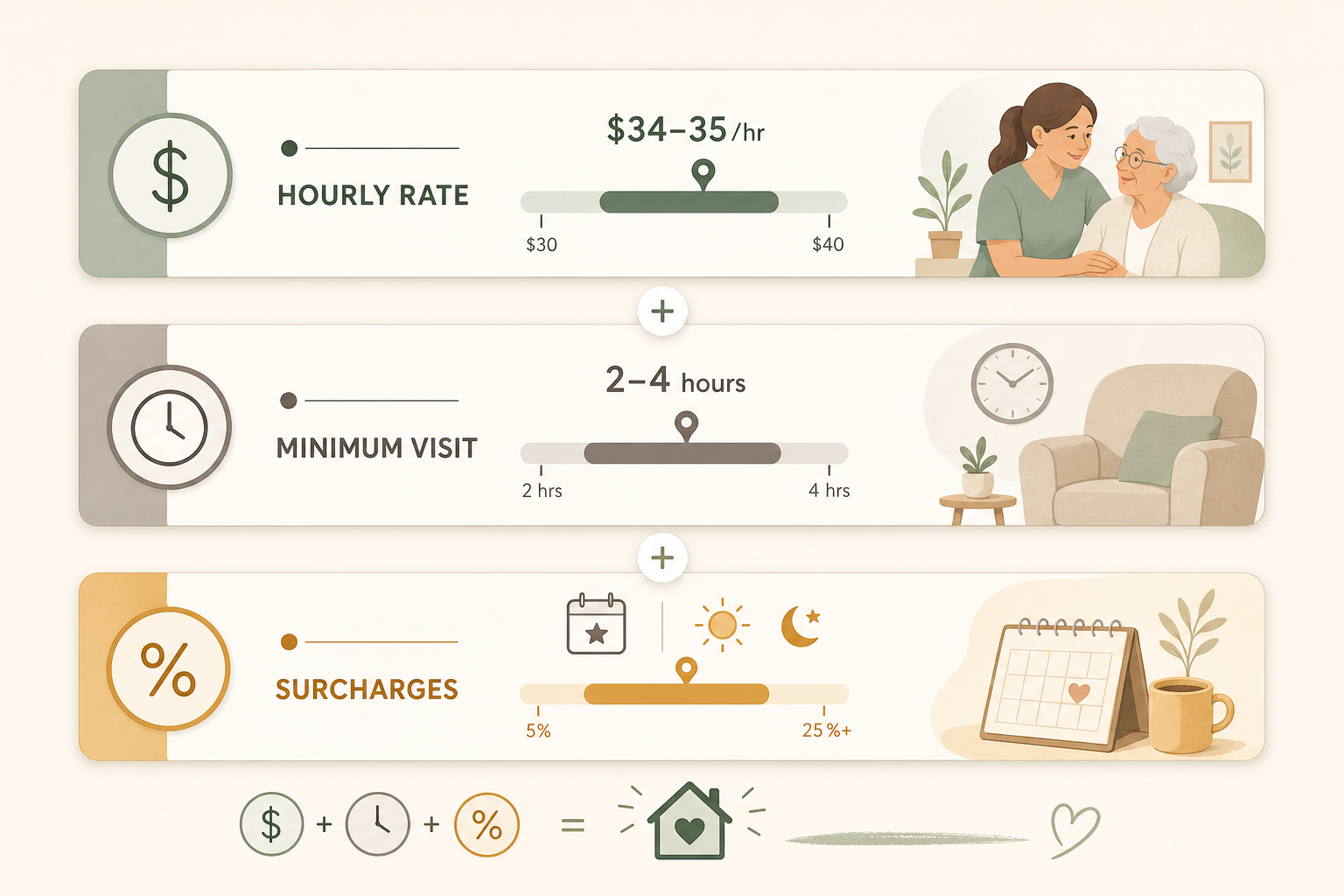
The national median cost for non-medical home care in 2026 is $34–$35 per hour, according to A Place for Mom's 2026 Costs of Long-Term Care report ($34/hr) and SeniorLiving.org's analysis citing CareScout/Genworth data ($35/hr). State medians range from $23 per hour in Louisiana to $44 per hour in South Dakota. These are medians — actual rates vary by city, agency, and the specific care plan.
Beyond the hourly rate, every family should clarify these cost components:
- Minimum visit length: Most agencies require a 2–4 hour minimum per visit, even if your parent only needs one hour of help. This is standard practice, but it means you pay for four hours even if the caregiver finishes tasks in two.
- Weekend and holiday surcharges: Expect rates to increase by $5–$10 per hour on weekends and major holidays.
- Overtime policies: Some agencies charge time-and-a-half for hours beyond 40 per week or for shifts exceeding 12 hours.
- Cancellation fees: Most agencies require 24–48 hours' notice for cancellations. Late cancellations may incur a partial or full charge.
- Assessment or onboarding fees: Some agencies charge a one-time fee for the initial in-home assessment and care plan development.
| Cost Component | Typical Range | Notes |
|---|---|---|
| Hourly rate (national median) | $34–$35/hr | Varies by state: $23 (LA) to $44 (SD) |
| Minimum visit length | 2–4 hours | Standard across most agencies |
| Weekend surcharge | +$5–$10/hr | Common; confirm before signing |
| Holiday surcharge | +$10–$15/hr | Major holidays only or all holidays? |
| Overtime (>40 hrs/week) | Time-and-a-half | Federal law; confirm agency policy |
| Cancellation fee | 50–100% of scheduled hours | 24–48 hour notice typically required |
| Assessment fee | $0–$150 | One-time; ask if waived with service agreement |
To estimate your monthly cost: multiply the hourly rate by the number of hours per week, then multiply by 4.3 (average weeks per month). At the national median of $34/hr, 15 hours per week costs approximately $2,208 per month; 30 hours per week costs approximately $4,416 per month, according to A Place for Mom's 2026 projections.
Step 7: Check Reputation Beyond Online Reviews — BBB, State Registries, and Referrals
Online reviews are useful for identifying extreme cases — multiple one-star complaints or a pattern of five-star reviews that read like marketing copy — but they are not a reliable measure of agency quality. Review platforms are susceptible to manipulation, and a single bad experience can dominate an otherwise solid agency's profile.
Use these verification methods instead:
- Better Business Bureau (BBB): Check the agency's BBB rating and, more importantly, read the complaint history. Look for patterns — unresolved complaints about billing, scheduling, or caregiver conduct are serious red flags.
- State health department or aging services agency: Contact your state's regulatory body for home care agencies. Ask whether the agency has been subject to any disciplinary actions, fines, or license suspensions.
- Current or recent client references: Ask the agency for three references from families whose care situation is similar to yours. Call them. Ask specific questions about reliability, communication, and how the agency handled problems.
- Healthcare provider recommendations: Hospital discharge planners, geriatric care managers, and primary care physicians often have direct experience with local agencies. Their recommendations carry more weight than online reviews.
- Local Council on Aging or Area Agency on Aging: These organizations maintain lists of vetted providers and can often share informal feedback about agencies they have worked with.
Step 8: The Care Plan — How to Ensure It Can Evolve with Changing Needs
A good care plan is the operational backbone of the entire arrangement. It should be a written document — not a verbal understanding — that specifies:
- The specific tasks the caregiver will perform (e.g., "assist with showering on Monday, Wednesday, Friday" not "help with bathing")
- The schedule and expected duration of each visit
- The name and contact information of the primary caregiver and backup caregivers
- Emergency contact information and protocols
- Any specific instructions related to medications, mobility, diet, or behavioral considerations
- The schedule for care plan review (every 30, 60, or 90 days is standard)
The care plan must be a living document. As your parent's needs change — and they will — the plan should be updated accordingly. Ask the agency how they handle mid-cycle changes. Can you increase hours with 48 hours' notice? What happens if your parent is discharged from the hospital and needs more intensive care temporarily? The agency's flexibility in these situations is a direct test of its operational quality.
Communication protocols are equally important. Who at the agency should you contact with questions or concerns? How will the caregiver document daily activities and observations? Will you receive a daily log, a weekly summary, or access to a secure online portal? The best agencies provide structured, consistent reporting that keeps you informed without requiring you to chase down information.
If your parent's needs escalate to the point where 24-hour care becomes necessary, our guide on warning signs that indicate 24-hour home care is needed can help you recognize the transition points and plan accordingly.
Red Flag Checklist: Signs an Agency Isn't Credible
Some agencies should be removed from consideration immediately. The following warning signs indicate an agency that is either operationally unsound or actively deceptive:
- Refuses to provide licensing, bonding, or insurance documentation in writing
- Cannot or will not describe its caregiver background check process
- Pressures you to sign a long-term contract or pay a large deposit before care begins
- Refuses to allow a meet-and-greet with the assigned caregiver before the first visit
- Gives vague or evasive answers about backup coverage for sick days or emergencies
- Cannot provide references from current or recent clients with similar care needs
- Has unresolved complaints with the Better Business Bureau or state regulatory agency
- Charges significantly below market rate ($20/hr or less in most markets) — this often indicates underpayment of caregivers, lack of insurance, or inadequate training
- Uses high-pressure sales tactics, limited-time discounts, or scare tactics to rush your decision
Choosing a home care agency is one of the most consequential decisions you will make as a family caregiver. The process is not quick — expect to spend several days working through these eight steps — but it is the best investment you can make in your parent's safety, dignity, and quality of life at home.
Questions to bring to a clinician or OT
This is not medical, legal, or a family's final decision — only a framework. Bring these questions to a clinician, occupational therapist, or your local Area Agency on Aging.
Find Local HelpRelated reading
Noticed something outdated or inaccurate on this page? Flag a correction. We review every report against CDC, NIA, and AARP HomeFit guidance before updating a page.