
Caregiver decision guide
A Complete Guide to In-Home Care Options for Seniors: Services, Costs, and How to Choose
This guide helps adult children understand the full range of in-home care services available for aging parents. It covers the key distinction between non-medical home care and medical home health care, provides a detailed breakdown of eight service types with 2026 cost data, and offers a practical decision framework based on your loved one's needs.

Why In-Home Care Matters: The Planning Gap
The numbers are clear and consistent across every major survey: approximately 93% to 94% of adults aged 55 and older say they want to remain in their own homes as they age. The U.S. Department of Health and Human Services estimates that someone turning 65 today has a nearly 70% chance of needing some form of long-term care services at some point. These two statistics create a fundamental tension: the overwhelming majority of older adults want to age in place, yet most families have not built a real plan for how to make that possible.
This planning gap is not a matter of neglect. It exists because the landscape of in-home care is fragmented and confusing. Most family caregivers — typically adult children in their 40s and 50s who are managing careers, their own families, and a parent's sudden health decline — do not realize there are at least eight distinct types of in-home care services. Each type has a different cost structure, different training requirements for the caregiver, and a different pathway for funding. Making a decision without understanding this full menu is like ordering from a restaurant when you can only see two items on the list.
This guide exists to close that gap. It is structured differently from the typical cost-only or program-only articles you may have already found. It uniquely combines three elements: the complete taxonomy of in-home care services, the critical distinction between non-medical home care and medical home health care, and a practical decision framework based on the Activities of Daily Living (ADL) and Instrumental Activities of Daily Living (IADL) assessment model. If you are reading this after a parent's hospitalization or a recent fall, start with the decision framework in section seven. If you are exploring options before a crisis, read from the beginning.
For a deeper look at why so few families have a concrete aging-in-place plan, see our article on the planning gap in aging at home.
The Fundamental Distinction: Home Care vs. Home Health Care
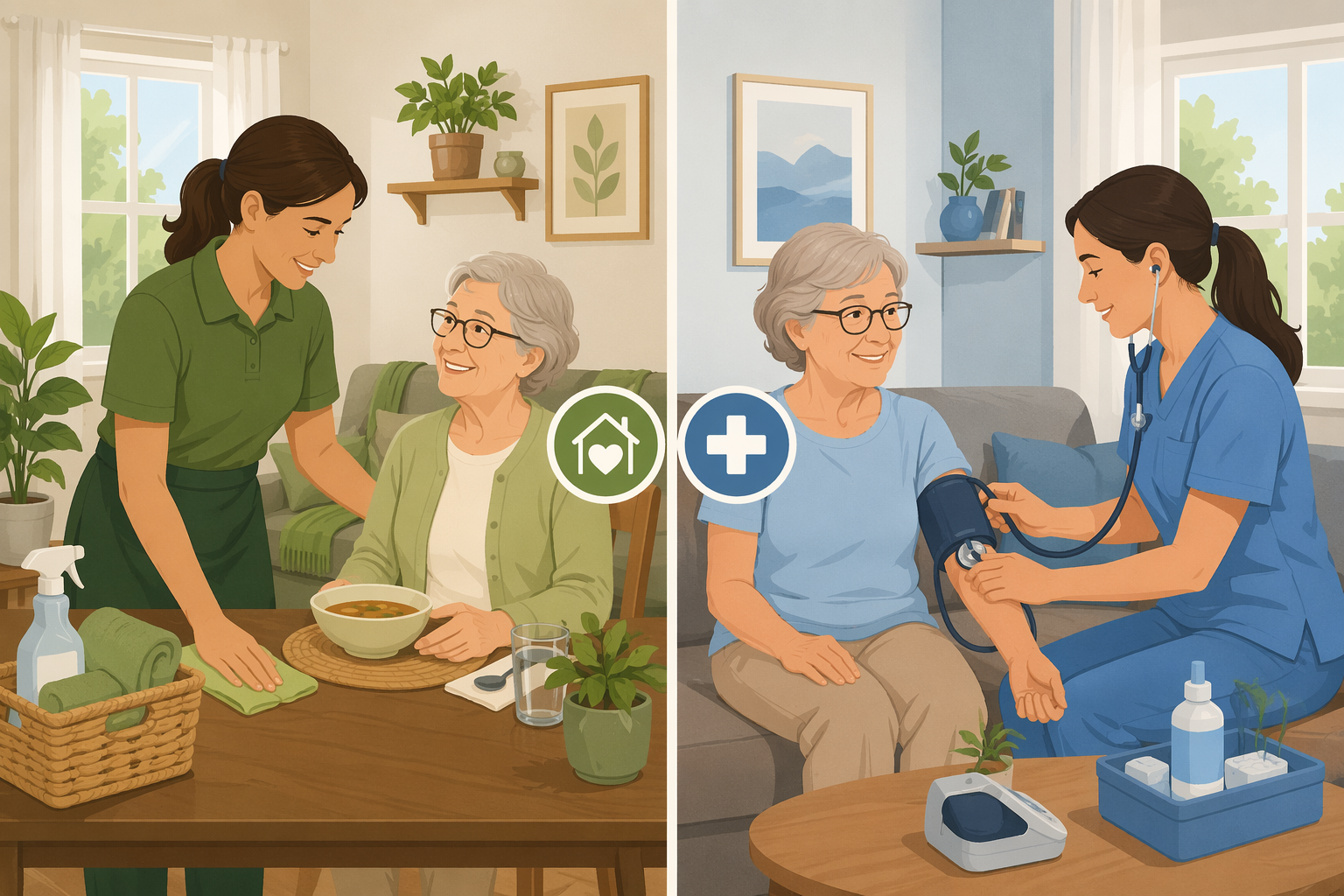
Before examining the specific service types, it is essential to understand the single most common and costly mistake families make: confusing non-medical home care with medical home health care. These are two entirely different categories of service, regulated differently, staffed by professionals with different credentials, and — most critically — paid for through completely different mechanisms.
| Dimension | Home Care (Non-Medical) | Home Health Care (Medical) |
|---|---|---|
| What it provides | Companionship, assistance with daily activities, homemaking, transportation | Skilled nursing, physical therapy, occupational therapy, speech therapy, wound care |
| Who provides it | Home care aides, companions, personal care attendants (typically no medical license required) | Registered nurses, licensed practical nurses, physical therapists, occupational therapists |
| Who orders it | No prescription needed; arranged directly by the family | Must be ordered by a physician as part of a plan of care |
| Typical cost (2026) | $30–$44 per hour (national median $34/hour) | $50–$90 per hour depending on the type of skilled care |
| Insurance coverage | Not covered by Medicare; rarely covered by private insurance; Medicaid varies by state | Covered by Medicare Part A/B when criteria are met; covered by many private insurance plans |
| Regulatory oversight | Varies by state; some states require licensing, others do not | Agencies must be Medicare-certified to receive reimbursement |
The sources below provide additional detail. The A Place for Mom cost report clearly distinguishes home care from home health care, as does the U.S. News guide and the National Institute on Aging. The Alzheimer's Association also uses this same four-part taxonomy in its guidance on in-home services.
The Full Service Menu: Eight Types of In-Home Care
Once you understand the home care versus home health care distinction, the next step is to learn the specific service types available within each category. The following eight types represent the full range of in-home care options available in 2026. Most families will use a combination of two or more types over time as needs evolve.
1. Companion Care
Companion care is the entry point for many families. It provides supervision, conversation, recreational activities, and light assistance with Instrumental Activities of Daily Living (IADLs) such as grocery shopping, meal preparation, and transportation to appointments. It does not include hands-on personal care like bathing or dressing. Companion care typically costs $25 to $30 per hour nationally, according to Senioridy's 2026 data. It is often the most affordable option and can be a good starting point for a senior who is lonely or needs occasional help but is otherwise independent.
For a deeper discussion of when companionship is the right choice, see our guide on recognizing the signs a senior needs social support.
2. Personal Care (ADL Support)
Personal care services provide hands-on assistance with the core Activities of Daily Living: bathing, dressing, grooming, toileting, eating, and transferring (moving from bed to chair, for example). This is the service type most people picture when they think of home care. The National Institute on Aging includes these ADLs as the standard measure of functional ability. Personal care costs $30 to $35 per hour nationally, according to Senioridy, and is the most commonly needed service for seniors with moderate functional decline.
3. Homemaker Services
Homemaker services focus on the home environment rather than the person: housekeeping, laundry, meal preparation, grocery shopping, and errands. The Alzheimer's Association lists homemaker services as a distinct category separate from companion and personal care. Some agencies bundle homemaker services with companion care, while others offer them separately. The cost is generally in the same range as companion care, $25 to $30 per hour.
4. Home Health Care (Skilled Care)
Home health care is the medical side of the distinction. It includes skilled nursing services (wound care, injections, IV therapy, medication management, vital sign monitoring), physical therapy, occupational therapy, and speech therapy. These services must be ordered by a physician and provided by a Medicare-certified home health agency. The U.S. News guide, citing CareScout's 2025 Cost of Care Survey, reports a national median rate of $90 per hour for a private duty nurse. However, when covered by Medicare, the patient pays nothing for covered services (except 20% for durable medical equipment).
5. Live-In Care
Live-in care involves a caregiver who resides in the home, typically working in shifts to provide 24-hour coverage. This is the most expensive non-medical option, with Senioridy reporting costs of $200 to $350 per day, or approximately $20,000 to $24,000 per month. Live-in care is appropriate for seniors who need frequent assistance throughout the day and night but do not require skilled nursing. For a complete guide to this option, see our article on live-in companions for the elderly.
6. Adult Day Care
Adult day care centers provide social activities, exercise, meals, personal care, and basic health services in a supervised group setting during daytime hours. The National Institute on Aging notes that adult day care is generally less expensive than in-home care or nursing home care. The Family Caregiver Alliance distinguishes between standard adult day care (social activities, meals, transportation) and adult day health care (more intensive medical services). Adult day care can be an excellent option for working caregivers who need reliable daytime supervision for a loved one with mild to moderate dementia or functional limitations.
7. Respite Care
Respite care is short-term relief for the primary family caregiver. It can last from a few hours to several weeks and can be provided at home, in a health care facility, or at an adult day care center. The National Institute on Aging directs caregivers to the ARCH National Respite Locator Service for local resources. Respite care is not a long-term solution, but it is a critical tool for preventing caregiver burnout. For hospice patients, Medicare covers up to five consecutive days of respite care in a facility.
8. Hospice and Palliative Care at Home
Hospice care at home provides comfort-focused medical care, pain management, and emotional support for individuals with a terminal illness, typically with a prognosis of six months or less. Palliative care is similar but can be provided at any stage of a serious illness, alongside curative treatment. Both can be delivered at home by interdisciplinary teams that include nurses, social workers, chaplains, and trained volunteers. Medicare hospice coverage is comprehensive and includes medications, medical equipment, and respite care.
| Service Type | Category | 2026 National Cost Range (per hour unless noted) | Best For |
|---|---|---|---|
| Companion Care | Non-medical | $25–$30/hour | Seniors who are lonely or need occasional IADL help |
| Personal Care | Non-medical | $30–$35/hour | Seniors needing hands-on ADL assistance |
| Homemaker Services | Non-medical | $25–$30/hour | Seniors who need help with housekeeping and meals |
| Home Health Care | Medical | $50–$90/hour (often covered by Medicare) | Seniors needing skilled nursing or therapy at home |
| Live-In Care | Non-medical | $200–$350/day | Seniors needing 24/7 non-medical supervision |
| Adult Day Care | Non-medical | $12–$25/hour (varies widely) | Working caregivers needing daytime supervision |
| Respite Care | Non-medical | Varies; some coverage via Medicare for hospice patients | Family caregivers needing short-term relief |
| Hospice/Palliative Care | Medical | Comprehensive Medicare coverage for eligible patients | Seniors with serious or terminal illness |
How to Assess Your Loved One's Needs Using the ADL/IADL Framework
Knowing the eight service types is only half the equation. The other half is accurately matching your loved one's needs to the right service. The most reliable tool for this is the Activities of Daily Living (ADL) and Instrumental Activities of Daily Living (IADL) framework, which is used by the National Institute on Aging, Medicare, and virtually every professional care assessment.
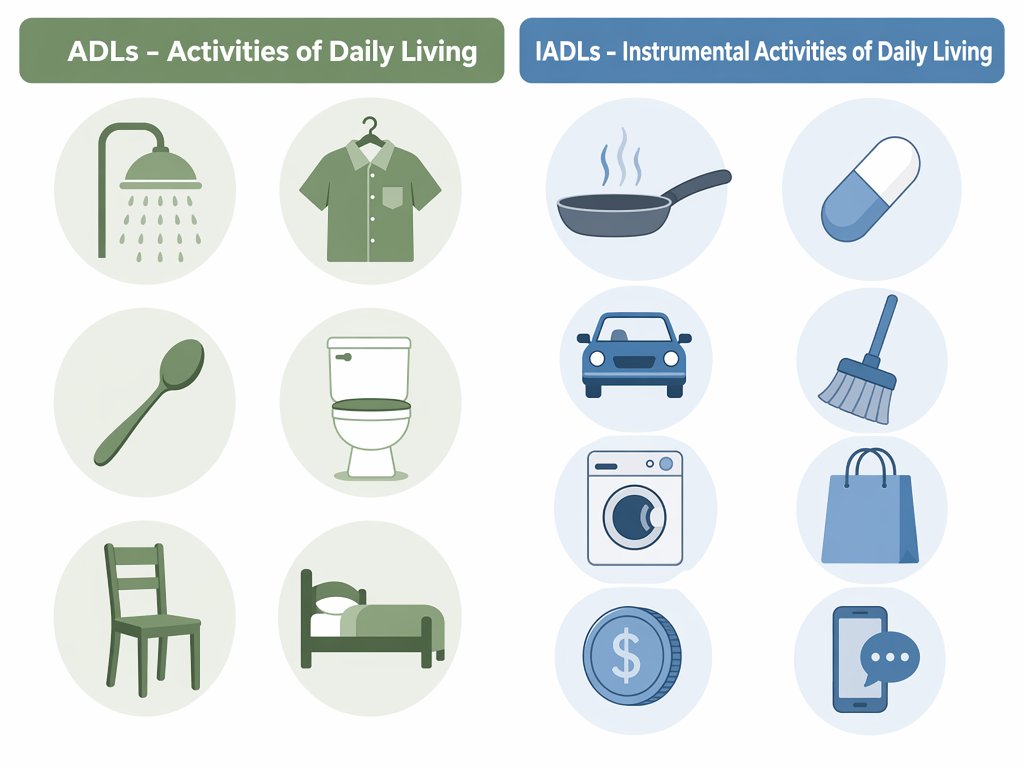
ADLs are the fundamental self-care tasks that a person must be able to perform to live independently. The six standard ADLs are:
- Bathing and showering
- Dressing and undressing
- Eating and feeding oneself
- Toileting and maintaining continence
- Transferring (moving between bed, chair, and standing position)
- Walking or moving around the home
IADLs are more complex tasks that require higher-level cognitive and organizational skills. They include:
- Meal preparation and planning
- Medication management (remembering doses and timing)
- Transportation and running errands
- Housekeeping and home maintenance
- Laundry and clothing care
- Shopping for groceries and necessities
- Managing finances and paying bills
- Using the telephone or communication devices
To perform a basic assessment, go through each ADL and IADL and ask: can this person do this task independently? Do they need supervision or reminders? Do they need hands-on physical assistance? Or are they completely unable to do it? The pattern of answers will point you toward the appropriate service type. For example, a senior who needs help only with IADLs (meal preparation, transportation, housekeeping) may need only companion care or homemaker services. A senior who needs help with two or more ADLs (bathing, dressing, toileting) likely needs personal care services. A senior who has a recent hospital discharge and needs wound care or physical therapy needs home health care.
For a complete explanation of the ADL assessment and how to use it in care planning, see our ADL glossary entry.
2026 Cost Breakdown by Service Type
Cost is often the first question families ask, and for good reason. In-home care represents a significant and ongoing financial commitment. The following data draws from multiple 2026 sources to give you a realistic picture of what you can expect to pay.
| Weekly Hours | Monthly Cost at $30/hour | Monthly Cost at $34/hour (National Median) | Monthly Cost at $44/hour (High-Cost State) |
|---|---|---|---|
| 7 hours/week | $910 | $1,031 | $1,336 |
| 15 hours/week | $1,950 | $2,208 | $2,860 |
| 30 hours/week | $3,900 | $4,416 | $5,720 |
| 44 hours/week | $5,700 | $6,478 | $8,392 |
The national median cost for non-medical home care in 2026 is $34 per hour, according to the A Place for Mom 2026 Costs of Long-Term Care and Senior Living Report. State-level medians range from $25 per hour in Mississippi to $44 per hour in South Dakota. CareScout's 2025 Cost of Care Survey, cited in the U.S. News guide, reports a slightly higher national median of $35 per hour for non-medical care. Senioridy's 2026 guide reports a range of $30 to $35 per hour. The variation across sources is small and reflects differences in survey methodology and geographic weighting.
For home health care (skilled nursing), the cost is substantially higher. CareScout reports a national median of $90 per hour for a private duty nurse. However, because home health care is often covered by Medicare, the out-of-pocket cost for eligible patients can be $0 for covered services.
For a comprehensive look at how to pay for these services — including long-term care insurance, VA benefits, Medicaid HCBS waivers, and other funding sources — see our separate guide on how to pay for in-home care in 2026. That article covers the funding landscape in depth; this guide will not replicate that content.
Medicare Coverage Realities: What It Pays For and What It Doesn't
Medicare's home health benefit is one of the most misunderstood aspects of in-home care. Many families assume that Medicare will pay for a home health aide to help their parent with bathing, dressing, and meals. In reality, Medicare's coverage is narrow and conditional.
According to Medicare.gov, Medicare Part A and Part B cover home health services only when all of the following conditions are met:
- The patient is homebound, meaning leaving home requires considerable effort and is generally not recommended.
- The patient needs part-time or intermittent skilled nursing care, physical therapy, occupational therapy, or speech therapy.
- The care is ordered by a physician and provided by a Medicare-certified home health agency.
- The patient is under a physician's plan of care that is reviewed regularly.
When these conditions are met, Medicare covers skilled nursing care, therapy services, medical social services, and — critically — home health aide care. The home health aide can provide hands-on personal care (bathing, grooming, toileting, feeding), but only when skilled care is also being provided. Medicare does not cover home health aide care as a standalone service.
The Center for Medicare Advocacy provides an important clarification: Medicare coverage should not be denied simply because a patient's condition is chronic, stable, or unlikely to improve. Restorative potential is not required. Medicare coverage is available to maintain an individual's condition or slow deterioration. There is no legal limit to the duration of the Medicare home health benefit, and the center advises against accepting arbitrary caps such as "aide services in excess of one visit per day are not covered."
A recent policy development worth noting: the U.S. News guide, dated May 5, 2026, references a May 13, 2026 CMS freeze on new home health enrollments. If you are reading this after that date, verify the current status of this policy with your local Medicare-certified agency, as it may affect the availability of new home health providers in your area.
Decision Framework: Matching Care Level to Service Type
The following decision framework is designed to help you move from assessment to action. It uses the ADL/IADL assessment as its starting point and branches based on medical needs, hours of care required, budget, and caregiver availability.
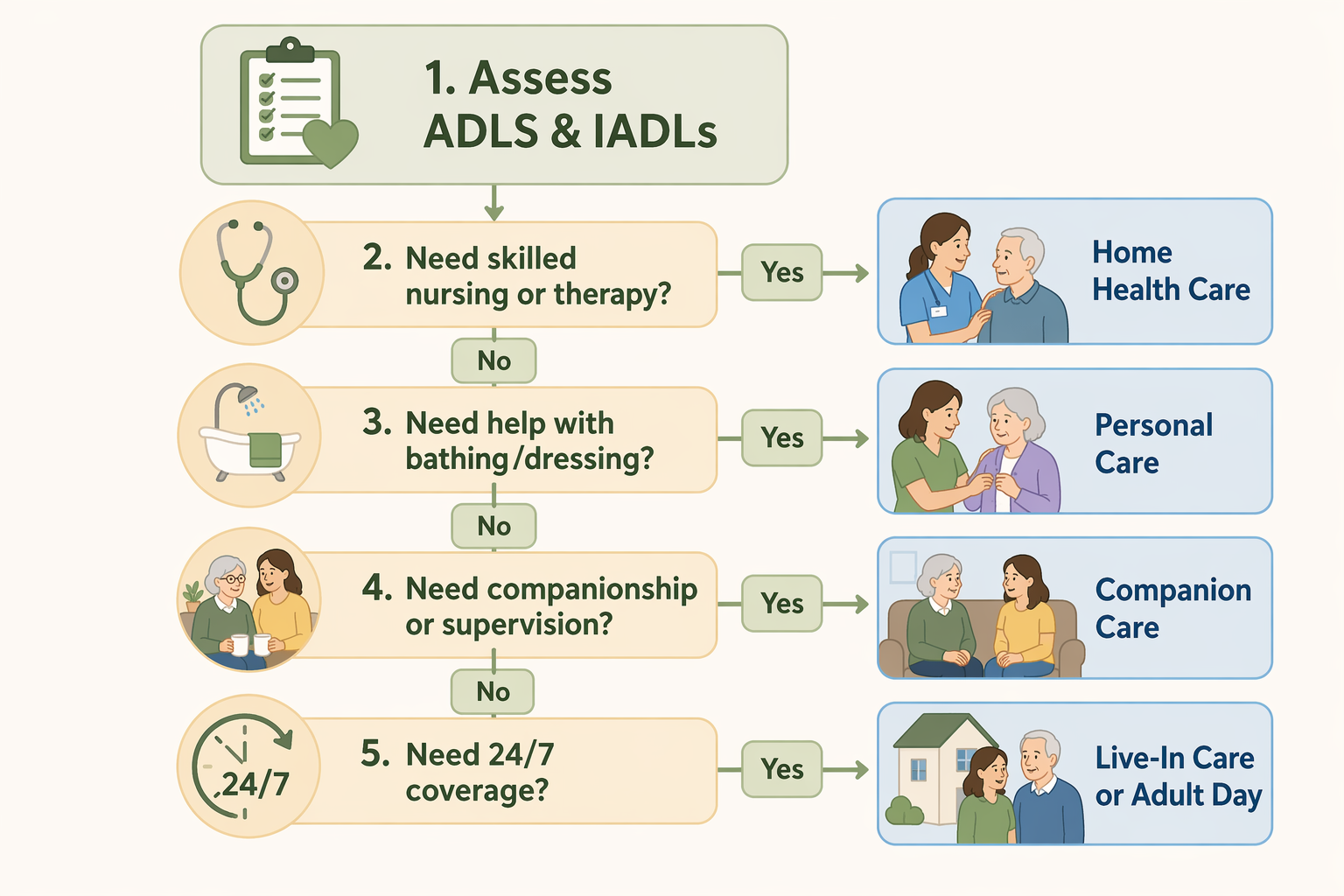
Start with the ADL/IADL assessment. Then ask these four questions in order:
- Does my loved one need skilled medical care (wound care, injections, therapy, medication management by a nurse)? If yes, start with home health care. Contact a Medicare-certified home health agency and have the physician order an evaluation. If no, proceed to question 2.
- Does my loved one need hands-on help with two or more ADLs (bathing, dressing, toileting, transferring)? If yes, personal care services are likely needed. If no, proceed to question 3.
- Does my loved one need help only with IADLs (meal preparation, housekeeping, transportation, medication reminders)? If yes, companion care or homemaker services may be sufficient. If no, proceed to question 4.
- Does my loved one need supervision or care throughout the day and night? If yes, consider live-in care or, if daytime only, adult day care combined with family care in the evenings. If the need is for fewer than 40 hours per week, home care is likely more affordable than assisted living.
This framework is a starting point, not a substitute for a professional assessment. An occupational therapist or geriatric care manager can provide a more detailed evaluation and recommend specific services. The Family Caregiver Alliance notes that geriatric care managers charge $75 to $150 per hour and can be located through the Aging Life Care Association.
| Assessment Result | Likely Service Type(s) | Typical Weekly Hours | Estimated Monthly Cost (National Median) |
|---|---|---|---|
| IADL help only (no ADL deficits) | Companion care or homemaker services | 7–15 hours/week | $1,031–$2,208 |
| 1–2 ADL deficits (e.g., bathing, dressing) | Personal care | 15–30 hours/week | $2,208–$4,416 |
| 3+ ADL deficits or frequent needs | Personal care, possibly live-in care | 30–44+ hours/week | $4,416–$6,478+ |
| Recent hospitalization, needs skilled care | Home health care (medical) | Varies; typically intermittent | Often covered by Medicare |
| Terminal illness, comfort-focused care | Hospice care at home | As needed | Comprehensive Medicare coverage |
Where to Start: Next Steps for Family Caregivers
If you have read this far, you are already ahead of most families. You now understand the full menu of in-home care options, the critical distinction between home care and home health care, how to assess your loved one's needs using the ADL/IADL framework, the 2026 cost landscape, and how Medicare fits into the picture. Here are the concrete next steps to take:
- Conduct an ADL/IADL assessment. Use the lists in section four of this guide. Write down which tasks your loved one can do independently, which they need help with, and which they cannot do at all. This will be your reference document for every conversation with providers.
- Talk to the primary care physician. Ask for a referral to home health care if skilled services are needed. Even if skilled care is not needed, the physician can provide documentation of the senior's functional limitations, which may be required for Medicaid waivers or long-term care insurance claims.
- Contact your local Area Agency on Aging. Use the Eldercare Locator (800-677-1116) to find your local office. Area Agencies on Aging provide free information and referral services, including lists of licensed home care agencies, adult day care centers, and respite care programs.
- Explore funding sources. Review our guide on how to pay for in-home care in 2026 for a detailed look at long-term care insurance, VA Aid & Attendance benefits, Medicaid HCBS waivers, and other options. Do not assume you must pay entirely out of pocket.
- Decide between an agency and an independent caregiver. Agencies handle screening, training, insurance, and backup coverage, but they charge 20% to 30% more than independent caregivers, according to Senioridy. Independent caregivers are less expensive but require you to handle payroll taxes, background checks, and backup coverage. There is no single right answer; the choice depends on your risk tolerance and administrative capacity.
- Interview providers with a structured list of questions. Ask about caregiver training and screening, what happens if the regular caregiver is sick, how the agency handles medication management, and whether they have experience with your loved one's specific condition (dementia, mobility limitations, etc.). The Alzheimer's Association recommends conducting interviews at home and sharing personal facts about the person to build a bond with potential caregivers.
Building a sustainable in-home care plan is a process, not a single decision. Needs will change over time, and the service types you choose today may need to be adjusted in six months or a year. The key is to start with a clear understanding of the full menu of options, an honest assessment of your loved one's needs, and a realistic picture of the costs involved. This guide is designed to be a reference you can return to as those needs evolve.
Questions to bring to a clinician or OT
This is not medical, legal, or a family's final decision — only a framework. Bring these questions to a clinician, occupational therapist, or your local Area Agency on Aging.
Find Local HelpRelated reading
Noticed something outdated or inaccurate on this page? Flag a correction. We review every report against CDC, NIA, and AARP HomeFit guidance before updating a page.