
How to Pay for In-Home Care in 2026: 7 Funding Sources Families Need to Know
In-home care costs $30–$35/hour nationally, but most seniors have only $2,000–$4,000/month in Social Security. This guide maps seven funding sources — private pay, VA Aid & Attendance, Medicaid HCBS waivers, long-term care insurance, Medicare home health, life insurance living benefits, and reverse mortgages — with 2026 eligibility, benefit amounts, and a layered payment strategy for adult children managing caregiving finances.

The Cost Reality: What Families Are Up Against in 2026
The first question most adult children ask after realizing a parent needs help at home is also the hardest: "How are we going to pay for this?" The answer starts with a number that often lands like a punch to the gut.
In 2026, the national median cost for private nonmedical in-home care is $34 per hour, according to data from A Place for Mom's 2026 Costs of Long-Term Care Report. SeniorLiving.org, using CareScout data, puts the median at $35 per hour. Both sources agree on the range: state medians vary from roughly $25 per hour in Mississippi to $44 per hour in South Dakota and Washington.
To make these hourly rates concrete, here is what they translate to at different levels of weekly care:
| Weekly Hours | Care Scenario | Monthly Cost at $34/hr |
|---|---|---|
| 7 hours/week | Occasional companionship, light housekeeping, or meal prep | $1,031/month |
| 15 hours/week | Regular assistance with bathing, dressing, and medication reminders | $2,208/month |
| 30 hours/week | Daily support for multiple ADLs, some overnight coverage | $4,416/month |
| 44 hours/week | Extensive care, near full-time coverage during waking hours | $6,478/month |
There is also a significant markup to consider if you use an agency rather than hiring an independent caregiver directly. Agencies typically charge 20 to 30 percent more than independent providers. That premium buys background checks, training, worker's compensation insurance, and backup coverage when the regular aide is unavailable — protections that many families find worth the cost, especially when care needs are complex.
The Income Gap: Why Most Seniors Can't Afford Care on Their Own
Now compare those costs to the income most older adults actually have. The average Social Security benefit in 2026 is roughly $1,500 to $2,500 per month. Add a small pension or part-time work, and a typical senior household might bring in $2,000 to $4,000 per month total.
Do the math: even 15 hours per week of care at $34/hour costs $2,208 per month — more than many seniors receive from Social Security alone. At 30 hours per week, the monthly cost of $4,416 exceeds the total income of most older adults. The gap between what care costs and what a parent can afford is often $3,000 to $5,000 per month or more.
7 Funding Sources for In-Home Care in 2026
The following seven funding sources represent the full landscape of options available to American families in 2026. No single source covers everything for everyone. The key is understanding which ones apply to your parent's situation and how to combine them into a workable monthly budget.
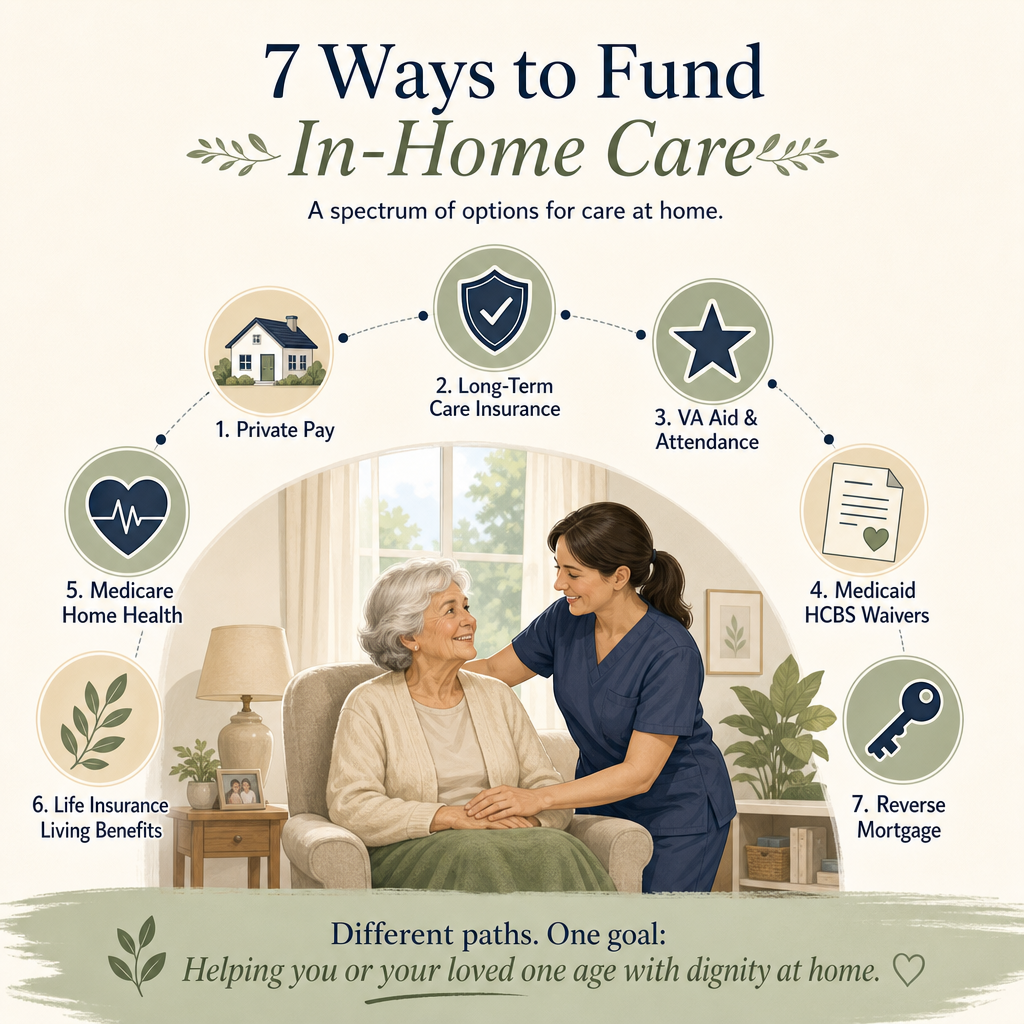
1. Private Pay (Out-of-Pocket)
Private pay is simply paying for care from personal savings, retirement accounts, or family contributions. It is the most common funding source — at least initially — because it requires no applications, no eligibility determinations, and no waiting periods.
For many families, private pay covers the first few months of care while applications for other funding sources are being processed. The challenge is sustainability: at $5,700 to $6,500 per month for extensive care, even a modest nest egg can be depleted within a year or two.
2. VA Aid & Attendance
The VA Aid & Attendance pension is one of the most valuable — and most underutilized — funding sources for in-home care. It provides tax-free monthly payments to qualifying veterans and their surviving spouses who need assistance with daily activities.
| Recipient | Maximum Monthly Benefit (2026) |
|---|---|
| Veteran with a spouse | $2,295/month |
| Veteran alone | $1,936/month |
| Surviving spouse | $1,244/month |
Eligibility requires 90 or more days of active duty with at least one day during a wartime period. The veteran does not need to have been injured in combat — peacetime service does not qualify, but service during the Vietnam War, Gulf War, or other designated periods does.
VA benefits can be used to pay for home care aides, adult day care, and even some home modifications. For more on using VA benefits for structural changes, see our guide on Funding Sources for Home Modifications.
3. Medicaid HCBS Waivers
Medicaid's Home and Community-Based Services (HCBS) waivers are the primary public funding source for long-term personal care at home. Unlike Medicare, Medicaid covers custodial care — help with bathing, dressing, eating, toileting, and other activities of daily living.
Coverage varies significantly by state, but typical HCBS waivers authorize 20 to 40 hours per week of personal care, with up to 84 hours per week available for individuals with intensive needs. Financial eligibility is strict: most states require income under roughly $2,500 per month and assets below $2,000 to $2,500 (excluding the primary home and one vehicle).
Because HCBS waivers are state-administered, the first step is to contact your state's Medicaid office or local Area Agency on Aging. They can tell you whether your state offers a waiver program, what the current wait time is, and what documentation you will need.
4. Long-Term Care Insurance
Long-term care insurance (LTCI) policies are designed specifically to cover the cost of custodial care, including in-home aides. A typical policy purchased in recent years pays $100 to $250 per day, which translates to $3,000 to $7,500 per month — enough to cover a substantial portion of in-home care costs.
Benefits are triggered when the policyholder needs help with two or more activities of daily living (ADLs) — typically bathing, dressing, eating, toileting, transferring, and continence — or has a cognitive impairment like dementia. Most policies have an elimination period of 30 to 90 days, meaning the policyholder must pay out-of-pocket for that initial period before benefits begin.
If your parent has an existing LTCI policy, locate it now and review the benefit amount, elimination period, and benefit period (how many years it pays). Filing a claim requires a physician's certification of functional need and often a care plan from a home health agency. For help understanding ADL decline and when it triggers insurance eligibility, see our ADL and IADL Decline Timeline.
5. Medicare Home Health (Skilled Care Only)
Medicare is often the first thing families think of when they need help paying for care — and it is also the most misunderstood. Original Medicare (Part A and Part B) covers skilled home health services at 100 percent for homebound patients: nursing care, physical therapy, occupational therapy, and speech-language pathology. It does not cover custodial or personal care — bathing, dressing, meals, companionship, or homemaker services — as stand-alone services.
Medicare Advantage (Part C) plans may offer additional home care benefits beyond Original Medicare, but coverage varies widely by plan and county. If your parent has a Medicare Advantage plan, call the plan directly and ask specifically about in-home support services — do not assume they are covered.
6. Life Insurance Living Benefits
A life insurance policy does not have to be held until death. Many policies include living benefits that allow the policyholder to access a portion of the death benefit while still alive to pay for long-term care. There are three main mechanisms:
- Accelerated death benefits: Many policies include a rider that lets the policyholder draw down the death benefit tax-free if they are diagnosed with a chronic or terminal illness. This is the simplest option — no sale of the policy is required.
- Cash value loans: For permanent life insurance policies (whole life, universal life), the policyholder can borrow against the accumulated cash value. The loan does not need to be repaid, but it reduces the death benefit.
- Viatical settlements: The policyholder sells the policy to a third party for a lump sum — typically 50 to 80 percent of the face value. This is a more drastic option and may have tax implications.
If your parent has a life insurance policy they no longer need for beneficiary protection, converting it into a living benefit can provide a significant lump sum to fund months or years of in-home care.
7. Reverse Mortgages
A reverse mortgage allows homeowners aged 62 and older to convert a portion of their home equity into tax-free cash without selling the home or making monthly mortgage payments. The loan is repaid when the homeowner moves out permanently, sells the home, or passes away.
The amount available depends on the homeowner's age, the home's value, and current interest rates — typically 40 to 75 percent of the home's equity. For a home worth $300,000, that could mean $120,000 to $225,000 in available funds — enough to cover several years of part-time in-home care.
Medicare's Limited Role: Skilled Care Only — Not Custodial Care
Because Medicare confusion is so common — and so costly — it deserves its own section. When a parent is discharged from the hospital after a fall or surgery, Medicare will cover home health services if the patient is homebound and needs skilled nursing or therapy. That coverage includes a home health aide for a limited time, but only as part of the skilled care plan, not as a stand-alone service.
Once the skilled need ends — the wound heals, the patient reaches their therapy goals — Medicare stops paying for the aide. The family is then left with a parent who still needs help bathing, dressing, and managing meals, but no insurance coverage for those services.
Medicaid HCBS Waivers: State-by-State Availability and Eligibility
Medicaid HCBS waivers are the most important public funding source for long-term in-home care, but they are also the most variable. Because each state administers its own Medicaid program, eligibility criteria, covered services, and wait times differ dramatically.
In states with robust HCBS waiver programs, a senior who qualifies can receive 20 to 40 hours per week of in-home personal care, with up to 84 hours per week for those with intensive needs. Services typically include:
- Personal care assistance (bathing, dressing, grooming, toileting)
- Homemaker services (light housekeeping, laundry, meal preparation)
- Respite care for family caregivers
- Adult day health services
- Case management and care coordination
Financial eligibility is strict. Most states require:
- Income under roughly $2,500 per month (varies by state; some have higher thresholds)
- Assets under $2,000 to $2,500 (excluding the primary home, one vehicle, and certain personal belongings)
- A documented need for a nursing-home level of care (assessed by the state)
VA Aid & Attendance: Who Qualifies and How Much It Pays in 2026
The VA Aid & Attendance pension is a cash benefit — not a reimbursement — that veterans and surviving spouses can use to pay for any type of care, including in-home aides, adult day care, assisted living, or nursing home care. The money is paid directly to the veteran or spouse and can be used flexibly.
To qualify, the applicant must:
- Have 90 or more days of active military service, with at least one day during a wartime period
- Have an honorable discharge (other than dishonorable)
- Need assistance with daily activities (bathing, dressing, eating, toileting, or mobility) OR be bedridden OR be a patient in a nursing home OR have significantly reduced eyesight
- Meet income and asset limits (though medical expenses can reduce countable income)
| Recipient Category | 2026 Maximum Monthly Benefit |
|---|---|
| Veteran with a spouse | $2,295/month |
| Veteran alone | $1,936/month |
| Surviving spouse | $1,244/month |
VA benefits can also be used for home modifications. For details on using VA grants for grab bars, ramps, and bathroom renovations, see our Funding Sources for Home Modifications guide.
Long-Term Care Insurance: Benefits, Elimination Periods, and How to File
Long-term care insurance is designed to fill the gap that Medicare leaves open: custodial care at home. If your parent purchased a policy years ago — and many did during the 1990s and 2000s — it may be the single most valuable asset they have for funding in-home care.
Typical policy benefits range from $100 to $250 per day, which translates to $3,000 to $7,500 per month. Most policies have a benefit period of 2 to 5 years, though some offer lifetime coverage. The elimination period — the number of days the policyholder must pay out-of-pocket before benefits kick in — is typically 30 to 90 days.
To file a claim, you will need:
- A physician's certification that the policyholder needs help with 2+ ADLs or has a cognitive impairment
- A care plan from a licensed home health agency or care manager
- Receipts and invoices for care services provided
- The original policy documents (or a copy from the insurance company)
Creating a Layered Payment Strategy: A Decision Framework for Families
Very few families rely on a single funding source. The most successful approach is a layered strategy that combines two or more sources to cover the monthly gap between care costs and the senior's income.
Here is a decision framework to help you identify which sources apply to your parent's situation:
| If Your Parent... | Start With These Sources | Then Layer With... |
|---|---|---|
| Is a veteran or surviving spouse | VA Aid & Attendance (apply immediately — 3-12 month wait) | Private pay during the application period; Medicaid if eligible |
| Has low income and few assets | Medicaid HCBS waiver (apply immediately — 6 month to 3 year wait) | Private pay or family contributions during the wait; VA if veteran |
| Has a long-term care insurance policy | LTCI claim (file as soon as 2+ ADL help is needed) | Private pay during the elimination period; Medicare for skilled needs |
| Owns a home with significant equity | Reverse mortgage (after counseling; consult an elder law attorney) | Private pay or LTCI for ongoing care costs |
| Has a life insurance policy they no longer need for beneficiaries | Living benefits (accelerated death benefit or cash value loan) | Any other source — living benefits provide a lump sum, not monthly income |
| Has moderate savings but no insurance or VA eligibility | Private pay (budget carefully — track depletion rate) | Medicaid planning (consult an elder law attorney to protect assets) |
A concrete example: A 78-year-old widow with $2,000/month in Social Security, $50,000 in savings, and a home worth $250,000 needs 20 hours/week of in-home care costing $2,720/month. Her income covers only $2,000. The gap is $720/month. She applies for a Medicaid HCBS waiver (12-month wait in her state) and uses her savings to cover the gap during the wait. Once the waiver is approved, it covers the full cost of care, and her savings remain intact.
Tax Considerations: Medical Deductions and Other Savings
One often-overlooked way to reduce the net cost of in-home care is the medical expense tax deduction. If your parent itemizes deductions on their federal tax return, they may deduct qualified medical expenses that exceed 7.5 percent of their adjusted gross income (AGI). In-home care costs — including payments to home health aides, homemaker services, and even some personal care assistants — generally qualify as deductible medical expenses.
For example, if your parent has an AGI of $30,000, the 7.5 percent threshold is $2,250. If they paid $25,000 for in-home care during the year, they could deduct $22,750 ($25,000 minus $2,250). At a 22 percent marginal tax rate, that deduction would save roughly $5,000 in federal taxes.
Other tax-advantaged strategies that may help include using a Health Savings Account (HSA) if your parent is still working and has a high-deductible health plan, or setting up a Qualified Income Trust (also called a Miller Trust) to help meet Medicaid income limits while preserving access to HCBS waivers. These strategies require professional guidance.
Related reading
- Does Medicare Cover Companion Care? A Family Guide to Paying for Elder Companion Services
- How to Pay for Elderly Home Care: Medicare, Medicaid, VA Benefits, and Out-of-Pocket Options Explained
- The Hidden Economics of Long-Term Care: What Families Don't Know About Costs, Coverage, and Financial Risk Until It's Too Late
Noticed something outdated or inaccurate on this page? Flag a correction. We review every report against CDC, NIA, and AARP HomeFit guidance before updating a page.
Part of the Fall Prevention section.