A Caregiver's Observation Checklist for Dementia Driving Warning Signs
Reviewed: 2026-07-05
A Caregiver's Observation Checklist for Dementia Driving Warning Signs
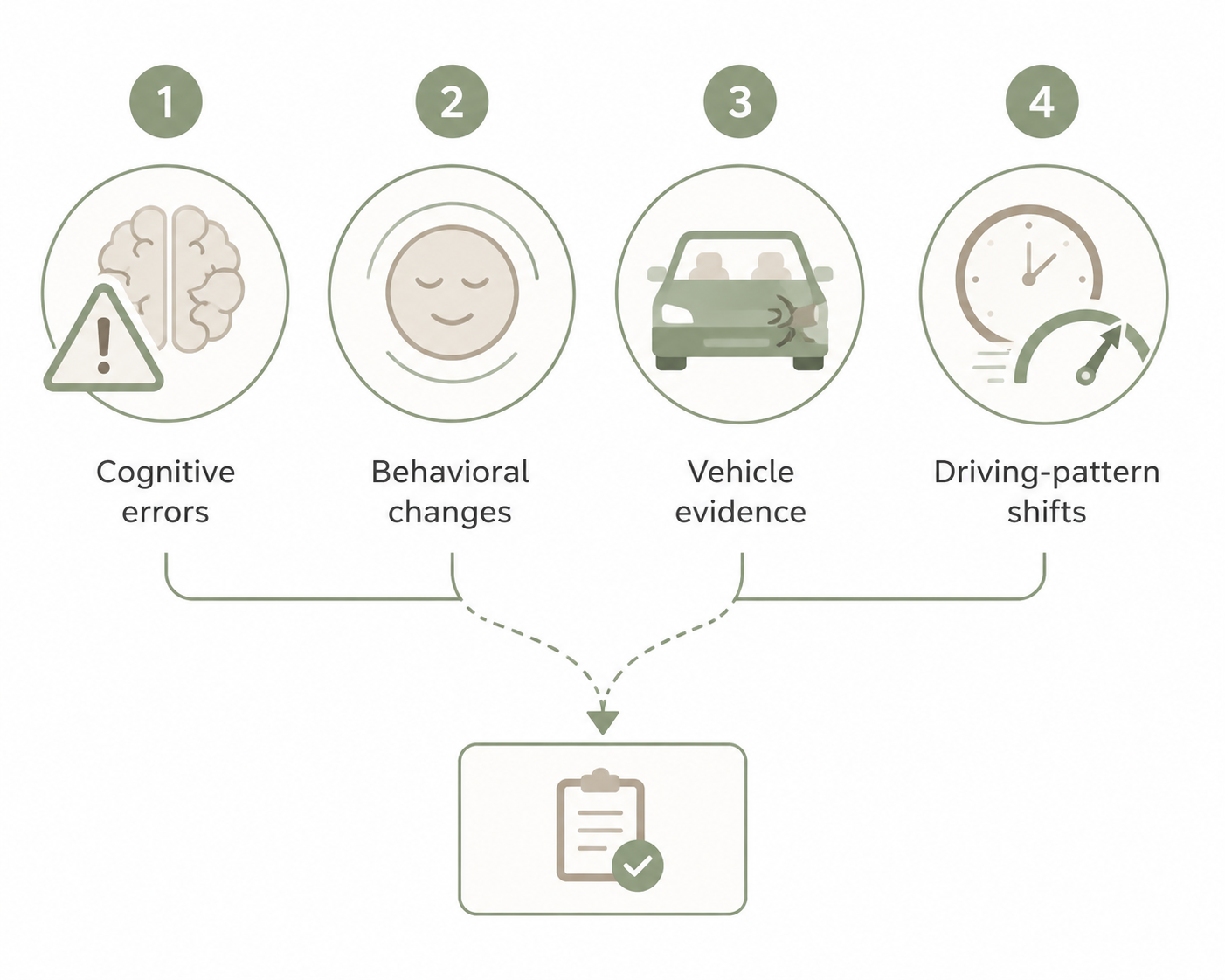
This structured checklist helps family caregivers recognize specific, observable warning signs of unsafe driving in a person with dementia, organized by cognitive errors, behavioral changes, vehicle evidence, and driving-pattern shifts, so they can document concerns with concrete evidence before having a difficult conversation.
By Editorial Team
new caregiver
experienced caregiver
long-distance caregiving
spousal caregiver
working caregiver
daily routines
medication management
personal hygiene
care coordination
first steps
ADLs
IADLs
The first useful question is not, “Should Mom stop driving today?” It is, “What exactly have we seen?” With dementia and driving safety, vague worry needs to become dated, described observations: the missed turn, the scrape on the garage post, the two-hour errand that used to take twenty minutes, the anger that appears only when traffic gets complicated.
A caregiver’s checklist matters because the driver’s own reassurance is not reliable enough to settle the question. The American Academy of Neurology rates patient self-rating of driving ability as not useful, with Level A evidence, while caregiver rating has Level B support.[1] That does not mean every worried child is automatically right. It means the family has to watch carefully, write down what happens, and look for a pattern the physician or driving specialist can actually use.
Use this threshold: if you observe two or more warning signs across different domains, request a formal driving evaluation. One odd incident may have another explanation. A repeated pattern, especially across more than one kind of evidence, deserves action.
The Four Domains To Watch
The National Institute on Aging lists warning signs such as getting lost on familiar routes, confusing the gas and brake pedals, making lane-control errors, receiving traffic tickets, driving at inappropriate speeds, and finding new dents or scrapes on the car.[2] Those signs become easier to use when they are sorted into four observable domains.
Domain
What you are looking for
Why it matters
Cognitive errors
Lost routes, missed signs, pedal confusion, poor lane control, trouble following a normal driving sequence
These often show that the task of driving is becoming too complex to manage safely
Behavioral changes
New anger, confusion, nervousness, panic, or defensiveness during or after driving
These can signal that the driver is overwhelmed, especially when paired with concrete road events
Vehicle evidence
New dents, scrapes, near misses, traffic tickets, unexplained repairs, mailbox or garage damage
These signs may appear even when no one was in the passenger seat
Driving-pattern shifts
Driving too slowly or too fast, avoiding ordinary routes, taking unusually long for short errands
These show how the person’s real-world driving routine is changing
Do not give all four domains equal weight in your own mind. Cognitive errors usually need the closest attention because they are easy to excuse one by one and dangerous when they repeat. Vehicle evidence and pattern shifts are especially helpful when the older adult still drives alone. Behavioral changes matter, but irritability by itself does not prove unsafe driving.
Cognitive Errors: The Signs Families Often Struggle To Name
Driving depends on memory, attention, judgment, sequencing, and quick correction. Dementia can disturb those abilities unevenly. A parent may still chat pleasantly at the table and still become unsafe when a light changes, a lane narrows, or an unfamiliar detour appears.
Getting lost on familiar routes, including routes to the grocery store, pharmacy, church, a sibling’s house, or a long-used doctor’s office.
Missing stop signs, traffic lights, lane markings, crosswalks, or turn-only signs.
Confusing the gas and brake pedals, braking suddenly without a clear reason, or accelerating when trying to stop.
Drifting across lanes, hugging the curb, clipping corners, or needing repeated reminders to stay centered.
Having trouble with ordinary driving sequences, such as backing out, checking mirrors, signaling, merging, parking, or responding to a four-way stop.
Making turns from the wrong lane, hesitating in the middle of an intersection, or stopping where traffic does not expect a stop.
The most helpful notes describe the exact driving task that broke down. “Dad seemed confused” is weaker than “Dad stopped at a green light on Maple and waited until the car behind honked.” “Mom is getting worse” is weaker than “Mom missed the same left turn to the pharmacy twice this month, then said the road looked different.”
Also watch for errors that happen after a change in routine. A person with dementia may manage a short, rehearsed route on a quiet morning but become unsafe when rain, construction, glare, heavier traffic, or a passenger’s conversation adds one more demand. That does not make the concern less real. It tells you when the driving system is beginning to fail.
Behavioral Changes: Record What Happens Around The Emotion
Anger, nervousness, and defensiveness belong on the checklist, but they should not be treated as stand-alone proof. Many older adults become upset when driving is questioned because driving represents privacy, usefulness, adulthood, and control. The Alzheimer’s Association notes that stopping driving may increase the risk of depression and social isolation, so families should not treat this as a small loss.[3]
Still, behavior during driving can reveal overload. Write down the driving event attached to the reaction.
Anger after a passenger points out a missed sign, drifting lane, or wrong turn.
Confusion when choosing between lanes, exits, parking spaces, or turn options.
New nervousness on routes the person used to drive comfortably.
Startling easily at normal traffic sounds, pedestrians, cyclists, or cars merging nearby.
Insisting nothing happened after a passenger, neighbor, or other driver describes a near miss.
The goal is not to diagnose personality. It is to capture whether the emotional change appears alongside driving demands the person used to manage.
Vehicle Evidence: What Shows Up When No One Was In The Car
Some of the clearest warning signs are sitting in the driveway. New dents, scrapes, damaged mirrors, bent license plates, and garage or mailbox marks are part of the NIA’s warning-sign guidance, especially when the driver cannot clearly explain what happened.[2]
New scratches along the side of the vehicle, especially at garage-door or parking-lot height.
Repeated tire, rim, mirror, bumper, or fender damage.
Reports from neighbors, store staff, relatives, or parking-lot witnesses about close calls.
Traffic tickets, warnings, or notices for red lights, stop signs, speeding, unsafe turns, or lane violations.
Unexplained repairs, insurance claims, or reluctance to say where the car was damaged.
If possible, photograph damage with the date and note where the car was parked or driven that day. Avoid turning the inspection into an interrogation. “I’m writing this down so we can talk clearly with the doctor” is less inflammatory than “You hit something again.”
Driving-Pattern Shifts: The Errand Tells Its Own Story
A change in driving pattern can be just as important as a single road error. Families often notice these signs before they know what to call them: a short errand takes much longer, the driver returns shaken, or a once-routine route is suddenly avoided.
Driving much too slowly for road conditions or much too fast for traffic, weather, or neighborhood streets.
Taking unusually long to complete short, familiar errands.
Avoiding left turns, highways, night driving, busy intersections, parking garages, or certain neighborhoods without a clear physical reason.
Returning from errands without completing them, buying the wrong items, or being unable to explain where the time went.
Restricting driving to a tiny set of routes while insisting overall driving ability has not changed.
Reduced driving can lower exposure to crashes, so fewer crashes do not automatically mean the person is safe. If a diagnosed driver appears to have fewer crashes because they now drive far fewer miles, that is not the same as preserved driving ability.
A Simple Observation Log That Physicians Can Use
The observation log is the bridge between private family concern and a physician-supported conversation. It also helps siblings stop arguing from impressions. One person may remember the angry exchange. Another may remember the scrape. The log lets everyone see whether the incidents belong to the same pattern.
Field
What to write
Date and time
When the incident happened or when evidence was found
Location
Street, parking lot, driveway, route, intersection, or destination
Observer
Who saw it, heard about it, found the damage, or received the call
What happened
A plain description of the action, not a conclusion about character
Domain
Cognitive error, behavioral change, vehicle evidence, or driving-pattern shift
Repeat?
Whether this is the first time, a repeated sign, or part of a recent cluster
Photo taken, physician called, family notified, ride arranged, evaluation requested
A useful entry sounds like this: “June 14, 3:30 p.m., Oak Street and Fifth. I was in the passenger seat. Mom rolled through the stop sign, then seemed surprised when I mentioned it. Cognitive error. Similar missed stop noted by neighbor last month. No collision.”
A less useful entry sounds like this: “Mom is unsafe and stubborn.” It may be emotionally true in the moment, but it gives the physician nothing specific to work with and gives the rest of the family plenty to argue about.
How often to recheck
If the person with dementia continues driving, the Family Caregiver Alliance recommends re-evaluation every six months.[4] That schedule is not permission to ignore a serious near miss until the calendar says it is time. It is a reminder that dementia changes, and a decision that seemed workable in spring may not hold through winter.
When The Checklist Should Trigger A Formal Evaluation
Ask for a formal driving evaluation when you have two or more warning signs across different domains. For example, a new garage scrape plus getting lost on a familiar route is stronger evidence than one scratch alone. A missed stop sign plus angry denial plus an unusually long errand gives the physician a clearer picture than “He says he is fine, but I’m worried.”
The American Academy of Neurology has recommended that people with mild dementia strongly consider discontinuing driving, a point Mayo Clinic has highlighted in caregiver-facing guidance.[5] That recommendation does not mean a brief memory screen by itself can decide driving fitness. Driving is a functional task. It requires performance evidence, caregiver observations, medical judgment, and, when appropriate, a specialized driving evaluation.
A standard DMV road test is also not the same as a complete answer. Neurology Advisor summarizes evidence that standard DMV tests can under-identify impaired drivers because they occur under controlled conditions.[6] A clean test result may be reassuring in one narrow setting, but it should be weighed against real-world incidents, especially those that happen on familiar roads or under ordinary daily stress.
What To Say When You Bring The Log Forward
This article is not the whole driving-cessation conversation. That conversation needs planning, alternatives, and respect for the loss involved. For the first step, keep the message narrow: “We have noticed several specific driving changes, and we need help deciding what is safe.”
Bring the log to the primary care physician, neurologist, geriatrician, or memory-care clinician. Ask whether the person should be referred for a formal driving evaluation and whether any medical, medication, vision, or functional issues need review. If there has been a crash, near miss, police contact, or repeated route confusion, say that plainly.
State reporting laws vary widely. Some states require certain clinicians to report medical conditions that may impair driving; others do not. Caregivers should verify their own state’s requirements rather than assuming one national rule applies.
The checklist is not a weapon to use against a parent. It is a way to protect everyone from making a high-stakes decision by denial, panic, or family vote. Once the pattern is written down, the next step becomes clearer: request a formal driving evaluation and begin the family-and-physician conversation with evidence instead of accusation.


Comments
Join the discussion with an anonymous comment.