
Caregiver decision guide
The Complete Guide to Home Helps for the Elderly: Services, Modifications, Technology, and Funding
This guide provides a comprehensive, layered overview of home helps for aging parents who want to age in place. It covers in-home care services, home modifications, assistive technology, support services, and funding options — helping adult children understand the full landscape before a crisis forces reactive decisions.
Introduction: Why a Layered Approach to Home Helps Matters
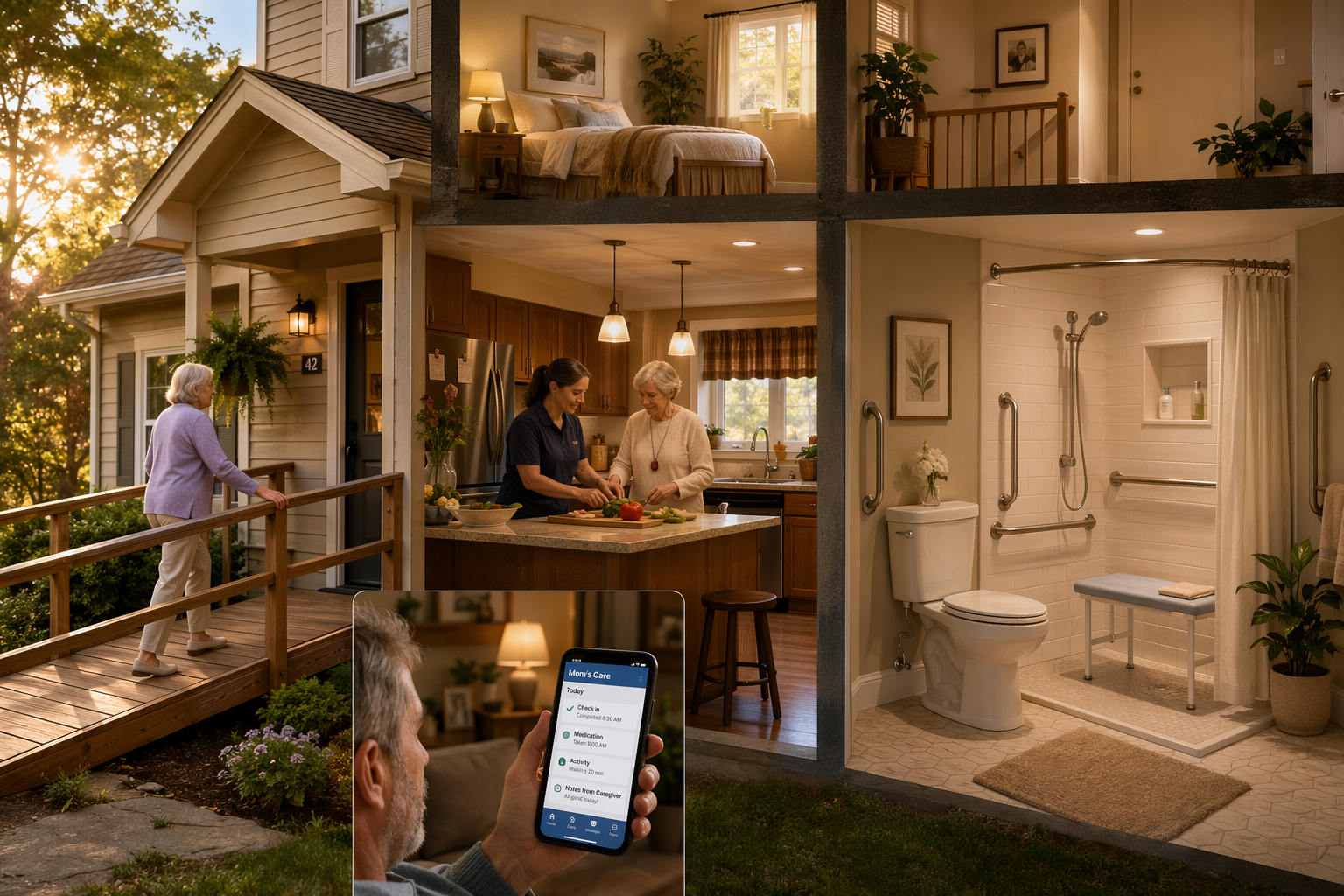
When an aging parent wants to remain at home, the term "home helps" can mean anything from a weekly grocery delivery to a full-time skilled nurse. The challenge for most families is not a lack of options — it is knowing which combination of services, modifications, technology, and funding sources actually works for their specific situation. Without a structured view, decisions get made reactively after a crisis: a hospital discharge, a fall, or a sudden decline in function.
The gap between aspiration and reality is stark. An AARP survey found that over 87% of adults aged 65 and older prefer to age in place, yet U.S. Census Bureau data indicates that only 10% of American homes are adequately designed for an aging population. Every year, more than 1 in 4 older adults reports a fall, and approximately 41,000 older adults die as a result — 112 people every day, according to the CDC's STEADI initiative.
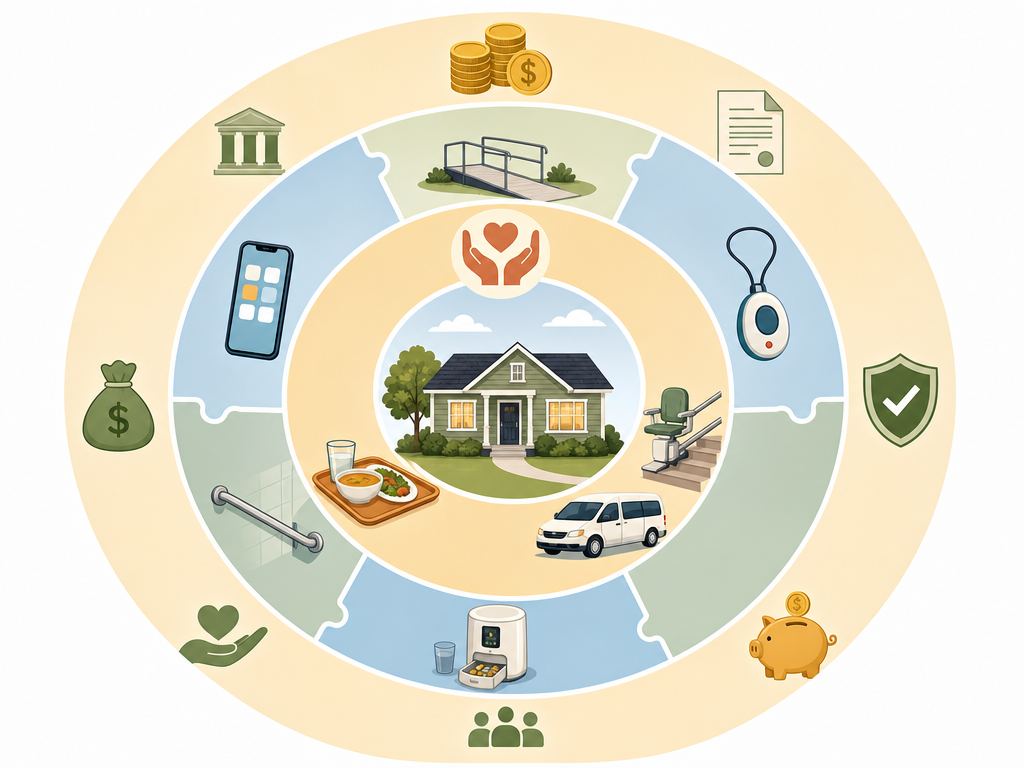
This guide is built around a simple thesis: successful aging in place requires understanding four interconnected layers — in-home care services, home modifications, assistive technology, and support services — alongside the funding pathways that make them accessible. Most families benefit from surveying all four layers before a crisis forces a narrow, reactive decision. The sections below provide a landscape view; each links to deeper resources for when you are ready to move from orientation to action.
Layer 1: In-Home Care Services — From Companion Care to Skilled Nursing
In-home care services exist on a spectrum from non-medical assistance with daily routines to skilled medical care ordered by a physician. Understanding the distinctions matters because they determine who provides the service, what it costs, and whether insurance will contribute.
The Four Main Service Categories
- Companion care: Non-medical assistance with social engagement, light housekeeping, meal preparation, and errands. Typically provided by home care aides or agencies. Not covered by Medicare.
- Personal care (ADL assistance): Help with bathing, dressing, toileting, transferring, and eating — the activities of daily living that determine functional independence. Delivered by home health aides or personal care attendants.
- Home health aide: Skilled assistance provided under a plan of care, often including medication management, wound care, and therapy. Requires a physician's order and is typically intermittent rather than around-the-clock.
- Skilled nursing: Registered nurses or licensed practical nurses providing medical care such as IV therapy, catheter changes, and complex medication administration. Covered by Medicare only when short-term, medically necessary, and ordered by a physician.
The National Institute on Aging provides a comprehensive overview of these service types and notes that Medicare covers home health services only when they are short-term, medically necessary, and ordered by a physician. Medicare does not cover custodial personal care — the kind of daily assistance that most families need for the longest duration.
Layer 2: Home Modifications — Evidence-Based Changes That Reduce Falls and Care Hours
Home modifications are structural or design changes that make a home safer and more accessible. Unlike care services, which address a person's functional limitations through human assistance, modifications address the environment itself — removing barriers that cause falls, limit mobility, and increase the need for caregiver help.
What the Evidence Shows
A 2025 systematic review by Su-Min Cha, published in PMC, analyzed 20 studies on home modifications for aging in place. The findings are compelling: 13 of 20 studies (65%) confirmed the effectiveness of home modifications in reducing falls, improving functional independence, and generating cost savings. Among the most notable results:
- Stark et al. (2017) conducted a randomized controlled trial showing a 39% reduction in falls among older adults who received home modifications.
- Carnemolla et al. (2019) found a 42% reduction in weekly care hours after modifications — informal care dropped 46% and formal care dropped 16%.
- Pettersson et al. (2018) demonstrated that removing environmental barriers reduced accessibility issues by up to 35%.
These are not marginal improvements. A 39% reduction in falls translates to thousands of emergency room visits avoided. A 42% reduction in care hours can mean the difference between a family managing at home and needing to consider facility-based care.
Common Modifications and Their Costs
According to a 2008 HHS ASPE report analyzing 2006 Health and Retirement Study data, the most common home modifications among older adults were railings at entrances (36.2%), grab bars in showers or tubs (30.3%), and a seat for the shower or tub (27.3%). Among those who added features, roughly 75% paid less than $500, and 77% of modifications were self-funded.
For a room-by-room priority guide that tells you which modifications to tackle first and how to sequence them, see our dedicated resource: The Caregiver's Guide to Home Modifications for Aging in Place.
Layer 3: Assistive and Monitoring Technology — Staying Safe and Connected
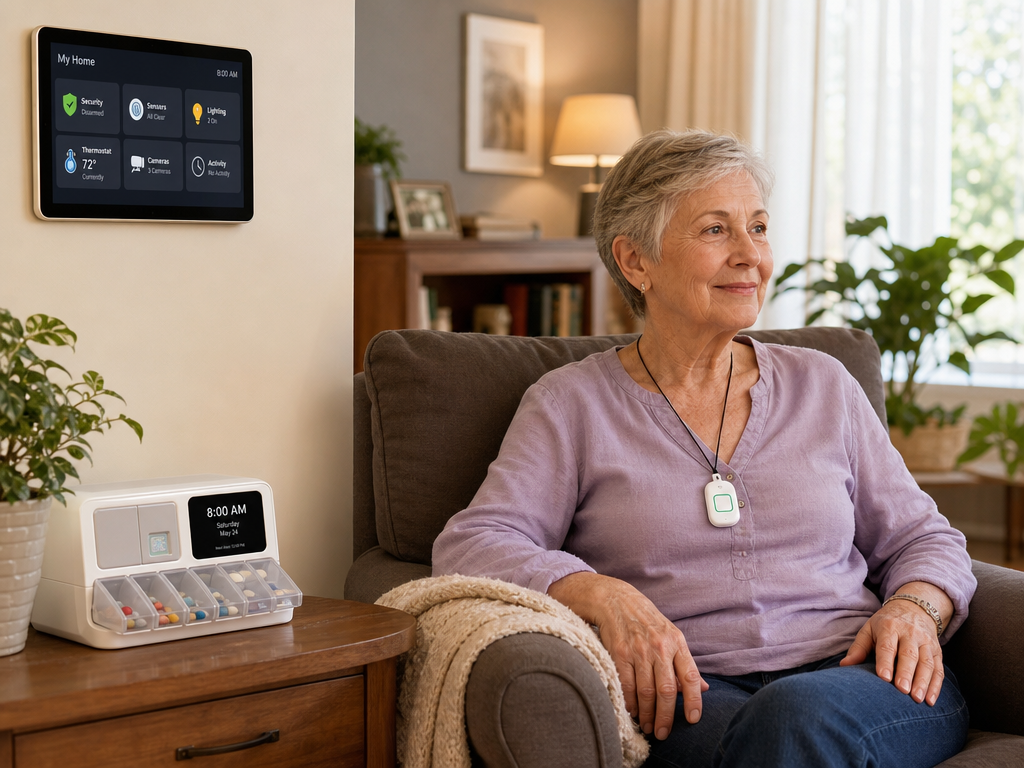
Technology fills gaps that neither human care nor home modifications can address alone. A medical alert pendant provides a direct line to help when a caregiver is not in the room. A smart medication dispenser reduces the risk of missed or double doses. Passive home sensors can alert a long-distance caregiver when a parent has not opened the refrigerator or left the bedroom by mid-morning.
The relevance of medication management technology is underscored by an Oregon State University study cited by AgingCare.com, which found that nearly 40% of adults aged 65 and older take five or more prescription medications. The more medications in the regimen, the higher the risk of errors, interactions, and missed doses — all of which can lead to hospitalizations that defeat the goal of aging in place.
Key Technology Categories at a Glance
- Personal Emergency Response Systems (PERS): Wearable or wall-mounted buttons that connect to a monitoring center. Some include automatic fall detection.
- Smart home sensors: Motion detectors, door sensors, stove monitors, and bed occupancy sensors that track activity patterns and send alerts for anomalies.
- Medication management devices: Automated pill dispensers with alarms, locked compartments, and remote monitoring for missed doses.
- GPS trackers: Wearable or device-based location tracking for older adults who wander, particularly relevant for those with dementia.
Our Monitoring Technology section provides product-neutral explainers for each category, covering how the technology works, what features to evaluate, and what privacy and consent considerations apply — especially when monitoring a cognitively impaired individual.
Layer 4: Support Services — Meals, Transportation, and Adult Day Care
Support services address the social, nutritional, and logistical needs that in-home care workers and family caregivers cannot always cover. They are often the difference between an older adult thriving at home and slowly becoming isolated.
The National Institute on Aging describes several categories of support services that complement formal care:
- Nutrition and meal services: Programs like Meals on Wheels (reachable at 888-998-6325) deliver prepared meals to homebound seniors. Some programs also offer congregate meal sites where older adults can eat together.
- Transportation services: Volunteer driver programs, reduced-fare public transit, and specialized medical transport help seniors get to appointments, grocery stores, and social activities.
- Adult day care: Structured programs that provide supervision, meals, and activities during daytime hours. These give family caregivers a reliable break while ensuring the older adult is in a safe, engaging environment.
- Friendly visitor and senior companion services: Volunteer-based programs that provide social contact through regular visits or phone calls, addressing loneliness and social isolation.
These services are typically low-cost or free, funded through a mix of federal Older Americans Act grants, local Area Agencies on Aging, and charitable organizations. They do not require a physician's order and are available to any older adult who meets age and residency criteria.
Financial Help: Understanding Medicare, Medicaid, VA Benefits, and Other Funding Sources
The most common question from family caregivers is not "what does my parent need" but "how will we pay for it." The answer depends on which layer of home helps you are trying to fund, because each funding source has specific rules about what it covers and who qualifies.
Major Funding Pathways
- Medicare: Covers only short-term, medically necessary skilled home health care ordered by a physician. Does not cover custodial personal care (bathing, dressing, toileting) — the type of care most families need for the longest duration.
- Medicaid HCBS waivers: Home and Community-Based Services (1915(c) and Section 1115) waivers in most states cover home modifications such as wheelchair ramps, stairlifts, and walk-in bathtubs. However, waivers are not entitlements — they may have waiting lists, and eligibility limits are typically around $2,829/month income and $2,000 in countable resources (2024 figures). The home itself is not counted as an asset.
- VA benefits: Eligible veterans and surviving spouses may access home modification grants through programs like the VA's Home Improvements and Structural Alterations (HISA) grant and the Specially Adapted Housing (SAH) grant.
- USDA Section 504 grants: Low-income rural homeowners aged 62 and older may qualify for grants up to $10,000 for home repairs and modifications that remove health and safety hazards.
- Long-term care insurance: Policies vary widely, but many cover in-home care services and some cover home modifications. Review the policy's definition of "home health care" and any elimination periods before relying on it.
For a deeper dive into Medicare, Medicaid, and private payment strategies, see our family guide: How to Pay for Senior Health Care Services.
Cost Comparison: Home Care vs. Home Modifications vs. Assisted Living
Understanding the relative costs of different approaches helps families make informed trade-offs. The table below presents high-level national figures; actual costs vary by location, level of care, and specific services needed.
| Option | Typical Cost Range | What It Covers | Key Caveat |
|---|---|---|---|
| In-home nonmedical care | $25–$44/hr (national median $34/hr in 2026) | Companion care, personal care, light housekeeping, meal prep | Not covered by Medicare; most families pay out-of-pocket |
| Home modifications | Most under $500 per feature; stairlifts $3,000–$10,000 | Grab bars, ramps, railings, bathroom safety, lighting | 77% self-funded; some Medicaid waivers and VA grants available |
| Assisted living facility | $4,500–$6,500/month (national median varies widely by state) | Housing, meals, 24/7 supervision, some personal care | Not covered by Medicare; Medicaid coverage varies by state |
How to Get Started: Using the Eldercare Locator and Area Agencies on Aging
If you are reading this guide because a crisis has already happened — a fall, a hospital discharge, a sudden change in function — the most important step is to get connected to your local aging services network. You do not need to figure this out alone.
Your First Three Actions
- Call the Eldercare Locator at 800-677-1116. This national, federally funded service connects you to your local Area Agency on Aging (AAA). The AAA can provide a needs assessment, explain what services are available in your county, and help you navigate eligibility for programs like Medicaid waivers and nutrition services.
- Request a home safety assessment. Many AAAs offer free or low-cost home assessments to identify fall hazards and recommend modifications. This is the fastest way to get an expert opinion on what environmental changes your parent's home actually needs.
- Ask about case management. If your parent has multiple chronic conditions or complex care needs, a case manager can coordinate across medical providers, home care agencies, and support services — reducing the burden on you as the family caregiver.
For a more detailed walkthrough of how to navigate the broader aging services system — including how to prepare for a needs assessment and what questions to ask — see our step-by-step guide: How to Navigate the Aging and Disability Resource System.
Questions to bring to a clinician or OT
This is not medical, legal, or a family's final decision — only a framework. Bring these questions to a clinician, occupational therapist, or your local Area Agency on Aging.
Find Local HelpRelated reading
Noticed something outdated or inaccurate on this page? Flag a correction. We review every report against CDC, NIA, and AARP HomeFit guidance before updating a page.