
Caregiver decision guide
Power Outage Preparedness for Elderly with Medical Equipment
This guide helps caregivers build a device-specific power backup and emergency plan for seniors on home medical equipment, covering required wattage audits, backup tier matching, refrigerated medication protection, and utility reconnection registration.
Power outage preparedness for elderly parents who use medical equipment starts in a different place than an ordinary storm checklist. The first question is not whether there are flashlights in a drawer. It is which machine stops first, how long it can safely stop, and who knows what to plug it into when the room is dark.
For a senior using oxygen, a ventilator, CPAP or BiPAP, home dialysis, a power wheelchair, or refrigerated medication, “backup power” is not one item. A UPS, a portable power station, and a generator solve different problems. Treating them as interchangeable is how families discover, at the worst possible hour, that a generator takes too long to start for a ventilator, or that a battery sized for phone charging cannot run a concentrator through the night.
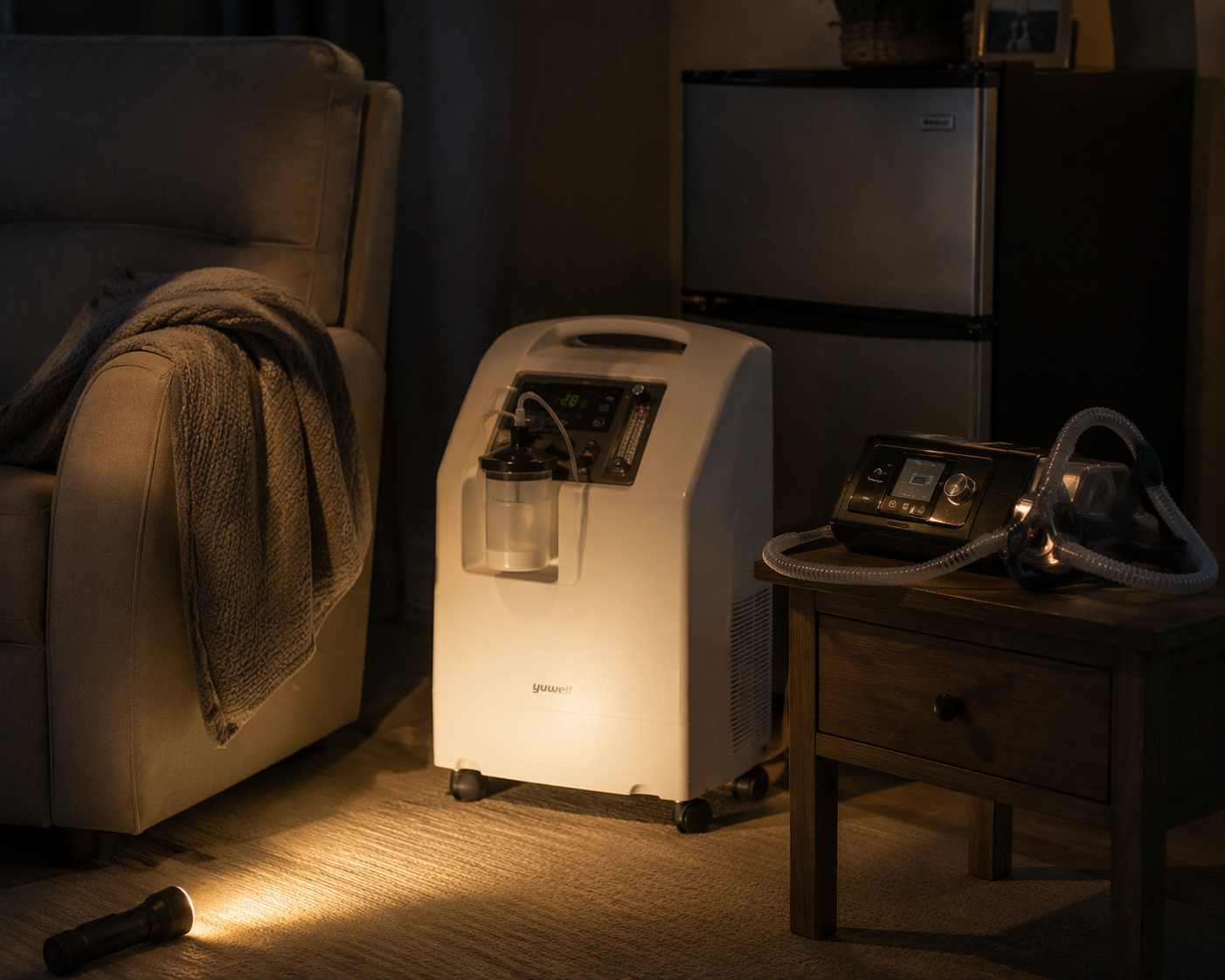
The most useful plan is a written device audit. It should sit with the medication list, emergency contacts, utility account number, and physician documentation, ideally in the same emergency contact binder the family would grab for any urgent call. For long-distance caregivers, the same document needs to be readable by the neighbor, sibling, aide, or building manager who may reach the home first.
Start With A Device Power Audit
Do not begin with the battery catalog. Begin with the equipment already in the home. Walk room by room and write down every device that must keep working, must restart correctly, or must protect medication from temperature changes.
Typical home equipment has broad wattage ranges: oxygen concentrators may draw about 300–600 watts continuously; CPAP and BiPAP units are often about 30–90 watts; home dialysis equipment may draw about 200–400 watts continuously and also depends on clean-water coordination; power wheelchair chargers may draw about 150–300 watts; and a refrigerator used for medication may draw about 100–150 watts while running.[1][2]
Those ranges are planning clues, not permission to guess. Check the nameplate, power brick, user manual, or supplier paperwork for the actual device in the home. If the label gives amps instead of watts, ask the equipment supplier, pharmacist, home health agency, or electrician to help convert it before buying backup power.
| Audit field | What to write down | Why it matters during an outage |
|---|---|---|
| Device name and model | Exact device, supplier, and support phone number | The helper on site should not have to describe “the breathing machine” to a utility, supplier, or nurse. |
| Rated watts or amps | Number from the nameplate, power brick, or manual | Battery size and generator capacity depend on the real load, not a generic estimate. |
| Runtime criticality | Continuous, overnight, scheduled treatment, charging only, or temperature protection | A concentrator and a wheelchair charger do not have the same urgency. |
| Switchover requirement | Instant, short interruption acceptable, manual restart acceptable, or confirm with clinician/supplier | Some equipment cannot wait for a generator to be pulled out and started. |
| Existing internal battery | Whether the device has one, how long it lasts, and whether the family has tested it | A built-in battery is useful only if everyone knows its real runtime. |
| Backup match | UPS, portable power station, generator, medication cooler, evacuation plan, or a combination | Different risks require different backups. |
| Decision threshold | Battery percentage, hours remaining, indoor temperature, medication temperature, or treatment deadline | Evacuation decisions should not be debated after the numbers are already bad. |
Put this table where someone can use it without logging into anything. A printed copy on the refrigerator, one in the emergency binder, and one photo saved to the caregiver’s phone is not excessive. During the first awkward hour of an outage, redundancy is kindness.
Oxygen Concentrators Are Continuous-Load Devices
An oxygen concentrator is usually the device that makes vague planning suddenly concrete. A 300–600 watt continuous load is very different from charging a phone or running a lamp.[1][2] If the senior needs oxygen continuously, the question is not simply, “Do we have a battery?” It is, “How many hours will this exact concentrator run at this setting, and what is the next move before that time is gone?”
Caregivers should also separate the concentrator from portable oxygen arrangements. If the plan includes backup cylinders, write down where they are stored, how long they last at the prescribed flow rate, who can move them, and who orders replacements. A backup cylinder no one can lift, unlock, or calculate under stress is only half a plan.
Ventilators Need Instant Switchover Planning
Ventilators deserve their own line in the audit because the timing problem is different. The backup has to bridge the interruption immediately. Emergency power guidance for electricity- and battery-dependent medical devices identifies ventilators as requiring sub-10 millisecond switchover support; a standard generator with a 10–30 second startup delay is not enough by itself for that first gap.[1]
That is where an appropriately specified UPS belongs. It is not there to run the whole house. It is there to keep the device from dropping during the transition, while another power source or evacuation plan is activated. The family should confirm UPS compatibility with the ventilator supplier or clinician, because the wrong kind of backup can create a false sense of safety.
CPAP And BiPAP Can Be Planned In Watt-Hours
CPAP and BiPAP planning is often more arithmetical. A device drawing about 30–90 watts over an overnight period needs roughly 210–720 watt-hours of battery capacity for one night, before allowing for inverter losses, humidifier use, battery age, and cold-weather performance.[1][2]
The humidifier matters. Many CPAP users can extend battery runtime by turning off heated humidification during an outage, if their clinician says that is acceptable. That instruction should be written down ahead of time, not negotiated at bedtime with a low battery alarm already blinking.
Home Dialysis Adds Water And Schedule Pressure
Home dialysis is not just an electrical load. Equipment may draw about 200–400 watts continuously, but the treatment also depends on clean water supply, supplies, treatment timing, and clinical instructions.[1] The outage plan should say when to call the dialysis provider, whether treatment can be delayed, where the backup treatment location is, and what transportation would be used if the home cannot support treatment.
Match Each Device To The Right Backup Tier
Once the audit is written, backup choices become less emotional. The point is not to buy the largest gadget. The point is to match the failure mode.
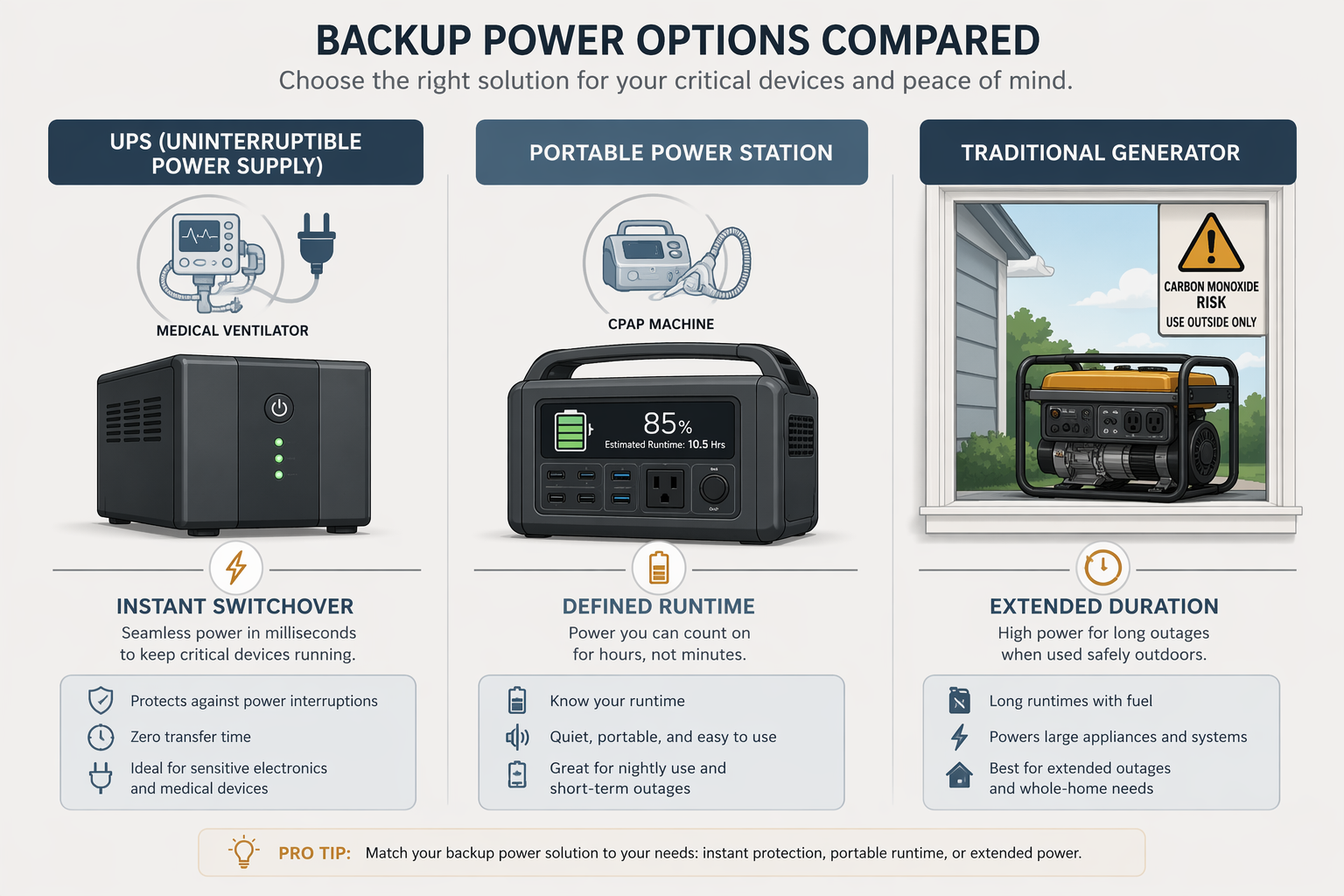
| Backup tier | Best fit | Poor fit | Caregiver check |
|---|---|---|---|
| UPS | Devices that cannot tolerate a power gap, such as ventilator setups requiring instant switchover | Long runtime for high-wattage equipment | Confirm switchover time, waveform compatibility, and device approval with the supplier. |
| Portable power station | Defined battery runtime for CPAP/BiPAP, some concentrator use, communications, small medical loads, or bridging until evacuation | Unlimited runtime or whole-home support | Calculate watt-hours against the actual device draw and test with the device before relying on it. |
| Generator | Longer outages and higher continuous loads when safely operated outdoors | Instant switchover by itself, indoor use, garage use, or operation near doors and windows | Plan fuel, placement, extension cords, transfer safety, and who is physically able to operate it. |
| Evacuation or powered shelter | When power needs exceed safe home backup, batteries are falling, indoor temperature is unsafe, or treatment cannot be delayed | A last-minute argument after equipment is already failing | Set the threshold in writing and identify transportation before the outage. |
A UPS is a bridge, not a household power plan. Portable power stations are useful when the family can calculate a realistic runtime and recharge strategy. Generators can carry longer outages, but they introduce their own hazard and workload. A senior living alone may technically own a generator and still be unable to move it, fuel it, start it, or place it safely in bad weather.
Generator placement is not a detail to handle later. Carbon monoxide poisoning is a leading acute risk during generator use, and generators should be kept at least 20 feet away from windows, doors, and vents.[3][4] “Just outside the garage” is not a safe compromise. Neither is a porch close to a bedroom window.
If a generator is part of the plan, write the placement spot into the plan and walk it once in daylight. Mark which heavy-duty cords are used, where they are stored, and who is allowed to set it up. If no one local can do that safely, the plan needs a different backup tier or an earlier evacuation threshold.
Build A Refrigerator Protocol For Medications
Refrigerated medication should not be treated as a footnote behind the larger machines. The CDC temperature range for refrigerated medications is 36–46°F, and refrigerated drugs should be discarded after 24 hours without power unless the label explicitly says otherwise.[3] That is a simple rule, but it only helps if someone can see the temperature and knows when the clock started.
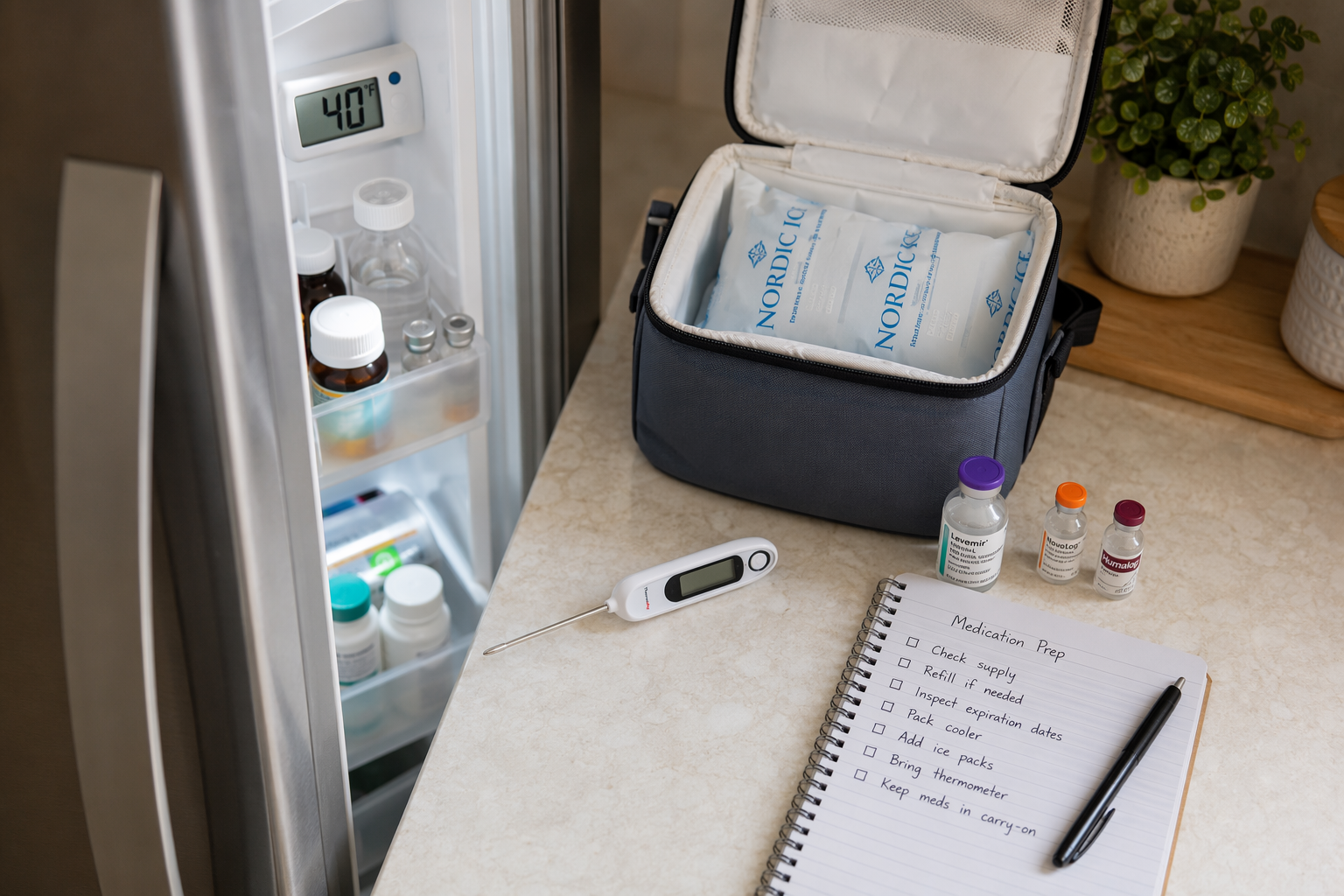
- Keep a refrigerator thermometer inside the medication refrigerator or main refrigerator section where the medication sits.
- Write the outage start time on painter’s tape or a notepad on the fridge door.
- Avoid opening the refrigerator unless the medication must be moved or checked.
- Prepare a cooler and ice packs in advance, but protect medications from direct freezing contact unless the pharmacist confirms that is safe.
- Call the pharmacist or prescribing office if the temperature went out of range, the label gives special instructions, or the 24-hour point is approaching.
Ready.gov also advises keeping refrigerator and freezer doors closed during an outage and using coolers with ice when needed.[4] For medications, that general advice needs labels and thresholds added: medication name, safe range, discard instruction, pharmacy phone number, and the person authorized to make the call if the senior is unsure.
Register With The Utility, But Do Not Treat It As A Rescue Promise
Utility medical priority lists are worth doing because they are usually free and they put the account on the utility’s radar. The ADA National Network notes that utility companies maintain priority reconnection lists for people who use electricity- and battery-dependent assistive technology and medical devices, and registration may require physician documentation.[1]
The annoying part is also the important part: the program varies by provider. A caregiver should call the local electric utility, ask for the medical baseline, life-support, critical care, or priority restoration program, and write down the exact documentation required. Some utilities renew enrollment periodically. Some require the physician to complete a form. Some use the list for notification and planning rather than guaranteed faster reconnection.
- Utility account number and service address
- Senior’s name as it appears on the account
- Medical device names and whether they are life-sustaining
- Physician, clinic, and fax or portal information
- Enrollment date, renewal date, and confirmation number
This is especially important when the caregiver lives two towns away. The person calling the utility during an outage should not be hunting for an account number while the local helper is staring at a battery indicator. A long-distance caregiver emergency plan should name who calls the utility, who checks the equipment, who has a key, and who can transport the senior if the plan moves from backup power to evacuation.
Set Evacuation Thresholds Before The Battery Is Low
Evacuation is much easier to postpone than to execute. That is why the decision point has to be written before the outage, when everyone is calm enough to be honest about mobility, weather, equipment weight, and transportation.
| Trigger | Example threshold to define with the care team | Action |
|---|---|---|
| Ventilator or critical respiratory support | UPS reaches a specified remaining runtime or the secondary power source is not operating | Call emergency services, the device supplier, or the clinical contact according to the written plan. |
| Oxygen concentrator | Backup battery or oxygen cylinder supply falls below the written number of hours | Move to the identified powered location before the supply is nearly gone. |
| CPAP/BiPAP | Battery capacity will not cover the next sleep period | Use the approved reduced-power setup or relocate before bedtime. |
| Home dialysis | Treatment cannot be completed within the clinically approved window | Call the dialysis provider and activate the backup treatment or transport plan. |
| Refrigerated medication | Temperature is out of range or the 24-hour no-power point is approaching | Move medication according to pharmacist guidance or arrange replacement. |
| Power wheelchair | Chair battery or charger backup will not support safe transfers and essential movement | Relocate while the senior can still transfer safely. |
Temperature belongs in this discussion too. Older adults can be more vulnerable when heating, cooling, elevators, and powered medical equipment fail. Ready.gov specifically includes older adults among people who should plan for power outages with their support network and medical needs in mind.[5] If heat, cold, stairs, or lack of elevator access would make the home unsafe, the evacuation threshold should include those conditions, not just device battery levels.
For seniors with limited mobility, the transport plan needs more than “go to my daughter’s house.” It should say whether the wheelchair fits through the doorway, whether the ramp is usable in rain, who can lift the portable oxygen, and whether the destination has grounded outlets in the room where the senior will sleep. The same practical thinking used in mobility-adapted emergency planning applies here: the route matters as much as the destination.
Practice The Plan Quarterly Without Turning It Into A Family Exam
A quarterly practice should be ordinary, short, and specific. It is not a disaster drill with sirens and shame. It is fifteen to thirty minutes of checking whether the plan still matches the house.
- Ask the senior to point to the device audit, medication list, and utility registration confirmation.
- Have the local helper find the backup battery, UPS, extension cord, cooler, thermometer, and key documents.
- Check battery charge levels and expiration or service dates on supplies.
- Read the evacuation thresholds out loud and confirm they still make sense.
- Update phone numbers for the utility, supplier, pharmacy, physician, and local backup person.
The practice will feel less intrusive if it is attached to something already routine: changing smoke alarm batteries, reviewing medications, rotating ice packs, or updating the care calendar. If the senior feels embarrassed by the amount of equipment in the home, keep the tone practical. The goal is not to prove dependence. It is to make sure the people who care about them can act quickly without guessing.
Ordinary outage supplies still matter: flashlights, charged phones, safe walking paths, water, food, and fall prevention when floors are wet or rooms are dark. Those are covered well in broader resources such as a storm preparation and falls checklist. For a senior on powered medical equipment, those supplies sit around the device plan, not in place of it.
A safe outage plan is built from small, unglamorous facts: the concentrator’s wattage, the UPS switchover time, the CPAP’s overnight watt-hours, the medication refrigerator temperature, the utility account number, the neighbor with the key, and the battery percentage that means it is time to leave. When those facts are written down and rehearsed, the first hour of an outage becomes a sequence of actions instead of a family improvisation.
References
- Emergency Power Planning for People Who Use Electricity and Battery-Dependent Assistive Technology and Medical Devices — ADA National Network
- Preparing for a Power Outage as a Medical Device User — American Lung Association
- What to Do to Protect Yourself During a Power Outage — CDC
- Power Outages — Ready.gov
- Older Adults — Ready.gov
Questions to bring to a clinician or OT
This is not medical, legal, or a family's final decision — only a framework. Bring these questions to a clinician, occupational therapist, or your local Area Agency on Aging.
Find Local HelpRelated reading
Noticed something outdated or inaccurate on this page? Flag a correction. We review every report against CDC, NIA, and AARP HomeFit guidance before updating a page.