A Caregiver's Guide to Medications That Increase Fall Risk in Older Adults
Reviewed: 2026-07-05
A Caregiver's Guide to Medications That Increase Fall Risk in Older Adults
Learn which common medications raise fall risk in older adults, how they affect balance and alertness, and how to work with a healthcare provider to review and safely reduce unnecessary fall-risk drugs.
By Editorial Team
new caregiver
experienced caregiver
long-distance caregiving
spousal caregiver
working caregiver
daily routines
medication management
personal hygiene
care coordination
first steps
ADLs
IADLs
After an older parent falls, it is natural to look at the floor first: the rug edge, the bathroom threshold, the missing grab bar. Those things matter. But the medication list deserves a place on the table just as quickly, because several common medications linked to falls in older adults can make a person sleepier, slower to react, lightheaded when standing, or less steady on their feet.
The safe first move is not to stop pills. It is to ask for a structured medication review with the prescriber or pharmacist, especially after a fall, near-fall, hospitalization, new prescription, dose change, or new confusion. Some medicines are necessary. Some are doing more good than harm. Some may be adjustable. The point is to sort those out with someone who can weigh the risks, watch for withdrawal, and make a tapering plan when needed.
The medication groups worth flagging before the next visit
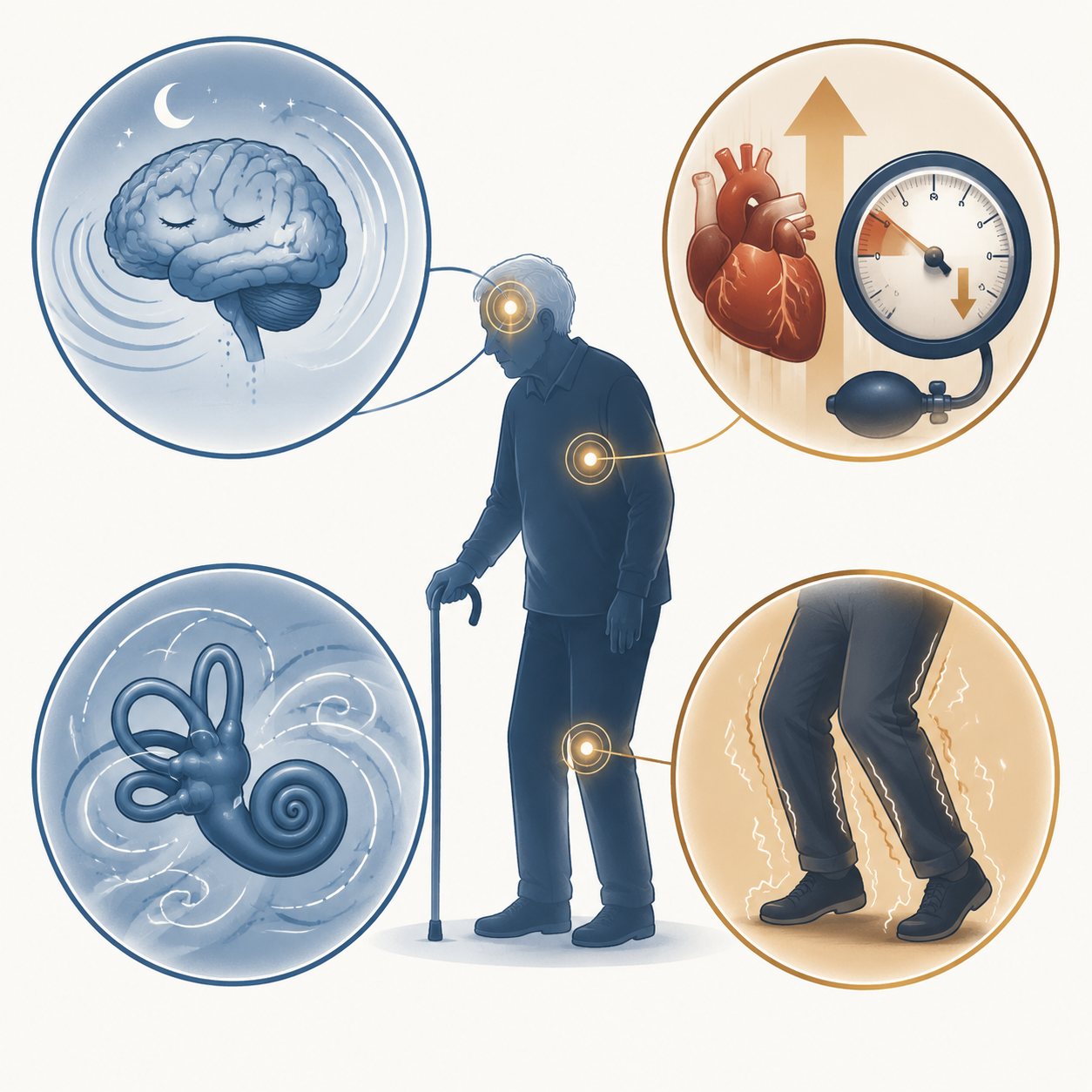
A caregiver does not need to become a pharmacist to prepare a better question. Start by circling the medication groups that commonly show up in fall-risk discussions: antidepressants, benzodiazepines, opioids, gabapentinoids, blood pressure medicines and diuretics, sleep aids, antihistamines such as diphenhydramine, and muscle relaxants. Harvard Health groups many of these under central nervous system depressants, blood pressure medicines and diuretics, antihistamines, and muscle relaxants because they can affect alertness, balance, or blood pressure in ways that make a fall more likely.[1]
Medication group
Why it may matter for falls
What to bring up
Antidepressants, including SSRIs and SNRIs
Can be associated with falls through dizziness, sleepiness, balance effects, or other pathways; depression and anxiety may also affect fall risk
Ask whether the medicine is still needed at the current dose and whether it was started for mood, pain, sleep, or anxiety
Benzodiazepines and sedative sleep medicines
Can slow reaction time, increase sedation, and worsen confusion, especially overnight or early in the morning
Ask about safer sleep or anxiety options and whether tapering is appropriate
Opioids and gabapentinoids
Can cause drowsiness, dizziness, and impaired coordination; risk may rise when combined with other sedating medicines
Ask whether pain control can be adjusted without increasing fall risk
Blood pressure medicines and diuretics
Can contribute to lightheadedness or blood pressure drops when standing, especially after initiation or dose changes
Ask whether standing blood pressure should be checked and whether symptoms line up with timing
Antihistamines and muscle relaxants
Can cause sedation, blurred thinking, weakness, or balance problems
Ask whether the medicine is still needed or whether a less sedating option exists
That table is a starting point, not a verdict. The same drug can be a reasonable choice for one older adult and a poor fit for another. What changes the conversation is the pattern: a fall after a new dose, a parent nodding off at lunch, dizziness when standing from the recliner, or a sleep pill taken “only sometimes” that never makes it onto the printed medication list.
How ordinary prescriptions can turn into fall risk
Most medication-related fall risk is not dramatic. It looks like a slower reach for the walker. A pause before answering. A hand on the wall after getting out of bed. A person who used to stand, turn, and walk now stands, wobbles, and waits.
Sedation and slower reaction time
Sedating medicines do not have to knock someone out to raise risk. A mild delay can be enough: the foot catches the rug, the body does not correct in time, and the fall has already happened. Benzodiazepines, opioids, gabapentinoids, some antidepressants, sleep medicines, antihistamines, and muscle relaxants can all be relevant here, especially when more than one is taken on the same day.
This is where families often miss gabapentin or pregabalin. They may think of the prescription as “for nerve pain,” not as something that can add to sleepiness or dizziness. Harvard Health quoted geriatrician Dr. Sarah Berry as saying gabapentin prescriptions increased fourfold between 2006 and 2018 and that they “probably pose just as much fall risk as opioids.” That is expert concern, not the same thing as a definitive head-to-head conclusion for every patient, but it is enough reason to include gabapentinoids in a fall-focused medication review.[1]
Dizziness, balance changes, and antidepressants
Antidepressants deserve careful handling because they are easy to either over-blame or ignore. In a nationally representative study of 8,742 Medicare beneficiaries, SSRI use was associated with a 29% higher fall risk and SNRI use with a 32% higher fall risk, even after the researchers controlled for depression itself.[2]
That last part matters. Depression and anxiety can themselves affect sleep, concentration, strength, appetite, activity, and attention to surroundings. So the lesson is not “antidepressants cause every fall.” The more useful lesson is that antidepressants remain worth reviewing even when the underlying condition is real and serious.
The same study found that more than one-third of antidepressant users had no depression diagnosis, which suggests that some older adults may be taking these medicines for reasons such as sleep, pain, or anxiety rather than a current depression diagnosis.[2] That does not automatically make the prescription wrong. It does mean the caregiver can ask a cleaner question: “What is this one treating now, and is it still the best option given the falls?”
Lightheadedness on standing
Blood pressure medicines and diuretics are a different kind of fall-risk conversation. They are often important, and poorly controlled blood pressure has its own dangers. The concern is timing, dose, hydration, and whether the person’s blood pressure drops when moving from lying or sitting to standing.
A 2024 BMJ cohort study of about 30,000 nursing home residents found that starting an antihypertensive medication was associated with fracture rates of 5.4 versus 2.2 per 100 person-years.[3] That finding should not be read as a reason to avoid blood pressure treatment. It is a reason to monitor closely after initiation or dose changes, ask about dizziness, and check whether the fall happened during the window when the body was adjusting.
Confusion and the prescription cascade
Sometimes the problem is not one drug but a chain. A medication causes insomnia, so a sleep aid is added. A pain medicine causes dizziness, so the person moves less, gets weaker, and needs more help walking. Johns Hopkins Medicine describes this kind of “prescription cascade” as one way polypharmacy can become risky in adults 60 and older.[4]
Families are often the only ones who can describe the real sequence. The chart may show a neat list. The kitchen counter may show something else: an old bottle kept for bad nights, an over-the-counter antihistamine used as a sleep aid, a pain pill taken before physical therapy, and a new blood pressure dose after a hospital stay.
Polypharmacy is the turning point
Once four or more medications are involved, the question changes. It is no longer only “Which class is risky?” It becomes “How much total burden is this person carrying?” The Canadian Deprescribing Network, citing systematic reviews, states that fall risk rises about 75% when a person takes four or more medications, independent of the specific drug classes.[5]
That number is useful because caregivers can count before they can interpret pharmacology. Count prescriptions. Count over-the-counter products. Count sleep aids. Count pain medicines. Count supplements if they are part of the daily routine. Then mark which ones are new, which ones changed dose, and which ones are taken only some days.
Johns Hopkins Medicine reports that about one-third of adults ages 60 to 70 take five or more medications.[4] That does not mean one-third are being treated badly. It means many families are living in the zone where medication review is not a luxury. It is basic fall prevention.
What to do before the appointment
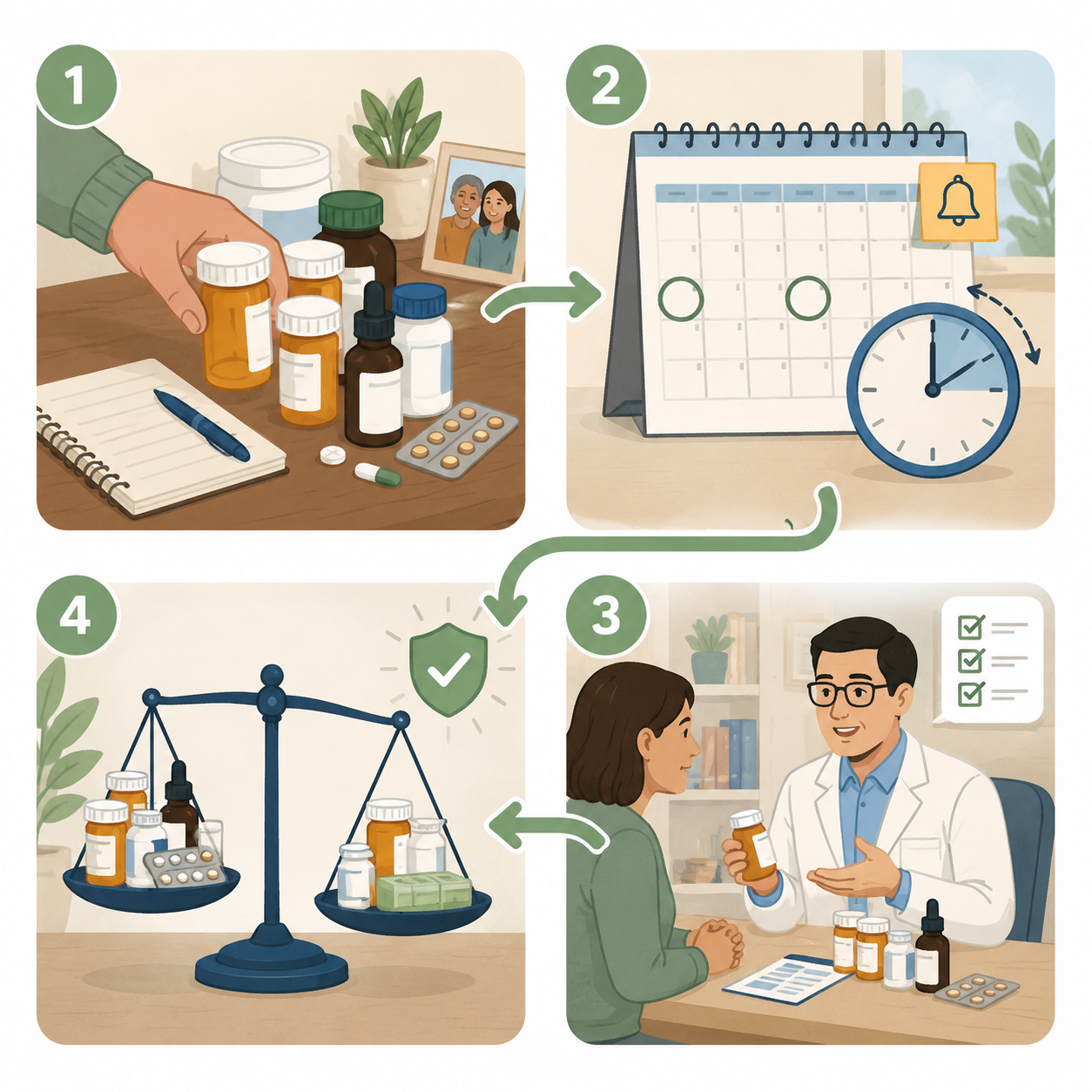
The most helpful preparation is plain and slightly tedious: make the invisible list visible. If you need a broader system for building a master list, sorting bottles, and keeping medication records current, use this caregiver medication management guide. For a fall-risk visit, the list should answer a narrower question: could any medicine be making balance, alertness, or standing blood pressure worse?
Gather every prescription bottle, over-the-counter medicine, pain reliever, sleep aid, allergy medicine, patch, cream, eye drop, and supplement.
Write when each one is taken: morning, noon, evening, bedtime, overnight, or only as needed.
Mark anything started, stopped, restarted, or changed after a hospitalization, emergency visit, specialist appointment, or recent refill.
Write down falls, near-falls, dizziness, daytime sleepiness, confusion, weakness, and lightheadedness on standing, including the time of day when they happen.
Bring the real bottles or a current photo of each label, not just the printed after-visit summary.
If the older adult uses more than one prescriber, the review should still land somewhere. Primary care, geriatrics, a clinical pharmacist, or the prescribing specialist may be the right starting point depending on who knows the full picture. What matters is that someone reviews the whole list, not just the one medicine they personally prescribed.
How to ask for a fall-focused medication review
A rushed appointment goes better when the question is specific. “Could any of these be contributing to dizziness, sleepiness, confusion, low blood pressure, or falls?” is easier to answer than “Are these pills okay?” It also avoids sounding like an accusation. You are not asking the clinician to defend every prescription. You are asking them to review the list in light of a new safety problem.
The National Council on Aging recommends medication review as part of fall-risk reduction and discusses deprescribing resources, including HomeMeds-style approaches that identify medications that may contribute to falls and other geriatric problems.[6] The CDC’s STEADI clinical resources include the SAFE Medication Review Framework for clinicians, giving families a legitimate phrase to use rather than a vague worry.[7]
“Can we review this list for fall-risk-increasing drugs?”
“Were any of these started for sleep, pain, anxiety, or appetite rather than the condition listed on the chart?”
“Could the timing be causing morning grogginess or nighttime unsteadiness?”
“Should we check sitting and standing blood pressure?”
“If one of these is no longer helping, what would a safe taper look like?”
That last question matters. Benzodiazepines, opioids, some antidepressants, and other long-used medicines can cause withdrawal, rebound symptoms, or a return of the condition they were treating if stopped abruptly. A safe plan may involve a slow taper, a substitute, a dose change, a timing change, closer monitoring, or a decision to leave the medication alone because its benefits still outweigh its risks.
What “reducing risk” can look like
A medication review does not always end with fewer pills. Sometimes it ends with a different bedtime. Sometimes the prescriber lowers a dose, changes a diuretic schedule, checks orthostatic blood pressure, removes a duplicate therapy, or asks the family to track symptoms for two weeks before deciding. Sometimes the answer is, “This medicine is still important, but now we know to watch it.”
Deprescribing, when appropriate, is a clinical process. The NCOA’s deprescribing resources frame it as a way to manage medications and reduce fall risk, not as a do-it-yourself cleanup project.[6] That distinction protects the older adult, especially when the medicine treats pain, mood, sleep, seizures, blood pressure, or withdrawal-prone symptoms.
Medication review also works best beside the rest of fall prevention. Vision, footwear, strength, balance, assistive devices, lighting, bathroom setup, and home hazards still matter. If the fall has exposed broader mobility issues, this guide to maintaining mobility at home can sit next to the medication conversation rather than replace it.
Where the caregiver’s job stops
The caregiver’s job is to notice patterns, gather the real list, and bring a better question into the room. It is not to decide alone that a blood pressure pill, antidepressant, sleep medicine, opioid, or gabapentin should disappear by Friday.
Medication-related fall risk is common because it hides inside ordinary care: the pill for sleep, the dose changed after discharge, the antidepressant started years ago, the allergy medicine bought without a prescription, the pain medicine no one thinks of as sedating. It is also one of the more actionable fall risks, as long as it is treated as a review-and-adjust problem rather than a stop-the-drug problem.
Bring the bottles. Bring the fall story. Ask, “Could any of these be contributing to dizziness, sleepiness, or falls?” Then let the prescriber manage the tradeoffs, the monitoring, and any taper that needs to happen safely.


Comments
Join the discussion with an anonymous comment.