The Family Caregiver's Guide to Navigating Senior Healthcare: From Medicare to Care Coordination
A step-by-step guide for adult children managing an aging parent's healthcare, covering how to build a care team, master Medicare preventive services, create a coordination system, and know when to bring in a geriatric care manager.
By Editorial Team
new caregiver
care coordination
medication management
first steps
adult children
📄
A printable version of this guide is available. Use your browser's print function (Ctrl+P / ⌘P) to save or print.
Why Healthcare Navigation Is the Hidden Burden of Family Caregiving
When adult children step into a caregiving role, they expect the hard parts to be hands-on: helping a parent bathe, managing medications, or preventing falls. What catches most people off guard is something far less visible but often more draining — the sheer cognitive load of navigating a fragmented healthcare system.
Consider the numbers. The National Council on Aging estimates that 78% of older adults have two or more chronic conditions, which means their care involves multiple specialists, overlapping medication schedules, and frequent transitions between settings. Family caregivers spend an average of eight or more hours per week on medical management alone — scheduling appointments, coordinating between providers, tracking test results, and deciphering insurance explanations of benefits. That is the equivalent of a part-time job, and it sits on top of everything else you do.
This guide is built around a straightforward thesis: the overwhelm you feel is not a sign that you are doing something wrong. It is a sign that the system is fragmented by design, and that you need a structured approach to navigate it. The five steps that follow will help you build a care team, master Medicare's preventive benefits, create a coordination system that actually works, handle the high-risk moments when care transitions, and know when to bring in a professional guide.
Step 1: Build Your Parent's Healthcare Team
Most older adults have a primary care provider, but that single relationship is rarely enough when multiple chronic conditions are in play. The goal of Step 1 is to assemble a coordinated team where each member has a defined role — and where you, as the family caregiver, are the hub that keeps everyone connected.
The family caregiver is the central hub connecting a coordinated healthcare team.
Who Should Be on the Team
Geriatrician or geriatric-focused primary care provider. These physicians have specialized training in the complex, multi-condition needs of older adults. They are more likely to consider how medications interact, how cognitive changes affect treatment adherence, and how social factors influence health outcomes. The supply of geriatric clinicians is growing — it increased 4% between September 2024 and September 2025, reaching a new high — but demand still outpaces supply, so you may need to search early.
Clinical pharmacist. A pharmacist who specializes in geriatric medication management can review your parent's full medication list for duplications, interactions, and drugs that are potentially inappropriate for older adults. Many Medicare Part D plans include medication therapy management at no extra cost.
Home health nurse or care coordinator. If your parent receives in-home services, a home health nurse can serve as the eyes and ears between doctor visits, monitoring vital signs, wound healing, and medication adherence. For families not yet using home health, a care coordinator — often a registered nurse employed by the health system or Medicare plan — can fill this role.
Specialists relevant to your parent's conditions. A cardiologist, endocrinologist, neurologist, or orthopedist, depending on the diagnosis. The key is to ensure one person — ideally the geriatrician or primary care provider — has a complete picture of what every specialist is doing.
How to Make the Team Work
A team only helps if its members communicate. At every appointment, bring a one-page summary of your parent's current medications, recent test results, and the specific question you need answered. Ask each provider to send visit summaries to the primary care provider's office. If your health system offers a patient portal, use it to send messages that copy multiple providers — this creates a written record and keeps everyone in the loop.
If your parent has a dementia diagnosis, the stakes are even higher. The CMS GUIDE Model, launched in July 2024, provides comprehensive dementia care coordination including a 24/7 support line, caregiver training, and up to $2,500 in annual respite services. Ask your parent's provider whether they participate in the GUIDE Model.
Step 2: Master the Medicare Preventive Calendar
One of the most underutilized tools in senior healthcare is the Medicare Annual Wellness Visit. This yearly appointment is not a head-to-toe physical exam — it is a preventive planning session that covers cognitive assessment, fall risk screening, depression screening, and a review of your parent's medications and immunizations. And it is covered at no cost-sharing under Medicare Part B.
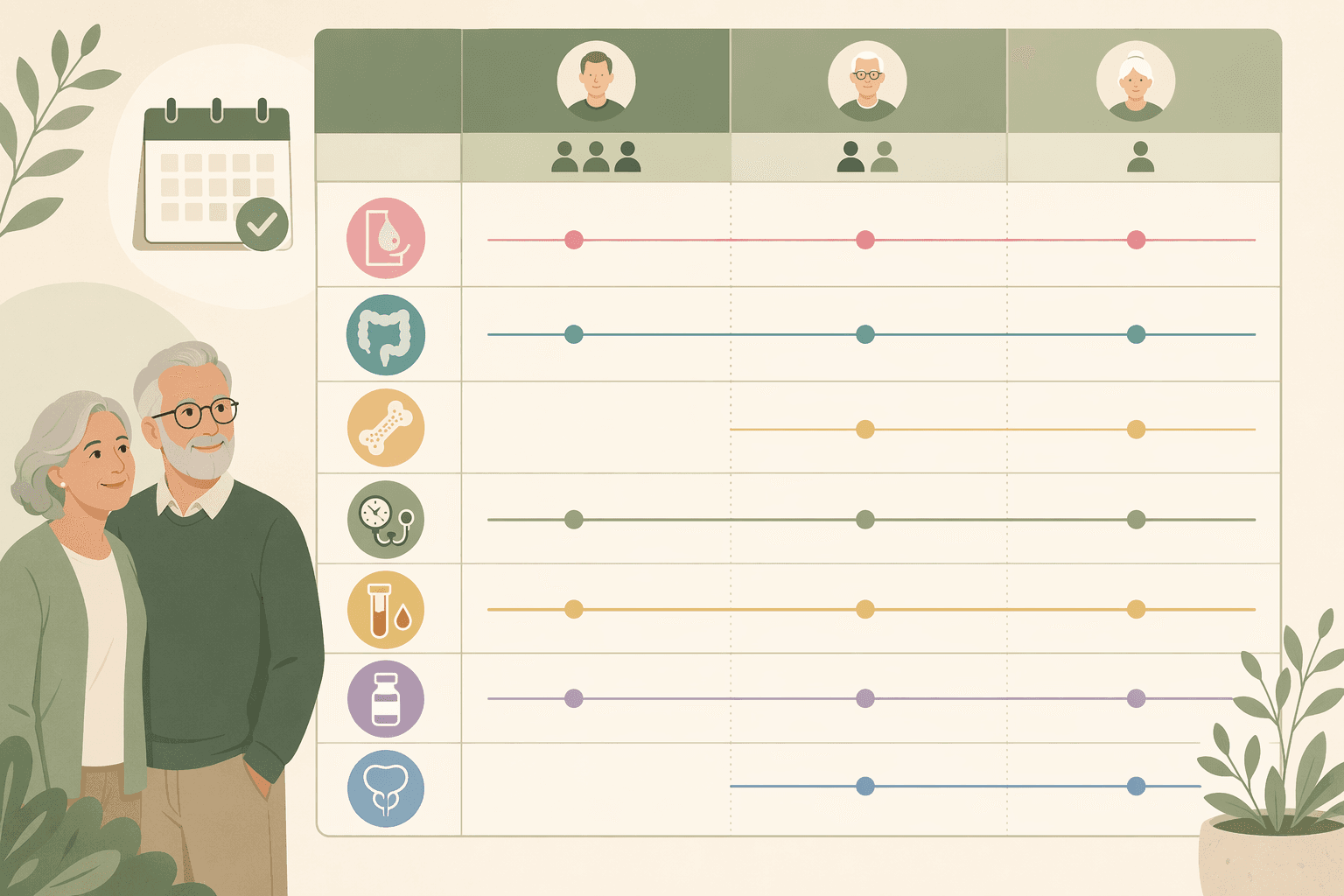
Beyond the Annual Wellness Visit, Medicare covers 27 or more preventive services recommended by the U.S. Preventive Services Task Force (USPSTF). The challenge is that no single provider automatically schedules all of them — you need to track them yourself. The table below organizes the most important screenings by category, with the age ranges and frequency recommended by the USPSTF.
A visual timeline of key preventive screenings by age bracket.
Key preventive services covered by Medicare at no cost-sharing, organized by category with USPSTF-based age and frequency recommendations. Source: Better Health While Aging / Dr. Leslie Kernisan, updated May 2025.
Category
Service
Recommended Age / Frequency
Key Notes
Mental Health & Cognition
Depression screening
Annual, all adults 65+
Covered at no cost under Medicare; often done during Annual Wellness Visit
Mental Health & Cognition
Cognitive impairment screening
Annual, all adults 65+
Part of the Annual Wellness Visit; look for signs of memory changes
Safety & Function
Fall risk assessment
Annual, all adults 65+
Includes balance, gait, and medication review; critical for preventing injuries
Safety & Function
Functional impairment screening
Annual, all adults 65+
Assesses ability to perform daily activities independently
Physical Health
Blood pressure screening
Every 1–2 years
More frequent if elevated or if parent has diabetes or heart disease
Physical Health
Cholesterol screening
Every 5 years (or more often if high risk)
Fasting not always required; check with the lab
Physical Health
Diabetes screening (Type 2)
Every 3 years for adults with sustained blood pressure >135/80
Earlier and more frequent if overweight or with family history
Physical Health
Osteoporosis screening (bone density)
Once for women 65+; men 70+ if risk factors present
DEXA scan is the standard; repeat every 2 years if osteopenia is found
Cancer Screening
Colorectal cancer screening
Ages 50–75; after 75, discuss with provider
Options: colonoscopy every 10 years, FIT test annually, or Cologuard every 3 years
Cancer Screening
Breast cancer screening (mammogram)
Ages 50–74, every 2 years
After 74, discuss with provider based on health status and life expectancy
Cancer Screening
Cervical cancer screening (Pap smear)
Not routine after 65 if adequate prior screening
Discuss with gynecologist if there is a history of abnormal results
Cancer Screening
Lung cancer screening (low-dose CT)
Ages 50–80 with 20+ pack-year smoking history
Annual screening; requires a shared decision-making visit with a provider
Cancer Screening
Prostate cancer screening (PSA)
Not recommended for men 70+
For men 55–69, discuss risks and benefits with provider; shared decision-making is key
Vaccinations
Influenza vaccine
Annual, all adults 65+
High-dose or adjuvanted flu vaccine recommended for 65+
Vaccinations
Pneumococcal vaccine
Age lowered to 50 as of October 2024
Two types: PCV20 alone or PCV15 followed by PPSV23; discuss with provider
Vaccinations
Shingles vaccine (Shingrix)
Two doses, ages 50+
91–97% effective; even if you had shingles before, you should still get it
Vaccinations
Tetanus, diphtheria, pertussis (Tdap)
One dose if not received as adult; then Td booster every 10 years
Important for grandparents who will be around infants
Vaccinations
COVID-19 vaccine
Updated annually; all adults 65+
Check current CDC recommendations for the most recent formulation



Comments
Join the discussion with an anonymous comment.