How to Hire a Home Health Aide for an Elderly Parent
This guide walks families through the exact steps to find, vet, hire, and manage a home health aide for an elderly parent, from needs assessment to ongoing management, with expert-backed interview questions and screening checklists to avoid costly mistakes.
By Editorial Team
new caregiver
experienced caregiver
long-distance caregiving
spousal caregiver
working caregiver
daily routines
medication management
personal hygiene
care coordination
first steps
ADLs
IADLs
The first step in hiring a home health aide for an elderly parent is not calling an agency, posting on a care platform, or asking neighbors who they used. It is writing down the job before anyone tries to fill it.
Families often reach this point after a fall, a hospital discharge, a frightening medication mistake, or the slow realization that one parent is quietly covering for the other. By then, everyone wants relief quickly. That urgency is understandable, but it is also where bad hires begin: the family says, “Mom needs help,” and the aide hears five different jobs.
A workable hiring process has an order. First define the care need. Then decide whether an agency or private hire fits the family’s capacity and risk tolerance. Only after that should you source candidates, interview, screen, run a trial period, and set up a management system.
Stage
What the family produces
Needs assessment
A written care profile covering personal care, health-related needs, companionship, and household tasks
Agency vs. private hire decision
A clear choice about who handles payroll, screening, insurance, scheduling, and backup coverage
Sourcing
A short list of agencies or candidates that match the written job
Interviewing
Notes that compare candidates against the same questions
Screening
Documentation of background checks, references, driving record if relevant, and insurance or workers’ compensation responsibilities
Trial period
Observed fit in the parent’s actual home, with written feedback
Ongoing management
A care plan, daily log, communication cadence, and backup plan
Start by turning “needs help” into a written care profile
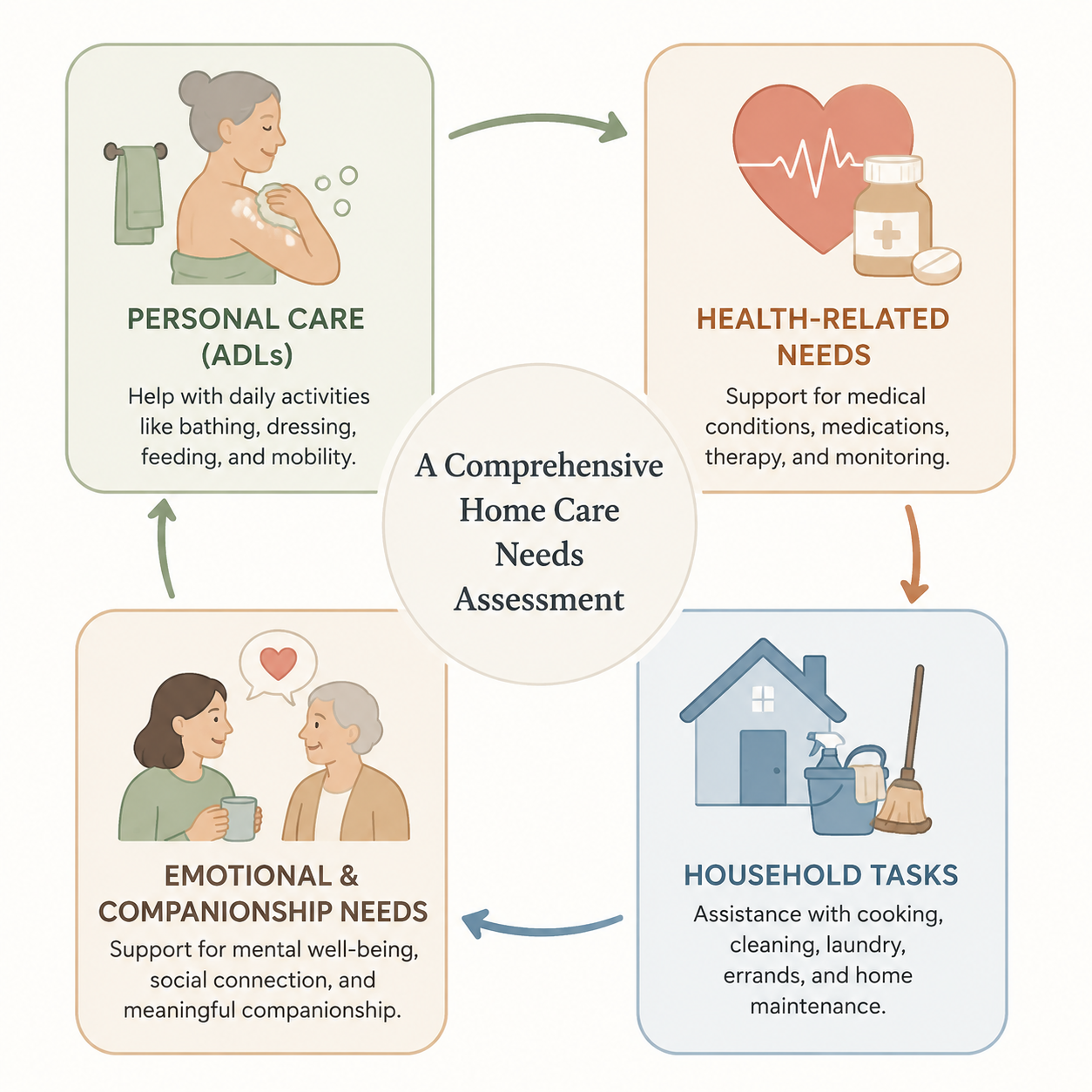
The National Institute on Aging describes in-home services in practical categories: personal care, health-related support, household help, and companionship or social support for older adults living at home.[1] The National Council on Aging also recommends that families clarify the older adult’s needs before hiring, because the right caregiver depends on the actual tasks, schedule, and level of supervision required.[2]
That sounds obvious until a family tries to do it. One sibling may be worried about bathing. Another is focused on meal preparation. The parent may say the only problem is transportation. The person who lives closest may know the real issue is that no one is sure whether pills were taken correctly on the days nobody visited.
Personal care ADLs
Start with activities of daily living, because these determine how hands-on the aide’s work will be. Write down whether your parent needs cueing, standby assistance, or physical help with bathing, dressing, toileting, transferring, eating, grooming, or walking from room to room.
Be specific about the hard moments. “Needs help bathing” is too vague. “Needs someone nearby while stepping into the shower, refuses help washing hair, and is embarrassed by male aides” gives an agency or candidate something real to respond to. It also protects your parent from being treated as a generic assignment.
Health-related needs
Next list the health-related tasks. These may include medication reminders, blood pressure prompts, diabetes-related routines, fall precautions, mobility support, dementia supervision, post-surgical restrictions, or watching for changes that should be reported to family or a clinician. Do not assume every aide can perform every health-related task. Scope of practice and training requirements vary by state, by agency policy, and by whether the worker is a home health aide, personal care aide, certified nursing assistant, or licensed nurse.
This is also where families often confuse home care with home health care. Nonmedical home care usually helps with daily living and supervision. Medicare-covered home health care is tied to skilled medical need and eligibility rules, not simply the fact that an older adult needs long-term help at home. If payment depends on Medicare, clarify that before hiring for ongoing custodial care.
Companionship and emotional fit
Companionship is not a decorative extra. For some parents, the aide who can make lunch and talk calmly through a confused afternoon will prevent more conflict than the aide with the longest resume. Write down whether your parent prefers quiet, conversation, a shared language, religious or cultural familiarity, a steady routine, or someone comfortable with memory loss, grief, anxiety, irritability, or resistance to help.
This does not mean hiring only by personality. Warmth matters, but a warm aide without boundaries, reliability, and appropriate screening can create a new problem. The care profile should describe the kind of presence your parent responds to, then the hiring process should test whether the person can provide that presence safely and consistently.
Household tasks
Finally, list household tasks separately from personal care. Light housekeeping, laundry, dishes, meal preparation, grocery support, pet care, mail sorting, and transportation can quietly become the whole job if nobody defines them. Decide what is essential, what is optional, and what is outside the aide’s role.
A written care profile should end with schedule and environment: days needed, hours per visit, overnight needs, stairs, pets, smoking, parking, assistive devices, family members who may be present, and who the aide contacts when something changes. This is the document you use when speaking with agencies or candidates. If you cannot describe the job in writing, you are not ready to compare applicants fairly.
Decide whether you are buying agency infrastructure or becoming the employer
The AARP and National Alliance for Caregiving 2025 report found that one-third of family caregivers use paid help, yet many families still arrive at hiring with little practical guidance about how to choose, supervise, or replace that help.[3] That gap becomes most expensive when families compare agency and private-hire rates as if the hourly price is the whole decision.
Agencies often cost more than private hires. A common estimate is a 20% to 30% agency premium, though local spreads can be very different, especially in rural areas or thin labor markets. That extra cost is not just a markup for convenience. It can include recruitment, background checks, training, scheduling, payroll, liability coverage, workers’ compensation, supervision, and backup coverage when the regular aide is unavailable.[4]
With private hire, the family may get a lower hourly rate, more direct control, and sometimes a more personal arrangement. The tradeoff is that the family takes on employer-level work. Someone must verify qualifications, call references, arrange tax and payroll compliance, understand workers’ compensation responsibilities, check insurance exposure, handle schedule gaps, document expectations, and decide what happens when the aide is sick, late, injured, or no longer a fit.
Question
Agency
Private hire
Who recruits and screens aides?
Usually the agency
The family
Who handles payroll and tax withholding?
Usually the agency
The family or a payroll service
Who provides backup if the aide cannot come?
Agency may offer replacement coverage
The family must arrange it
Who carries liability and workers’ compensation responsibilities?
Agency should provide proof of coverage
Family must verify and manage obligations
Who supervises performance?
Agency plus family feedback
The family
Who updates the care plan?
Agency may help maintain it
The family
None of this makes agencies automatically better. Some families have the time, experience, and local network to manage a private aide well. Some agencies overpromise, rotate staff too often, or send aides who are technically available but poorly matched. The useful question is not “Which is cheaper?” It is “Who is responsible for each part of the job when something goes wrong?”
Labor-market pressure also matters. The Bureau of Labor Statistics reported median 2024 pay for home health and personal care aides of $34,900 per year, or $16.78 per hour, and projected 17% employment growth from 2024 to 2034, with about 765,800 openings per year on average.[5] Those are national figures, not a promise about your town. They explain why hiring may feel competitive or slow, especially where agencies have fewer workers to draw from.
Training rules should be checked locally. Federal requirements set a baseline for certain home health aide roles tied to Medicare-certified agencies, but states maintain their own registries and may require more training or different certification processes. Before you rely on a credential, check your state board of health or state home care licensing office.
Source candidates only after the job is defined
Once the care profile is written and the agency-versus-private decision is clear, sourcing gets simpler. You are no longer asking, “Who is good?” You are asking, “Who can safely and reliably do this job, during these hours, in this home, with this parent?”
Area Agency on Aging: Ask for local home care resources, caregiver support programs, and any public registries or referral lists.
Hospital discharge planner or rehab social worker: Use this route when the need follows hospitalization, surgery, a fall, or a new diagnosis.
Geriatric care manager: Consider this if family members disagree, live far away, or need professional help translating needs into a care plan.
Home care agencies: Ask whether they can staff your specific schedule and needs before booking a general intake call.
Online platforms such as Care.com or Caregivers.com: Use your written profile as the post, not a vague request for “elder care help.”
Personal referrals: Treat them as leads, not shortcuts. A wonderful aide for one neighbor may be wrong for dementia care, transfers, evenings, or transportation.
If an agency cannot answer basic questions about matching, supervision, replacement coverage, fees, minimum hours, cancellation rules, or what happens when an aide is not a fit, move slowly. A Place for Mom’s agency-selection guidance emphasizes reviewing contracts and asking how agencies screen, train, supervise, and handle care-plan changes before signing.[6]
Interview for the hard parts of the job, not just general kindness
NIA, NCOA, and ElderLawAnswers all provide question sets families can adapt when interviewing in-home aides.[1][2][7] The strongest interviews do not feel like a script read nervously from a phone. They use the same core questions for each candidate so the family can compare answers later, then leave enough room to notice how the person listens, clarifies, and talks about older adults.
What you need to learn
Questions to ask
Condition-specific experience
Have you worked with someone who has similar needs, such as dementia, fall risk, Parkinson’s symptoms, diabetes routines, or post-hospital weakness? What did a typical shift involve?
Hands-on care comfort
Are you comfortable helping with bathing, dressing, toileting, transfers, and mobility? Are there tasks you do not perform?
Availability and reliability
Which days and hours are you consistently available? What would make you late or unavailable, and how much notice do you give?
Difficult behavior
What do you do when an older adult refuses a shower, becomes suspicious, repeats the same question, or says they do not want help?
Boundaries
How do you handle requests from family members that are not in the care plan? What personal tasks or household tasks are outside your role?
Transportation
Can you drive the client if needed? Do you have a valid license, insurance, and a reliable vehicle? Are you comfortable with errands and medical appointments?
Backup planning
If you are sick or have an emergency, what happens? If working through an agency, who sends the replacement?
Communication style
How do you update family members after a shift? What changes would you report immediately?
Safety judgment
Tell us about a time you noticed a change in a client’s condition or home safety. What did you do?
Fit with the parent
How would you introduce yourself to someone who is unsure they want help at home?
Listen for concrete answers. “I’m very patient” is pleasant but thin. “I give the person a few minutes, offer two choices, and try again after breakfast unless there is a safety issue” tells you more. For dementia, fall risk, transfers, medication reminders, or transportation, examples matter.
If the parent can participate, include them in some part of the interview. They do not need to carry the administrative burden, but they should not meet the aide for the first time after everyone else has already decided. Watch whether the candidate speaks to your parent directly or talks around them to the adult children.
Screen before the first unsupervised shift
Screening is where families are most tempted to relax because someone seems kind, experienced, or urgently available. Do not skip it. A home health aide may be alone with your parent, in the home, around medications, personal documents, keys, mobility equipment, and financial papers.
Background check: Confirm who runs it, what it covers, and how recent it is.
Reference calls: Speak with prior families or supervisors when possible, and ask about reliability, boundaries, communication, and reason for leaving.
Driving record: Require this if the aide will drive your parent, run errands, or use the family vehicle.
TB test or immunization status: Ask when relevant to agency policy, state rules, medical vulnerability, or household preference.
Credential verification: Check state registries or licensing bodies when the role requires certification.
Agency insurance: Request proof of liability coverage and workers’ compensation coverage before care starts.
Private-hire employer obligations: Clarify payroll taxes, workers’ compensation, unemployment insurance, liability exposure, overtime, and written employment terms.
Written scope: Document what the aide may do, may not do, and must report.
For an agency, do not accept “we screen everyone” as the final answer. Ask what screening means, whether checks are repeated, how complaints are handled, and whether you can decline a proposed aide after meeting them. For a private hire, decide who in the family is the employer contact. If everyone manages the aide, nobody manages the aide.
Use a trial period in the real home
A trial period is not a formality. It is the first time the written care plan meets the parent’s actual kitchen, bathroom, stairs, habits, pride, and frustration. Care.com’s guidance on caregiver mismatch emphasizes watching the early period closely, identifying specific concerns, and using clear communication before deciding whether a caregiver is or is not the right fit.[8]
Plan the first shift when a family member can be present for at least part of the visit. Do not hover over every task, but do observe the moments that matter most: entering the home, greeting your parent, reviewing the care plan, bathroom safety, meal preparation, transfer help, medication-reminder routine, and end-of-shift communication.
Ask the parent: Did you feel respected? Was anything uncomfortable? Would you be willing to have this person return?
Ask the aide: Was the care plan accurate? Were any tasks unclear, unsafe, or outside your role?
Ask the family contact: Did the aide arrive on time, follow instructions, document the shift, and communicate concerns appropriately?
Ask the agency, if using one: How should feedback be given, and how quickly can the match be adjusted?
Put the feedback in writing. A parent may say “she was fine” to avoid hurting someone’s feelings, then tell a daughter later that the aide rushed through dressing or kept looking at her phone. Written notes help separate awkward first-day discomfort from problems that will only get worse.
Set up the management system before everyone relaxes
The first good week is a relief, but it is not the end of hiring. A good home health aide arrangement has to be maintained. That maintenance usually falls to one adult child, spouse, or nearby relative, and it is kinder to name that job than to let it silently land on the person who answers texts fastest.
Create one written care plan and keep it where the aide can use it. It should include emergency contacts, diagnoses the aide needs to know, mobility precautions, medication-reminder instructions if allowed, food preferences, bathing routine, toileting routine, household tasks, transportation rules, pet instructions, communication expectations, and what changes must be reported immediately.
Daily log: Record arrival and departure time, meals, fluids if relevant, mood, mobility, falls or near-falls, refused care, appointments, and anything unusual.
Communication cadence: Decide whether updates happen after every shift, weekly, or only when something changes.
Single family contact: Give the aide one primary person for schedule changes and care questions.
Backup plan: Write down who covers a missed shift, how much notice is required, and when family must step in.
Review date: Revisit the care plan after the first week, after the first month, and whenever health or behavior changes.
Parent-aide tension should be handled early and concretely. “Dad doesn’t like her” is a starting point, not a conclusion. Is the aide moving too quickly? Is the parent embarrassed by bathing help? Is there a language barrier, a personality mismatch, a task the aide was never told about, or a loss of control the family has not acknowledged? Some problems can be solved by adjusting the care plan. Others mean the match is wrong.
The goal is not to find a perfect stranger and then hope the arrangement runs itself. The goal is to match a real aide to a documented care situation, give that aide the information needed to do the job, and keep enough structure around the relationship that your parent, the aide, and the family all know what happens next.

Comments
Join the discussion with an anonymous comment.