
Caregiver decision guide
Private Sitter vs. Home Care Agency: The Real Cost and Risk Comparison for Families
A data-driven comparison for adult children deciding between hiring a private sitter or using a home care agency. This guide quantifies the true total cost of ownership, including hidden employer taxes, insurance, and time commitments, to help you make an informed choice.

The Core Question: Agency or Private Sitter?
When your parent needs a few hours of companionship and supervision each week — someone to keep them company, prepare a meal, remind them to take their medication, and make sure they don't wander or fall — you face a fundamental choice: hire a private sitter directly, or contract with a home care agency. The hourly rate difference is stark. But the real question is whether that gap survives the hidden costs of becoming an employer.
This article provides a quantified total-cost-of-ownership model for both routes. It goes beyond the hourly sticker price to account for employer taxes, insurance, background checks, payroll management, and the value of your own time. By the end, you will have a clear framework for deciding which path fits your family's specific situation.
The Hourly Cost Breakdown: Agency vs. Private Sitter
The headline numbers are the starting point for every family's calculation. According to A Place for Mom's 2026 Costs of Long-Term Care and Senior Living Report, the national median cost for non-medical home care through an agency is $34 per hour. State-level medians range from $25 per hour in Mississippi to $44 per hour in South Dakota.
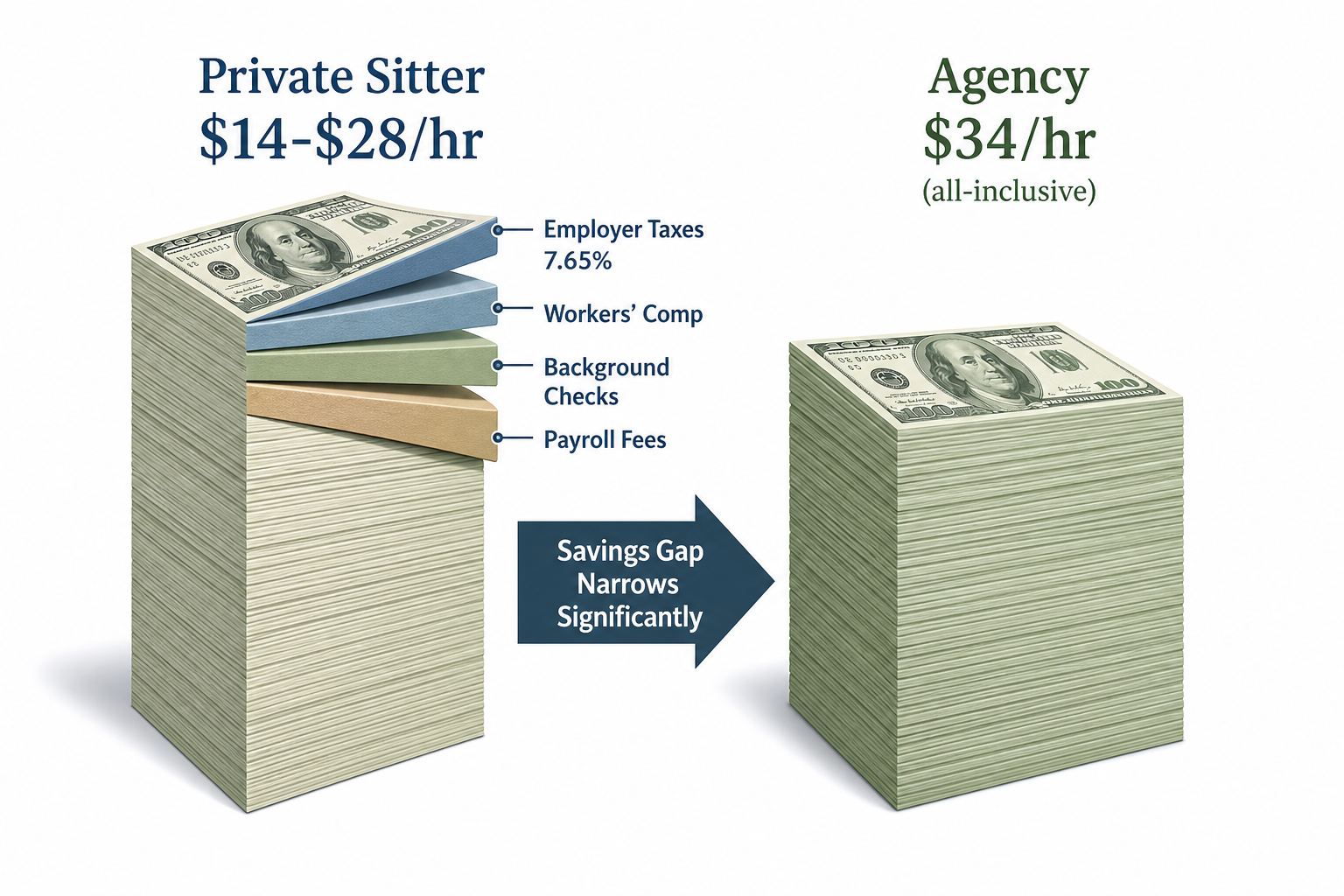
On the other side, independent private sitters typically charge between $14 and $28 per hour, according to PayingForSeniorCare (2024 data). That represents a 20% to 30% savings on the hourly rate alone — a difference that can amount to thousands of dollars per year for a part-time schedule.
| Cost Factor | Agency (2026) | Private Sitter (2024) |
|---|---|---|
| National median hourly rate | $34/hr | $14–$28/hr |
| Lowest state median | $25/hr (Mississippi) | Varies by metro area |
| Highest state median | $44/hr (South Dakota) | Varies by metro area |
| Typical savings vs. agency | — | 20%–30% on hourly rate |
For a detailed breakdown of private companion rates by state, see our companion article: How Much Does a Private Elderly Companion Cost in 2026?. For a broader view of all home care costs, refer to the Elderly Care Cost Per Hour in 2026: A State-by-State Guide.
The Hidden Costs of Hiring a Private Sitter: The Employer Tax Burden
The most significant hidden cost of hiring a private sitter is the employer tax burden. The IRS considers anyone who pays a household employee more than $2,700 per year (2024 threshold) to be a household employer. This means you cannot simply pay the sitter as an independent contractor using a 1099 form. The IRS has consistently ruled that in-home caregivers must be classified as W-2 employees.
As a household employer, you are responsible for:
- FICA taxes: 7.65% of wages (6.2% for Social Security + 1.45% for Medicare) on wages exceeding the $2,700 annual threshold.
- FUTA (Federal Unemployment Tax): 6% on the first $7,000 of wages, though a 5.4% tax credit typically reduces this to 0.6%.
- State unemployment insurance (SUI): Rates vary by state and are based on your payroll.
To see how this adds up, consider a typical part-time schedule: 20 hours per week at $20 per hour, for 50 weeks per year.
| Cost Item | Calculation | Annual Amount |
|---|---|---|
| Gross wages (20 hrs/wk × $20/hr × 50 wks) | — | $20,000 |
| Employer FICA (7.65% on wages over $2,700) | 7.65% × ($20,000 – $2,700) | $1,323 |
| FUTA (0.6% effective on first $7,000) | 0.6% × $7,000 | $42 |
| State unemployment (estimated 2.5% on first $10,000) | 2.5% × $10,000 | $250 |
| Total employer tax burden | — | $1,615 |
That $1,615 in employer taxes adds roughly $1.62 per hour to the effective cost of the sitter — raising the real hourly rate from $20 to $21.62 before any other hidden costs. The 20% to 30% savings on the hourly rate has already begun to shrink.
The Hidden Costs of Hiring a Private Sitter: Insurance, Background Checks, and Payroll
Beyond payroll taxes, families who hire privately must also cover several other costs that are bundled into an agency's rate.
- Workers' compensation insurance: Required in most states for household employees. If a private sitter is injured in your parent's home, you could be liable for medical bills and lost wages. An agency carries its own workers' comp policy.
- Background checks: A thorough national background check typically costs between $10 and $100. Agencies absorb this cost as part of their screening process.
- Payroll service fees: Managing payroll taxes, quarterly filings, and year-end W-2s is complex. Payroll services like Care.com HomePay, SurePayroll, and Gusto charge $30 to $50 per month to handle compliance.
- Liability insurance: Private sitters are not required to carry liability insurance or be bonded. If the sitter damages property or is accused of theft, the family has limited recourse. Agencies typically bond and insure their caregivers.
When you add these costs to the employer tax burden, the effective hourly cost of a private sitter rises significantly. The table below shows the cumulative effect.
| Cost Component | Private Sitter ($20/hr base) | Agency ($34/hr all-inclusive) |
|---|---|---|
| Base hourly rate | $20.00 | $34.00 |
| Employer taxes (FICA + FUTA + SUI) | +$1.62/hr | Included |
| Workers' comp insurance | +$0.50–$1.00/hr | Included |
| Background check (amortized) | +$0.10–$0.50/hr | Included |
| Payroll service ($40/mo amortized) | +$0.50/hr | Included |
| Effective hourly cost | $22.72–$23.62/hr | $34.00/hr |
The Cost of Your Time: Recruiting, Managing, and Firing
The costs above are monetary. But there is another cost that is harder to quantify: your time. As the employer of a private sitter, you take on responsibilities that an agency handles as part of its service.
- Recruiting: Writing a job description, posting on job boards, screening applicants, conducting interviews, and checking references. This can take 10 to 20 hours or more.
- Onboarding: Obtaining an Employer Identification Number (EIN) from the IRS, registering with your state's labor department, completing USCIS Form I-9, and setting up payroll.
- Scheduling and management: Coordinating weekly schedules, handling cancellations, communicating about your parent's changing needs, and providing ongoing supervision.
- Firing: If the arrangement does not work out, you are responsible for terminating the employment relationship — a difficult and emotionally charged process that includes final pay, unemployment paperwork, and finding a replacement.
For an adult child managing a full-time career and their own family, these time commitments are not trivial. An agency acts as the employer of record, handling all of these tasks. If a sitter calls in sick, the agency sends a replacement. If the relationship is not working, the agency manages the transition.
Risk Comparison: What Are You Really Paying For?
The agency's higher hourly rate buys more than convenience. It buys a structured risk management system that most families cannot replicate on their own.
| Risk Factor | Private Sitter | Home Care Agency |
|---|---|---|
| Liability insurance | None — family may be personally liable | Agency carries general liability insurance |
| Workers' compensation | None — family liable for on-the-job injuries | Agency provides workers' comp coverage |
| Background checks | Family must arrange and pay ($10–$100) | Agency conducts as part of hiring process |
| Backup coverage for sick days | None — family must find replacement | Agency provides backup caregiver |
| Theft protection | None — sitter is not bonded | Agency caregivers are typically bonded |
| Payroll and tax compliance | Family must manage (or pay $30–$50/mo for service) | Agency handles all payroll and taxes |
| Supervision and quality control | Family provides ongoing supervision | Agency provides regular check-ins and supervision |
The most serious risk is injury. If a private sitter falls while helping your parent, or is injured while performing duties in your parent's home, you could face significant medical bills or even a lawsuit. Without workers' compensation insurance, those costs come out of your pocket. An agency's workers' comp policy covers this scenario entirely.
The Decision Matrix: When Private Makes Sense vs. When Agency Is Worth It
There is no single right answer. The best choice depends on your family's specific circumstances. The following matrix maps common scenarios to the recommended option.
| Your Situation | Recommended Choice | Why |
|---|---|---|
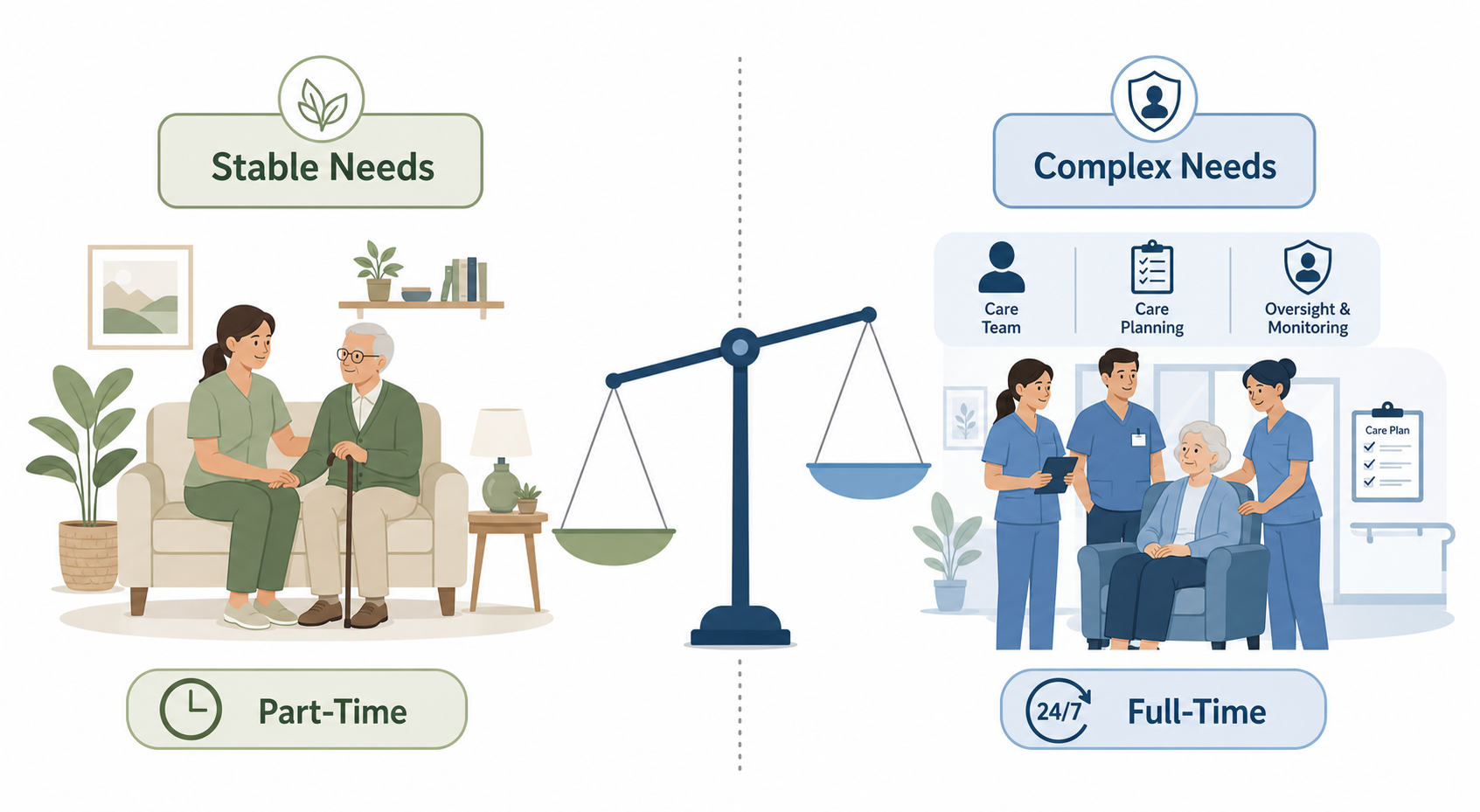
| Stable, predictable needs; 10–15 hrs/week | Private sitter | Lower total cost; manageable employer responsibilities at low hours; lower risk exposure |
| Part-time care (15–25 hrs/week); you have time to manage | Private sitter | Significant savings even after hidden costs; worth the time investment if you can handle payroll and compliance |
| Full-time care (30+ hrs/week) | Agency | Risk exposure and management burden increase with hours; agency backup coverage becomes critical |
| Complex medical or behavioral needs | Agency | Agency provides trained, supervised caregivers; private sitters typically lack formal training |
| Crisis mode (urgent need after hospital discharge) | Agency | Agency can start care immediately; private hiring takes weeks |
| Long-distance caregiver; no local oversight | Agency | Agency provides supervision, backup, and quality assurance that you cannot provide remotely |
| Tight budget; you have time and organizational bandwidth | Private sitter | Maximum savings if you can manage the employer role effectively |
| Low risk tolerance; want maximum protection | Agency | All-inclusive insurance, bonding, and compliance provide peace of mind |
How to Start Whichever Path You Choose
Once you have decided, the next step is taking action. Here is how to begin on either path.
If you choose an agency
- Ask about their screening process: Do they conduct national background checks? Are caregivers bonded and insured?
- Clarify backup coverage: What happens if the regular caregiver is sick or on vacation? Is there a guaranteed replacement?
- Understand the billing structure: Is it a flat hourly rate, or are there additional fees for weekends, holidays, or overtime?
- Request references from other families who have used the agency for companion-level care.
If you choose a private sitter
Hiring a private sitter requires more upfront work, but the savings can be substantial. Follow these steps to do it legally and safely.
- Find candidates through trusted sources: word of mouth, local caregiver registries, or online platforms. Conduct thorough interviews and check at least two references.
- Run a national background check ($10–$100). Do not skip this step.
- Obtain an EIN from the IRS and register with your state's labor department. Set up a payroll service ($30–$50/month) to handle tax withholding and filings.
- Draft a written caregiver agreement that outlines duties, schedule, pay rate, overtime policy, and termination terms. This is especially important if the caregiver is a family member, as it can affect Medicaid eligibility.
- Verify your state's workers' compensation requirements and obtain a policy if required.
For a detailed step-by-step walkthrough of the private hire process, see our guide: How to Find and Pay for Home Help for an Elderly Parent: A Step-by-Step Guide.
Questions to bring to a clinician or OT
This is not medical, legal, or a family's final decision — only a framework. Bring these questions to a clinician, occupational therapist, or your local Area Agency on Aging.
Find Local HelpRelated reading
Noticed something outdated or inaccurate on this page? Flag a correction. We review every report against CDC, NIA, and AARP HomeFit guidance before updating a page.