Aging in Place Checklist After a Parent Falls: A 5-Phase Action Plan
After a parent falls at home, caregivers need a single, sequenced plan covering immediate response, medical follow-up, a professional home safety evaluation (now covered by Medicare), prioritized modifications, and emotional recovery. This five-phase framework draws on CDC, NIA, and Medicare guidance to help families act decisively and break the cycle of increased fall risk.
By Editorial Team
new caregiver
experienced caregiver
long-distance caregiving
spousal caregiver
working caregiver
daily routines
medication management
personal hygiene
care coordination
first steps
ADLs
IADLs
An aging in place checklist after a parent falls has to start before the shopping list. In the first hour, the job is not to decide which grab bar to buy. It is to decide whether your parent is medically safe, whether they should be moved, and what needs to be documented before everyone gets tired and the details blur.
A fall at home is often treated like a mess to clean up: help them up, check for bruises, reassure each other, move on. That is understandable. It is also where families lose the best prevention window. One fall doubles future fall risk, and fewer than half of older adults see a doctor after a fall, even though follow-up can uncover medication problems, blood pressure drops, vision changes, balance issues, or injuries that were not obvious on the floor.[1]
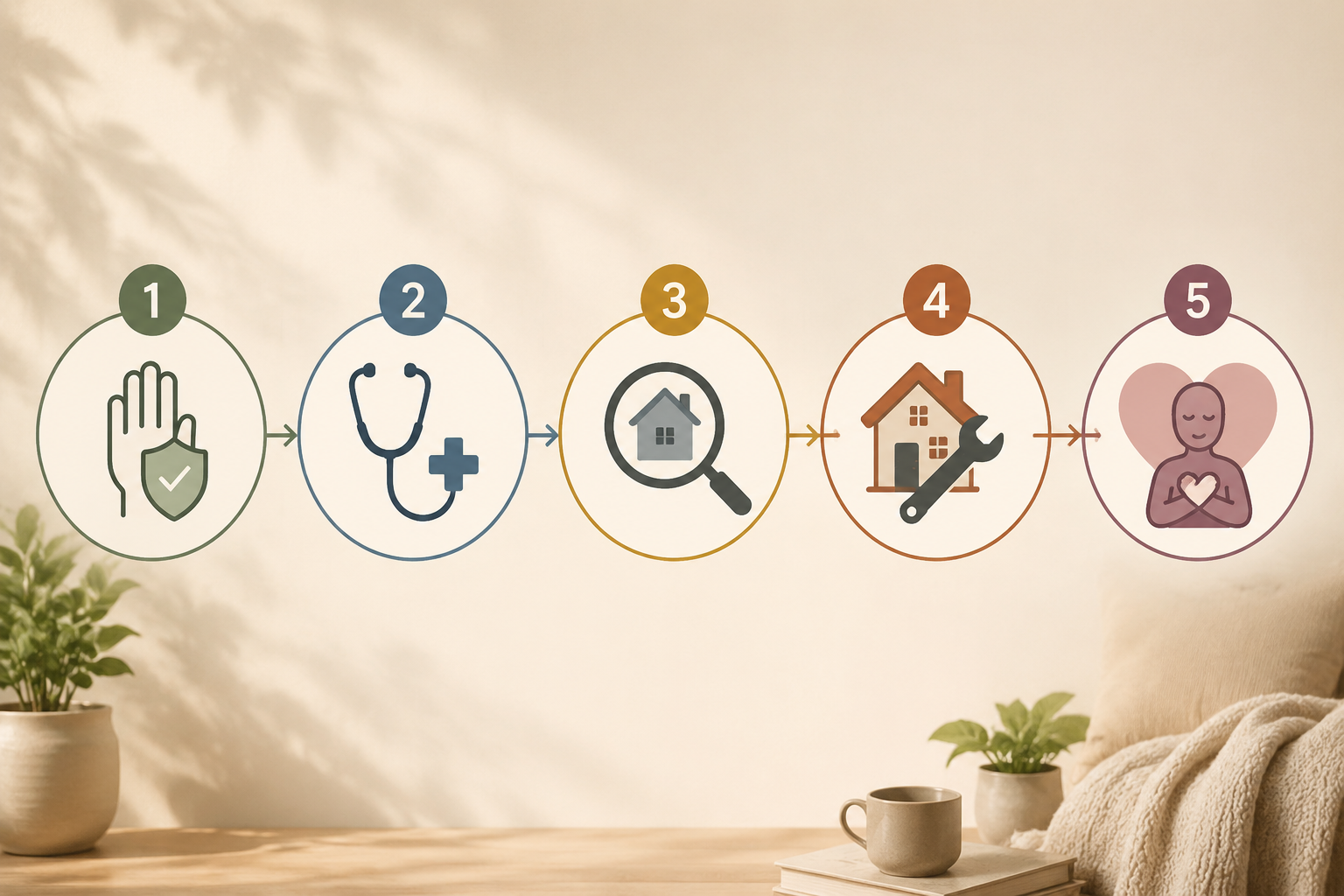
Use the fall to create a dated plan. Not a vague promise to be more careful. Not a cart full of safety products. A sequence.
Phase
When
Main decision
1. Immediate response
Right now
Is this an emergency, and can your parent move safely?
2. Medical follow-up
Today to tomorrow
What caused or contributed to the fall, and what was injured?
3. Professional home safety evaluation
This week
What hazards would a trained evaluator prioritize first?
4. Targeted home modifications
This month
Which fixes reduce the most risk without creating new problems?
5. Emotional recovery
Ongoing
Is fear quietly shrinking your parent’s activity and strength?
Phase 1: Make the First Hour Safer
Start by slowing the room down. If your parent is on the floor, do not rush to pull them up. Ask what hurts. Look for bleeding, deformity, confusion, head impact, severe pain, or signs they may have fractured a hip. Call 911 if they hit their head, cannot get up, have heavy bleeding, seem confused, have chest pain or shortness of breath, may have a hip fracture, or you are not sure they can be moved safely.[2]
If there is no obvious emergency and they want to stand, make it controlled. Bring a sturdy chair close. Have them roll to their side, get to hands and knees if they can, place their hands on the chair, and rise slowly with support. If they cannot do this without pain, dizziness, or weakness, stop. Needing help up is not a failure; it is information.
Write down the time of the fall and where it happened.
Ask what they remember immediately before the fall: dizziness, rushing to the bathroom, tripping, turning, standing up, reaching, or blacking out.
Take photos of the area before moving rugs, cords, shoes, pet bowls, or furniture.
Keep watching for delayed symptoms: increasing pain, sleepiness, confusion, vomiting, weakness, faintness, or signs of shock.
The photo is not for blame. It helps the doctor, therapist, or home safety evaluator understand the fall as an event with clues, not just a sentence in a portal message.
Phase 2: Turn “I’m Fine” Into a Medical Follow-Up
If your parent was not taken to the emergency room, call their primary care office the same day or the next business day. Use plain language: “My parent fell at home. We need a post-fall evaluation, not just a routine visit.” The reason is simple: many causes of falls are not visible in the bruise pattern.
This is the handoff families often miss. The discharge paper says “follow up,” the parent says they feel okay, and two weeks later everyone has moved on except the risk factors that are still sitting there.
Bring a short, specific agenda. A good post-fall visit may include orthostatic blood pressure checks, a medication review, gait and balance assessment, vision screening, imaging when symptoms or the fall pattern call for it, lab work such as vitamin D, B12, or thyroid testing when clinically appropriate, and a bone health review if osteoporosis risk or fracture history is part of the picture.[3]
Ask for
Why it matters after a fall
Orthostatic blood pressure
Checks whether blood pressure drops when your parent stands, which can cause dizziness or fainting.
Medication review
Looks for sedatives, sleep aids, blood pressure drugs, or combinations that may increase dizziness, confusion, or instability.
Gait and balance assessment
Shows whether weakness, shuffling, poor turning, or unsteady transfers need therapy.
Vision screening
Catches changes that make steps, thresholds, rugs, or pets harder to see.
Imaging when indicated
Helps rule out fractures or head injury when symptoms, impact, or pain pattern warrant it.
Labs when indicated
Can identify contributors such as vitamin deficiency or thyroid problems when the clinician suspects them.
Bone health review
Matters because a fall with fragile bones can change the consequence from soreness to fracture.
Do not let the appointment end with only “be careful.” Ask what changed because of the fall. Is a medication being adjusted? Is physical therapy being ordered? Is a walker or cane being evaluated for proper fit? Should the parent avoid stairs for now? Should they be seen sooner if pain worsens? The visit should produce instructions that someone can actually follow on Tuesday morning.
If there was an emergency room visit, read the discharge sheet before the day ends. Look for follow-up timing, medication changes, warning signs, imaging results, and activity restrictions. Then make the follow-up appointment yourself if your parent will let you. “Call your doctor” is not a plan until there is a date and time.
Phase 3: Get a Professional Home Safety Evaluation This Week
After the medical follow-up is in motion, bring trained eyes into the home. This is different from walking around with a hardware-store checklist. An occupational therapist, physical therapist, or Certified Aging-in-Place Specialist can connect the fall story to the actual movements your parent makes: getting out of bed, turning in the bathroom, carrying laundry, stepping over the threshold, reaching for a mug, answering the door.
This step became more important in 2026. Medicare Part B began covering professional home safety evaluations starting in January 2026 when ordered by a physician, according to coverage guidance summarized for patients and families.[4] That does not mean every related item is free, and it does not mean every home modification is covered. It means families should now ask the doctor directly for an order and then verify deductibles, copays, network rules, and Medicare Advantage requirements before scheduling.
The physician order matters because it turns the evaluation from a good idea into a documented health-related service. Ask the primary care doctor, geriatrician, or post-hospital clinician for an order for a home safety evaluation after a fall. If physical therapy or occupational therapy is already being discussed, ask whether the therapist can evaluate transfers, mobility, bathroom safety, and assistive-device use in the home.
The CDC’s STEADI “Check for Safety” brochure is a useful framework for what the evaluator is looking for: floors, stairs, lighting, bathrooms, kitchens, bedrooms, and common walking paths.[5] The difference is that a professional can judge priority. A loose rug in the hallway, a towel bar being used like a grab bar, and a parent who gets dizzy after standing are not three equal checklist items. Together, they describe a likely repeat fall.
Before the visit, share where the fall happened and what your parent was doing.
Have your parent demonstrate normal routines if safe: bathroom trips, bed transfers, favorite chair, stairs, kitchen reach, and entryway use.
Ask the evaluator to separate urgent fixes from later improvements.
Ask which recommendations require a contractor, which can be done this weekend, and which should wait until therapy or medical results are clearer.
Get the recommendations in writing so siblings, doctors, and contractors are working from the same page.
Be careful with certainty here. Home safety evaluations and targeted interventions can reduce fall risk, and some programs report reductions up to 36%, but results depend on the person, the home, the follow-through, and whether medical contributors are addressed at the same time.[4] The evaluation is not a magic shield. It is the best way to stop guessing.
Phase 4: Fix the Highest-Risk Parts of the Home First
Once you have medical input and a home safety evaluation, start with the fixes that match how the fall happened and how your parent actually lives. The National Institute on Aging recommends looking room by room for fall hazards, including bathrooms, stairs, bedrooms, kitchens, and walking paths.[6] That does not mean every room gets equal money this month.
Bathrooms usually deserve fast attention because they combine water, hard surfaces, turning, reaching, and private routines your parent may not want help with. Install grab bars anchored into wall studs, add a non-slip shower surface, consider a shower chair, and evaluate whether a raised toilet seat or toilet safety frame would make transfers safer. Do not use suction-cup grab bars for weight-bearing support; they are not reliable for the job families usually want them to do.[7]
Stairs and entryways come next if your parent uses them daily. Add secure handrails on both sides when possible, improve lighting, repair uneven steps, mark edges if depth perception is a problem, and remove clutter near the landing. At the entry, look for thresholds, loose mats, poor lighting, packages left in the path, and whether your parent is trying to manage keys, mail, a cane, and a storm door at the same time.
Bedroom pathways matter because many falls happen when people are tired, rushed, or not fully awake. Clear the route from bed to bathroom. Add nightlights or motion-sensor lighting. Check bed height: too low can make standing difficult; too high can make feet dangle and transfers unstable. Put glasses, phone, water, and a light within easy reach so the first movement of the night is not a blind reach into darkness.
In the kitchen, lower the demand for reaching and climbing. Move frequently used items to waist-to-shoulder height. Retire the step stool if balance is uncertain. Consider lever-style handles if grip strength or arthritis makes knobs difficult. In hallways, remove clutter, tape down or remove loose cords, improve lighting, and make sure furniture does not turn the walking path into an obstacle course. The NCOA’s fall-proofing guidance is useful here because it keeps attention on ordinary household hazards rather than specialty equipment alone.[8]
Do this weekend: remove loose rugs, clear pathways, add nightlights, move daily-use items within reach, clean up cords, and improve entry lighting.
Schedule soon: stud-mounted grab bars, stair rail repairs, threshold fixes, better bathroom equipment, and lighting changes that require electrical work.
Plan carefully: walk-in shower conversions, ramps, widened doorways, flooring replacement, and major layout changes.
When fixes become expensive, pause long enough to match the scope to the likely future. A few hundred dollars of urgent safety work is different from a remodel that changes the long-term housing plan. If Medicare will not pay for a modification, review funding sources for home modifications and broader aging-in-place remodel grants, loans, and assistance programs before assuming the only option is family cash.
For contractor work, choose someone who understands aging-in-place details, not just general remodeling. Grab bar blocking, shower slope, threshold height, lighting placement, and door swing can decide whether a beautiful fix is actually safe. If you are hiring, use a guide to choose an aging-in-place contractor and ask whether local programs such as Habitat for Humanity aging-in-place services are available in your area.
If the recommended changes are extensive, compare the remodel against care alternatives before the family starts ordering materials. A remodel cost versus assisted living decision guide can help turn a stressful argument into a budget and care conversation.
Phase 5: Watch Confidence as Closely as Bruises
The fall may be over physically before it is over emotionally. Some parents become more cautious in a healthy way. Others quietly begin shrinking their world. They stop walking to the mailbox. They stop showering unless someone is home. They give up church, errands, gardening, or the basement laundry because the fear feels bigger than the activity.
That pattern matters because fear can become a fall risk of its own: fear leads to activity restriction, activity restriction leads to weakness and poorer balance, weakness raises fall risk, and another fall makes the fear feel justified. Nearly 1 in 3 older adults develops significant anxiety after a fall, and one cited study found that 26% met PTSD criteria at a two-month follow-up.[9]
Those numbers should not be used to label every worried parent. They should give families permission to take the emotional part seriously. A parent who says “I’m fine” but stops moving normally is giving you another kind of symptom.
Track what your parent has stopped doing since the fall.
Ask about confidence in specific activities, not general fear: showering, stairs, getting out of bed, walking outside, using the toilet at night.
Encourage safe, prescribed movement rather than blanket rest, especially if physical therapy has been recommended.
Tell the doctor if fear is causing isolation, poor sleep, panic symptoms, refusal to bathe, or major activity restriction.
Ask about mental health support when anxiety, depression, or trauma symptoms persist.
Cognitive behavioral therapy is described as a gold-standard treatment for fall-related anxiety, and Medicare Part B covers outpatient mental health services for conditions such as anxiety, depression, and PTSD, including some telehealth services.[9] For an adult child trying to coordinate care from work, that coverage detail can matter. The right support may be a therapist, a physical therapist, a primary care follow-up, or all three working from the same story.
Put the Plan on a Calendar
A useful post-fall plan has dates attached. Today: document the fall, watch for delayed symptoms, and call for medical advice if anything is uncertain. Tomorrow: confirm the follow-up appointment and ask what should be checked. This week: request the physician order for a home safety evaluation and verify Medicare or plan rules. This month: complete the urgent home fixes first, then price the larger ones. Ongoing: notice whether your parent is moving more safely or moving less.
Preventing the next fall is not one purchase, one checklist, or one serious family talk. It is a sequenced response during the weeks when action matters most: medical follow-up, trained eyes on the home, practical fixes in the right order, and attention to the confidence your parent needs to keep living in the house safely.

Comments
Join the discussion with an anonymous comment.