
Caregiver decision guide
What Is 'Home Help for the Elderly'? A Complete Guide to Types of In-Home Care Services
Adult children new to caregiving often confuse companion care, personal care, home health, and skilled nursing — leading to costly mismatches. This guide breaks down the six-tier spectrum of in-home services, what each costs, who provides it, and how to match your parent's needs to the right level of care.
Why 'Home Help' Means Different Things to Different Families
When you first search for "home help for the elderly," the results blur together. Home care. Home health. Homemaker. Companion care. Personal care aide. Home health aide. CNA. The terms are used interchangeably by providers, insurers, and well-meaning friends — but they describe fundamentally different services with different costs, different credentials, and different legal scopes of practice.
This ambiguity has a real financial cost. Families routinely pay for skilled nursing they don't need because they didn't know a home health aide could handle the task. Or they hire a companion for a parent who needs hands-on bathing assistance, only to discover the companion isn't legally allowed to provide it. The result is either overpaying by $20–40 per hour or leaving a critical care gap that leads to a preventable crisis.
This guide breaks down the six distinct tiers of in-home care services — from companion visits to registered nursing — with concrete descriptions of what each tier does and does not do, the credentials required, and the cost range you should expect in 2026. Our goal is to give you a decision framework that prevents costly mismatches before they happen.
The Six-Tier Spectrum of In-Home Care Services
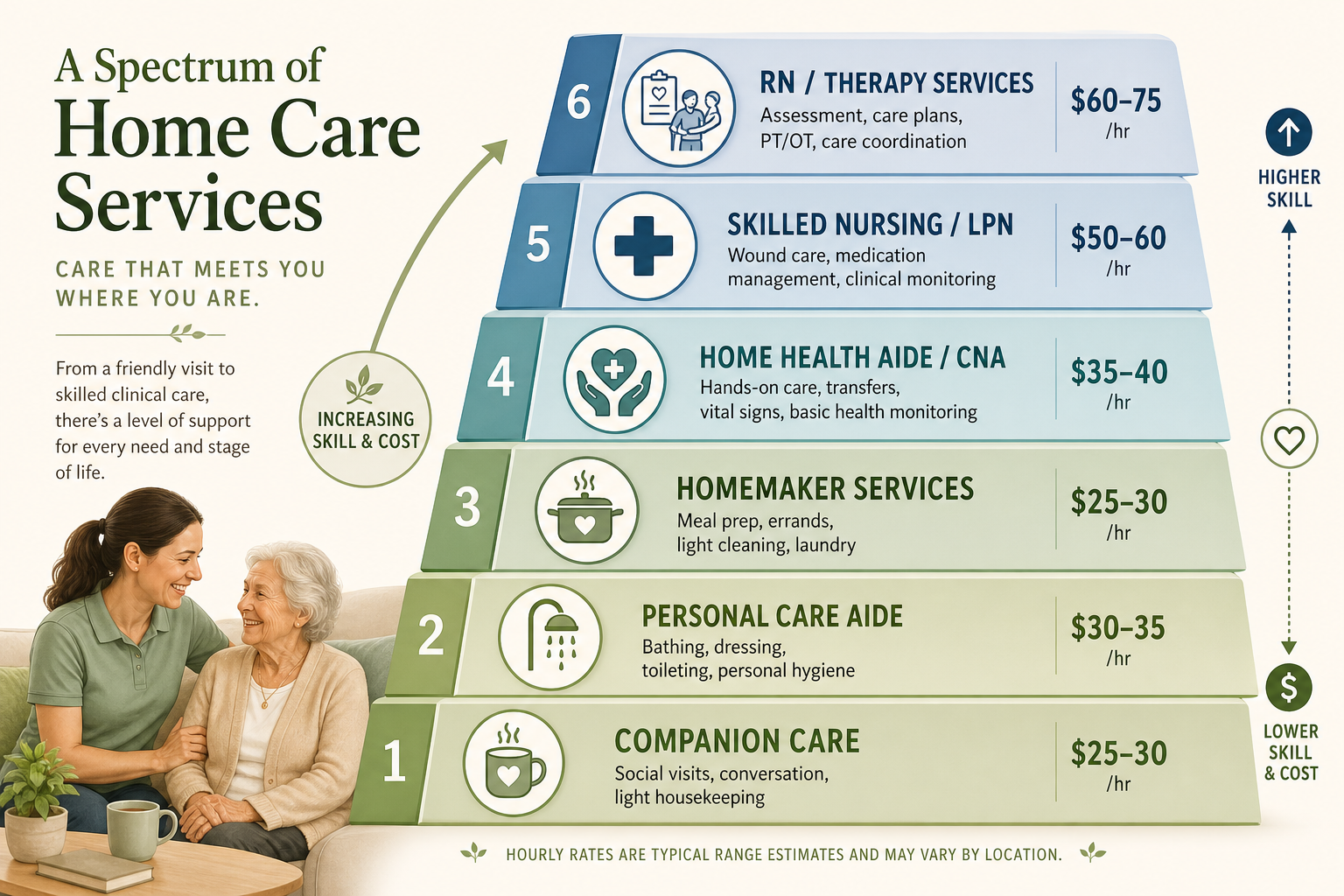
Every in-home care provider falls into one of six categories, defined by the type of training they've completed and the tasks they are legally permitted to perform. Understanding this hierarchy is the single most important step in matching your parent's needs to the right level of care.
Tier 1: Companion Care
Companions provide social interaction, supervision, and light assistance with non-medical tasks. They are typically not required to hold formal healthcare certifications. Their role is to reduce isolation, engage the older adult in conversation or activities, and provide a reassuring presence.
What companions do: conversation and companionship, reading aloud, playing cards or board games, accompanying on walks, providing transportation to appointments, light meal preparation (warming pre-prepared food), and light housekeeping such as washing dishes or tidying up.
What companions do NOT do: hands-on bathing or toileting assistance, medication administration, wound care, transfers (lifting or moving the person from bed to chair), or any medical task. If your parent needs help getting in and out of the shower, a companion is not the right service.
For a detailed breakdown of what companion care covers and where its boundaries lie, see our dedicated guide: What Does a Companion for the Elderly Actually Do? Scope, Limitations, and How It Differs from Personal Care.
Tier 2: Personal Care Aide / Home Care Aide
Personal care aides (PCAs) — sometimes called home care aides — are trained to assist with activities of daily living (ADLs): bathing, dressing, grooming, toileting, and transferring. Training requirements vary significantly by state, but typically include a high school diploma or equivalent and on-the-job training. Some states require a minimum number of training hours (often 16–40 hours) and a competency evaluation.
PCAs can help with meal preparation, light housekeeping, medication reminders (not administration), and escorting to appointments. They are the most common type of in-home caregiver for older adults who need hands-on assistance but do not require medical procedures.
Tier 3: Homemaker Services
Homemaker services focus on the household environment rather than the person. A homemaker handles cleaning, laundry, grocery shopping, meal preparation, and errands. They may also provide incidental companionship, but their primary role is maintaining a safe, clean, and well-stocked home.
Homemaker services are often confused with companion care, and in practice the two roles overlap significantly. The distinction is one of emphasis: a companion's primary purpose is social engagement; a homemaker's primary purpose is household maintenance. Many agencies offer a combined companion/homemaker role.
Tier 4: Home Health Aide (HHA) / Certified Nursing Assistant (CNA)
Home health aides and CNAs represent a significant step up in training and scope. CNAs complete state-approved training programs lasting 4–8 weeks and must pass a state certification exam. HHAs receive additional training beyond the CNA level, including instruction in simple wound care, blood pressure readings, and other basic medical tasks.
Both CNAs and HHAs can provide hands-on physical support for ADLs — bathing, toileting, dressing, transferring, and turning/repositioning bedridden patients. They can record vital signs and assist with medications and treatments as directed by a supervising nurse. HHAs can perform simple wound care and take blood pressure readings.
Most states maintain public registries where you can verify a CNA or HHA's certification status. This is an essential step before hiring.
Tier 5: Licensed Practical Nurse (LPN)
LPNs complete approximately 12 months of vocational training and must pass the NCLEX-PN exam. They are licensed to perform a wider range of medical tasks than CNAs or HHAs, including administering medications (oral, topical, and injectable), placing catheters, dressing complex wounds, monitoring vital signs, and providing patient education.
LPNs work under the supervision of a registered nurse or physician. They are appropriate when your parent needs regular medical monitoring or medication management that exceeds what an HHA can provide, but does not require the full scope of an RN.
Tier 6: Registered Nurse (RN) and Therapy Services
RNs hold either an associate degree (2 years) or a bachelor of science in nursing (4 years) and must pass the NCLEX-RN exam. They are the highest level of in-home care provider and can perform all the tasks an LPN can, plus developing and managing care plans, administering IV medications, performing comprehensive assessments, and coordinating with physicians.
Therapy services — physical therapy, occupational therapy, and speech-language pathology — are typically provided by licensed therapists who hold graduate degrees in their respective fields. These services are almost always prescribed by a physician and are usually covered by Medicare when medically necessary.
Quick-Reference Table: Matching Your Parent's Needs to the Right Service
The table below maps common care needs to the appropriate service tier. Use it as a starting point when discussing your parent's situation with providers.
| Care Need | Appropriate Service Tier(s) | Minimum Credential Required |
|---|---|---|
| Socialization, conversation, supervision | Companion care | None (informal) |
| Light housekeeping, laundry, grocery shopping | Homemaker services / Companion care | None (informal) |
| Meal preparation (cooking from scratch) | Homemaker services / Personal care aide | None (informal) |
| Medication reminders (not administration) | Personal care aide / Companion care | None (informal) |
| Medication administration (oral, injectable) | Skilled nursing (LPN or RN) | LPN license or higher |
| Bathing assistance (hands-on) | Personal care aide / HHA / CNA | State-specific training (varies) |
| Toileting and incontinence care | Personal care aide / HHA / CNA | State-specific training (varies) |
| Transferring (bed to chair, chair to toilet) | HHA / CNA (or higher) | CNA certification or higher |
| Turning and repositioning (bedridden) | CNA / HHA (or higher) | CNA certification or higher |
| Wound care (simple, non-infected) | HHA (with additional training) or LPN/RN | HHA training or LPN license |
| Wound care (complex, infected, or surgical) | Skilled nursing (LPN or RN) | LPN license or higher |
| Blood sugar monitoring / insulin management | Skilled nursing (LPN or RN) | LPN license or higher |
| Physical therapy after surgery or injury | Licensed physical therapist | Doctorate in Physical Therapy (DPT) |
| Occupational therapy (ADL retraining) | Licensed occupational therapist | Master's or doctorate in OT |
| Care plan development and coordination | Registered nurse (RN) | RN license (ADN or BSN) |
How to Assess What Your Parent Actually Needs: A Self-Assessment Checklist
Before you call a single agency, take 30 minutes to complete an honest assessment of your parent's functional needs. This step is the single most effective way to avoid overpaying for skilled care you don't need or under-hiring for hands-on needs that a companion cannot legally provide.
Work through the following checklist. For each activity, note whether your parent can perform it independently, needs supervision or cueing, needs hands-on assistance, or is completely dependent.
Activities of Daily Living (ADLs)
- Bathing: Can your parent get in and out of the shower or tub safely? Can they wash all body parts without assistance?
- Dressing: Can they select appropriate clothing, put it on, fasten buttons and zippers, and remove it without help?
- Toileting: Can they get to the toilet, transfer on and off, manage clothing, and clean themselves?
- Transferring: Can they get in and out of bed, a chair, or a wheelchair without assistance?
- Continence: Can they control bladder and bowel function, or do they need help with incontinence products?
- Feeding: Can they bring food to their mouth, chew, and swallow safely?
Instrumental Activities of Daily Living (IADLs)
- Meal preparation: Can they plan and cook balanced meals safely?
- Housekeeping: Can they maintain a clean, safe living environment?
- Medication management: Can they take the right dose at the right time without reminders?
- Transportation: Can they drive safely or use public transportation independently?
- Money management: Can they pay bills, track expenses, and avoid financial scams?
- Communication: Can they use the phone, manage mail, and schedule appointments?
Agency vs. Independent Caregiver: What Families Need to Know
Once you know what level of care you need, the next decision is whether to hire through an agency or find an independent caregiver directly. Each path has distinct tradeoffs that affect cost, risk, and peace of mind.
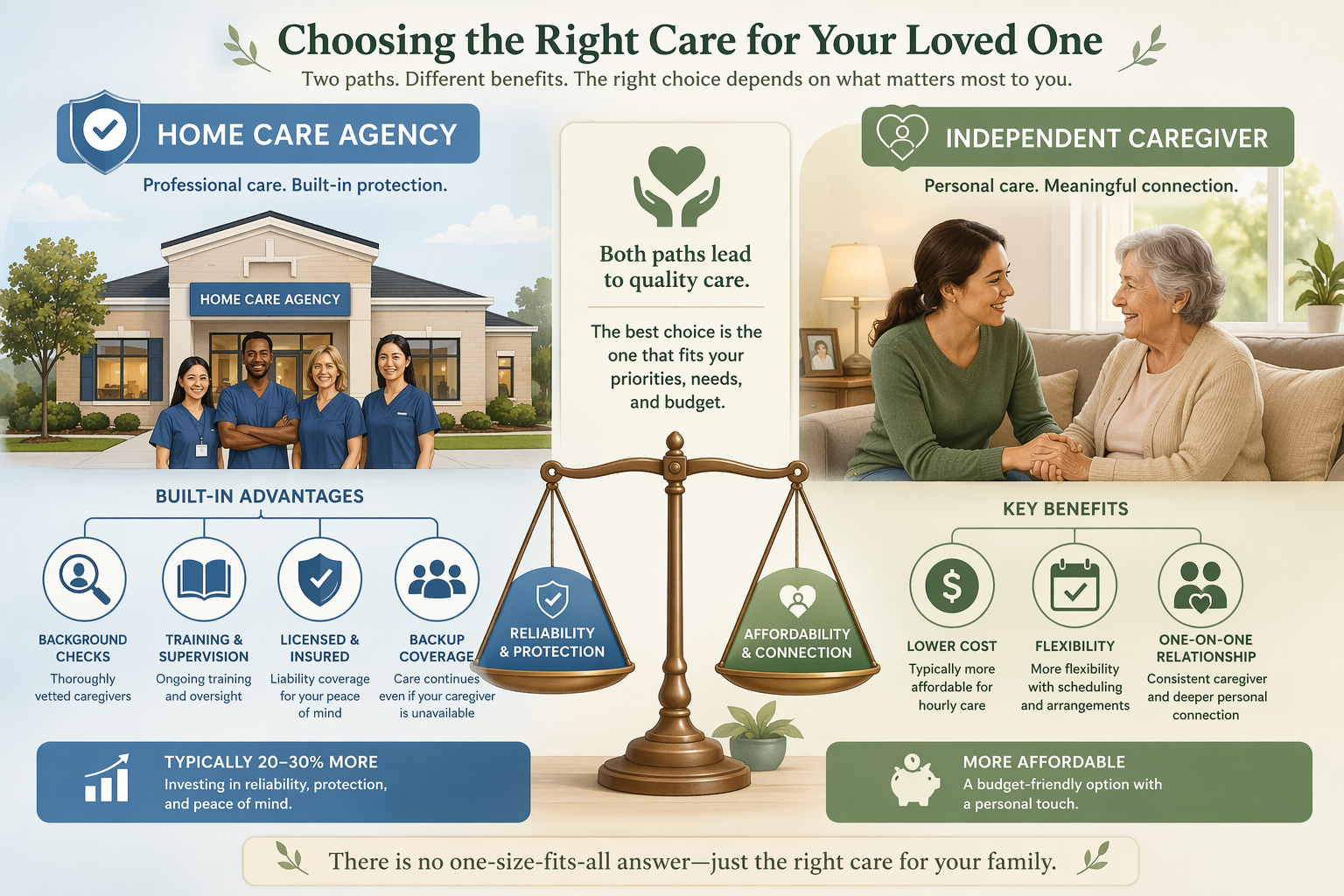
Agencies typically charge 20–30% more than independent caregivers, according to industry data from SeniorLiving.org. That premium buys several things: background checks and drug screening, professional liability insurance and workers' compensation coverage, ongoing training and supervision, and backup coverage if the regular caregiver is sick or unavailable.
Independent caregivers charge less — often $20–25 per hour compared to an agency's $30–35 per hour for the same level of care — but the family assumes responsibility for vetting, scheduling, payroll taxes, and finding backup coverage. If the independent caregiver calls in sick, there is no replacement.
For a detailed comparison of agency, registry, and independent hiring options, see our guide: Home Care Agency vs. Home Health Agency vs. Registry: Which Type of Elderly Care Company Is Right for Your Parent?.
What Each Service Tier Costs in 2026
Cost is the most common source of confusion and frustration for families. The national median for nonmedical in-home care in 2026 is approximately $34–35 per hour, according to data from both A Place for Mom and SeniorLiving.org. But that single number masks enormous variation by service tier and geographic location.
| Service Tier | National Cost Range (per hour) | Typical Monthly Cost (30 hrs/week) |
|---|---|---|
| Companion care | $25–$30 | $3,000–$3,600 |
| Personal care aide / Homemaker | $30–$35 | $3,600–$4,200 |
| Home health aide / CNA | $35–$40 | $4,200–$4,800 |
| Skilled nursing (LPN) | $50–$60 | $6,000–$7,200 |
| Registered nurse (RN) / Therapy | $60–$75 | $7,200–$9,000 |
State-level variation is substantial. The lowest median hourly rates are in Louisiana ($23/hr) and Mississippi ($25/hr), while the highest are in Washington ($42/hr), Minnesota ($41/hr), and Colorado ($40/hr), according to SeniorLiving.org's 2026 state-by-state analysis.
Most families can reduce their total cost by layering services: using a companion or personal care aide for the bulk of daily needs and bringing in skilled nursing only for specific medical tasks. For example, a parent who needs help with bathing and meal prep but also requires weekly wound care might use a personal care aide for 25 hours per week ($30/hr) and an LPN for 2 hours per week ($55/hr), for a blended rate of approximately $32/hr rather than paying $55/hr for all 27 hours.
Key Questions to Ask When Interviewing Providers
Whether you choose an agency or an independent caregiver, these questions will help you verify that you're hiring the right level of care and avoid costly mismatches.
Questions for Agencies
- What credentials do your caregivers hold? Can you provide a breakdown of CNAs, HHAs, LPNs, and RNs on staff?
- Do you conduct national background checks and drug screening on all caregivers?
- What training do your caregivers receive beyond state minimum requirements?
- What is your backup plan if the assigned caregiver is sick or unavailable?
- Do you carry professional liability insurance and workers' compensation coverage?
- How do you supervise and evaluate caregiver performance? How often does a supervisor visit the home?
- Can we meet the caregiver before they start? What is the process if we need to request a different caregiver?
Questions for Independent Caregivers
- What is your training and certification? Can you provide documentation?
- Have you passed a background check? Can you provide a copy?
- Do you have liability insurance? (Most independent caregivers do not — this is a risk the family assumes.)
- What specific tasks are you comfortable and trained to perform? (Be explicit about bathing, toileting, transfers, and any medical tasks.)
- What is your availability? Do you have other clients? What happens if you are sick?
- Can you provide references from at least two previous clients?
- Are you willing to sign a written care agreement that specifies duties, schedule, and rate?
Next Steps: Building Your Parent's Care Plan
You now have the framework to make an informed decision. Here is the action path we recommend:
- Complete the self-assessment checklist above. Identify which ADLs and IADLs your parent needs help with.
- Match those needs to the appropriate service tier using the quick-reference table.
- Decide whether to use an agency or hire independently, based on your risk tolerance and oversight capacity.
- Interview at least two providers using the questions above. Verify credentials through your state registry.
- Start with a trial period — one to two weeks — to confirm the match is working before committing to a long-term arrangement.
- For guidance on layering multiple services (companion care plus periodic skilled visits), see our step-by-step guide: Building Your Parent's Services Stack: A Step-by-Step Guide to Layering Home Care From Free Community Services to Skilled Nursing at Home.
Two national resources can help you find local providers and navigate the system: the Eldercare Locator (800-677-1116), a public service of the U.S. Administration on Aging that connects families to local aging services, and your local Area Agency on Aging, which can provide information about home care options, funding sources, and community-based services in your area.
Questions to bring to a clinician or OT
This is not medical, legal, or a family's final decision — only a framework. Bring these questions to a clinician, occupational therapist, or your local Area Agency on Aging.
Find Local HelpRelated reading
- Companion Care vs. Home Health Aide vs. Personal Care vs. Skilled Nursing: How to Choose What Your Parent Actually Needs
- When to Hire a Sitter for an Elderly Parent: 7 Signs It's Time and How to Start the Conversation
- When More Medications Means More Risk: A Caregiver's Guide to Polypharmacy in Older Adults
Noticed something outdated or inaccurate on this page? Flag a correction. We review every report against CDC, NIA, and AARP HomeFit guidance before updating a page.