
Glossary entry
Building Your Parent's Services Stack: A Step-by-Step Guide to Layering Home Care From Free Community Services to Skilled Nursing at Home
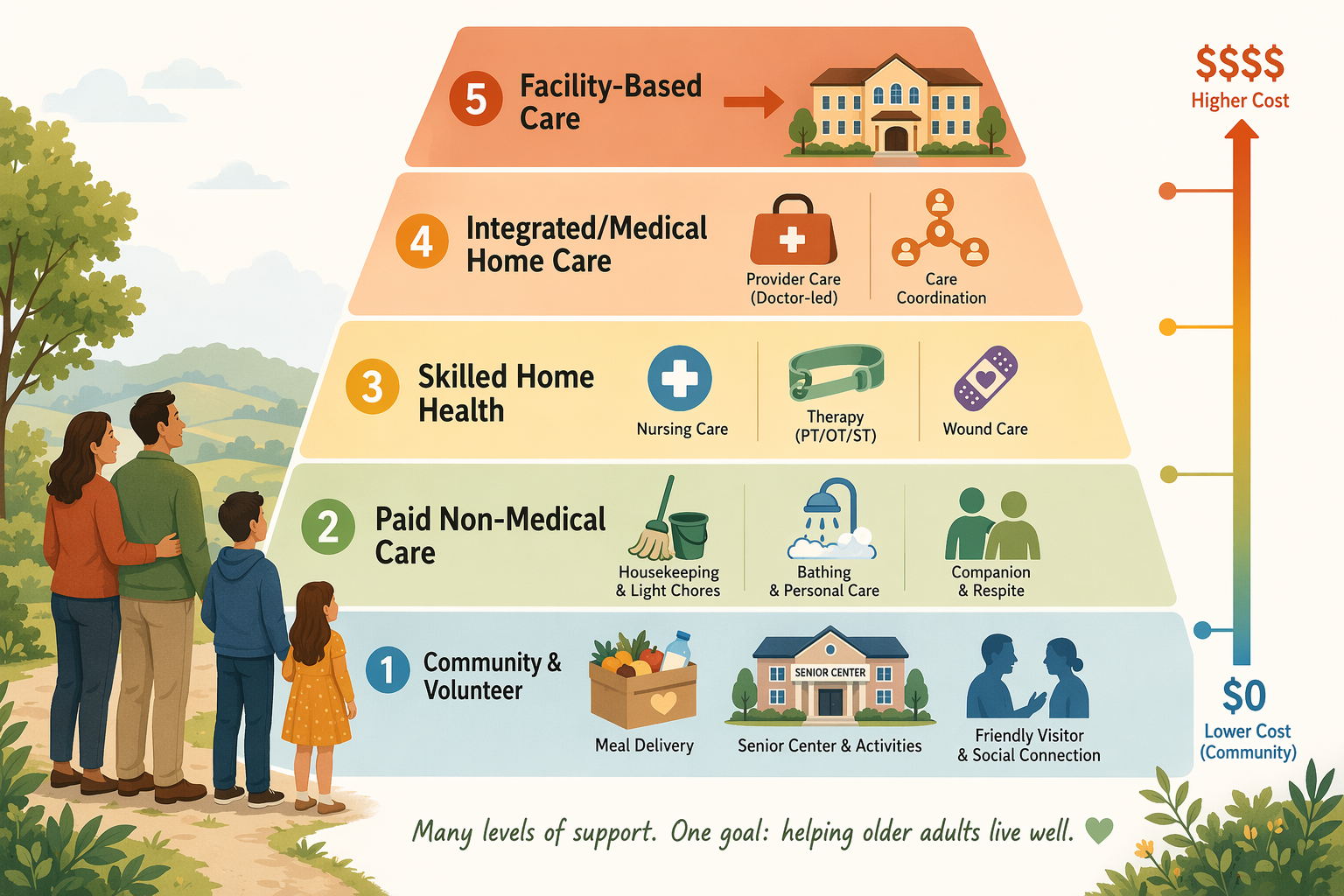
Why a Layered 'Services Stack' Approach Works Better Than Adding Care Reactively
Most families build a home care plan the hard way: they wait for a crisis — a fall, a hospitalization, a dementia-related incident — and then scramble to find a single service that addresses the immediate problem. That service often turns out to be more expensive than necessary, poorly matched to the actual need, or unsustainable over time. Then another crisis hits, and another service gets added. The result is a patchwork of care that costs more and covers less than a thoughtfully layered plan.
A more effective approach is to think in terms of a services stack — a tiered system where each layer addresses a specific level of need, and each layer can delay or eliminate the need for the next, more expensive tier. You start with the broadest, most affordable supports (free community services), add paid non-medical help only when daily tasks become difficult, and bring in skilled medical care only when a doctor determines it is medically necessary. The stack is not a one-time decision; it is a framework you return to as needs evolve.
The logic is straightforward: a Meals on Wheels delivery can reduce loneliness and the risk of malnutrition, which may delay the need for a home health aide. A few hours of light housekeeping per week can prevent a fall caused by clutter, which may avoid a hospitalization that triggers a need for skilled nursing. Each layer buys time and preserves independence at a lower cost than the layer above it.
Layer 1: Community and Volunteer Services — Starting at $0
The foundation of the services stack is a set of community-based programs that are either free or very low cost. These services do not provide medical care or hands-on personal assistance, but they address two of the most common threats to independent living: social isolation and unmet basic needs.
The National Institute on Aging notes that services like friendly visitor programs and senior companion services are often volunteer-based and available at no cost. Meals on Wheels delivers nutritious meals to seniors who have difficulty shopping or cooking for themselves. Senior centers offer social activities, exercise classes, and often provide low-cost meals. Transportation services — some free, some subsidized — help seniors get to medical appointments, grocery stores, and community events.
The most important entry point for Layer 1 is your local Area Agency on Aging (AAA). AAAs provide free case management, information and referral services, and can connect you to the full range of community-based programs in your area. You can reach your local AAA through the Eldercare Locator at 800-677-1116.
- Meals on Wheels: Hot meal delivery, typically free or low-cost. Call 888-998-6325 to find a local program.
- Friendly visitor programs: Volunteer-based companionship, often at no cost.
- Senior centers: Social activities, exercise classes, low-cost meals.
- Transportation vouchers: Some state and local nonprofits offer free or subsidized rides.
- Adult day care: Supervised social and recreational activities during the day; costs vary but are often lower than in-home care.
These programs are chronically underfunded relative to the need. A 2025 critical review from Johns Hopkins found that the FY2023 Older Americans Act (OAA) budget for home-delivered meals was $366 million — just 0.04% of total Medicare spending. Despite this, the same review found that home-delivered meal programs reduce loneliness and nursing home placement. Even small amounts of support at this level can make a meaningful difference.
Layer 2: Paid Non-Medical Home Care — $25–$44 per Hour
When community services are no longer enough to keep a parent safe and comfortable at home, the next layer is paid non-medical home care. This includes help with activities of daily living (ADLs) — bathing, dressing, toileting, transferring, and eating — as well as instrumental activities of daily living (IADLs) like meal preparation, light housekeeping, laundry, medication reminders, and transportation.
According to A Place for Mom's 2026 cost data, the national median hourly rate for non-medical in-home care is $34 per hour. State medians range from $25 per hour in Mississippi to $44 per hour in South Dakota. U.S. News, citing CareScout's 2025 Cost of Care Survey, reports a similar national median of $35 per hour. At 44 hours per week — roughly the equivalent of a full-time work week — the monthly cost at the national median is $6,478.
| Hours per Week | Monthly Cost at $34/hr (National Median) | Monthly Cost at $44/hr (High-Cost State) |
|---|---|---|
| 7 hours/week | $1,031 | $1,336 |
| 15 hours/week | $2,208 | $2,860 |
| 30 hours/week | $4,416 | $5,720 |
| 44 hours/week | $6,478 | $8,392 |
A key decision at this layer is whether to hire through a home care agency or hire a private caregiver directly. Multiple sources confirm that hiring privately can save 20–30% compared to using an agency. However, that saving comes with significant responsibilities: you become the employer, which means handling payroll taxes, workers' compensation insurance, liability insurance, and background checks. The IRS classifies caregivers as employees, not independent contractors, making under-the-table payments illegal and a common audit trigger.
| Factor | Home Care Agency | Private Caregiver |
|---|---|---|
| Cost | Higher (agency markup covers overhead) | 20–30% lower |
| Backup coverage | Agency provides replacement if caregiver is sick | You must arrange backup |
| Background checks | Agency handles | You must conduct |
| Payroll and taxes | Agency handles | You are the employer |
| Flexibility | Less flexible on tasks and schedule | More flexible |
| Satisfaction | Families 40% more likely to report satisfaction (NAHC) | Varies widely |
Vicki Demirozu, quoted in A Place for Mom's cost guide, notes that "there's evidence that even small amounts of in-home care, such as helping someone with meals or light housekeeping, can extend their independence." This is supported by the National Institute on Aging, which emphasizes that help with everyday activities can delay the need for more intensive care.
Layer 3: Skilled Home Health — Medicare-Covered Short-Term Care
Skilled home health is a fundamentally different service from non-medical home care. It is medical care provided in the home by licensed professionals — registered nurses, physical therapists, occupational therapists, speech-language pathologists, and medical social workers. It is ordered by a physician and is always short-term and goal-oriented.
The National Institute on Aging explains that Medicare covers home health services only when all of the following conditions are met:
- The patient is under a doctor's care and the doctor certifies that they need skilled nursing or therapy services.
- The patient is homebound — leaving home requires considerable and taxing effort.
- The care is part-time or intermittent (not full-time, long-term care).
- The services are provided by a Medicare-certified home health agency.
Skilled home health typically covers:
- Skilled nursing (wound care, medication management, IV therapy, catheter care)
- Physical therapy (mobility, balance, strength after a fall or surgery)
- Occupational therapy (adapting daily activities and home environment)
- Speech therapy (swallowing, communication after a stroke)
- Medical social work (care coordination, counseling, community resource referrals)
A critical distinction: skilled home health is not a replacement for non-medical home care. If your parent needs help with bathing or meal preparation but does not need skilled nursing or therapy, Medicare will not cover it. Many families end up using Layer 2 (paid non-medical care) alongside Layer 3 (skilled home health) during a recovery period.
For a practical example of how skilled home health fits into a broader care plan after a specific event, see The Post-Fall Coordination Playbook, which walks through coordinating home care, therapy, contractors, and monitoring technology after a fall.
Layer 4: Home-Based Primary Care and PACE Models — Integrated Medical and Social Care
For seniors with complex, chronic conditions — multiple medications, frequent hospitalizations, difficulty traveling to a doctor's office — the standard model of clinic-based primary care often fails. Layer 4 addresses this gap through two integrated care models: Home-Based Primary Care (HBPC) and the Program of All-Inclusive Care for the Elderly (PACE).
According to the Johns Hopkins critical review published in the Annual Review of Public Health (2025), HBPC now serves approximately 4.4 million patients with more than 40,000 providers. In HBPC, a primary care physician or nurse practitioner makes house calls, often supported by a team that includes a nurse, social worker, and pharmacist. The review found that HBPC reduces caregiver burden, hospital admissions, and nursing home entry.
PACE is a more comprehensive model that provides all Medicare and Medicaid-covered services — primary care, medical specialties, therapies, prescription drugs, adult day care, transportation, home care, and even nursing home care when needed — through a single coordinated team. Participants must be 55 or older, live in a PACE service area, and meet their state's nursing home level of care criteria.
The Johns Hopkins review found that PACE is associated with greater satisfaction, fewer hospitalizations, and lower mortality compared to traditional fee-for-service care. However, PACE serves a relatively small population — it is not available in every community, and enrollment is capped by the number of PACE centers.
Layer 5: When Home Is No Longer Enough — Signs It's Time to Consider Facility-Based Care
The services stack is designed to extend independent living at home as long as possible, but it cannot eliminate the possibility that a facility-based setting will eventually become the safer or more practical option. The goal is to recognize the transition signals early enough to make a planned move rather than a crisis-driven one.
Here are the most common signals that home-based care may no longer be sufficient:
- The need for 24/7 supervision exceeds what family caregivers and paid aides can provide.
- Wandering or unsafe behaviors (common in dementia) cannot be managed safely at home.
- Caregiver burnout has reached a point where the primary caregiver's own health is at risk.
- The cost of 44+ hours per week of home care ($6,478/month at the national median) exceeds the cost of assisted living in your market.
- Frequent falls or hospitalizations indicate that the home environment is no longer safe despite modifications and support.
- Skilled nursing needs (wound care, IV medications, complex medical management) exceed what home health can provide on an intermittent basis.
A critical financial reality: at 44 hours per week of non-medical home care, the monthly cost of $6,478 can exceed the cost of assisted living in many markets. U.S. News reports that a semi-private nursing home room averages $9,581 per month, while a private room is $10,798. When home care costs approach or exceed facility costs, and the care needs are significant, the financial argument for a facility becomes harder to ignore.
| Care Setting | Typical Monthly Cost (National Median) | What It Includes |
|---|---|---|
| Community services (Layer 1) | $0 – $500 | Meals, transportation, social activities, case management |
| Non-medical home care (Layer 2, 44 hrs/wk) | $6,478 | Personal care, homemaking, companionship, medication reminders |
| Assisted living | $4,500 – $6,500 (varies widely) | Housing, meals, 24/7 supervision, some personal care |
| Skilled nursing facility (semi-private) | $9,581 | 24/7 skilled nursing, therapy, meals, housing |
| Skilled nursing facility (private) | $10,798 | Same as semi-private, private room |
Decision Framework: Monthly Cost Comparison at Each Layer and How to Move Up
The services stack is not a ladder you climb in one direction. You may add Layer 2 (paid home care) while continuing Layer 1 (Meals on Wheels). You may use Layer 3 (skilled home health) temporarily after a hospitalization while maintaining Layer 2. You may skip Layer 4 (PACE) if it is not available in your area. The framework is a decision tool, not a rigid sequence.
The following table summarizes each layer, its typical monthly cost, and the key signal that it may be time to move to the next layer.
| Layer | Typical Monthly Cost | When to Add This Layer | Signal to Move Up |
|---|---|---|---|
| 1: Community & Volunteer | $0 – $500 | Parent is socially isolated or needs help with meals/transportation | Parent needs help with bathing, dressing, or toileting |
| 2: Paid Non-Medical Home Care | $1,031 – $8,392 (depending on hours) | ADL or IADL assistance is needed regularly | Parent needs skilled nursing or therapy after a medical event |
| 3: Skilled Home Health | $0 (Medicare-covered, short-term) | Doctor orders skilled nursing or therapy after hospitalization or injury | Care needs become chronic and require daily skilled management |
| 4: HBPC or PACE | Varies (Medicare/Medicaid-covered for eligible) | Parent has complex chronic conditions and frequent hospitalizations | 24/7 supervision or skilled nursing needs exceed what home-based models can provide |
| 5: Facility-Based Care | $4,500 – $10,798 | Home is no longer safe despite maximum support | N/A — this is the top of the stack |
A few practical principles to keep in mind as you build your parent's services stack:
- Start with Layer 1 even if you think your parent needs more. Many families skip community services because they assume they are not "enough," but these programs reduce isolation and provide a baseline of support that makes higher layers more effective.
- Do not wait for a crisis to add a layer. The evidence is clear that even small amounts of in-home care extend independence. Adding 7–15 hours per week of paid help early can delay the need for 44+ hours later.
- Revisit the stack every 3–6 months. Needs change. A parent who was stable with Meals on Wheels and 10 hours of home care may need more after a fall or a change in medication.
- Use the cost comparison as a reality check. If your parent needs 44+ hours of home care per week, run the numbers on assisted living. The cheaper option may not be the one you expect.
For a deeper look at funding sources that can help pay for multiple layers of the stack, see How to Pay for In-Home Senior Care: 9 Funding Sources Every Family Should Know. And if you are trying to decide between an agency and a private caregiver for Layer 2, the guide Home Care Agency vs. Home Health Agency vs. Registry breaks down the differences.
Browse more in the Glossary.