
Glossary entry
Home Care Agency vs. Home Health Agency vs. Registry: Which Type of Elderly Care Company Is Right for Your Parent?
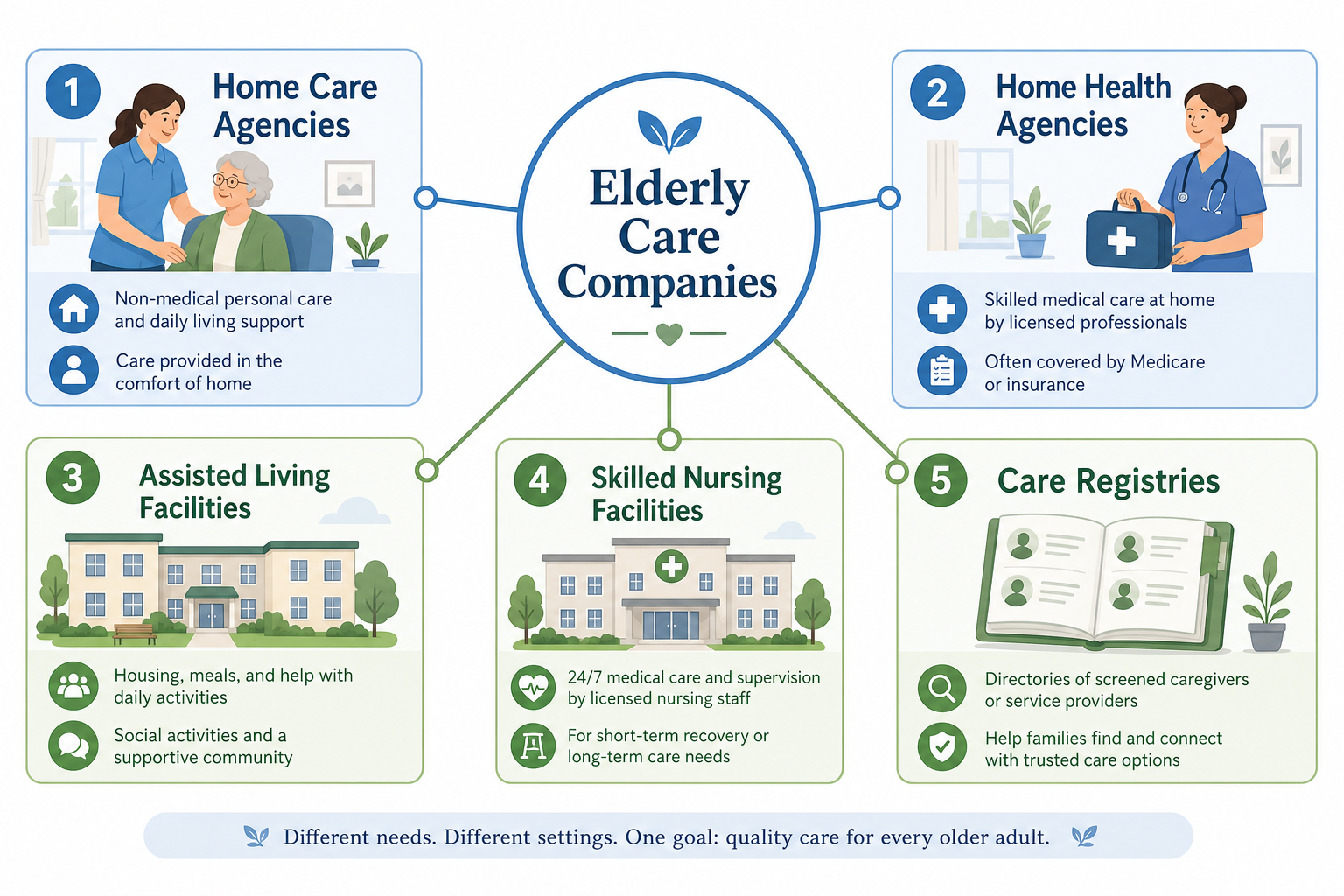
The In-Home Care Landscape: 3 Main Company Types Families Encounter
When you realize your parent needs help at home, the search for an "elderly care company" quickly reveals a confusing landscape. You will find licensed home care agencies, home care registries, home health agencies, national franchise chains, and local independent providers — each operating under a different legal and financial structure. The type of company you choose determines who is legally responsible for the caregiver, how much protection and backup you have, and what you will ultimately pay. Most families do not understand these structural differences until something goes wrong — a missed shift, an injury, a tax liability surprise.
This guide covers the three main in-home company structures: licensed home care agencies (employee model), home care registries (independent contractor model), and home health agencies (skilled medical model). It also compares national franchise agencies against local independent agencies, so you can match the company type to your parent's needs and your own capacity to manage risk.
Licensed Home Care Agencies: The Employee Model
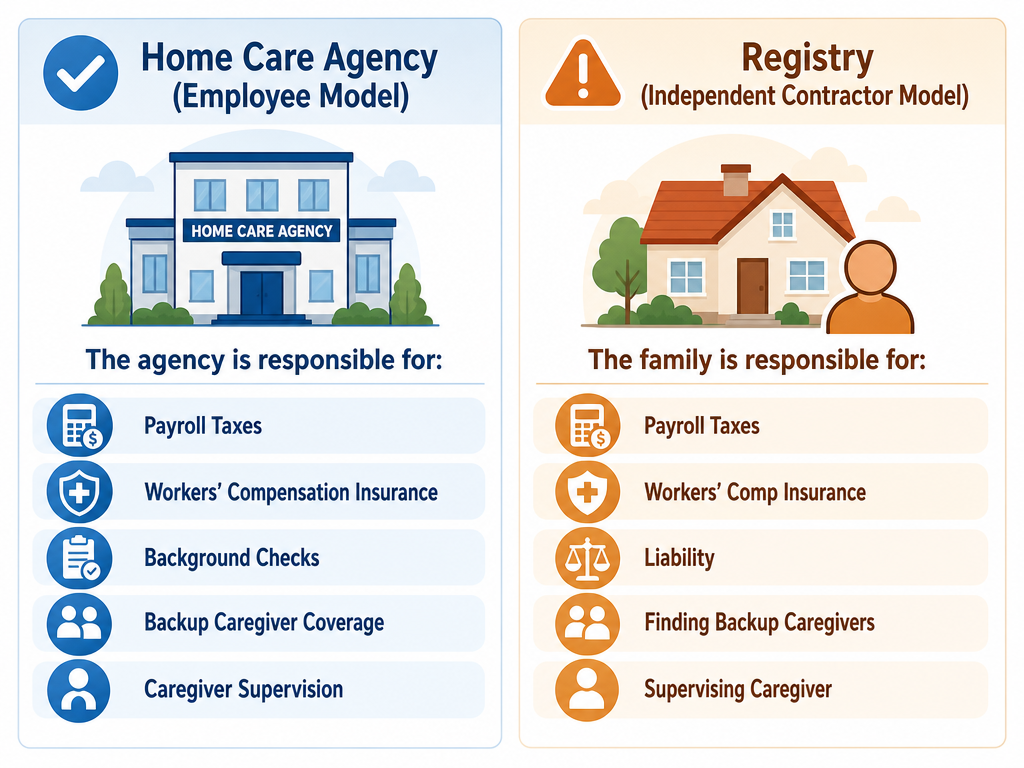
A licensed home care agency recruits, screens, hires, trains, and supervises its caregivers as W-2 employees. The agency handles payroll taxes, workers' compensation insurance, liability insurance, and bonding. It also provides backup coverage if a caregiver calls in sick or quits on short notice. For families, this means the agency — not you — is the legal employer.
Pros of Licensed Agencies
- Bonded and insured: The agency carries liability and workers' compensation coverage, protecting you from financial exposure if a caregiver is injured in your home or if theft occurs.
- Background checks: Agencies typically conduct criminal background checks, reference checks, and drug screenings before hiring.
- Backup coverage: If your regular caregiver cannot make a shift, the agency is responsible for finding a replacement. This is critical given that caregiver turnover rates in home care reach approximately 79% industry-wide.
- Tax handling: The agency withholds and pays federal and state taxes, Social Security, Medicare, and unemployment insurance on behalf of the caregiver.
- Supervision and training: Agencies provide ongoing training and supervision, and they handle performance management and termination if a caregiver is not a good fit.
Cons of Licensed Agencies
- Higher hourly rates: Agencies charge more per hour than registries or private hires because they absorb employment costs and overhead.
- Minimum hour requirements: Many agencies set a minimum of two to four hours per visit, which may be more than you need for simple tasks like medication reminders or meal preparation.
- Potential for caregiver turnover: Despite backup policies, high industry turnover means your parent may see multiple different caregivers over time, which can be disruptive for someone with dementia or a preference for consistency.
Home Care Registries: The Independent Contractor Model
A home care registry — also called a private duty registry or staffing service — does not employ caregivers. Instead, it maintains a list of independent contractors and refers them to families. The registry may perform a basic screening, but it does not handle payroll, taxes, workers' compensation, or supervision. When you hire through a registry, you become the legal employer.
Pros of Registries
- Lower hourly rates: Because the registry does not carry employment costs, the hourly rate is typically lower than a licensed agency.
- More choice: You can interview multiple caregivers and select the one who seems like the best personality and skill match for your parent.
- Flexibility: You may be able to negotiate hours, duties, and scheduling directly with the caregiver without agency-imposed minimums.
Cons of Registries
- You become the employer: You are responsible for payroll taxes (federal and state taxes, Social Security, Medicare, unemployment insurance), workers' compensation insurance, and liability insurance.
- No backup coverage: If the caregiver does not show up, you are responsible for finding a replacement. There is no agency dispatcher to call.
- No supervision: You must manage the caregiver's performance, provide training, and handle termination if things do not work out.
- Background check gaps: Most registries do not perform the same level of background checks that licensed agencies do. You may need to conduct your own.
- Hidden costs: Paying an accountant or elder law attorney for payroll help, purchasing workers' compensation insurance, and the potential loss of income if the caregiver misses shifts can offset the lower hourly rate.
National Franchise Agencies vs. Local Independent Agencies
Within the licensed agency category, you will encounter two structural models: national franchise chains and locally owned independent agencies. Both operate under the employee model, but they differ in policies, pricing, training, and flexibility.
| Feature | National Franchise Agency | Local Independent Agency |
|---|---|---|
| Policies and pricing | Preestablished, consistent across locations | Set by the individual owner; may be more negotiable |
| Staff training | Standardized training programs across all franchise locations | Varies by owner; may be more tailored to local needs |
| Brand consistency | High — same look, feel, and service expectations everywhere | Low — each agency has its own brand and approach |
| Caregiver matching | Follows a corporate matching process | Owner may have deep local knowledge and flexibility |
| Accountability | Corporate oversight; complaints can escalate beyond the local office | Direct relationship with the owner; faster resolution possible |
| Local market knowledge | May be limited if corporate policies override local judgment | Owner typically knows local senior resources, facilities, and providers |
Neither model is inherently better. A franchise may appeal if you value standardized training and the ability to escalate concerns beyond the local office. A local independent agency may be a better fit if you want a personalized relationship with the owner and more flexibility in scheduling and caregiver matching.
Home Health Agencies: When You Need Skilled Medical Care
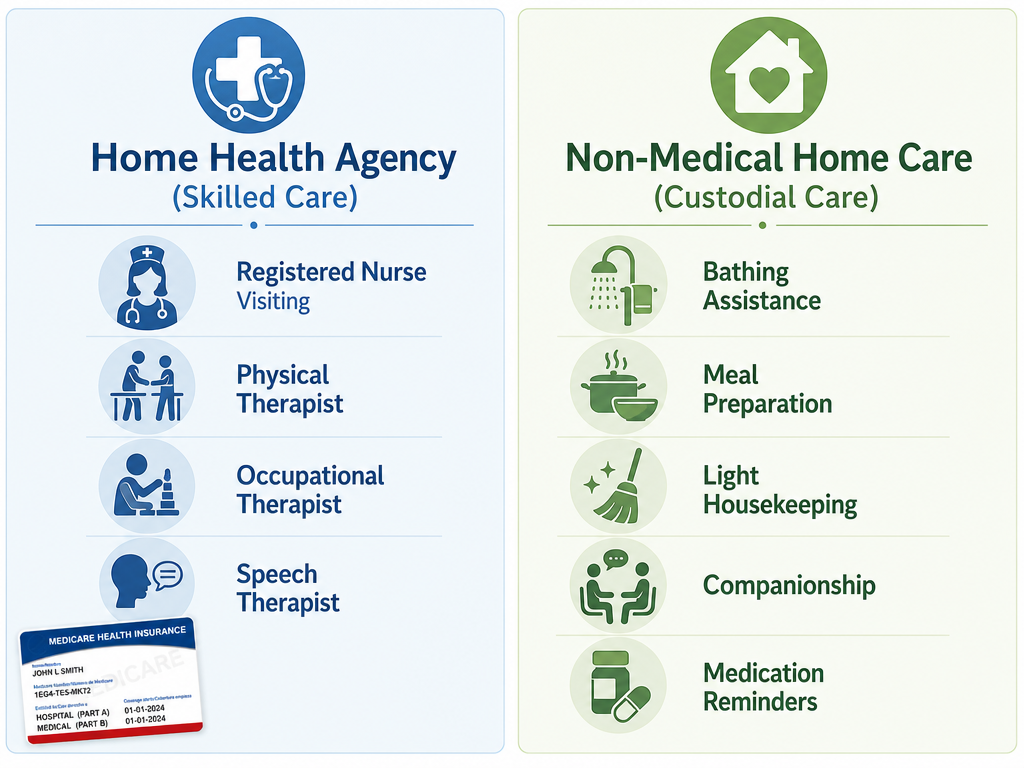
Home health agencies are fundamentally different from home care agencies. They employ licensed medical professionals — registered nurses (RNs), licensed vocational nurses (LVNs), physical therapists, occupational therapists, and speech-language pathologists — to provide skilled medical care in the home. Services are provided under a physician's order and are typically short-term, such as post-surgery rehabilitation or wound care.
The most common source of confusion for families is assuming that Medicare will pay for custodial home care — help with bathing, dressing, meal preparation, and companionship. Medicare does not cover custodial care. It covers home health services only when all of the following conditions are met: a physician certifies that you need skilled nursing care or therapy, a plan of care is established, and you are homebound. Visits are typically 30 minutes to 1.5 hours, two to three times per week, for a finite period of three to five weeks.
Decision Framework: 5 Questions to Determine Which Company Type Fits Your Situation
Use these five questions to narrow down which company structure is right for your family. Each question points to a specific company type or model.
1. Does your parent need skilled medical care or custodial help?
If your parent needs nursing care, physical therapy, or wound care after a hospital stay, start with a Medicare-certified home health agency. If they need help with bathing, dressing, meal preparation, or companionship — custodial care — look for a licensed home care agency or, if you are prepared to manage employer responsibilities, a registry.
2. Can you handle the legal and financial responsibilities of being an employer?
If you are comfortable managing payroll taxes, workers' compensation insurance, and liability, and you have the time to supervise and find backup, a registry may save you money. If the idea of being a legal employer feels overwhelming — or if you simply do not have the bandwidth — a licensed agency is the safer choice.
3. How critical is guaranteed backup coverage?
If your parent cannot be left alone safely — for example, if they have dementia, mobility issues, or are at high fall risk — guaranteed backup coverage is essential. Licensed agencies provide this. Registries do not. If you choose a registry, you need a contingency plan: a family member, neighbor, or backup caregiver who can step in on short notice.
4. Do you prefer standardized training or local flexibility?
If you want consistent, corporate-mandated training and policies, a national franchise agency may appeal. If you value a personal relationship with the owner and the ability to customize scheduling and caregiver matching, a local independent agency is likely a better fit.
5. What is your budget, including hidden costs?
The hourly rate is only part of the cost equation. A registry's lower rate may be offset by the cost of payroll services, workers' compensation insurance, and the financial risk of a missed shift. An agency's higher rate includes all employment costs and backup coverage. Calculate the total monthly cost, not just the hourly rate.
Cost Comparison: What Each Company Type Actually Costs
The table below compares typical hourly rate ranges for each company type, along with the hidden costs that can significantly affect your total monthly expense. Costs vary by state and region, so use these as general benchmarks, not quotes.
| Company Type | Typical Hourly Rate Range | Hidden Costs / Considerations |
|---|---|---|
| Licensed home care agency (employee model) | $25 – $35 per hour | Includes payroll taxes, workers' comp, liability insurance, backup coverage, supervision. Minimum 2–4 hours per visit. |
| Home care registry (independent contractor model) | $18 – $28 per hour | Family pays payroll taxes (~7.65% FICA + state taxes), workers' comp insurance, liability insurance. No backup coverage. May need to hire an accountant or attorney for payroll setup. |
| National franchise agency | $28 – $38 per hour | Similar to licensed agency but may include franchise overhead costs. Standardized training and policies. |
| Local independent agency | $22 – $32 per hour | Similar to licensed agency but may offer more flexible pricing. Owner may negotiate rates for longer-term commitments. |
| Home health agency (skilled care) | Covered by Medicare (no direct cost to patient for covered services) | Requires a physician's order and homebound status. Covers skilled nursing, PT, OT, speech therapy for a finite period. Does not cover custodial care. |
The lower hourly rate of a registry can be deceptive. If you factor in payroll taxes (approximately 7.65% for Social Security and Medicare, plus state unemployment taxes), workers' compensation insurance (typically $0.50–$2.00 per hour of care), and the potential cost of an accountant or elder law attorney, the effective hourly cost can approach or exceed that of a licensed agency — without the backup and supervision protections.
Next Steps: How to Evaluate Specific Companies
Once you have identified which company type fits your situation, the next step is evaluating individual companies. Every agency and registry is different, and the quality of care your parent receives depends on the specific provider you choose.
- Verify licensing: Check your state's licensing database for home care agencies. States that require licensing typically offer an online provider database where you can look up license status, inspection results, and complaints.
- Ask about background checks: Request details on what screening the company conducts — criminal background checks, reference checks, drug testing, and motor vehicle records.
- Confirm insurance coverage: Ask for proof of liability insurance and workers' compensation coverage. If using a registry, ask what insurance they carry (if any) and what you will need to purchase separately.
- Understand backup policies: Ask specifically: What happens if the caregiver calls in sick? How quickly can you provide a replacement? Is there a backup guarantee?
- Read the contract carefully: Look for minimum hour requirements, cancellation policies, rate escalation clauses, and any fees for changing caregivers.
For a complete walkthrough of how to evaluate individual providers — including interview questions, red flags, and a printable checklist — see How to Evaluate Elderly Care Companies: A Step-by-Step Guide for Family Decision-Makers.
Browse more in the Glossary.