
Caregiver decision guide
How to Pay for Senior Caregiver Services: Medicare, Medicaid, VA Benefits, and Out-of-Pocket Options
A practical guide for family caregivers navigating the confusing payment landscape for senior care. Learn what Medicare, Medicaid, and VA benefits actually cover, what you'll pay out of pocket, and creative strategies to make care more affordable.

The Core Confusion: Home Care vs. Home Health Care
Most families hit a wall the first time they call a home care agency expecting insurance to pay for a parent's bathing, meal preparation, or companionship. The agent asks for a diagnosis and a doctor's order, and the conversation stalls. The root of this confusion is a distinction that the industry and government programs treat as absolute, but that families experience as a blurry line: the difference between home care and home health care.
Home care — also called non-medical home care or personal care — covers the activities of daily living (ADLs) that a person needs to stay safe at home: bathing, dressing, toileting, transferring, eating, and light housekeeping. It is provided by home health aides, personal care aides, or companions. It does not require a doctor's prescription, and it is the type of care that most families need for the longest duration.
Home health care is skilled care: nursing, physical therapy, occupational therapy, speech therapy, and wound care. It must be prescribed by a physician, provided by licensed professionals, and directed at a specific medical condition. It is almost always short-term and episodic.
| Feature | Home Care (Non-Medical) | Home Health Care (Skilled) |
|---|---|---|
| Services | Bathing, dressing, meals, companionship, light housekeeping | Nursing, physical therapy, wound care, medication management |
| Who provides it | Home health aides, personal care aides, companions | Registered nurses, licensed practical nurses, physical/occupational therapists |
| Doctor's order required? | No | Yes |
| Typical duration | Months to years (ongoing) | Days to weeks (short-term, episodic) |
| Insurance coverage | Not covered by Medicare; may be covered by Medicaid HCBS waivers, VA benefits, or LTC insurance | Covered by Medicare Part A/B if patient is homebound and care is doctor-prescribed |
What Medicare Actually Covers (and What It Doesn't)
Medicare is the most misunderstood payer in senior care. The National Institute on Aging confirms that Medicare has limited coverage for short-term, doctor-prescribed home health services from Medicare-certified agencies. That is the ceiling. Medicare does not pay for non-medical home care — no bathing, no meals, no companionship — regardless of whether you hire an agency or an independent caregiver.
To qualify for Medicare-covered home health care, your parent must meet three conditions:
- Be under a doctor's care and receiving services under a plan of care established and reviewed by a physician.
- Need skilled nursing care on an intermittent basis, or physical therapy, speech-language pathology, or continued occupational therapy.
- Be homebound — meaning leaving home requires considerable and taxing effort, and the patient typically cannot leave without assistance.
Even when these conditions are met, Medicare covers only the skilled services. A home health aide may provide some personal care (bathing, dressing) as part of the skilled plan, but only for a limited period and only when skilled care is also being provided. Once the skilled need ends, the aide services end too.
Medicare may recertify home health services every 60 days if the patient continues to meet eligibility criteria. But the program is designed for recovery from illness or injury, not for managing chronic decline. A parent with progressive dementia who needs help with bathing and meals but does not need skilled nursing will not qualify.
Medicaid and Home and Community-Based Services (HCBS) Waivers
Medicaid is the largest payer of long-term care in the United States, but it is a program for people with limited income and assets. For seniors who qualify financially, Medicaid can cover non-medical in-home care through Home and Community-Based Services (HCBS) waivers. These waivers allow states to use Medicaid funds to pay for personal care, homemaker services, respite care, and other supports that keep people out of nursing homes.
The critical detail: HCBS waivers are state-specific. Eligibility rules, covered services, and waitlists vary dramatically. Some states have generous programs with no waitlist; others have capped enrollment and years-long queues. A few states allow self-directed care, where the family can hire and pay a relative (including a spouse in some cases) as the caregiver.
- Income limits: Most states require the senior's income to be at or below 300% of the Supplemental Security Income (SSI) federal benefit rate. In 2026, that is roughly $2,829 per month in most states, though some use lower thresholds.
- Asset limits: Typically $2,000 for a single person (some states allow up to $10,000 or more). The home is usually exempt up to a certain equity limit. Other assets like retirement accounts and vehicles may have complex treatment.
- Functional need: The senior must need a nursing-home level of care, as determined by a state assessment. This usually means needing help with at least two ADLs or having a significant cognitive impairment.
- Self-directed options: In about 40 states, families can use a self-directed Medicaid model to hire their own caregivers, including family members. The family manages hiring, scheduling, and payroll, and the state reimburses up to a budget cap.
For families who qualify, Medicaid HCBS waivers can be transformative. They can cover 20–40 hours per week of in-home care at no cost to the family. But the application process is lengthy, and the financial eligibility rules require careful navigation. Start by contacting your state's Medicaid office or your local Area Agency on Aging to ask about HCBS waiver availability and application procedures.
VA Benefits for In-Home Care: Aid and Attendance, Housebound, and Respite
For veterans and surviving spouses, the Department of Veterans Affairs offers some of the most generous in-home care benefits available — but they are underutilized because the application process is daunting. The two main programs are Aid and Attendance and Housebound benefits, which are monthly pension supplements paid to qualifying veterans and surviving spouses who need help with daily activities.
| Benefit | Who Qualifies | What It Covers | Maximum Monthly Payment (2026 est.) |
|---|---|---|---|
| Aid and Attendance | Veteran or surviving spouse who needs help with ADLs, is bedridden, in a nursing home, or has severe vision loss | In-home care, assisted living, nursing home, or family caregiver compensation | Up to $2,300+ for a single veteran; up to $1,500+ for a surviving spouse |
| Housebound | Veteran or surviving spouse who is substantially confined to home due to a permanent disability | In-home care and support services | Lower than Aid and Attendance; varies by dependency status |
| VA Respite Care | Veteran enrolled in VA health care who has a caregiver | Up to 30 days of respite care per year in a VA facility or through a contracted provider | Covered at no cost to the veteran (within benefit limits) |
The Aid and Attendance benefit is the most valuable. It is a monthly cash payment that the veteran or surviving spouse can use to pay for any type of care, including hiring a family member. Unlike Medicaid, there is no requirement to use a licensed agency. The family can hire a relative, a neighbor, or an independent caregiver, and the VA does not dictate who provides the care.
Eligibility for Aid and Attendance requires:
- The veteran must have served at least 90 days of active duty, with at least one day during a wartime period (WWII, Korea, Vietnam, Gulf War).
- The veteran must have an honorable discharge (other-than-honorable discharges may qualify in limited cases).
- The veteran must meet both financial and medical eligibility criteria. The medical criteria require needing help with ADLs, being bedridden, living in a nursing home, or having vision worse than 5/200 in both eyes.
- The veteran's net worth must be below a certain threshold (approximately $155,000 in 2025, excluding the primary home and vehicle).
The application process requires submitting VA Form 21-2680 (Examination for Housebound Status or Permanent Need for Regular Aid and Attendance) along with medical evidence and financial documentation. Many families use a VA-accredited claims agent or a Veterans Service Officer (VSO) to help with the application — the process is complex enough that the success rate is significantly higher with professional assistance.
Long-Term Care Insurance: What to Look For
Long-term care insurance (LTCI) policies vary so widely that two policies from the same company can have completely different coverage for in-home care. If your parent has an LTCI policy, the first step is to read the benefit summary — not the marketing brochure — and look for these specific provisions:
- Home care coverage: Does the policy explicitly cover non-medical home care, or only nursing home and assisted living? Some older policies cover only facility care.
- Benefit trigger: Most policies require needing help with at least two ADLs (bathing, dressing, toileting, transferring, continence, eating) or having a severe cognitive impairment. The policy should specify which ADLs count and how they are assessed.
- Elimination period: This is the number of days the policyholder must pay out of pocket before benefits begin. Common elimination periods are 30, 60, or 90 days. Some policies waive the elimination period for home care.
- Daily or monthly maximum: Most policies cap the daily benefit (e.g., $150/day) or monthly benefit (e.g., $4,500/month). Compare this to the actual cost of home care in your area.
- Family caregiver coverage: Some newer policies allow paying a family member for care. Older policies typically require a licensed agency. If the policy requires an agency, the family cannot be reimbursed for providing care themselves.
If the policy covers home care and the parent meets the benefit trigger, the next step is to file a claim. The insurance company will require documentation from the parent's physician confirming the ADL deficit or cognitive diagnosis. Some policies require a face-to-face assessment by a nurse or social worker. The claims process can take 30–60 days, so start early.
Out-of-Pocket Costs: What You'll Actually Pay
For the majority of families who do not qualify for Medicaid and do not have VA benefits or LTC insurance, the cost of home care comes out of pocket. Understanding the numbers is essential for planning.
According to A Place for Mom's 2026 Costs of Long-Term Care and Senior Living Report, the national median cost for private non-medical in-home care is $34 per hour. SeniorLiving.org reports a median of $35 per hour for home health aides based on CareScout data. The range across states is wide: from $23 per hour in Louisiana to $44 per hour in South Dakota and Washington.
| Hours per Week | Monthly Cost at $34/hr (Low Estimate) | Monthly Cost at $35/hr (High Estimate) |
|---|---|---|
| 7 hours/week (1 hour/day) | $1,031 | $1,061 |
| 15 hours/week (~2 hours/day) | $2,208 | $2,273 |
| 30 hours/week (~4 hours/day) | $4,416 | $4,545 |
| 44 hours/week (~6 hours/day) | $6,478 | $6,666 |
These figures assume hiring through a home care agency. Independent caregivers typically charge 20–30% less than agencies, according to PayingForSeniorCare. However, hiring independently means the family takes on the responsibilities of payroll taxes, workers' compensation insurance, and background checks. Some families use third-party payroll services to manage these obligations.
For a deeper breakdown of hourly rates by state, hidden costs like overtime and holiday pay, and strategies for estimating your family's total monthly budget, see our complete guide to in-home senior care costs in 2026.
Tax Deductions for Caregiver Expenses
The IRS allows taxpayers to deduct unreimbursed medical expenses that exceed 7.5% of their adjusted gross income (AGI) as an itemized deduction. For many family caregivers, the cost of home care qualifies as a medical expense — but only if the care is medically necessary and documented by a physician.
The key rule: help with activities of daily living (bathing, dressing, toileting, eating, transferring) is deductible if the senior has a diagnosed condition that makes them unable to perform these activities without assistance, and a doctor documents the need. This applies whether the care is provided by a licensed agency or an independent caregiver.
- Deductible expenses: Payments to home care agencies, independent caregivers, adult day care centers, and assisted living facilities (for the medical portion of the cost). Also deductible: transportation to medical appointments, prescription medications, and certain home modifications (grab bars, ramps, stair lifts) if medically necessary.
- Non-deductible expenses: General housekeeping, meal delivery (unless part of a medical diet plan), and companionship services that are not medically necessary. The IRS distinguishes between medical care and non-medical support.
- Documentation required: A doctor's letter stating the diagnosis, the specific ADL deficits, and the need for assistance. Keep detailed records of all payments, including the caregiver's name, dates of service, hours worked, and the nature of the care provided.
- Who claims the deduction: If the senior is claimed as a dependent on your tax return, you can include their medical expenses in your own deduction. If the senior files their own return, they claim the deduction. If you pay the expenses directly and the senior does not reimburse you, you may be able to claim the deduction if you meet the dependency requirements.
Creative Strategies to Make Care More Affordable
When the numbers above feel overwhelming — and for most families they do — the solution is rarely a single payment source. It is a combination of strategies that reduce the total hours of paid care needed, shift some costs to lower-cost alternatives, and leverage every available benefit.
- Mix informal family care with paid care: The average family caregiver provides 22.8 hours of unpaid care per week, according to A Place for Mom's 2025 caregiver survey. If family members can cover mornings and evenings, paid care may only be needed for 4–6 hours during the middle of the day — cutting the monthly cost by 50–70%.
- Use adult day care as a lower-cost alternative: Adult day care centers provide supervision, meals, and social activities during daytime hours. The cost is typically $20–$25 per hour, compared to $34–$35 per hour for in-home care. Medicare does not cover adult day care, but some Medicaid HCBS waivers and LTC insurance policies do.
- Hire independent caregivers directly: Agencies charge 20–30% more than independent caregivers to cover their overhead, insurance, and payroll taxes. If you are comfortable managing payroll and background checks, hiring an independent caregiver can save $7–$10 per hour. Use a third-party payroll service to handle tax withholding and workers' compensation.
- Explore shared caregiving arrangements: In some communities, two or three families share a single caregiver who works split shifts. The caregiver gets full-time hours (and thus a stable income), and each family pays a reduced rate. This works best when the seniors live near each other.
- Use a personal care agreement to compensate family members: A personal care agreement (also called a caregiver contract) is a written agreement between the senior and a family member that specifies the services to be provided, the payment rate, and the schedule. This allows the family member to be paid from the senior's funds without triggering gift tax issues, and it may qualify as a deductible medical expense.
Decision Flowchart: Matching Your Situation to Payment Options
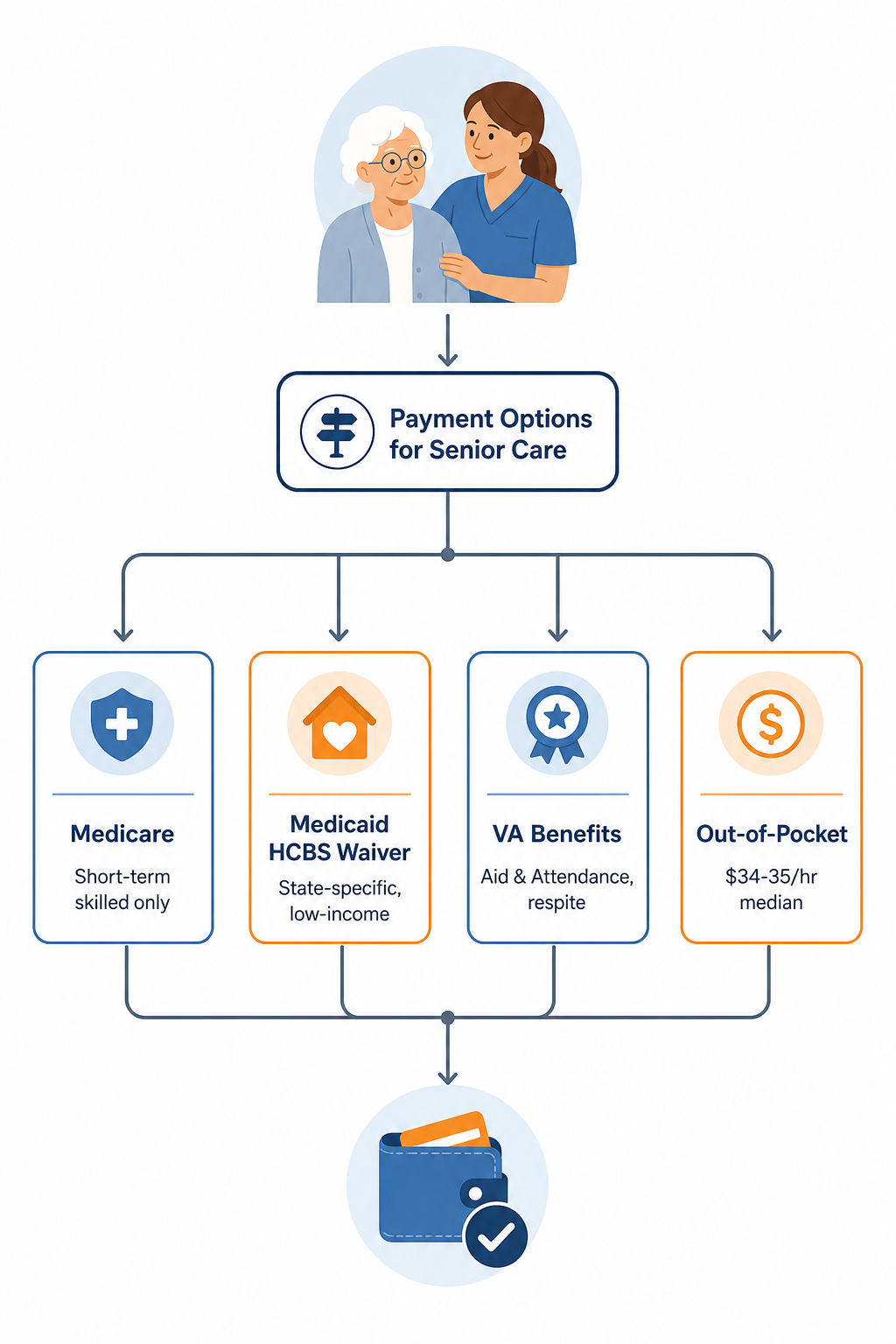
The flowchart above summarizes the decision process. Here is how to use it:
- Start with the type of care needed. If your parent needs skilled nursing or therapy after a hospitalization, Medicare is the first payer to explore. If they need ongoing help with bathing, meals, and supervision, skip Medicare and move to the next question.
- Check veteran status. If your parent is a veteran or surviving spouse, apply for VA Aid and Attendance and Housebound benefits. This is the most generous payment source for in-home care and does not require using an agency.
- Assess income and assets. If your parent's income and assets are below your state's Medicaid thresholds, apply for an HCBS waiver. Contact your local Area Agency on Aging for state-specific guidance.
- Review existing insurance. If your parent has a long-term care insurance policy, check whether it covers home care and what the benefit trigger is. File a claim if eligible.
- Plan for out-of-pocket costs. For most families, some level of out-of-pocket spending is unavoidable. Use the cost table above to estimate your monthly budget, then apply the creative strategies to reduce the total hours of paid care needed.
For help determining how many hours of care your parent actually needs, see our decision framework for matching care hours to care options. It walks you through a structured assessment of ADL and IADL deficits and translates them into a recommended weekly care schedule.
Resources and Next Steps
The payment landscape for senior care is fragmented, but the resources below can help you navigate it. Start with the one that matches your parent's situation.
- Eldercare Locator: 1-800-677-1116. A public service of the U.S. Administration on Aging that connects you to local Area Agencies on Aging. Call to find state-specific Medicaid HCBS waiver information, local adult day care centers, and caregiver support programs.
- Local Area Agency on Aging (AAA): Search 'Area Agency on Aging + your county' to find your local office. AAAs provide free or low-cost counseling on Medicare, Medicaid, and other benefits. They also administer the National Family Caregiver Support Program, which may offer small grants for respite care.
- VA Benefits Hotline: 1-800-827-1000. For questions about Aid and Attendance, Housebound benefits, and respite care. Ask to speak with a benefits counselor or request a referral to a Veterans Service Officer (VSO) who can help with the application.
- State Medicaid Office: Search 'Medicaid + your state' for the official state website. Look for the HCBS waiver section. Most states publish a waiver handbook that explains eligibility, covered services, and how to apply.
- National Family Caregiver Support Program (NFCSP): Administered by local AAAs, this program provides information, counseling, and limited financial assistance for respite care. Eligibility is based on the caregiver's relationship to the care recipient and the care recipient's age (usually 60+).
For a more detailed guide to applying for government programs, including step-by-step application instructions for Medicaid HCBS waivers and VA benefits, see our financial assistance guide for caregivers of aging parents. For quick answers to common questions — like 'Does Medicare cover medical alert systems?' or 'Can I get paid for being a family caregiver?' — visit our FAQ on paying for elderly home care.
Start with the decision flowchart above. Identify which payment path applies to your situation, then explore the relevant section of this guide. The cost of care is real, but so are the options. The key is knowing where to look.
Questions to bring to a clinician or OT
This is not medical, legal, or a family's final decision — only a framework. Bring these questions to a clinician, occupational therapist, or your local Area Agency on Aging.
Find Local HelpRelated reading
Noticed something outdated or inaccurate on this page? Flag a correction. We review every report against CDC, NIA, and AARP HomeFit guidance before updating a page.