
Caregiver decision guide
Agency vs. Independent Caregiver: A Decision Framework for Families
This guide helps adult children actively comparing hiring options for a parent's care. It reframes the decision around tradeoffs—cost, management burden, backup coverage, and legal liability—rather than quality, and provides a structured decision tree, hidden-cost analysis, and hybrid models to match the choice to your family's specific circumstances.

The Real Question Isn't Quality — It's Tradeoffs
When families start comparing caregiver options, the first question is almost always the wrong one: "Which option provides better care?" The uncomfortable truth is that quality depends almost entirely on the individual caregiver — their experience, temperament, and reliability — not on whether they are employed by an agency or work independently. A compassionate, well-trained independent caregiver can deliver care that surpasses what a rushed agency employee provides. And a well-managed agency can offer consistency and accountability that a solo caregiver cannot match.
The real decision is about tradeoffs. Every family must solve a four-variable equation: cost, management burden, backup coverage, and legal liability. The right answer depends on your family's specific capacity — how much time you have, how far away you live, and how much financial risk you can absorb.
This article builds on our existing Private Caregiver vs. Agency: A Complete Decision Guide for Families by adding three elements that most comparison articles skip: a structured decision tree that ties the choice to your specific circumstances, a detailed breakdown of the hidden costs of independent hiring, and hybrid models that bridge the two paths.
Agency vs. Independent: Side-by-Side Comparison
The table below maps the key differences across eight dimensions. Use it as a quick-reference anchor as you read through the deeper analysis that follows.
| Dimension | Home Care Agency | Independent Caregiver |
|---|---|---|
| Cost | Higher hourly rate (median $34–$35/hr in 2026); includes markup for overhead, insurance, and training | 20–30% lower hourly rate; no agency markup, but family absorbs employer costs |
| Hiring Ease | Agency handles screening, background checks, matching, and onboarding; family interviews final candidate | Family manages the entire search: posting, interviewing, running background checks, verifying references |
| Backup Coverage | Agency provides replacement caregiver if the regular worker is sick or unavailable | Family must arrange backup care independently; no guaranteed replacement |
| Care Consistency | May send different caregivers day to day; some agencies guarantee the same caregiver for each shift | Same person every shift if schedule is consistent; no rotation unless family hires multiple caregivers |
| Liability & Insurance | Agency carries liability insurance and workers' compensation; family is not the employer of record | Family becomes the employer and may need workers' comp and liability coverage; significant legal exposure if uninsured |
| Scope of Services | Typically limited to non-medical personal care; many agencies prohibit driving, heavy cleaning, or medication reminders | Broader flexibility; can include driving, light housekeeping, meal preparation, and companionship — but no medical tasks |
| Training & Oversight | Agency provides initial training and ongoing supervision; caregiver is evaluated by agency management | No formal training requirement; family must assess competence and provide orientation themselves |
| Communication | Single point of contact (agency office); family does not manage the caregiver directly for scheduling or issues | Direct communication with the caregiver; family handles scheduling changes, feedback, and conflict resolution |
What You'll Actually Pay: 2026 Cost Analysis
According to A Place for Mom's 2026 Costs of Long-Term Care and Senior Living Report, the national median cost for non-medical in-home care through an agency is $34 per hour. SeniorLiving.org, drawing on CareScout data, reports a similar national median of $35 per hour for a home health aide in 2026. Both sources agree that independent caregivers typically cost 20–30% less than agency caregivers, reflecting the absence of agency overhead for screening, training, insurance, and administration.
To put these numbers in context, here are monthly estimates for common care schedules based on the $34/hr agency median:
| Care Schedule | Hours per Week | Monthly Cost (Agency, $34/hr) | Monthly Cost (Independent, ~$25/hr) |
|---|---|---|---|
| Light assistance (3 hrs/day, 5 days/week) | 15 hrs/week | ~$2,208/month | ~$1,625/month |
| Half-day coverage (6 hrs/day, 5 days/week) | 30 hrs/week | ~$4,416/month | ~$3,250/month |
| Full-day coverage (8 hrs/day, 5 days/week) | 40 hrs/week | ~$5,888/month | ~$4,333/month |
| Nearly full-time (8 hrs/day, 7 days/week) | 56 hrs/week | ~$8,243/month | ~$6,067/month |
The Hidden Costs of Hiring Independently
The 20–30% savings of independent hiring is real, but it is not free money. Families who hire independently take on employer responsibilities that agencies absorb. Three costs in particular are easy to overlook:
- Payroll taxes. As the employer, you are responsible for paying the employer's share of FICA (Social Security and Medicare taxes) — roughly 7.65% of the caregiver's wages. You must also withhold the employee's share and remit both to the IRS. This is not optional.
- Workers' compensation insurance. If your caregiver is injured while working in your home, you could be liable for medical expenses and lost wages. Most homeowner's insurance policies do not cover this. A standalone workers' comp policy for a household employee typically costs a few hundred dollars per year, but the risk of going without it is substantial.
- Replacement search costs. When your independent caregiver is sick, on vacation, or quits, you bear the full cost of finding a replacement — including the time spent interviewing, running background checks, and training someone new. For families with tight schedules, this cost can quickly erode the hourly savings.
These costs vary by state — workers' compensation requirements, tax rates, and unemployment insurance rules differ. The general framework above applies nationwide, but you should verify your state's specific requirements through your state labor department or a payroll service.
Which Path Fits Your Family? A Decision Tree
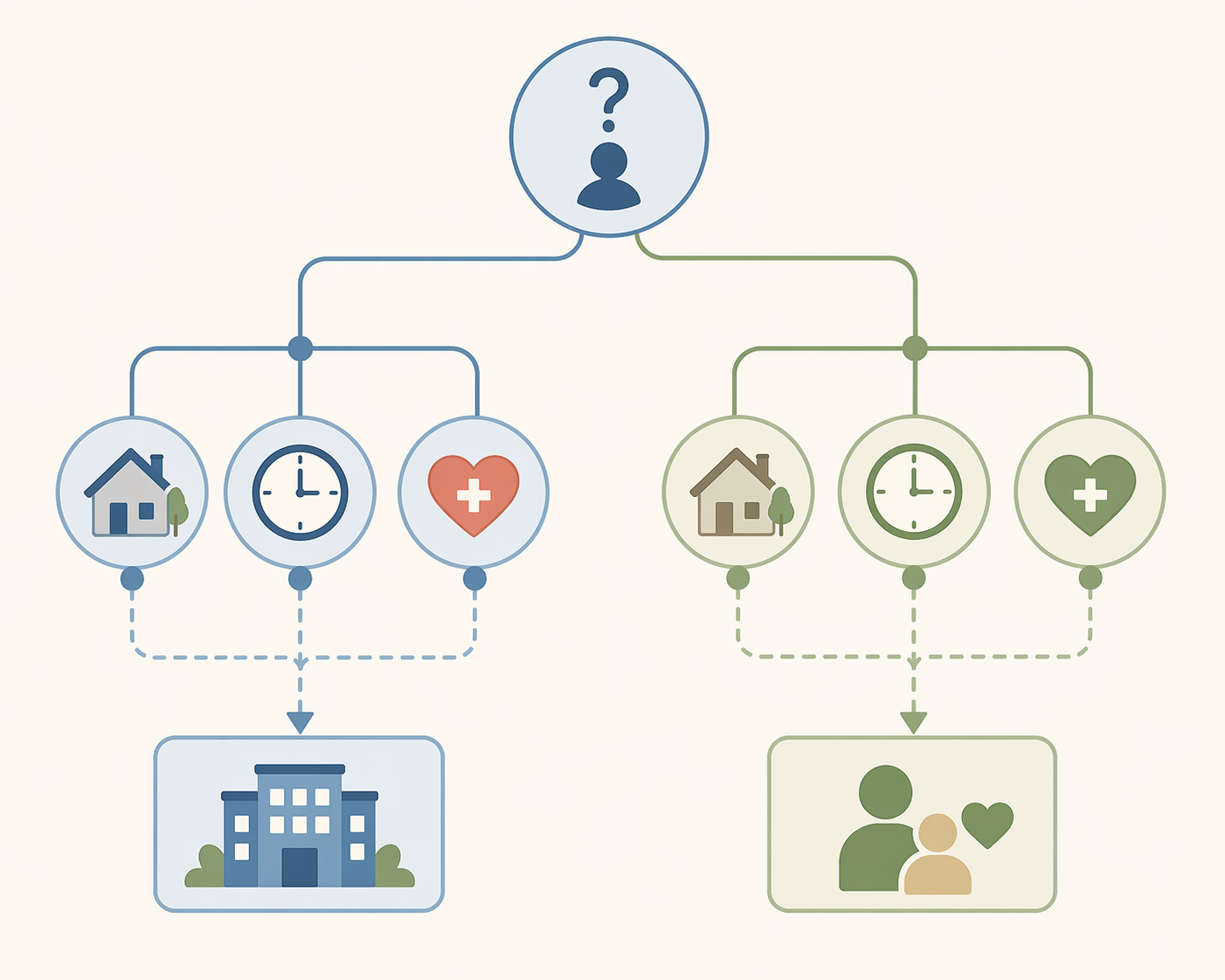
The right choice depends on three family-specific factors: your physical proximity to the senior, the amount of time you can dedicate to management, and the senior's care needs. Work through the questions below to find your recommended path.
Factor 1: Are you local or long-distance?
- You live within 30 minutes of the senior and can visit regularly → Independent hiring is feasible if you have the time and skills to manage it.
- You live more than an hour away or in a different state → An agency is strongly recommended. Managing payroll, scheduling, and emergencies from a distance adds complexity that most long-distance caregivers cannot handle effectively.
Factor 2: Do you have management bandwidth?
- You have flexible work hours, a supportive employer, or are not working → You likely have the bandwidth to handle hiring, payroll, scheduling, and backup planning.
- You are working full-time, have young children, or are already stretched thin → The management burden of independent hiring will compound your stress. An agency's infrastructure is worth the premium.
Factor 3: What kind of care does the senior need?
- Non-medical personal care (bathing, dressing, meal prep, companionship) → Both agency and independent caregivers can provide this. The choice depends on your answers to Factors 1 and 2.
- Medical tasks (wound care, medication management, catheter care) → Neither an agency nor an independent caregiver can perform these tasks unless they are a licensed nurse. You need a home health agency with skilled nursing staff, not a non-medical home care agency.
- Driving, heavy cleaning, or flexible task assignments → Independent caregivers typically offer broader flexibility. Many agencies prohibit driving clients and performing certain household tasks.
How to Vet Either Option
Whether you choose an agency or an independent caregiver, thorough vetting is essential. The National Council on Aging (NCOA) recommends a structured approach: assess needs across personal care, health care, emotional care, and household care; explore all options (agency, independent, family/friends); interview and screen thoroughly; and consider a trial period before committing.
Vetting an Agency
- Ask about caregiver training: What initial training do caregivers receive? Is it ongoing? Does it cover dementia care, fall prevention, or other specific needs?
- Understand communication: How will the agency communicate schedule changes, care notes, or concerns? Is there a single point of contact for your family?
- Request caregiver matching: Will the agency try to assign the same caregiver for every shift? What happens if that caregiver is unavailable?
- Confirm backup policies: What is the agency's guarantee for replacement coverage if a caregiver calls in sick? How quickly can they send someone?
Vetting an Independent Caregiver
- Conduct a thorough interview: Ask about experience with specific conditions (dementia, mobility limitations, diabetes), availability, and how they handle emergencies.
- Run a background check: Use a reputable service. Do not skip this step even if the candidate comes recommended.
- Verify references: Call at least two previous clients. Ask about reliability, communication, and whether they would hire the person again.
- Consider a trial period: Start with a short-term arrangement (one to two weeks) before committing to a long-term schedule. This gives both sides a chance to assess fit.
- Write a written care agreement: CareScout recommends a written agreement covering duties, schedule, pay rate, overtime policy, termination terms, and expectations for backup coverage.
Hybrid Models: The Best of Both Worlds
For families who want the cost savings of independent hiring but cannot manage the employer responsibilities, two hybrid models bridge the gap:

Registry Services
Registry services (sometimes called referral agencies or matching services) connect families with pre-screened independent caregivers. Unlike full-service agencies, they do not employ the caregivers — they do not handle payroll, taxes, or supervision. The registry handles initial background checks and matching; the family becomes the employer of record. This model reduces the search burden while preserving the cost advantage of independent hiring. Fees are typically a one-time placement fee or a lower ongoing percentage than a full agency markup.
Payroll Management Services
Payroll management services handle tax withholding, remittance, and year-end reporting for families who hire independent caregivers. They do not find or vet caregivers — they only handle the employer compliance side. This is a good option for families who have found a caregiver they trust but want to avoid the administrative burden of payroll taxes, workers' compensation, and unemployment insurance. Monthly fees are typically modest (often $50–$100 per month) and are tax-deductible as a medical expense.
Making Your Decision: A Summary Framework
Before you choose, answer these five questions honestly. Your answers will point you toward the right path.
- Can I be physically present within 30 minutes of the senior most of the time? If no, lean toward an agency.
- Do I have at least 5–10 hours per week to dedicate to caregiver management (scheduling, payroll, communication, backup planning)? If no, lean toward an agency or a hybrid model.
- Am I comfortable being an employer — handling payroll taxes, workers' compensation, and potential liability? If no, choose an agency or a payroll management service.
- Does the senior need tasks that agencies typically prohibit, such as driving or heavy cleaning? If yes, independent hiring or a registry service may be the only option.
- What is my backup plan if the caregiver is unavailable? If you do not have a family member or friend who can step in, an agency's guaranteed backup coverage is valuable.
If you are still uncertain after working through these questions, our broader Senior Home Services: A Practical Decision Framework for When to Hire Help, What It Costs, and How to Start provides a wider view of care options, including home health agencies, adult day programs, and hospice support. And for a deeper look at the full financial picture, see The True Cost of Elderly Care: What $34 Per Hour Doesn't Tell You About the Hidden Financial Burden on Family Caregivers.
Remember: the goal is not to find the "best" option in the abstract. The goal is to find the option that fits your family's specific capacity — your time, your location, your tolerance for risk, and the senior's needs. That is the only framework that will serve you well over the months and years of caregiving ahead.
Questions to bring to a clinician or OT
This is not medical, legal, or a family's final decision — only a framework. Bring these questions to a clinician, occupational therapist, or your local Area Agency on Aging.
Find Local HelpRelated reading
Noticed something outdated or inaccurate on this page? Flag a correction. We review every report against CDC, NIA, and AARP HomeFit guidance before updating a page.