Is Home Instead Worth It? What Real Families and Caregivers Say
Home Instead reviews range from 2.1 to 4.3 stars depending on the platform. This article explains why those scores are nearly useless for choosing a local franchise and provides a practical framework for evaluating your local office based on real family and caregiver experiences.
By Editorial Team
home care agency
Home Instead
franchise home care
caregiver reviews
choosing home care
📄
A printable version of this guide is available. Use your browser's print function (Ctrl+P / ⌘P) to save or print.
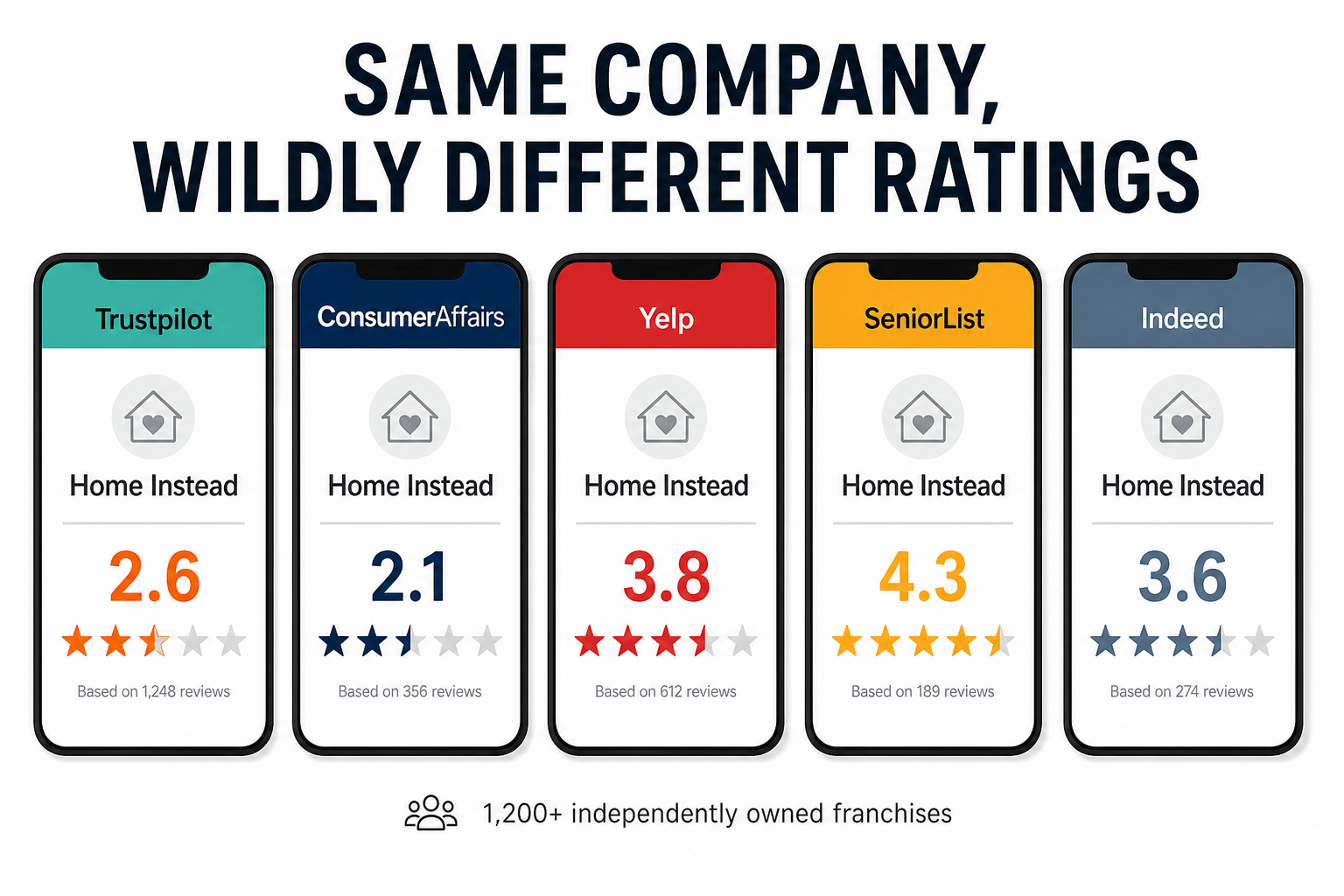
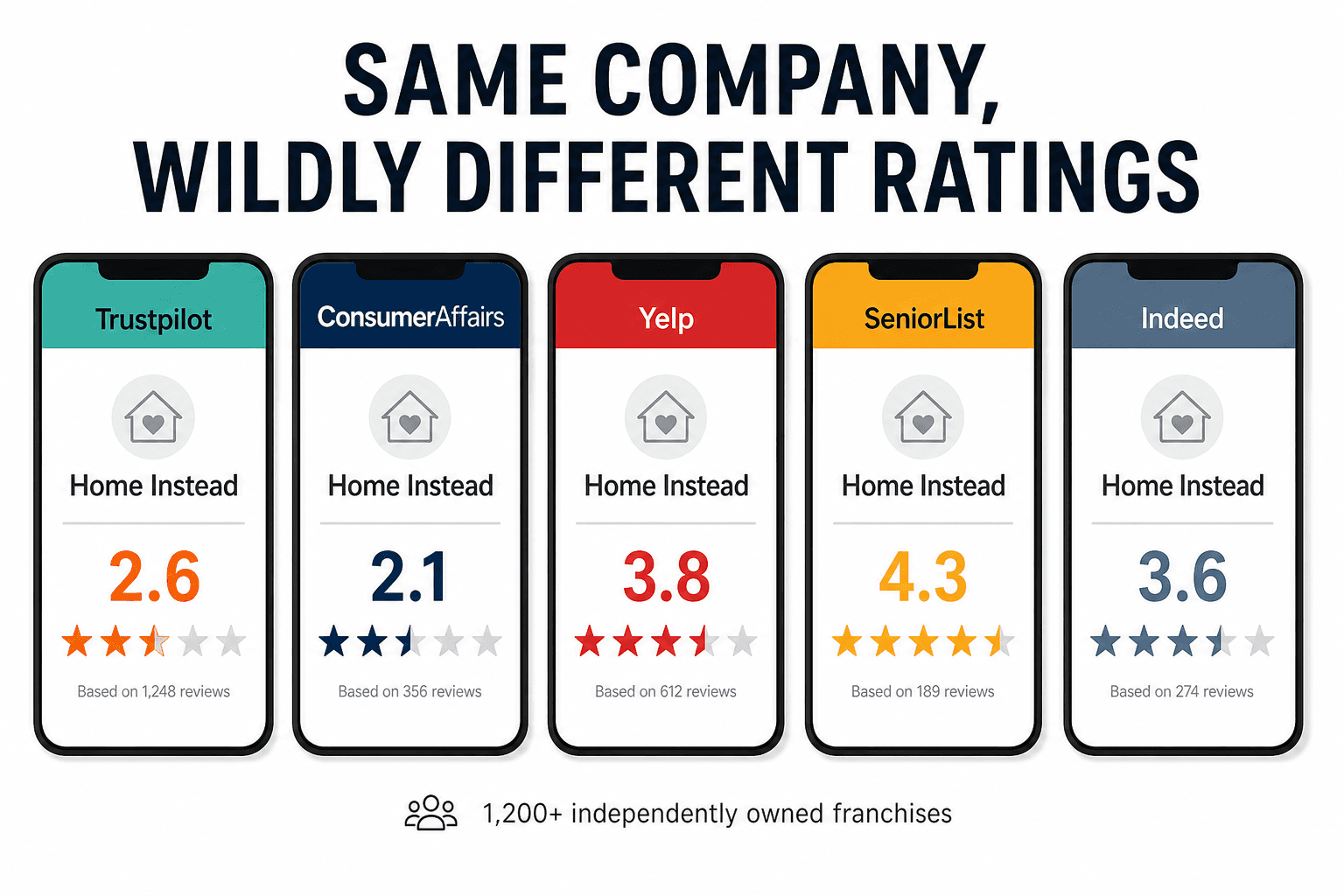
Home Instead's ratings span from 2.1 to 4.3 stars depending on the platform — a spread that tells you more about the limits of aggregated reviews than about the quality of any single franchise.
The Home Instead Review Paradox: 2.1 Stars on One Platform, 4.3 on Another
If you have spent any time researching Home Instead, you have likely encountered a confusing contradiction. On Trustpilot, the company sits at 2.6 out of 5 stars. On ConsumerAffairs, it drops to 2.1. Yet on SeniorList, the same national brand earns a 4.3 out of 5, and SeniorLiving.org gives it a 4 out of 5. Yelp lands somewhere in the middle at 3.8, while Indeed — where caregivers rate their employer — shows a 3.6.
How can the same company generate such wildly different scores? The short answer is that each review platform attracts a different audience — families who had a bad experience are more likely to post on ConsumerAffairs, while SeniorList's curated review process may capture a more balanced sample. But the real reason runs deeper than platform bias, and understanding it is essential before you make a decision about care.
Why National Reviews Tell You Almost Nothing About Your Local Franchise
Home Instead is not a single company with uniform standards across every location. It is a network of more than 1,200 independently owned and operated franchises across six countries, each with its own owner, management team, local hiring pool, and office culture. In the United States alone, there were 619 franchised outlets operating at the end of 2024, according to the company's Franchise Disclosure Document. Each of those offices is a separate business run by a local franchisee who makes independent decisions about caregiver hiring, training, scheduling, and client communication.
When you read a national review score, you are averaging together the experiences of families in a well-managed franchise in Sugarland, Texas, with those in a struggling franchise in Puyallup, Washington, and every office in between. That average is mathematically meaningless for predicting what your local office will be like. As we explain in our guide to franchise vs. independent agencies, the franchise model means that two Home Instead offices 20 miles apart can deliver completely different levels of care.
What Families Praise: Compassionate Caregivers and Responsive Local Management
When families have a good experience with Home Instead, the praise tends to cluster around two themes: the quality of the individual caregiver and the responsiveness of the local office management.
A review from Sugarland, Texas, highlighted on The Senior List, praised the franchise for reliable staffing and responsive management — the kind of experience where the office answers the phone, addresses concerns quickly, and sends the same caregiver consistently. That consistency builds trust, especially for older adults who may be anxious about having a stranger in their home.
Home Instead also invests in training that families notice. Caregivers undergo comprehensive background checks including FBI fingerprint searches, sex offender registry checks, and drug tests, plus ongoing training in emergency response and dementia care. The company's Person-Centered Care Training for Alzheimer's Disease and Other Dementias follows guidelines recommended by the Alzheimer's Association. For families managing a dementia diagnosis, that training can make a meaningful difference in how a caregiver interacts with their loved one.
What Families Criticize: No-Shows, Inconsistent Quality, and Billing Disputes
The negative reviews tell a different story — and they are worth paying close attention to, not because they represent every franchise, but because the patterns reveal structural risks that any family should investigate before signing a contract.
The most common complaints fall into three categories:
Caregiver no-shows and last-minute schedule changes. A review from Puyallup, Washington, described inconsistent caregivers and untrained staff arriving without notice. When a caregiver does not show up, the family — often an adult child with their own job and responsibilities — must scramble to fill the gap.
Inconsistent quality between different caregivers. Even within a single franchise, families report that one caregiver may be excellent while another is unreliable or poorly matched to the client's needs. Since agencies often send multiple caregivers across a week, inconsistency becomes a recurring frustration.
Billing disputes and management responsiveness. A review from Fort Worth, Texas, alleged caregiver theft and a subsequent billing dispute — a serious accusation that underscores the importance of clear billing practices and responsive complaint resolution.
These complaints are not unique to Home Instead. Staffing shortages and scheduling instability are industry-wide problems. But because Home Instead is the largest senior care franchise in the world — serving approximately 100,000 older adults with 100,000 caregivers globally — the volume of negative reviews is correspondingly high.
The Caregiver-Side Reality: Low Pay, High Turnover, and What It Means for Clients
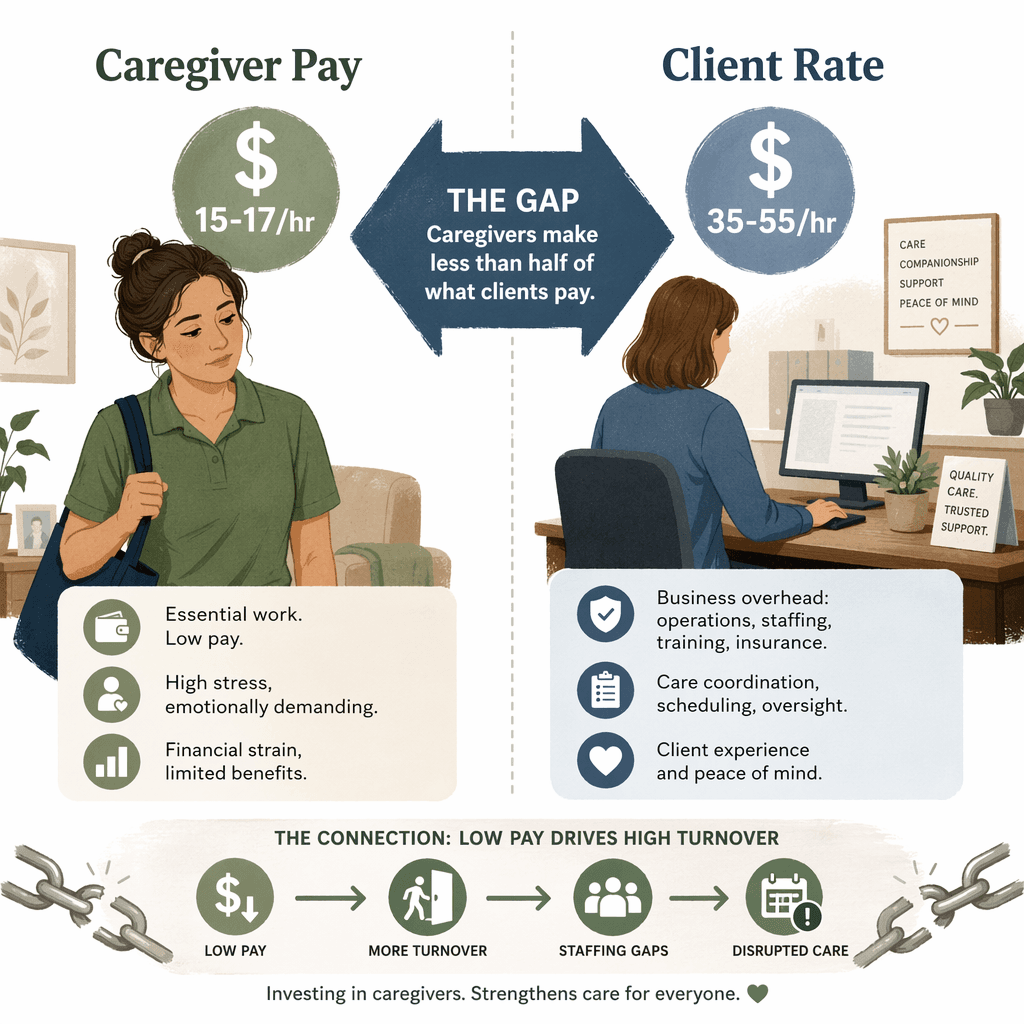
The gap between what caregivers earn and what families pay is a structural driver of turnover that affects every aspect of client experience.
To understand why scheduling problems and inconsistent quality are so common, it helps to look at the economics of home care from the caregiver's perspective.
Home Instead clients typically pay $35 to $55 per hour depending on the level of care and geographic location, according to The Senior List. The national median for home care in 2026 is $34 per hour, per A Place for Mom's 2026 Cost of Long-Term Care report. Yet the caregivers providing that care earn roughly $15 to $17 per hour — a figure consistent with industry-wide independent caregiver wages reported by PayingForSeniorCare. That means the agency retains a significant portion of the hourly rate to cover overhead, insurance, training, and profit.
Low wages drive high turnover. Caregivers who can earn more in retail, food service, or warehouse work often leave the field, creating a constant need to recruit and train new staff. When a franchise cannot maintain a stable pool of experienced caregivers, the consequences land directly on clients: last-minute schedule changes, unfamiliar faces at the door, and caregivers who may not have built rapport with the older adult they are assigned to support.
How to Evaluate Your Local Home Instead Franchise: A Practical Framework
Because national reviews are unreliable, you need a different approach. The following framework will help you assess your local franchise on the factors that actually determine your family's experience.
Questions to Ask During Your Consultation
Key questions to ask your local Home Instead franchise before signing an agreement.
Question
Why It Matters
What to Listen For
How do you match caregivers to clients?
A thoughtful matching process (personality, interests, care needs) predicts consistency and client satisfaction.
They describe a structured process, not just "we send whoever is available."
What happens when my regular caregiver is sick or unavailable?
Backup caregiver quality is the single most common pain point in negative reviews.
They have a dedicated backup pool, not just a rotating list of strangers.
What is your minimum shift length and weekly minimum?
Most Home Instead franchises require 4-hour minimum shifts and some require at least 12 hours per week.
They are upfront about minimums and explain why they exist.
Can I request the same caregiver for every visit?
Consistency is the strongest predictor of a positive experience.
They accommodate consistent scheduling and explain their policy for when the primary caregiver is unavailable.
How do you handle billing disputes or complaints?
Responsive complaint resolution separates well-managed franchises from struggling ones.
They describe a clear escalation process and a named contact person.
Can you provide references from current clients?
References from families currently using the service are far more valuable than any online review.
They provide at least two references without hesitation.
Red Flags to Watch For
Vague or evasive answers about caregiver matching and backup plans.
Reluctance to provide client references or a list of current clients you can contact.
High-pressure sales tactics or demands for a long-term contract without a trial period.
A pattern of negative reviews specifically about the same local office (not just the national brand).
Unwillingness to put scheduling commitments and billing terms in writing.
For a deeper walkthrough of the entire agency selection process — including how to compare multiple agencies, verify credentials, and structure a trial period — see our comprehensive guide to choosing a home care agency.
How to Give Your Loved One the Best Chance at a Good Experience
If after your evaluation you decide to move forward with Home Instead, your ongoing involvement will be the single biggest factor in whether the experience is positive or frustrating. Families who report the best outcomes tend to share a few habits.
Invest time upfront with local management. Introduce yourself to the office manager and the scheduling coordinator — not just the salesperson. These are the people who will handle day-to-day issues, and a personal relationship makes it easier to resolve problems quickly.
Request consistent caregiver matching and confirm the policy in writing. Ask for the same caregiver or a small consistent team. Most well-run franchises will accommodate this request.
Establish clear expectations about scheduling and backup plans. Before care starts, agree on what happens when a caregiver calls in sick. How much notice will you receive? Who will the replacement be? Having this conversation in advance prevents a crisis later.
Stay engaged as an active client. Check in regularly with your loved one and the caregivers. Address small concerns before they become big problems. A brief weekly call to the office manager to report how things are going can head off scheduling drift and staffing mismatches.
Document everything. Keep a log of scheduled vs. actual caregiver visits, note any billing discrepancies, and save all communications. If a dispute arises, you will have a clear record.
Home Instead can be an excellent choice — or a frustrating one — depending almost entirely on the quality of your local franchise. The national reviews will not tell you which one you are getting. But a thorough evaluation of your local office, combined with proactive management of the relationship, will give you the best possible chance at a positive outcome for your family.

Comments
Join the discussion with an anonymous comment.