
Caregiver decision guide
Care.com for Senior Care: An Honest 2026 Review of Costs, Pros, Cons, and How It Compares to Hiring Through an Agency
This review helps adult children (40s-50s) evaluate Care.com as a platform for hiring an in-home caregiver for an aging parent. It covers membership costs, caregiver rates, the 2024 FTC settlement, user ratings, and a practical comparison with home care agencies so families can decide which route fits their situation.
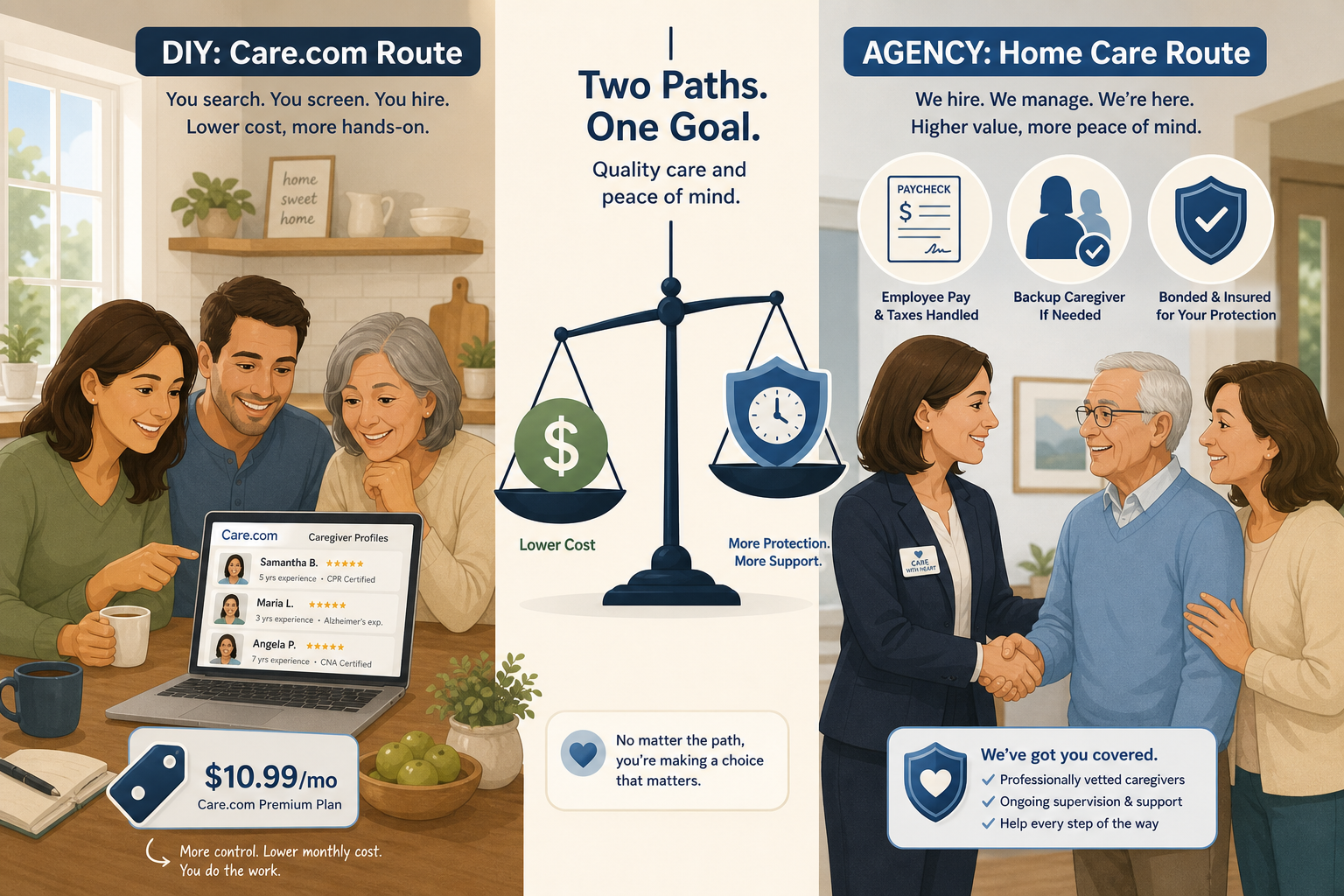
What Is Care.com and How Does It Work for Senior Care?
Care.com is a self-service online marketplace that connects families with independent caregivers. Think of it as a job board specifically for care work — you post a job description, browse candidate profiles, and manage the hiring process yourself. The platform covers child care, pet care, housekeeping, and senior care, but for this review we are focused entirely on its senior care offerings.
The basic workflow is straightforward:
- Create a free account and complete a needs quiz about the care recipient's location, schedule, and required tasks.
- Browse caregiver profiles that match your criteria, or post a job listing and wait for candidates to apply.
- View profiles that include experience, hourly rate, availability, and whether the caregiver has completed a Carecheck background screening.
- Pay for a membership to unlock the ability to message candidates, schedule interviews, and hire.
The critical detail most new users miss is that the free tier is essentially a browsing-only experience. You can see that caregivers exist in your area, but you cannot contact them without upgrading to a paid membership. This paywall is the single most common source of frustration among new users, and it was also the central issue in the 2024 FTC settlement, which we will cover in detail later.
Types of Senior Care Available on Care.com
Care.com organizes its senior care offerings into several categories. Understanding what is and is not available on the platform will save you time and prevent false expectations.
- In-home companion care: Non-medical support including conversation, meal preparation, light housekeeping, medication reminders, and transportation to appointments.
- Personal care: Hands-on assistance with bathing, dressing, toileting, and mobility — the activities of daily living (ADLs) that many older adults eventually need help with.
- Dementia and memory care: Some caregivers on the platform list experience with Alzheimer's and other forms of dementia. However, Care.com does not require specialized dementia training or certification for these listings.
- Assisted living search: Care.com offers a feature to search for senior living communities. According to a January 2026 review from The Senior List, this feature returned no results in multiple ZIP codes tested, suggesting it may have limited utility depending on your location.
- Senior care advisors: Care.com provides access to senior care advisors described as master's-level social workers. However, a hands-on review from SeniorLiving.org noted that users do not receive a dedicated personal advisor — support is limited to general FAQ-style assistance.
If you are unsure whether in-home care is the right choice for your parent's situation, our Senior Care Options comparison guide walks through the decision framework for in-home care versus assisted living, memory care, and skilled nursing facilities.
Care.com Cost Breakdown: Membership Fees and Caregiver Rates
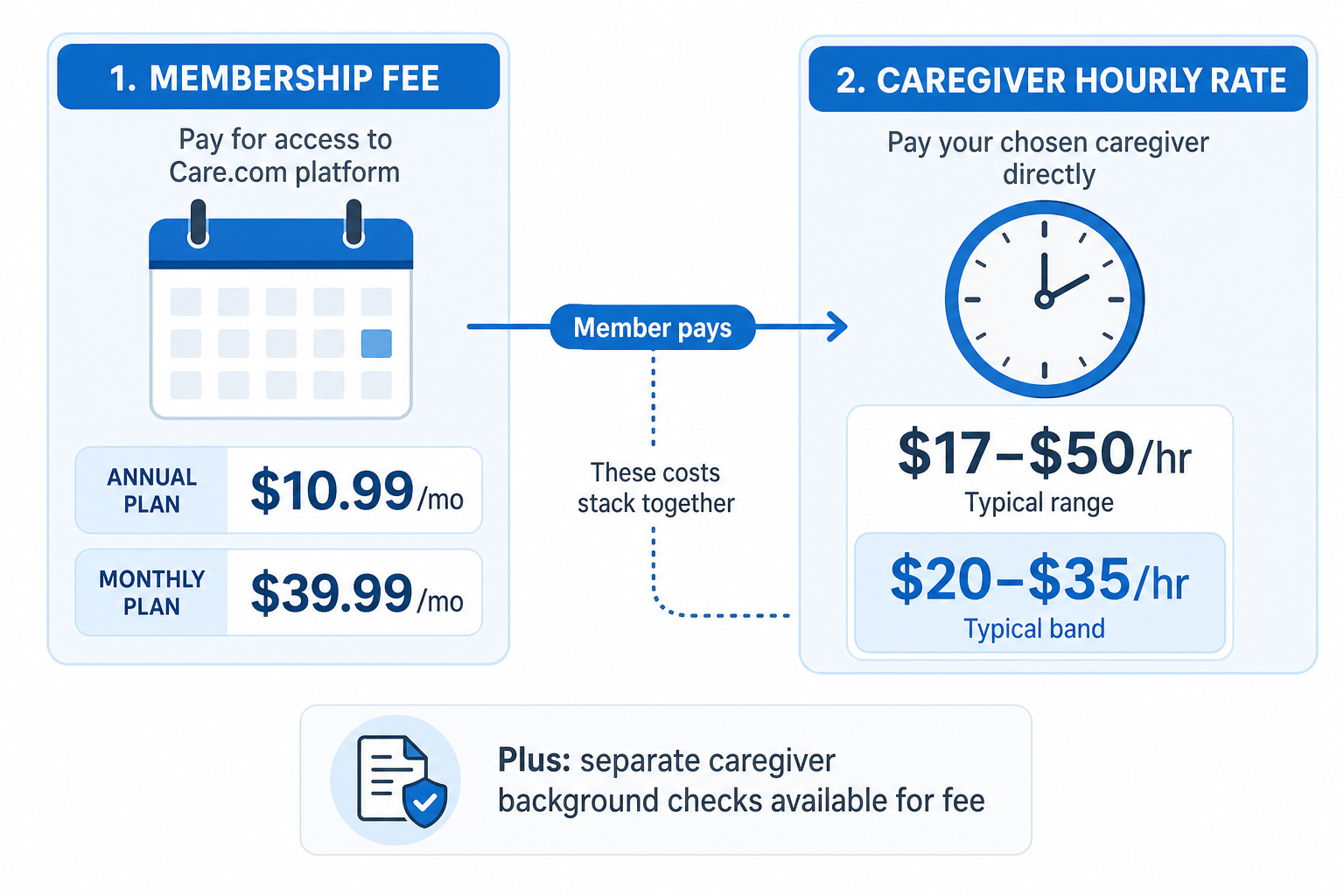
The cost of using Care.com has two independent components: what you pay Care.com for access to the platform, and what you pay the caregiver for their time. Understanding both is essential for budgeting.
Membership Pricing
Care.com offers three membership tiers based on commitment length. Pricing data from two independent review sites (SeniorLiving.org and The Senior List, both updated January 2026) is consistent:
| Plan | Monthly Cost | Commitment | Best For |
|---|---|---|---|
| Annual | $10.99/mo | 12 months | Families who plan to hire and may need to search again later |
| Quarterly | $25.99/mo | 3 months | Families actively searching and expecting to hire within a few months |
| Monthly | $39.99/mo | Month-to-month | Families who want to test the platform with no long-term commitment |
The annual plan works out to roughly $132 per year. The monthly plan costs nearly four times that at $480 per year. If you are confident you will use the platform, the annual plan is the most economical choice — but it requires a 12-month commitment, and the FTC settlement noted that some users reported difficulty canceling their memberships.
Caregiver Hourly Rates
Caregivers on Care.com set their own rates. Based on the research sources, the range is broad:
- Overall range: $17 to $50 per hour (The Senior List, January 2026)
- Typical experienced caregivers: $20 to $35 per hour (The Senior List)
- One reviewer's local market (SeniorLiving.org): $28 to $48 per hour; they hired a caregiver with 20 years of experience at $28 per hour
- Care.com's own 2026 Cost of Care Report (survey of 3,000 U.S. parents, November 2025) reports an average weekly cost for senior care of $795 for 40 hours — equivalent to roughly $19.88 per hour
For context, the national median cost for a home health aide in 2026 is approximately $35 per hour, based on CareScout/Genworth 2025 data cited by SeniorLiving.org. Homemaker services (non-medical assistance) average $33.99 per hour nationally. This means Care.com caregivers can be significantly cheaper than agency-employed aides — but the range is wide, and you get what you pay for in terms of experience and qualifications.
Trust and Safety: The FTC Settlement and User Ratings
Any honest review of Care.com in 2026 has to address the elephant in the room: the company's track record with trust and transparency. The data tells a complicated story.
The 2024 FTC Settlement
In August 2024, the Federal Trade Commission announced a settlement with Care.com over allegations that the company misled workers about job availability and earnings. According to the FTC's consumer alert, since 2019 more than half of millions of job postings on the platform were from free members who could not respond to applicants unless they upgraded to a paid membership. In other words, job seekers were seeing postings that looked like active opportunities but were effectively dead ends unless the poster paid up.
The settlement requires Care.com to pay $8.5 million for refunds and to change its business practices. The FTC also alleged that Care.com made cancellation difficult, with billing continuing despite users' attempts to cancel. The consumer alert advises job seekers not to pay to find a job and to report issues to ReportFraud.ftc.gov.
This settlement is relevant to families hiring senior care because the same paywall dynamic applies on the hiring side: you cannot meaningfully use the platform without paying for a membership, and canceling that membership has historically been a source of complaints.
User Ratings: Business vs. Customer Experience
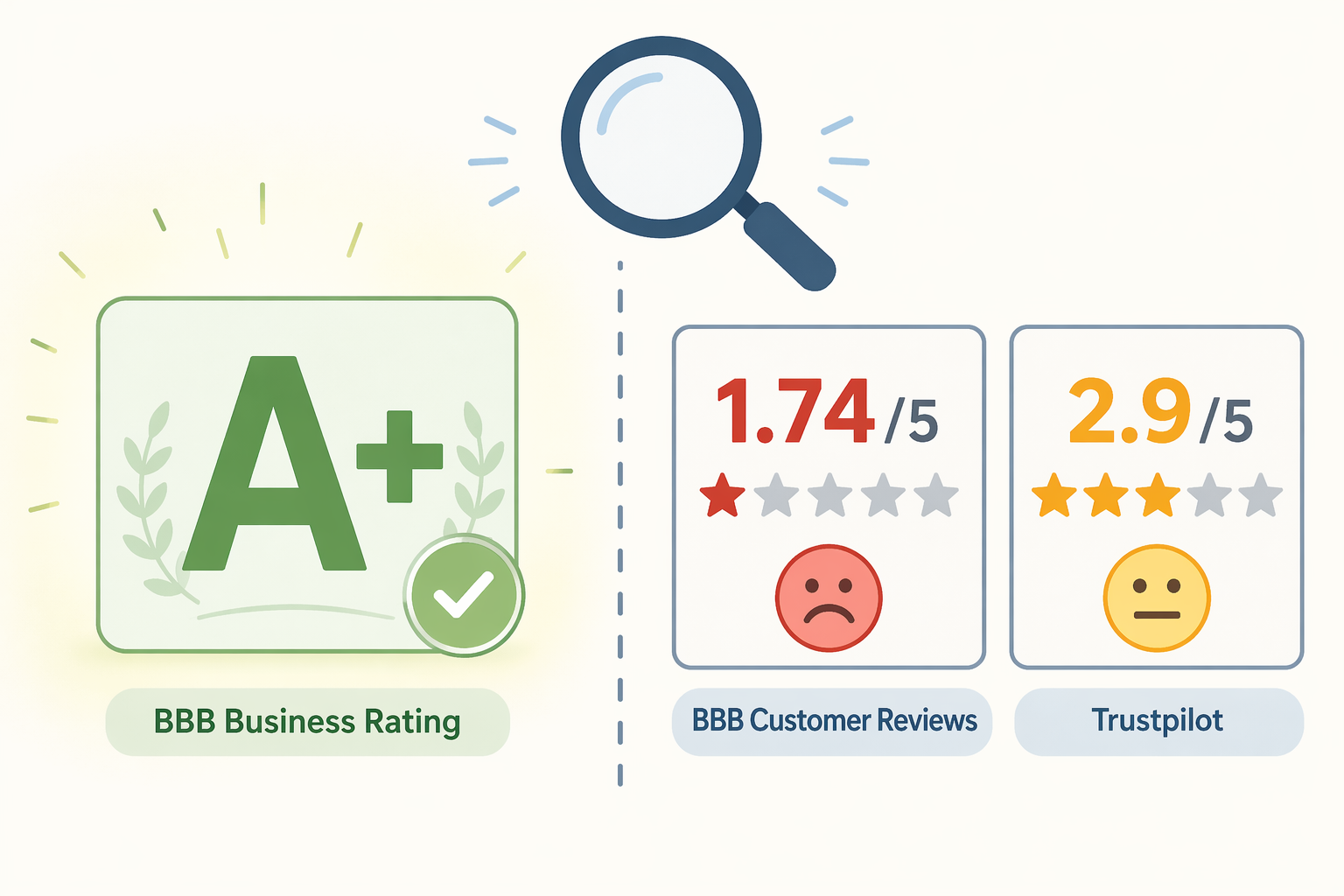
Care.com holds an A+ rating from the Better Business Bureau, which reflects the company's responsiveness to complaints and its business practices as evaluated by the BBB. However, the customer reviews tell a different story:
| Rating Source | Score | What It Measures |
|---|---|---|
| BBB Business Rating | A+ | Business practices and complaint resolution (not customer satisfaction) |
| BBB Customer Reviews | 1.74 / 5 | Actual user experiences submitted to the BBB |
| Trustpilot | 2.9 / 5 | General user reviews (as of January 2026) |
The 1.74 out of 5 on BBB customer reviews and 2.9 out of 5 on Trustpilot reflect a pattern of complaints about billing, cancellation difficulties, and the limited utility of the free tier. That said, user experiences vary widely — some families find excellent caregivers through the platform and are satisfied with the value. A balanced view acknowledges both the positive outcomes and the structural frustrations.
Background Checks: Carecheck and Its Limitations
Care.com requires all individual caregivers to undergo a Carecheck background screening. According to SeniorLiving.org's review, the Carecheck includes:
- Social Security number trace
- National Sex Offender Public Website search
- Multi-jurisdictional criminal database search
- Federal and county criminal records search
However, the Carecheck is not a comprehensive background investigation. It is a one-time check performed when the caregiver joins the platform, not an ongoing monitoring service. Care.com's own hiring guide recommends that families run their own additional checks. Extra background checks through Care.com cost additional fees beyond the membership.
What Using Care.com Actually Feels Like: A Step-by-Step Walkthrough
Knowing the pricing and ratings is one thing. Understanding what the day-to-day experience of using the platform actually feels like is another. Here is what you can expect from sign-up through hiring.
Step 1: The Needs Quiz
When you create a free account, Care.com prompts you through a needs quiz. You enter your parent's location, the type of care needed (companionship, personal care, dementia care, etc.), the schedule, and the hourly rate you are willing to pay. The platform then shows you matching caregiver profiles.
Step 2: Browsing and the Premium Gate
With a free account, you can see caregiver names, photos, experience summaries, and hourly rates. You can also see whether they have completed a Carecheck. What you cannot do is message them, view their full profile, or schedule an interview. To unlock those features, you must upgrade to a paid membership.
This is the moment where many users feel the platform's limitations. You may see several promising candidates, but you cannot gauge their actual availability, responsiveness, or fit without paying first. If you are evaluating multiple platforms, this paywall makes it difficult to compare Care.com with free alternatives before committing.
Step 3: Interviewing and Hiring
Once you have a paid membership, you can message candidates, schedule phone or video interviews, and negotiate rates and schedules. Care.com provides a guide to interview questions that covers background, duties, safety, and flexibility. Sample questions include asking about experience with memory impairment, CPR/first-aid training, how they would respond to care refusal, and whether they are willing to sign a contract restricting gifts or guests.
After you find a candidate and agree on terms, the hiring process is entirely between you and the caregiver. Care.com does not facilitate contracts, handle payments, or provide ongoing support. You are on your own to set up payroll, verify credentials, and manage the relationship.
Support and Guidance
Care.com offers a comprehensive hiring guide on its website covering the full process from assessing needs through creating a care plan. However, this is self-service educational content, not personalized support. The platform does not assign you a dedicated advisor — you rely on FAQ articles and community forums for guidance.
Care.com vs. Home Care Agencies: A Practical Comparison
The most important decision you will make is not which caregiver to hire — it is whether to use a self-service platform like Care.com or a licensed home care agency. Each approach has fundamentally different trade-offs.
| Factor | Care.com (DIY) | Home Care Agency |
|---|---|---|
| Cost | Membership ($10.99-$39.99/mo) + caregiver rate ($17-$50/hr) | 20-30% more than private hire (PayingForSeniorCare); national median ~$35/hr |
| Background checks | Carecheck included; extra checks cost additional fees; you manage verification | Comprehensive screening included; agency handles all verification |
| Liability insurance | You must verify; not provided by Care.com | Agency carries liability and workers' compensation insurance |
| Payroll and taxes | You are the household employer; must handle payroll taxes or use a service | Agency handles all payroll, taxes, and W-2s |
| Backup caregivers | You arrange backup coverage yourself | Agency provides replacement if primary caregiver is unavailable |
| Ongoing oversight | You manage the relationship, schedule, and performance | Agency supervises caregivers and conducts regular check-ins |
| Speed of hiring | Variable; depends on your market and how quickly you screen candidates | Typically faster; agency has a pool of vetted caregivers ready to start |
The 20-30% premium that agencies charge buys you something real: peace of mind. When you hire through an agency, the caregiver is the agency's employee, not yours. The agency handles background checks, carries liability and workers' compensation insurance, manages payroll and tax withholding, and provides a backup caregiver if your regular one calls in sick. For many families — especially those who are already stretched thin managing work, their own families, and caregiving — that premium is worth every dollar.
For a deeper look at the general decision framework between hiring privately and using an agency, see our Private Sitter for Elderly decision guide. That guide covers the broader trade-offs without the platform-specific focus on Care.com.
Practical Advice for Families Who Choose Care.com
If after weighing the trade-offs you decide that Care.com is the right fit for your situation, here is how to use the platform effectively and protect your family.
Vet Candidates Thoroughly
- Conduct a phone or video interview before scheduling an in-person meeting. Use Care.com's interview question guide as a starting point, but add your own questions specific to your parent's needs.
- Run your own background check through your state's court records and the national sex offender registry. Do not rely solely on the Carecheck.
- Check at least two professional references. Ask about reliability, punctuality, and how the caregiver handled difficult situations.
- Verify CPR and first-aid certification if those are important for your parent's condition.
- Involve your parent in the final interview and decision. The caregiver will be spending significant time with them, and their comfort and trust matter.
Set Up Payroll and Taxes Properly
As noted above, the IRS considers a caregiver you hire directly to be your household employee. This is not optional — misclassifying them as an independent contractor can result in back taxes, penalties, and legal liability. You have two options:
- Handle payroll yourself: Register for an Employer Identification Number (EIN) with the IRS, withhold Social Security and Medicare taxes (the "nanny tax"), pay federal and state unemployment taxes, and issue a W-2 annually.
- Use a payroll service: Companies like SurePayroll, HomePay, or Breedlove handle tax withholding, filings, and W-2 generation for a monthly fee (typically $30-$60 per month). This is often worth the cost for families who are not comfortable managing payroll themselves.
Create a Written Care Contract
A written agreement protects both you and the caregiver. Care.com's hiring guide recommends including:
- Work schedule and hourly rate
- Specific duties (personal care, housekeeping, meal preparation, medication reminders, transportation)
- Overtime and holiday pay policies
- Paid time off and sick leave
- Notice period for termination
- A clause restricting gifts, guests, and personal phone use during work hours
- Emergency contact information and protocol
Plan for Backup Care
One of the biggest risks of hiring an independent caregiver is that you have no backup when they are sick, on vacation, or need to resign. Before you hire, identify at least one backup option:
- A second caregiver from Care.com who can cover shifts
- A local home care agency that offers hourly respite care
- Family members or friends who can step in temporarily
- Adult day care programs in your area
For a broader overview of in-home care support — including HCBS waivers, daily living assistance, and community resources — see our guide to help for elderly and disabled adults at home.
Verdict: When Care.com Makes Sense and When an Agency Is Better
Care.com is not a bad platform. It is a useful tool for a specific type of family in a specific set of circumstances. The key is knowing whether you are that family.
Care.com Is a Good Fit When:
- You are comfortable managing the entire hiring process — screening, interviewing, background checks, payroll, and ongoing supervision.
- You have the time and energy to vet candidates thoroughly and manage the caregiver relationship.
- You have a backup plan for when the caregiver is unavailable (family members, a second caregiver, or adult day care).
- You want to save the 20-30% premium that agencies charge and are willing to take on the administrative work yourself.
- You are hiring for a predictable, part-time schedule where continuity of care is less critical.
A Home Care Agency Is a Better Fit When:
- You need a caregiver quickly and do not have weeks to search, interview, and vet candidates.
- Reliability is critical — you cannot afford gaps in care if the primary caregiver is unavailable.
- You want the peace of mind that comes with a vetted, insured, and supervised caregiver.
- You prefer to outsource payroll, taxes, and compliance to professionals.
- Your parent needs complex or medical-level care that requires a certified home health aide or nurse.
Questions to bring to a clinician or OT
This is not medical, legal, or a family's final decision — only a framework. Bring these questions to a clinician, occupational therapist, or your local Area Agency on Aging.
Find Local HelpRelated reading
Noticed something outdated or inaccurate on this page? Flag a correction. We review every report against CDC, NIA, and AARP HomeFit guidance before updating a page.