The Long-Distance Caregiver's First-Hour Emergency Response Plan
For: long-distance caregiverReviewed: 2026-07-05
The Long-Distance Caregiver's First-Hour Emergency Response Plan
When you are hundreds of miles away and get the call that your parent is in crisis, the first hour can make the difference between a controlled response and chaos. This guide provides a minute-by-minute protocol to activate local support, access critical documents, decide whether to travel, and keep communication clear.
By Editorial Team
new caregiver
experienced caregiver
long-distance caregiving
spousal caregiver
working caregiver
daily routines
medication management
personal hygiene
care coordination
first steps
ADLs
IADLs
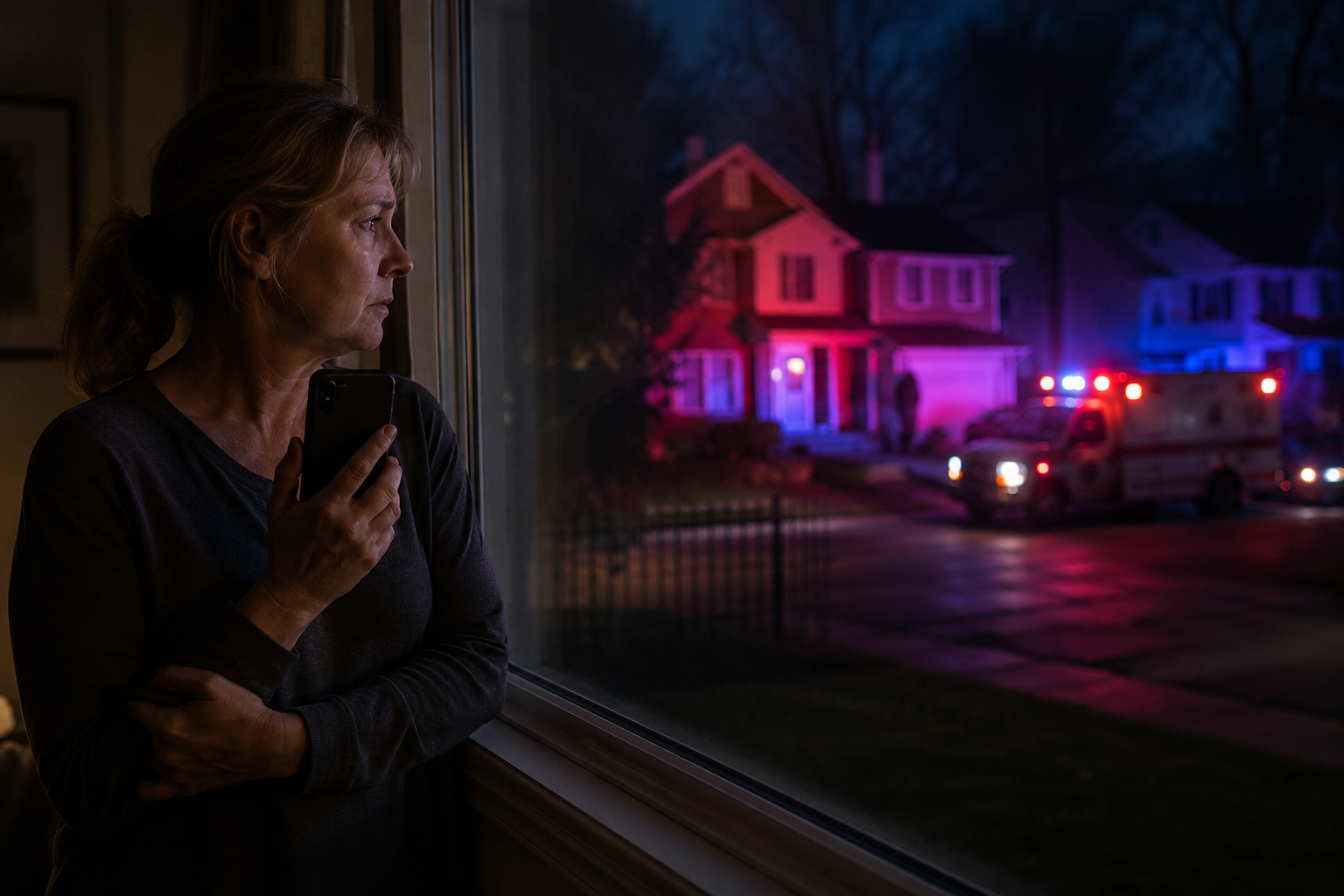
The call usually starts with too little information. A neighbor says there is an ambulance in your parent's driveway. Your parent is not answering. You are 500 miles away, holding a phone, trying to decide whether to call the hospital, book a flight, wake your sibling, or keep the neighbor on the line.
That is exactly when a long-distance caregiver emergency plan matters. Not someday, not after the discharge nurse calls, and not after four relatives have created four versions of the same story. The first hour is when missing medication lists, unlocked doors, unclear authority, and family group texts turn one medical event into a coordination failure.
For adults age 75 and older, one cited CDC-based figure puts emergency room use at 66 visits per 100 people annually, which makes an ER event ordinary enough to plan for instead of dramatic enough to deny.[1] The emotional load is not imaginary either: Family Caregiver Alliance reports that long-distance caregivers experience emotional distress at higher rates than local caregivers, 47% compared with 28%.[2] Distance does not only add miles. It adds silence between facts.
Build the One-Page Card Before Anyone Needs It
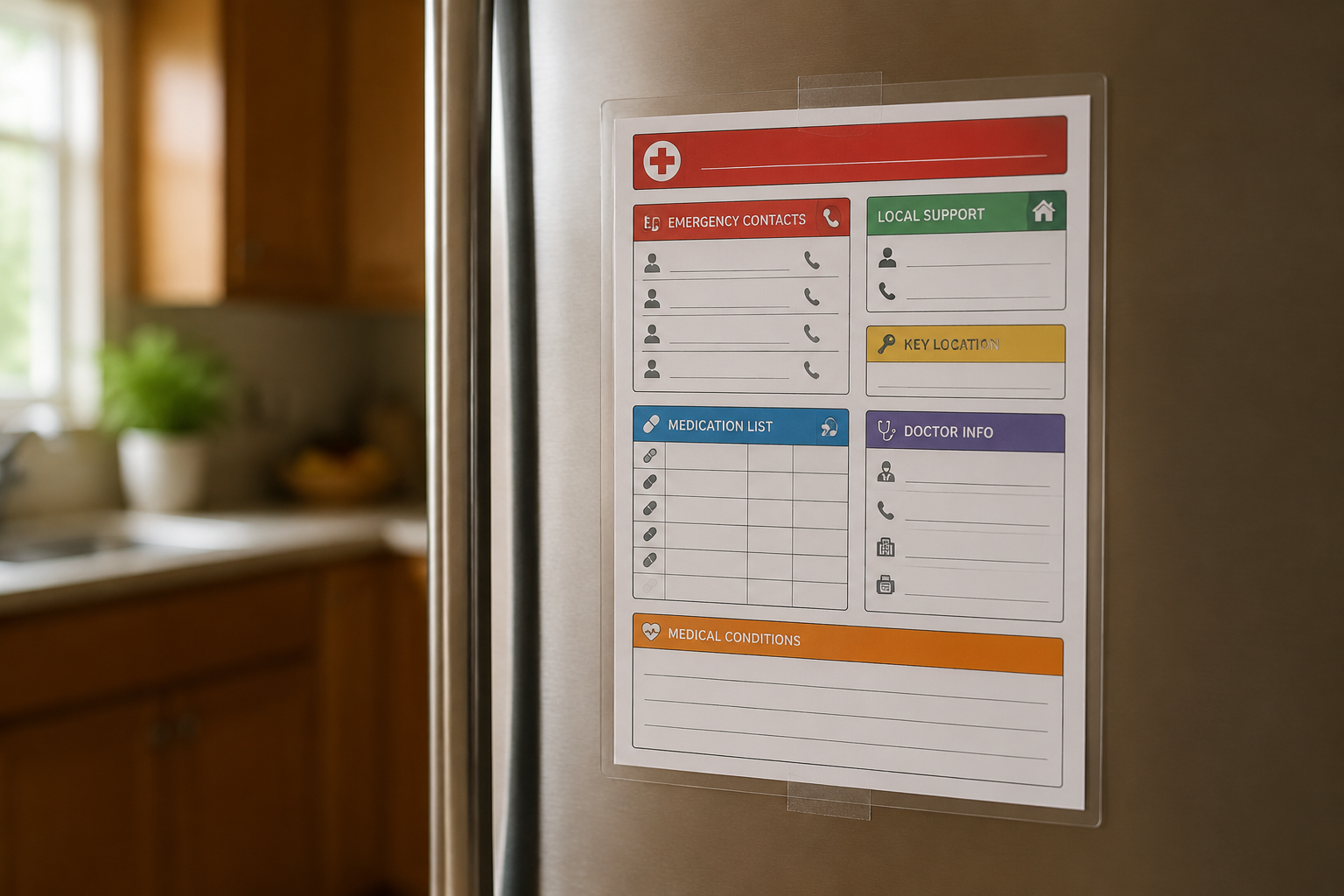
The best first-hour plan is not a binder. It is a one-page emergency response card: one copy on your parent's refrigerator or another obvious place, and one digital copy you can open from your phone. The National Institute on Aging recommends that long-distance caregivers organize key information, contacts, and local support before a problem occurs; the card turns that good advice into something usable when your hands are shaking.[3]
This card is not a legal file, a complete medical history, or proof that everyone will behave well under stress. It is a friction reducer. It gives the neighbor something to read aloud. It gives responders a medication list. It gives you a script before your brain starts trying to solve everything at once.
Parent's full legal name, date of birth, address, phone number, and preferred hospital, if any
Current medication list, allergies, major diagnoses, mobility limits, cognitive concerns, and implanted devices
Primary care doctor, key specialists, pharmacy, insurance information, and Medicare or plan details if available
Local support names: who has a key, who can meet responders, who can secure the house, and who can stay reachable
Distant caregiver command chain: hospital caller, family updater, travel decision-maker, and backup if the first person is unreachable
Document locations: health care proxy, power of attorney, advance directive, medication list, insurance card, and recent hospital paperwork
Family Caregiver Alliance's emergency preparedness checklist emphasizes emergency contacts, medical information, supplies, and plans for communication and evacuation.[4] For this particular job, keep the card narrower: what helps another adult act in the first hour while you are not physically there.
The First 60 Minutes
When the call comes, your job is not to become calm. Your job is to become organized faster than the situation becomes chaotic. Use the first hour as a sequence, not a cloud of urgent tasks.
Time
Main job
What changes
0-5 minutes
Verify the event and keep the caller useful
You move from rumor to location, responder status, and immediate safety facts
5-15 minutes
Activate local backup
Someone nearby becomes your hands, eyes, and door-opener
15-30 minutes
Prepare hospital information
Medication, diagnosis, contact, and authority details are ready before staff ask
30-45 minutes
Set the communication chain
Relatives stop calling everyone separately and one written record begins
45-60 minutes
Make the first travel decision
You decide whether to leave now or wait for admission-level information
0-5 Minutes: Keep the Caller on the Job
Do not start with the family group text. Start with the person who can still see the house.
Ask where your parent is now: inside the house, in the ambulance, already transported, or unknown.
Ask who is physically present: neighbor, police, fire department, EMTs, home aide, or no one.
Ask whether the door is locked, pets are loose, stove or appliances are on, or the house needs to be secured.
Ask whether responders have the refrigerator card or need the neighbor to read it aloud.
Ask for the ambulance destination if it is known, but do not assume the first answer is final.
If the caller is emotional, give one job at a time: "Please stay by the phone until the ambulance leaves." "Please tell me the hospital name if they say it." "Please lock the front door after they go." People nearby often want to help but do not know what counts as help.
5-15 Minutes: Activate Local Backup
Local activation is the part of the plan that either exists before the emergency or gets improvised badly during it. A commercial caregiving guide from Caring Village frames this preparation around practical questions such as who has a key, who can meet the ambulance, where medications are kept, and who can help locally.[5] Those questions are useful because they are not abstract. They assign the first hour to real people.
Your local list does not need to be large. It needs to be honest. A friendly neighbor who travels often is not the same as a neighbor who can answer at midnight. A sibling nearby who panics may still be useful for locking the house, but not for speaking with emergency staff. A paid geriatric care manager, if your family uses one, may be the best local point person because the role is already professional rather than emotional.
Local role
What that person does in the first hour
What to confirm before a crisis
Key holder
Lets responders or backup support into the home if needed
Has a working key, alarm code, and permission to use them
Responder contact
Meets EMTs, reads the emergency card, and reports the destination hospital
Knows where the card is and can stay reachable
Home closer
Locks doors, turns off appliances, checks pets, and secures the house
Knows basic house routines and whom to call about pets
Hospital runner
Can bring glasses, hearing aids, phone charger, medication list, or documents
Knows where essentials are stored and can drive or arrange transport
Professional backup
Coordinates locally if family cannot arrive quickly
Has authorization, contact information, and clear boundaries
This is also where pride and privacy make the plan harder. Some parents do not want neighbors to have a key. Some siblings resent being assigned. Some helpers say yes because the conversation is uncomfortable, not because they can really do the job. The card cannot fix that. It can expose the weak spots while there is still time to choose a lockbox, add a second contact, or scale back a role to something the person can actually do.
15-30 Minutes: Get Ready for the Hospital Call
Hospitals do not need a family biography in the first call. They need clean information: identity, medications, conditions, baseline function, decision-making contacts, and what changed today. If you already have the one-page card open, you can answer instead of searching email while a nurse waits.
Identity: full name, date of birth, address, and your relationship
Baseline: lives alone or with someone, walks independently or uses equipment, usually oriented or has memory changes
Medical facts: current medications, allergies, diagnoses, recent falls, recent hospitalizations, and known specialists
Authority: who is health care proxy or medical decision-maker, where documents are stored, and how to reach that person
Local contact: who can bring items, meet staff, or check the house if the hospital requests something
Keep legal-document work brief in this plan. You should know where the health care proxy, advance directive, power of attorney, insurance cards, and medication list are, but the first-hour card is not the place to solve every legal and financial gap. If that part is unfinished, use a separate legal and financial startup kit after the immediate incident is controlled.
30-45 Minutes: Stop the Parallel Phone Calls
Family chaos usually sounds caring from the inside. One person calls the ER desk. Another calls the neighbor. Someone texts your parent's phone. Someone posts "any update?" every three minutes. Staff hear partial information from multiple relatives, and the person farthest away becomes a switchboard operator instead of a coordinator.
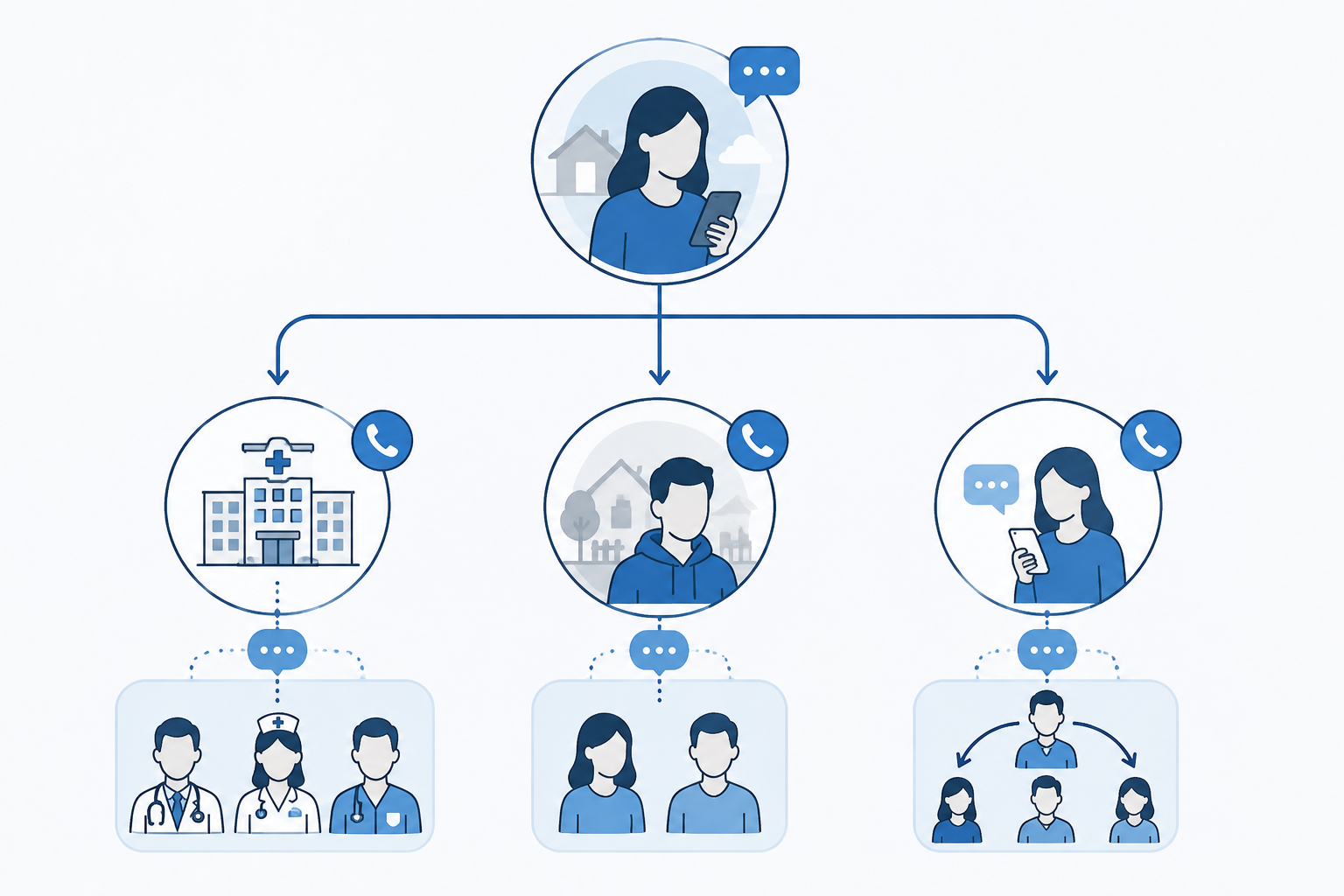
Set the command chain early. One person speaks with the hospital unless the hospital instructs otherwise. One person communicates with local backup. One person updates relatives. If your family is small, those roles may all sit with you for the first hour, but name them anyway so they can be handed off.
Hospital contact: calls or receives calls from the hospital, records names and times, and asks what decision is needed next.
Local backup contact: manages the neighbor, aide, care manager, key holder, pets, house, and item drop-offs.
Family updater: sends short updates at set intervals and tells relatives not to call the hospital separately.
Travel lead: checks flight, driving, hotel, work, child care, and backup options without booking impulsively before the medical picture is clearer.
Use one shared note, not memory. Record the time of the call, who called, where your parent was taken, the name of any clinician you spoke with, what they said, what they asked for, and what remains unknown. A messy note is better than a confident reconstruction at 2 a.m.
45-60 Minutes: Decide Whether to Travel Now
The travel decision is where distance punishes you for guessing. Leaving immediately can be right. It can also put you in an airport while the hospital is still running tests, your parent is discharged before you land, and no one is available to pick them up because everyone assumed you were coming.
For the first hour, separate "I need to go" from "I need to decide when to go." Local backup may be able to hold the situation for 12 to 24 hours if your parent is stable, not admitted, has a reachable local helper, and no immediate consent or discharge decision is pending. That window can let you book better travel, arrange coverage at home, and arrive when your presence will actually change the outcome.
Travel now, or start acting as if you will, when the hospital says there is an admission, a possible surgery or procedure requiring family input, a serious change in mental status, clear deterioration, no safe discharge plan, no reliable local person, or a need for decisions your parent cannot make. If you are the legal decision-maker and staff need you in person, the question is no longer whether the trip is convenient.
If this is true
First-hour travel posture
Parent is being evaluated, stable, and local backup is reachable
Wait for admission or discharge information while preparing options
Parent may be discharged soon but cannot safely get home alone
Activate local pickup or care support before booking travel
Hospital admission is likely or confirmed
Prepare to travel and ask what decisions are expected in the next 24 hours
Surgery, procedure consent, or major treatment decision is possible
Escalate travel planning immediately and confirm who can legally consent
No local backup can secure the house, bring essentials, or receive discharge instructions
Treat travel as urgent unless a paid or community backup can be activated
The Script to Keep by Your Phone
A script prevents you from starting every call from scratch. Put this on the digital version of the card and use it until the facts change.
My name is [name]. I am [parent's name]'s [relationship], and I am coordinating from [city/state].

Their date of birth is [DOB]. Their address is [address].

The local person who can help right now is [name, phone]. They can [meet responders / bring documents / secure the home / pick up items].

Key medical information: [medications], [allergies], [major diagnoses], [baseline mobility/cognition].

The health care decision-maker is [name]. The document is located [location], and a digital copy is [where].

Please tell me: current location, treating department, whether admission is expected, what information you need next, and when I should call back if I do not hear from you.
Use the same discipline with relatives. A useful family update sounds plain: "Dad was taken to Mercy ER at about 11:20 p.m. He is being evaluated. I spoke with the charge nurse at 11:45. No admission decision yet. Please do not call the ER; I will update this thread at 12:30 or sooner if the hospital calls." That message answers the question people are asking without creating six new calls for staff.
After the First Hour
Once the first hour is controlled, shift from response to tracking. Save the notes. Photograph or scan any new paperwork. Add the hospital name, clinician names, medication changes, test results if shared, and discharge warnings. Mark what failed: the neighbor did not answer, the medication list was old, the lockbox code was wrong, the sibling called the ER after being asked not to, or no one knew where the hearing aids were.
If the incident was a fall or likely to become a multi-day situation, move into a first-72-hours plan. If the call made it obvious that your family has been improvising everything, use a first-week caregiver roadmap or a first-30-days caregiver plan next. The emergency card is the beginning of coordination, not the whole caregiving system.
Distance becomes most dangerous when decisions float between people who all care but no one coordinates. The first-hour plan works because it gives the distant caregiver a job that can actually be done from far away: activate the local person, feed the hospital clean information, control the communication chain, and make the travel decision from facts instead of panic.

Comments
Join the discussion with an anonymous comment.