How Medicaid HCBS Waivers Fund Home Modifications: A Step-by-Step Guide
Reviewed: 2026-07-05
How Medicaid HCBS Waivers Fund Home Modifications: A Step-by-Step Guide
This article walks family caregivers through the step-by-step process of getting Medicaid HCBS waivers to pay for home modifications like ramps, grab bars, and stairlifts — including eligibility requirements, timeline, and the gatekeepers involved.
By Editorial Team
new caregiver
experienced caregiver
long-distance caregiving
spousal caregiver
working caregiver
daily routines
medication management
personal hygiene
care coordination
first steps
ADLs
IADLs
If the question at your kitchen table is, “Can Medicaid pay for the ramp, grab bars, stairlift, or bathroom changes before Mom falls again?” the practical answer is: sometimes, yes. The most common Medicaid pathway is a Home and Community-Based Services waiver, often called an HCBS waiver. These waivers can pay for home modifications when the change is medically or functionally necessary to keep a person safely at home.
This is not a quick reimbursement program where you buy equipment, send in a receipt, and wait for a check. HCBS waivers are state-administered programs. They usually require Medicaid financial eligibility, a nursing-facility level-of-care determination, a case manager, a home assessment, contractor estimates, prior authorization, and then installation. A family that starts with those steps in the right order has a much better chance of avoiding expensive false starts.
First, make sure you are in the Medicaid HCBS lane
A home modification can sit in several possible funding lanes: Medicaid HCBS, Medicare, private insurance, Veterans Affairs benefits, state housing programs, nonprofit grants, or private pay. The Medicaid HCBS waiver lane is the one to investigate when your parent needs help staying out of a nursing facility and may meet Medicaid’s financial and functional rules.
It is a real lane, not a rumor. In an HHS/ASPE review of 202 Medicaid HCBS waivers, 173 included home modification coverage, often under terms such as environmental accessibility adaptations or similar language.[1] That figure matters because families are often told “Medicaid may help” in a way that sounds vague. HCBS waivers are one of the main Medicaid vehicles for this kind of work.
The caution is just as important: HCBS waivers are not federal entitlements. States administer them, define covered services, set dollar limits, use prior authorization, and cap enrollment. A neighbor’s ramp approval in another state, or even under another waiver in the same state, does not prove your parent’s project will be covered.
The two eligibility gates: money and level of care
Before anyone measures the doorway or prices a roll-in shower, Medicaid has to decide whether your parent qualifies for the waiver. There are usually two separate gates.
Financial eligibility: income and assets must fit the state’s Medicaid long-term care rules.
Functional eligibility: your parent must meet the state’s nursing-facility level-of-care standard.
For 2024, many states used income limits around $2,829 per month and asset limits around $2,000 for long-term care Medicaid eligibility, but these figures are not universal and can vary by state, marital status, program, and planning rules.[2] If your parent is near the limit, do not guess. Ask the state Medicaid office, the local aging agency, or a qualified Medicaid planner what rule applies to the exact waiver you are considering.
The functional gate is where many families lose time. A doctor’s note saying “needs a safer bathroom” is useful, but it is not the same thing as a nursing-facility level-of-care determination. The waiver has to find that your parent’s care needs are serious enough that, without home and community-based support, nursing-facility care would be the comparable Medicaid service.
That does not mean your parent must want to move to a nursing facility. It means the waiver is designed as an alternative to that level of care. If your parent only needs light housekeeping or a convenience upgrade, the HCBS home modification route is probably not the right fit.
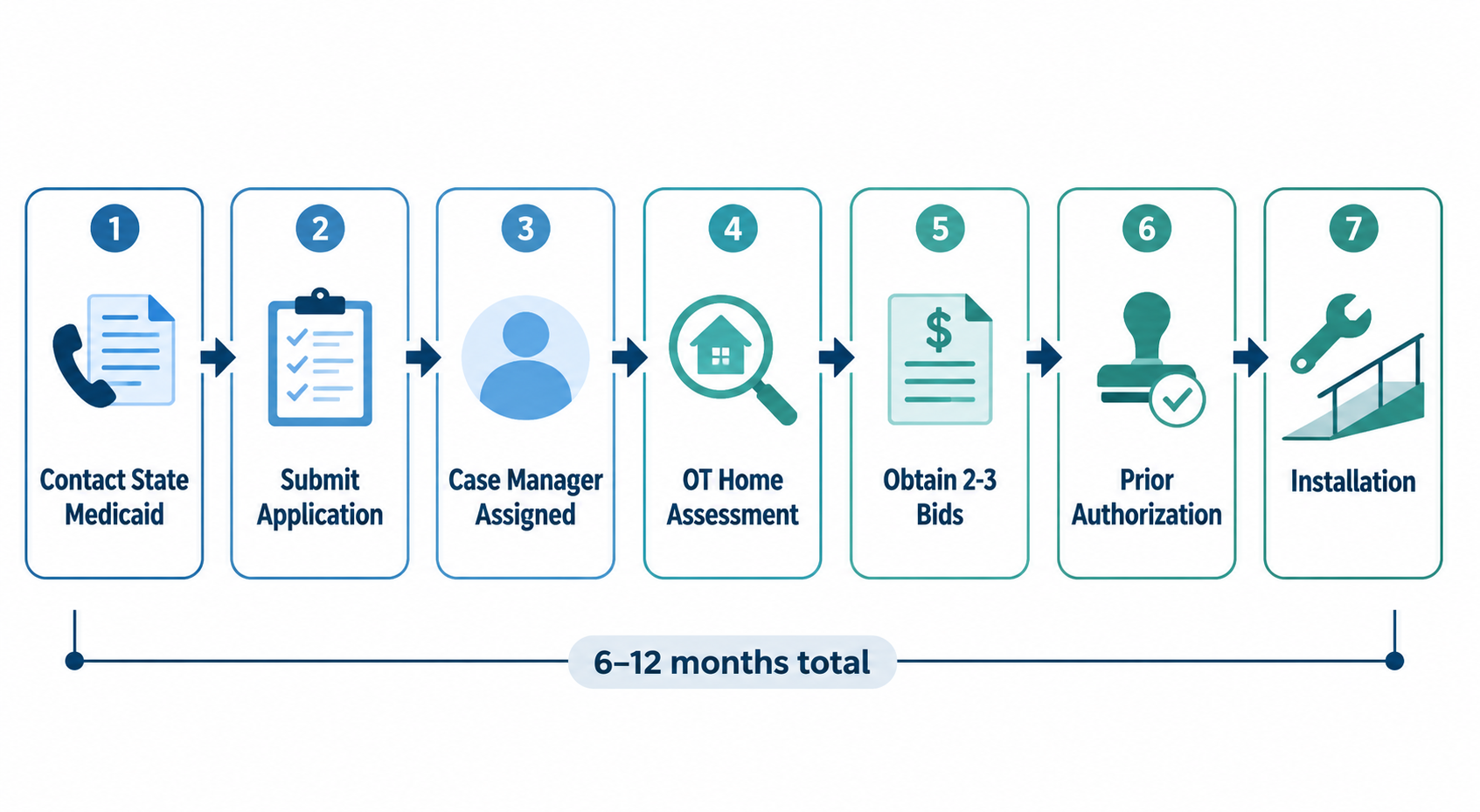
The usual path from first call to installation
The order matters. Families often call a contractor first because the safety problem is visible: the steps are too steep, the tub wall is too high, the hallway is too narrow for a walker. But under a waiver, the state generally wants eligibility, assessment, recommendations, bids, and authorization before work begins.
Step
What happens
Who usually controls the next move
Contact the right state office
Ask which Medicaid HCBS waiver covers older adults or adults with disabilities and whether it includes environmental accessibility adaptations.
State Medicaid agency, aging office, or ADRC
Submit the waiver application
Provide financial information and request the functional assessment required for waiver eligibility.
Applicant, family caregiver, eligibility worker
Case manager is assigned
If the person is eligible or moving through intake, a case manager helps coordinate services and documentation.
Waiver program or managed care organization
OT or qualified professional assesses the home
The assessor connects the person’s functional limitations to specific modifications.
Occupational therapist or approved assessor
Contractor bids are gathered
The proposed work is priced, often with itemized estimates and sometimes multiple bids.
Contractors, case manager, family
Prior authorization is reviewed
The waiver decides whether the modification is covered, necessary, reasonable, and within program limits.
Prior-authorization reviewer or waiver administrator
Installation is scheduled
Approved work is completed, inspected if required, and billed through the authorized process.
Approved contractor and waiver program
Provider-side Medicaid home modification guides commonly describe this same basic sequence: application, case management, home assessment, contractor bidding, prior authorization, and installation. Some programs require two or three contractor bids under competitive-bid rules before approval.[3]
Step 1: Call the state Medicaid agency or aging access point
Start with the office that can identify the correct waiver. In many states, that may be the state Medicaid agency, the Area Agency on Aging, an Aging and Disability Resource Center, or a managed care long-term services and supports plan. Use the words “HCBS waiver,” “home modifications,” and “environmental accessibility adaptations.” Those terms help staff route the call.
Ask four plain questions before you fill out anything complicated: Which waiver serves older adults? Does it cover home modifications? Is there a waitlist or interest list? What is the first required assessment?
Step 2: Apply before you hire anyone
If the home change is urgent, it is tempting to pay a contractor and try to sort out reimbursement later. That is risky. Many waiver programs will not pay for work that began before approval, even if the need was real. The application starts the file that later reviewers will use to decide whether the modification is covered.
Keep copies of the application, notices, assessment dates, denial or approval letters, case manager contact information, and every estimate. The point is not to make a perfect binder for its own sake. The point is that, when a reviewer asks why a stairlift is needed instead of another intervention, you can show the functional problem, the professional recommendation, and the cost in one place.
Step 3: Treat the case manager as a gatekeeper, not just a helper
Once a case manager is involved, ask what documentation the waiver requires for home modifications. The case manager may need to confirm that the modification fits the care plan, request an occupational therapy assessment, gather bids, or submit the prior-authorization packet.
This is also the moment to clarify whether the program uses self-direction or agency-managed services. If consumer-directed options are available, the family may have more responsibility for arranging vendors, paperwork, or scheduling. More control can be useful, but it is not the same as fewer rules.
Step 4: The OT assessment has to connect the hazard to the disability
The occupational therapist or other approved home assessor is often the rate-limiting person in the process. The assessment is not simply a walk-through where everyone agrees the bathroom looks unsafe. It has to translate daily function into a waiver-eligible recommendation.
A strong assessment connects the person’s limitation to the requested work: difficulty stepping over a tub wall, inability to use stairs to enter the home, unsafe transfers from toilet to walker, wheelchair clearance problems at the bedroom doorway, or repeated loss of balance in a poorly lit hallway. The recommendation should explain why the proposed change supports safety and independence at home.
This is why a general contractor’s opinion is not enough. The contractor can price and build. The OT or approved assessor explains functional necessity. If you need more detail on this part of the process, an OT-focused aging-in-place assessment guide is usually more useful than a general remodeling article.
Step 5: Get itemized bids that match the recommendation
Contractor estimates should match the approved scope as closely as possible. If the OT recommends a ramp with handrails to create an accessible entrance, the bid should price that work clearly. If the estimate mixes the ramp with unrelated porch repairs, decorative finishes, or general remodeling, the reviewer may slow down or deny the request until the covered and noncovered pieces are separated.
Ask for itemized estimates, license and insurance information if required, and realistic scheduling windows. If the waiver requires multiple bids, do not assume one preferred contractor is enough. Competitive-bid rules can feel unreasonable when a parent is unsafe at home, but missing a required bid can send the file backward.
Step 6: Wait for prior authorization before work starts
Prior authorization is the state’s or managed care plan’s formal approval before the waiver pays. The reviewer is usually looking for several things at once: eligibility, covered service category, medical or functional necessity, appropriate scope, required bids, cost limits, and whether the modification avoids institutional care or supports community living.
This is the desk where vague paperwork causes delays. “Bathroom remodel” is weaker than “replace tub with roll-in shower because participant cannot safely step over tub wall and requires seated transfers.” The second version gives the reviewer a functional reason to approve a specific adaptation.
Step 7: Installation comes after approval, not after the first estimate
Once authorization is issued, confirm who schedules the work, who signs off when it is complete, and how the contractor is paid. Some programs pay the provider directly. Others may have managed care or fiscal intermediary rules. Before anyone begins work, make sure the written approval matches the actual project.
If the approval is narrower than what the family expected, pause before adding privately paid upgrades. Mixing approved accessibility work with extra remodeling can complicate billing, inspections, and responsibility if something has to be corrected.
What Medicaid HCBS waivers commonly cover
Coverage language varies by state, but waiver home modification benefits often focus on adaptations that make the home safer and more accessible for the person’s disability-related needs. Commonly cited examples include ramps, grab bars, handrails, stairlifts, widened doorways, roll-in showers, walk-in tubs, non-slip flooring, lighting adaptations, accessible handles and fixtures, and personal emergency response systems.[2]
Often possible when justified
Often excluded or difficult to approve
Wheelchair ramp for the main entrance
New room addition that increases square footage
Grab bars, handrails, or transfer supports
Purely cosmetic bathroom or kitchen upgrades
Doorway widening for wheelchair or walker access
General home repairs unrelated to disability access
Roll-in shower or other bathing access change
Luxury materials beyond the accessibility need
Stairlift when needed for access to essential areas
Projects mainly intended to raise property value
Lighting, flooring, handles, or fixtures tied to safety
Work started before waiver approval
The ASPE compendium describes environmental accessibility adaptations as changes necessary to ensure health, welfare, and safety or to enable greater independence in the home, while also noting common cost-control limits and exclusions for changes that add square footage or are not directly tied to the person’s disability-related need.[1]
Do not plan around a national dollar cap
You may see articles mention a $14,000 Medicaid home modification benefit. Treat that as an example from specific waiver programs, not as a national promise. Medicaid HCBS home modification caps are state-specific and waiver-specific.
State-by-state waiver summaries show wide variation, including examples as low as a $1,000 lifetime cap under Iowa’s Elderly Waiver and as high as $20,000 over five years for Florida environmental accessibility adaptations.[2] The useful question is not “What does Medicaid pay nationally?” It is “What does this waiver in this state pay for this participant under this authorization?”
If the estimated project exceeds the cap, ask whether the scope can be narrowed to the highest-risk area first. For many families, that means the entrance, bathroom, or transfer path between bedroom and bathroom. A room-by-room home modification cost guide can help you understand what may need to be privately funded if the waiver only covers part of the work.
The timeline is usually months, not weeks
A realistic Medicaid HCBS waiver home modification timeline is often 6 to 9 months from first contact to installation, and it can stretch to 12 months or more when assessment scheduling, bids, prior authorization, or waitlists slow the file.[3] That is hard to hear when someone has already fallen. It is still better to know before you schedule a contractor or promise your parent that the bathroom will be changed next month.
Waitlists are part of the landscape. KFF reported that 38 states had Medicaid HCBS waiting or interest lists, with about 692,000 people on those lists in 2023.[4] That number sounds frightening, but the waiver type matters. KFF also found that average waits were much shorter for aging waivers than for intellectual and developmental disability waivers: about 5 months for aging waivers compared with about 50 months for I/DD waivers.[4]
The right takeaway is not panic and not reassurance. Ask your state whether the older-adult waiver has a waitlist, how the list is prioritized, whether crisis or transition criteria exist, and whether your parent can receive any interim services while waiting.
Where families most often lose time
Most delays are not caused by one dramatic mistake. They come from small mismatches between what the family thinks the program needs and what the reviewer is actually allowed to approve.
Calling Medicare first and stopping there. Medicare generally is not the main payer for permanent home modifications, so the HCBS waiver path may require a different office.
Assuming a doctor’s note replaces level-of-care approval. The waiver still needs its own functional eligibility determination.
Starting construction before authorization. Many programs will not cover work that was not approved in advance.
Submitting a remodeling estimate instead of an accessibility estimate. The bid should separate covered functional work from cosmetic or unrelated repairs.
Letting the OT recommendation and contractor bid describe different projects. The paperwork should tell one consistent story.
Planning around someone else’s waiver cap. Your parent’s state, waiver, and authorization control the dollar limit.
A practical file checklist before prior authorization
Before the case manager submits the request, the file should be easy for a reviewer to follow. You are trying to remove avoidable questions, not guarantee approval.
Waiver name and confirmation that home modifications or environmental accessibility adaptations are a covered service.
Financial eligibility status or pending application status.
Nursing-facility level-of-care determination or scheduled assessment date.
OT or approved assessor report connecting the person’s limitation to the requested modification.
Itemized contractor estimates, including required competing bids if the waiver asks for them.
Photos or measurements if the case manager says they are accepted or required.
Written prior authorization before work begins.
For a bathroom request, for example, the strongest packet is not “Mom needs a nicer shower.” It is a file showing that she cannot safely step over the tub wall, has a fall or transfer risk, needs bathing access to remain at home, received an OT recommendation for a specific adaptation, and has an itemized bid for that adaptation. A bathroom safety checklist can help families notice hazards, but the waiver still needs the formal assessment and authorization process.
When Medicaid is not the only path
If your parent does not meet Medicaid financial rules, does not meet nursing-facility level of care, or cannot wait for the waiver timeline, look at other funding lanes at the same time. Veterans benefits, state housing grants, local nonprofit programs, tax credits, and private financing may be relevant depending on the household. Those options have their own rules, and they should not be mixed up with Medicaid prior authorization.
Parallel planning is reasonable. What causes trouble is assuming one program’s approval logic applies to another. A nonprofit may care about income and local residency. A VA grant may depend on service-connected disability status. Medicaid HCBS cares about waiver eligibility, functional need, covered service definitions, and prior authorization.
What to do next
Start with the state, not the contractor. Ask which HCBS waiver applies to older adults, whether it covers home modifications, whether there is a waitlist, and what assessment opens the file. Then keep the project narrow enough to match the safety need: entry access, bathroom transfers, stair access, doorway clearance, flooring, lighting, or emergency response.
The most useful sequence is simple even when the process is not: confirm the waiver, apply, complete the level-of-care assessment, work with the case manager, get the OT home assessment, gather itemized bids, wait for prior authorization, and only then install. Medicaid HCBS waivers can fund important home modifications, but approval usually depends on correct sequencing, state rules, and documentation before installation.

Comments
Join the discussion with an anonymous comment.