
Caregiver decision guide
How to Hire a Private Sitter for an Elderly Parent: A Complete Step-by-Step Guide
A practical playbook for adult children who have decided to hire a private caregiver directly. Covers the full process from needs assessment and sourcing candidates to legal setup, tax compliance, contracts, and backup care planning.

Before You Begin: What This Guide Covers (and What It Doesn't)
If you are reading this, you have likely already weighed the options and decided that hiring a private caregiver directly is the right path for your family. That decision brings significant advantages — lower cost, more control over who enters your parent's home, and the ability to build a one-on-one relationship without an agency as an intermediary. It also means you are stepping into the role of a small employer, with all the legal and financial responsibilities that entails.
This guide is a complete operational playbook for families who have already made that choice. It covers the full process: assessing your parent's needs, finding qualified candidates, conducting interviews and background checks, setting up payroll and taxes correctly, drafting a solid contract, handling insurance, onboarding your new caregiver, and planning for the inevitable times when your sitter cannot make it.
What this guide does not do is rehash the decision between private hire and agency. If you are still deciding which route to take, our Private Caregiver vs. Agency decision guide walks through the trade-offs in detail. And if you are considering a live-in arrangement specifically, our article on the hidden legal and financial risks of hiring a live-in companion covers the additional complexities that come with that setup.
Step 1: Assess Your Parent's Care Needs
Before you post a job listing or call a single reference, you need a clear, written picture of what your parent actually needs. A vague job description — "help Mom around the house" — will attract candidates who may not match the real requirements, and it leaves both you and the sitter vulnerable to misunderstandings down the road.
Start by working through a structured needs assessment. The Family Caregiver Alliance recommends breaking needs into four categories: personal care, household care, health care, and emotional care. For each category, ask yourself: Can my parent do this independently? With reminders? With hands-on help? Not at all?
Needs Assessment Worksheet
| Category | Examples | Level of Help Needed |
|---|---|---|
| Personal care (ADLs) | Bathing, dressing, toileting, transferring, eating | Independent / Reminder / Hands-on / Full assist |
| Household care (IADLs) | Meal prep, laundry, cleaning, medication management, transportation | Independent / Reminder / Hands-on / Full assist |
| Health care | Medication administration, wound care, glucose monitoring, doctor visits | None / Reminder / Skilled nursing needed |
| Emotional care | Companionship, conversation, activities, supervision for safety | Minimal / Moderate / Constant supervision |
Once you have mapped the tasks, quantify the time commitment. How many hours per week does your parent actually need someone present? Be honest about whether the need is steady or varies by day. A common mistake is underestimating the hours, which leads to burnout for the sitter and gaps in coverage for your parent.
For a deeper understanding of how ADL and IADL needs typically progress over time, see our ADL and IADL decline timeline. This will help you anticipate how your parent's needs may change in the coming months and build flexibility into your hiring plan.
Step 2: Where to Find Qualified Private Sitters
Finding a good private sitter is less about casting a wide net and more about knowing where to look. The most reliable candidates often come through personal networks and local institutions, not generic job boards.
Start with word-of-mouth referrals. Ask your parent's primary care doctor, neighbors, friends who have hired caregivers, and local senior centers. The AARP recommends personal referrals as a first step because they come with built-in trust and a track record.
Beyond personal networks, consider these sourcing channels:
- Local CNA training programs: Graduates of certified nursing assistant programs have formal training and are often looking for their first job. Contact local community colleges or vocational schools.
- Senior centers and community bulletin boards: Many experienced caregivers post flyers at places where seniors gather. This is also a good way to find someone who already knows your local community.
- Aging Life Care Professionals: These care managers often know reliable caregivers in the area and can make referrals. Their services come with a fee, but the match quality is typically higher.
- Online platforms like Care.com: These give you access to a large pool of candidates, but the screening is minimal. You will need to do your own vetting.
- Caregiver registries: Some communities maintain registries of independent caregivers who have been pre-screened. Check with your local Area Agency on Aging.
Once you have a few leads, write a clear job description based on the needs assessment from Step 1. Include the specific tasks, the schedule, the location, and the pay range. A well-written job description attracts serious candidates and filters out people who are not a fit.
Step 3: Interviewing Candidates — Questions That Reveal Fit
The interview is your best opportunity to assess whether a candidate has the skills, temperament, and reliability your parent needs. Move beyond generic questions like "Why do you want to be a caregiver?" and ask scenario-based questions that reveal how the person thinks and acts under real conditions.
The Family Caregiver Alliance provides sample interview questions that focus on experience, problem-solving, and compatibility. Here are some of the most revealing ones:
- "Tell me about a time a client became confused or agitated. What did you do?" — This reveals how the candidate handles dementia-related behaviors, even if your parent does not currently have memory issues.
- "What would you do if my parent refused to take their medication?" — A good answer shows patience, creativity, and respect for the senior's autonomy.
- "How do you handle a situation where you disagree with a family member about the care plan?" — This reveals communication skills and professionalism.
- "What does a typical day look like for you when you are caring for someone?" — This helps you understand their approach to structure, companionship, and task prioritization.
Remember that the interview is a two-way conversation. A good candidate will also ask questions about your parent's personality, routines, and preferences. That curiosity is a positive sign — it shows they care about the match, not just the paycheck.
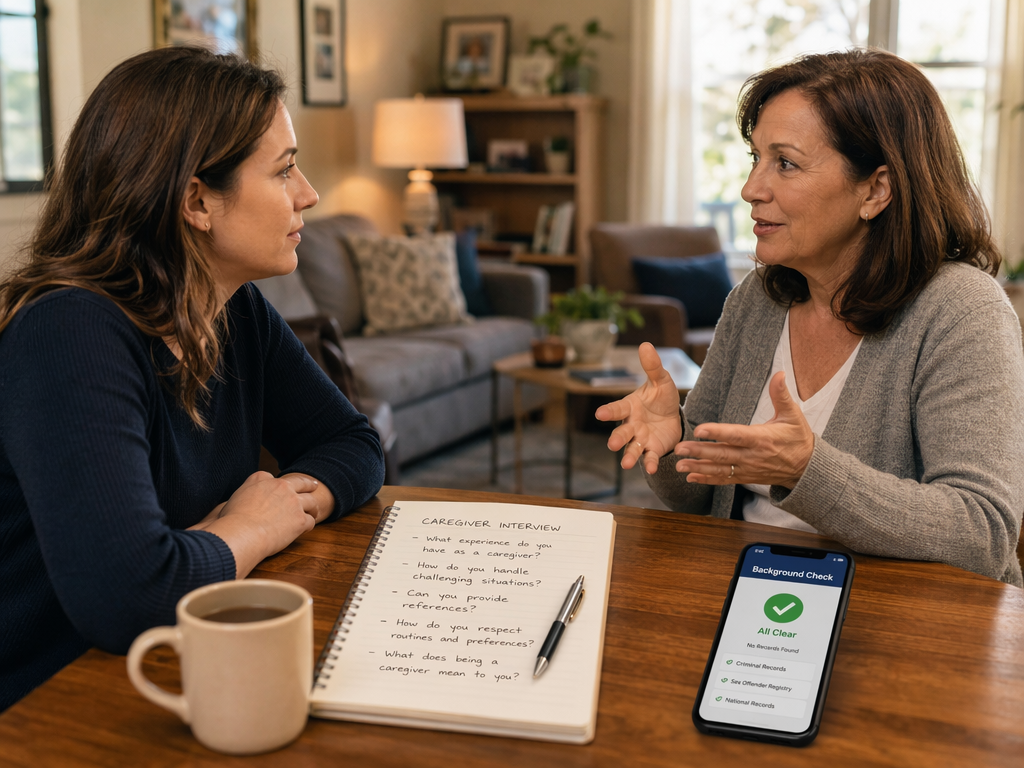
Step 4: Running Background Checks — Your Responsibility as an Employer
When you hire through an agency, background checks are part of the service. When you hire privately, that responsibility falls entirely on you. Skipping this step is one of the most common and most dangerous mistakes families make.
The Family Caregiver Alliance recommends the following checks for any private caregiver candidate:
- Criminal history check: Run a county, state, and national criminal background check. Be aware that some states, like California, are "closed record states," which makes criminal records harder to access through public databases. In those cases, you may need to use a professional background check service.
- Driving record check: If the sitter will drive your parent to appointments or errands, obtain a driving record from the state DMV.
- Credit check: Financial exploitation is a real risk. An estimated 5 million seniors are victims of financial exploitation annually, and 84% of elder abuse cases go unreported, according to the U.S. Senate Special Committee on Aging. A credit check can reveal financial distress that might increase risk.
- Professional reference checks: Ask for at least three references, with at least two from former employers. Call them. Ask specific questions about reliability, honesty, and how the candidate handled difficult situations.
- Photo ID verification: Ask for a driver's license or passport and verify that the name and photo match the person you interviewed.
You must obtain the candidate's written consent before running any background check. Most professional background check services provide consent forms as part of their process.
Step 5: Legal and Tax Setup — Becoming a Compliant Household Employer
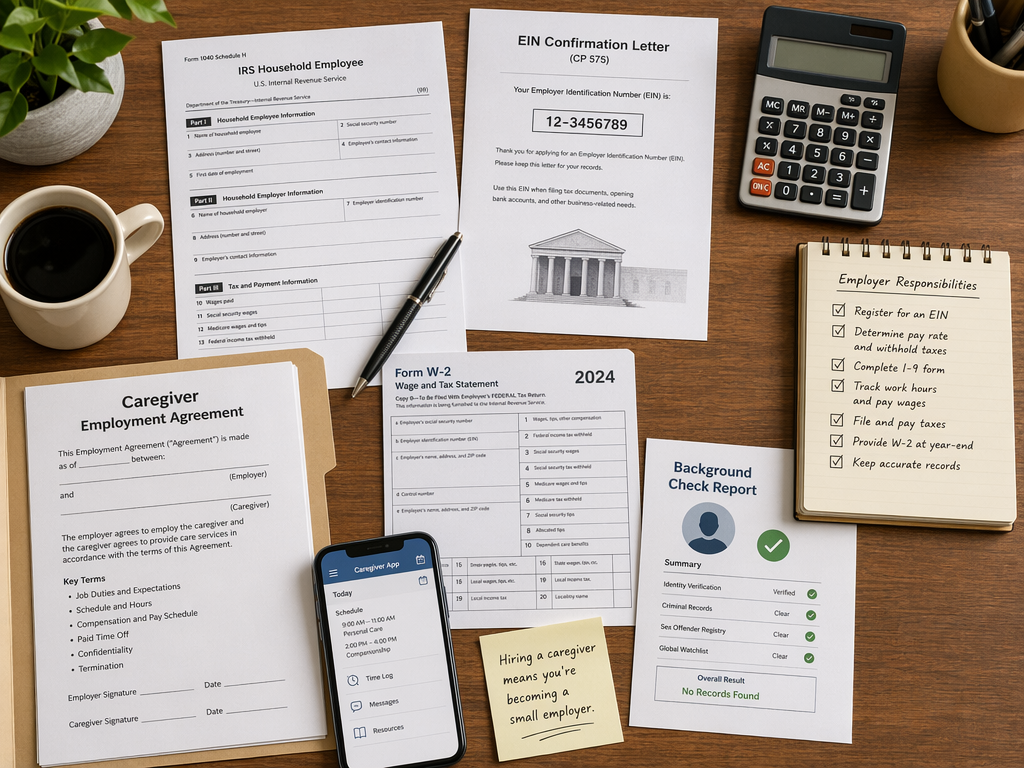
This is the section most families want to skip, and it is the one where skipping leads to the most serious consequences. When you hire a private caregiver, the IRS generally considers that person your household employee, not an independent contractor. That means you are responsible for withholding and paying Social Security and Medicare taxes, obtaining an Employer Identification Number (EIN), and following all applicable state labor laws.
The IRS Publication 926 covers household employer taxes in detail. The AARP and PayingForSeniorCare both confirm that the IRS has ruled that caregivers must be classified as employees, not independent contractors, in virtually all private-hire situations.
Key Employer Responsibilities at a Glance
| Requirement | What to Do | Source |
|---|---|---|
| Obtain an EIN | Apply online at IRS.gov — it is free and takes about 15 minutes | Family Caregiver Alliance, AARP |
| Classify as employee (W-2), not contractor (1099) | Withhold Social Security (6.2%) and Medicare (1.45%) from wages; pay matching employer portion | IRS Publication 926, PayingForSeniorCare |
| Complete Form I-9 and W-4 | Verify identity and work authorization; collect withholding preferences | Family Caregiver Alliance |
| Pay federal unemployment tax (FUTA) | If you pay $1,000 or more in wages in any calendar quarter | IRS Publication 926 |
| Check state requirements | Most states require state unemployment insurance and workers' compensation registration | AARP, state labor offices |
Paying a caregiver "under the table" is illegal. Beyond the legal risk, it can create serious problems for your parent's Medicaid eligibility. If your parent later needs nursing home care, Medicaid will review their finances for the past five years. Undocumented payments to a caregiver can be treated as gifts, triggering a penalty period that delays Medicaid coverage.
If this all sounds overwhelming, you are not alone. Many families use a third-party payroll service that specializes in household employment. These services handle tax withholding, filing, and year-end W-2 preparation for a monthly fee. The PayingForSeniorCare guide notes that these services exist specifically because the process is complicated for most families.
Step 6: Creating a Caregiver Contract That Protects Everyone
A written caregiver contract — sometimes called a personal care agreement — is not just a formality. It is a legally important document that protects both your family and the caregiver. The American Bar Association recommends updating the contract at least once per year, and A Place for Mom emphasizes that a well-drafted contract can serve as evidence for legitimate payments if a senior receiving Medicaid later enters a nursing home.
Essential Elements of a Caregiver Contract
| Contract Element | What to Include |
|---|---|
| Start date and duration | Exact start date, expected end date (if not open-ended), and review schedule |
| Detailed list of duties | Specific tasks from your needs assessment — not "general care" but "assist with bathing, prepare lunch, accompany to doctor appointments" |
| Hours and schedule | Days of the week, start and end times, flexibility expectations, overtime policy |
| Compensation | Hourly wage, pay frequency, overtime rate, mileage reimbursement (2025 IRS rate: $0.70/mile) |
| Benefits | Paid sick days, vacation time, health insurance if offered |
| Termination clause | Notice period required from either party, grounds for immediate termination |
| Liability and dispute resolution | How disputes will be handled, liability for injuries, agreement to mediate before litigation |
For compensation guidance, see our In-Home Senior Care Cost in 2026 guide for a full breakdown of hourly rates and monthly budgets. As a benchmark, the national median for agency-provided nonmedical home care in 2026 is $34 per hour, according to A Place for Mom's 2026 Cost of Long-Term Care report. Private sitters typically cost 20–30% less, though the exact savings vary by market.
Step 7: Insurance — What You Need to Know
Insurance is another area where families who hire privately often have gaps in coverage. When you hire through an agency, the agency carries liability and workers' compensation insurance. When you hire privately, those protections do not exist unless you put them in place.
Here are the key insurance considerations:
- Homeowner's insurance: Check your policy to see if it covers household employees. Many standard policies exclude or limit coverage for injuries to domestic workers. You may need to add a rider or purchase a separate policy.
- Workers' compensation insurance: This is required in many states for household employers. It covers medical expenses and lost wages if the caregiver is injured on the job. The Family Caregiver Alliance recommends carrying it even in states where it is not mandatory.
- Additional liability insurance: Some families purchase a separate liability policy to cover potential legal costs if a caregiver accuses a family member of assault or if an accident occurs in the home. A Place for Mom notes that families could incur legal fees in such situations.
Step 8: Onboarding and Setting Up for Success
A thoughtful onboarding process sets the tone for the entire working relationship. The first few days are when expectations are set, routines are established, and trust begins to build.
Use this onboarding checklist to ensure nothing is missed:
- Orientation to the home: Walk through the house together. Show the caregiver where supplies are kept, how to use appliances, where emergency exits are, and where your parent's medications are stored.
- Introduction to the senior and family: Facilitate a calm, unhurried introduction between the caregiver and your parent. Let them talk without you hovering. This is the beginning of their relationship.
- Review of the care plan: Go through the written care plan together. Be specific about routines, preferences, and any quirks your parent has. The more the caregiver knows upfront, the fewer surprises there will be.
- Emergency procedures: Review what to do in a medical emergency, a fire, or if your parent falls. Post emergency contact numbers in a visible location, including your number, the senior's doctor, and poison control.
- Communication preferences: Establish how and when you will communicate. Daily text updates? A shared log? Weekly phone calls? Clear communication from day one prevents small issues from becoming big problems.
- Trial period: Agree on a trial period — typically two to four weeks — during which either party can end the arrangement with shorter notice. This gives everyone a chance to see if the match works before committing long-term.
Throughout the trial period and beyond, maintain open lines of communication. Schedule a brief check-in call once a week for the first month, then monthly after that. Ask the caregiver how things are going, and encourage them to raise concerns early.
Step 9: Planning for Backup Care
No matter how reliable your sitter is, there will be days when they cannot come — illness, family emergencies, personal days. Planning for these gaps in advance prevents last-minute scrambles that leave your parent without care and you scrambling to rearrange your work schedule.
Build a backup care network using these strategies:
- Family and friends: Identify one or two family members or trusted neighbors who can step in for a day or two. Make sure they know the basics of your parent's routine and have a copy of the emergency contact list.
- A second part-time sitter: If your budget allows, hire a second person for a few hours a week. That person already knows your parent and can cover shifts when the primary sitter is unavailable.
- Respite care agencies: Some home care agencies offer short-term respite services on an as-needed basis. You pay the agency rate, but you get a trained professional who can step in quickly.
- Adult day centers: For daytime gaps, an adult day center can provide supervision, meals, and social activities. This is often a more affordable option than one-on-one care.
For a deeper look at temporary relief options, including funding sources and how to find qualified respite providers, see our Respite Care Options for Family Caregivers guide.
Questions to bring to a clinician or OT
This is not medical, legal, or a family's final decision — only a framework. Bring these questions to a clinician, occupational therapist, or your local Area Agency on Aging.
Find Local HelpRelated reading
Noticed something outdated or inaccurate on this page? Flag a correction. We review every report against CDC, NIA, and AARP HomeFit guidance before updating a page.