The Complete Guide to Elderly Care Companies: Types, Costs, and How to Choose in 2026
Overwhelmed by the range of elderly care companies after a parent's fall or diagnosis? This guide maps the 8 distinct company types—home care agencies, assisted living, nursing homes, CCRCs, adult day services, hospice, and geriatric care managers—with 2026 costs, decision criteria, and vetting steps to help you match the right type to your parent's needs.
By Editorial Team
new caregiver
home care
assisted living
nursing homes
care coordination
first steps
📄
A printable version of this guide is available. Use your browser's print function (Ctrl+P / ⌘P) to save or print.
Why the Elderly Care Landscape Is So Confusing
The first time you search for "elderly care companies" after a parent's fall or diagnosis, the results are a wall of overlapping terms. Home care. Home health. Assisted living. Skilled nursing. Continuing care. Adult day. Hospice. Geriatric care management. Each label sounds like it might be the right one, but none of them map cleanly to the question running through your head: What does my parent actually need, and who provides it?
Part of the confusion is structural. The global elderly care market is valued at approximately $1.64 trillion in 2026 and is projected to reach $3.06 trillion by 2033, growing at a compound annual rate of 9.3%, according to Coherent Market Insights. That scale attracts a vast range of providers — from national chains with hundreds of locations to local agencies operating out of a single office — and the terminology they use is not standardized. A "residential care facility" in one state may be called an "assisted living community" in another, and neither term tells you whether the staff can handle medication management or wound care.
The result is that families waste time and money navigating the wrong company types. A family whose parent needs only companionship and light housekeeping might tour an expensive assisted living community before realizing a non-medical home care agency would cost a fraction as much. Another family might assume Medicare covers a nursing home stay, only to discover the coverage is limited to short-term skilled care after a hospital discharge.
Non-Medical Home Care Agencies
Non-medical home care agencies provide what the name suggests: assistance with daily activities that do not require a licensed medical professional. This includes companionship, help with bathing and dressing, meal preparation, light housekeeping, medication reminders, and transportation to appointments. These agencies serve the largest segment of the elderly care market — home care services represent 39.1% of the global market in 2026, driven in part by the fact that 77% of U.S. adults aged 50 and older want to age in place.
Major National Agencies
Several large national franchises dominate this space, each with a slightly different service model:
Home Instead: Founded in 1994, operates more than 1,200 franchises in 14 countries, including roughly 600 in the U.S., with approximately 100,000 caregivers worldwide serving about 45,000 clients. Acquired by Honor Technology in 2021, the combined organization represents over $2.1 billion in home care services revenue. Home Instead offers a proprietary CarePro dementia training curriculum and publishes local owner turnover rates — a transparency signal worth checking.
Visiting Angels: Known for its "Select Your Caregiver" policy, which lets families interview and choose the caregiver who will work with their parent. The company reports a national average caregiver tenure exceeding two years — notably above the industry average.
Right at Home: Operates roughly 700 locations and uses the ClearCareGO platform for AI-driven alerts on client condition changes. Publishes quarterly client-satisfaction scores.
Comfort Keepers: Reports an annual caregiver turnover rate of 29% — significantly better than the industry average of 34.2% in 2025.
BrightStar Care: Holds Joint Commission accreditation and requires each local office to have a Director of Nursing on staff, which is unusual for a non-medical home care agency and provides an extra layer of clinical oversight.
2026 Cost Range
According to CareScout's 2025 Cost of Care Survey (the most recent national median data available), non-medical home care averages $35 per hour, representing a 3% year-over-year increase. Companion care specifically runs $28–$33 per hour nationally. At 44 hours per week, the annual cost reaches approximately $80,080. These figures vary significantly by geography — care in metropolitan areas and high-cost-of-living states can run 20–40% higher.
Home Health Care Agencies
Home health care agencies are fundamentally different from non-medical home care agencies. They employ licensed medical professionals — registered nurses, physical therapists, occupational therapists, speech-language pathologists — who provide skilled care in the home. Services include wound care, medication management, intravenous therapy, post-surgical rehabilitation, and monitoring of chronic conditions.
The National Institute on Aging notes that home health care is typically ordered by a physician and is often short-term, following a hospitalization or a decline in a chronic condition. Medicare covers these services when they are provided by a Medicare-certified home health agency, but only for a limited period and only if the patient is homebound and needs skilled nursing or therapy on an intermittent basis.
Major National Agencies
Bayada Home Health Care: Operates more than 380 locations across 22 states. One of the largest home health care providers in the U.S., with a strong focus on pediatric and adult skilled nursing.
LHC Group: Operates in 37 states and maintains a 24/7 RN-staffed triage line for clients and families. Provides home health, hospice, and community-based services.
2026 Cost Range
Skilled nursing in the home averages $90 per hour nationally according to CareScout's 2025 data. Physical therapy and occupational therapy visits are typically billed separately and may be covered by Medicare Part B if ordered by a physician.
Assisted Living Communities
Assisted living communities are residential facilities for older adults who need help with daily activities but do not require the 24-hour skilled nursing care provided by a nursing home. Residents typically live in private or semi-private apartments and have access to shared dining, social activities, and common areas. Services include up to three meals per day, personal care assistance, medication management, housekeeping, laundry, and 24-hour supervision.
The National Institute on Aging describes assisted living as a middle ground: more support than independent living, less intensive than a nursing home. Most residents pay the full cost out of pocket. Medicare does not cover long-term assisted living stays, though Medicaid may cover some services depending on the state.
Major National Providers
Brookdale Senior Living: The largest assisted living provider in the U.S. with more than 650 facilities across 41 states and a capacity of over 58,000 full-time residents. Offers six care types including independent living, assisted living, memory care, skilled nursing, CCRCs, and home health. Monthly base costs range from $2,160 to $14,300 for assisted living depending on location and level of care. Holds a 4.5 rating on SeniorLiving.org and A+ BBB rating.
Atria Senior Living: Operates approximately 340 facilities in 44 states. Known for a more upscale, hospitality-oriented model with chef-prepared meals and robust activity programs.
Sunrise Senior Living: Operates roughly 270 facilities in 29 states. Has a strong reputation for memory care programming.
2026 Cost Range
The national median cost for assisted living is $6,200 per month in 2025, according to CareScout, representing a 5% year-over-year increase. That translates to approximately $74,400 annually. Brookdale's published range ($2,160–$14,300/month) illustrates the enormous geographic and service-level variation — a studio apartment in a low-cost state with minimal care needs costs a fraction of a larger unit in a high-cost metro area with significant daily assistance.
Skilled Nursing Facilities (Nursing Homes)
Skilled nursing facilities — commonly called nursing homes — provide 24-hour nursing care, supervision, meals, assistance with activities of daily living, and rehabilitation services including physical, occupational, and speech therapy. They are the most medically intensive residential care setting and are appropriate for older adults who cannot be safely cared for at home or in an assisted living community due to complex medical needs, significant mobility limitations, or advanced dementia.
The National Institute on Aging notes that Medicare generally does not cover long-term nursing home stays. It will cover up to 100 days of skilled nursing care following a qualifying hospital stay (at least three days as an inpatient), but only if the care is provided by a Medicare-certified facility and the patient requires daily skilled nursing or therapy. After day 100, the patient is responsible for the full cost unless they qualify for Medicaid.
Major National Providers
Genesis HealthCare: Operates approximately 250 skilled nursing facilities across 22 states. One of the largest nursing home chains in the U.S.
The Ensign Group: Operates more than 300 facilities in 14 states. Known for a decentralized operating model where local leadership has significant autonomy.
ProMedica Senior Care: Operates over 300 facilities in 26 states. Formerly HCR ManorCare, now part of the ProMedica health system.
2026 Cost Range
According to CareScout's 2025 data, the national median cost for a private room in a nursing home is $10,798 per month ($355 per day, $129,575 annually). A semi-private room averages $9,581 per month ($114,975 annually). The private room rate increased 1% year over year, while the semi-private rate rose 3%.
Continuing Care Retirement Communities (CCRCs)
Continuing care retirement communities — also called life plan communities — offer a full spectrum of care on a single campus: independent living, assisted living, and skilled nursing. The model is designed for older adults who are currently healthy and independent but want to secure access to higher levels of care as their needs change without having to move to a different facility.
CCRCs typically require a significant upfront entrance fee — often $100,000 to $500,000 or more — plus a monthly fee that covers housing, meals, services, and access to higher levels of care. Some operate on a rental model with no entrance fee but higher monthly costs. The National Institute on Aging notes that Medicare, Medicaid, and long-term care insurance may cover some services within a CCRC, though coverage varies by the specific service and the resident's eligibility.
Adult Day Services, Hospice & Palliative Care, and Geriatric Care Managers
Adult Day Services
Adult day centers provide structured social activities, exercise, meals, personal care, and basic health services in a group setting during daytime hours. They are a cost-effective option for families who need care during the workday but want their parent to return home in the evening. The National Institute on Aging notes that costs tend to be lower than in-home care or nursing home care, and that Medicare does not cover adult day services.
The national median cost for adult day health care is $95 per day according to CareScout's 2025 data. At five days per week, that works out to roughly $1,900 per month — significantly less than home care or assisted living.
Hospice and Palliative Care Providers
Hospice care is comfort-focused care for individuals with a terminal illness who are no longer seeking curative treatment. Palliative care is similar but can be provided alongside curative treatment at any stage of a serious illness. Both focus on pain management, symptom control, and emotional and spiritual support for the patient and family.
The Medicare hospice benefit covers hospice care for eligible beneficiaries, including nursing, medical equipment, medications for symptom control, and short-term inpatient care. The National Institute on Aging notes that Medicare covers up to five consecutive days of respite care for hospice patients, giving family caregivers a brief break.
Geriatric Care Managers (Aging Life Care Experts)
Geriatric care managers — also called aging life care experts — are licensed nurses or social workers who assess an older adult's needs, create a comprehensive care plan, coordinate services across providers, and monitor the situation over time. They do not provide direct hands-on care; they function as a professional advocate and coordinator for families who are navigating a complex care landscape, especially when the family lives far away.
The National Institute on Aging states that Medicare and Medicaid do not pay for geriatric care management services. Long-term care insurance policies may cover some costs. Fees are typically charged by the hour or as a flat rate for an initial assessment and care plan.
Decision Matrix: Matching a Company Type to Your Parent's Needs
The following matrix maps each company type against the key factors that should drive your decision. Use it to narrow your options before you start calling providers.
Decision matrix for matching elderly care company types to your parent's needs. Budget ranges are national medians from 2025 CareScout data and may vary significantly by location.
Company Type
ADL Assistance Needed
Medical Complexity
Monthly Budget Range
Home Environment Safety
Social Engagement
Non-medical home care
Low to moderate (bathing, dressing, meals)
Low (no skilled nursing needed)
$4,000–$6,000 (20 hrs/wk)
Safe with modifications
Low (one-on-one with caregiver)
Home health care
Low to moderate
Moderate to high (post-surgery, chronic condition management)
$3,600–$7,200 (skilled nursing visits)
Safe with modifications
Low
Assisted living
Moderate (daily help with multiple ADLs)
Low to moderate
$4,000–$10,000+
Not applicable (facility)
High (group activities, dining)
Skilled nursing facility
High (full ADL assistance)
High (24/7 nursing care, complex medical needs)
$9,500–$11,000+
Not applicable (facility)
Moderate (structured activities)
CCRC
Varies (independent to skilled nursing on one campus)
Varies
$2,000–$6,000 monthly + $100K–$500K entrance fee
Not applicable (campus)
High (multi-level community)
Adult day services
Low to moderate
Low to moderate
$2,000 (5 days/week)
Safe with modifications (returns home at night)
High (group setting)
Hospice / palliative care
Varies
High (terminal or serious illness)
Covered by Medicare (hospice); varies (palliative)
Matching the right company type to your parent's needs is the first step toward a sustainable care plan.
2026 Cost Comparison Across All Company Types
The table below summarizes the national median costs for each company type based on CareScout's 2025 Cost of Care Survey, the most recent comprehensive national data available. These are starting points — actual costs in your area may be 20–40% higher or lower depending on geography, level of care needed, and specific services required.
2025 national median costs for elderly care company types. Source: CareScout Cost of Care Survey, July–November 2025. 2026 figures may shift slightly but are directionally accurate.
Company Type
Unit
National Median Cost (2025)
Annual Equivalent
Non-medical home care
Per hour
$35
$80,080 (44 hrs/wk)
Skilled nursing (home health)
Per hour
$90
Varies by visit frequency
Adult day health care
Per day
$95
$24,700 (5 days/wk)
Assisted living
Per month
$6,200
$74,400
Nursing home (semi-private room)
Per month
$9,581
$114,975
Nursing home (private room)
Per month
$10,798
$129,575
CCRC
Per month + entrance fee
$2,000–$6,000 + $100K–$500K
Varies widely
Hospice care
Covered by Medicare
$0 out-of-pocket for eligible
N/A
Geriatric care manager
Per hour (assessment)
$100–$200
Varies by engagement
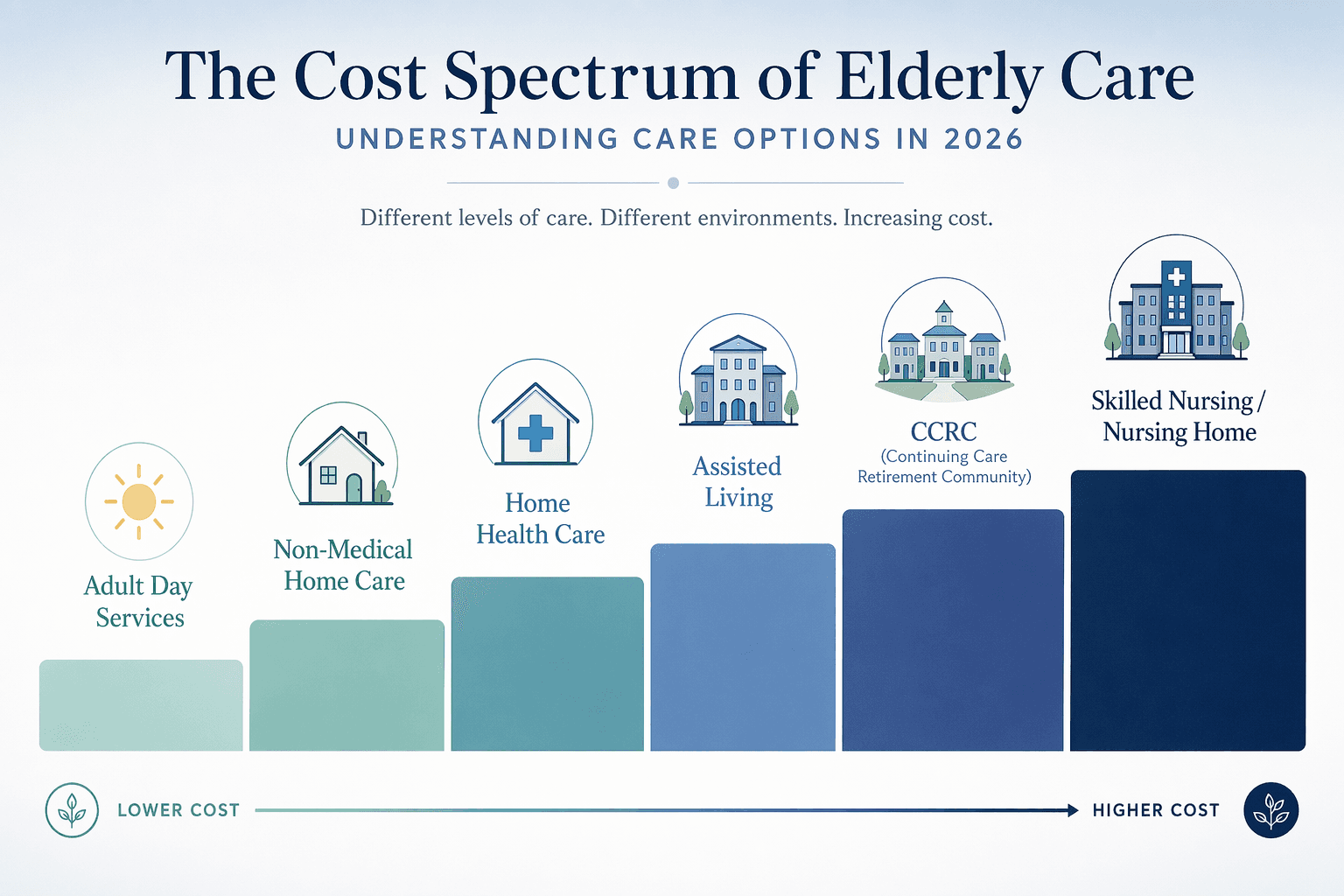
Cost spectrum of elderly care company types from lowest (adult day services) to highest (skilled nursing facility).
How to Vet Any Elderly Care Company
Once you have identified the company type that fits your parent's needs, the next step is evaluating individual providers. These criteria apply across all company types and will help you separate well-run organizations from those that may deliver inconsistent or unsafe care.
Licensing and certification: Every state licenses home care agencies, assisted living communities, and nursing homes differently. Verify that the provider holds a current license from your state's health department or aging services agency. For home health agencies, Medicare certification is essential if you plan to use Medicare coverage.
Caregiver turnover rate: As noted earlier, the industry average is 34.2% (2025). Ask any agency you are considering for their specific turnover rate. Under 30% is excellent; 30–40% is average; above 40% is a red flag. High turnover means your parent will see a rotating cast of caregivers, which undermines trust and consistency — especially important for dementia care.
Staff training, especially dementia care: Nearly 93% of U.S. adults aged 65 and older have at least one chronic condition, and many have some degree of cognitive impairment. Ask what specific training caregivers receive for dementia, Alzheimer's, and other cognitive conditions. Home Instead's CarePro curriculum and the Alzheimer's Association recognition are examples of meaningful training programs.
Inspection reports and complaint history: For nursing homes and assisted living communities, Medicare's Nursing Home Compare tool and state inspection reports are publicly available. Review the most recent survey for deficiencies, especially those related to quality of care, resident safety, and infection control.
Accreditation: Joint Commission accreditation is a voluntary but meaningful signal of quality for home health agencies and some home care agencies. BrightStar Care's requirement that every office have a Director of Nursing is another example of a structural quality indicator.
Published client satisfaction scores: Right at Home publishes quarterly client-satisfaction scores. Home Instead publishes local owner turnover rates. Any provider that is transparent about performance metrics is likely more confident in their quality than one that deflects these questions.
Use a structured checklist when vetting any elderly care company to ensure you cover all key criteria.
Payment sources by elderly care company type. Coverage varies by state, policy, and individual eligibility. Always verify with the specific provider and your state's Medicaid office.
Company Type
Private Pay
Medicare
Medicaid
Long-Term Care Insurance
VA Benefits
Non-medical home care
Yes (primary)
No
Varies by state (HCBS waivers)
Yes (if policy covers home care)
Yes (Aid & Attendance)
Home health care
Yes
Yes (short-term, skilled only)
Varies by state
Yes
Yes
Assisted living
Yes (primary)
No
Varies by state (HCBS waivers)
Yes (if policy covers assisted living)
Yes (Aid & Attendance)
Skilled nursing facility
Yes
Yes (up to 100 days, post-hospital)
Yes (for eligible individuals)
Yes
Yes
CCRC
Yes (primary)
Covers some services (skilled nursing, home health)




Comments
Join the discussion with an anonymous comment.