7 Funding Sources for Home Modifications When Medicare Won’t Pay
For: family caregiverStage: moderate assistance10 minReviewed: 2026-07-05
7 Funding Sources for Home Modifications When Medicare Won’t Pay
Medicare typically does not cover grab bars, ramps, or other home modifications. This guide walks through seven alternative funding sources — VA grants, Medicaid waivers, USDA loans, ABLE accounts, medical tax deductions, HUD grants, and nonprofit programs — with 2026-specific amounts and eligibility requirements.
By Editorial Team
new caregiver
experienced caregiver
long-distance caregiving
spousal caregiver
working caregiver
daily routines
medication management
personal hygiene
care coordination
first steps
ADLs
IADLs
The hard answer first: Original Medicare typically does not pay for structural home modifications for seniors. A doctor can agree that the front steps are unsafe, that the bathroom needs grab bars, or that a ramp would prevent a fall, and Medicare can still treat the work as a home improvement rather than a covered medical benefit. Medicare Advantage is not a reliable escape hatch either. In KFF’s 2026 review, only 21% of Medicare Advantage enrollees were in plans offering structural home modification benefits, and just 0.04% of individual Medicare Advantage plans covered them.[1]
That does not mean the answer is to pay the contractor out of pocket and hope for the best. It means the search has to move quickly from “Does Medicare cover this?” to “Which program fits this person, this house, this timeline, and this diagnosis?” The frustrating part is that the best sources are not equally available. A veteran may have a large grant available, but only with a qualifying service-connected disability. A Medicaid waiver may cover the modification, but the person may sit on a waitlist. A rural homeowner may qualify for a 1% federal loan, while a homeowner a few miles outside the eligible area may not.
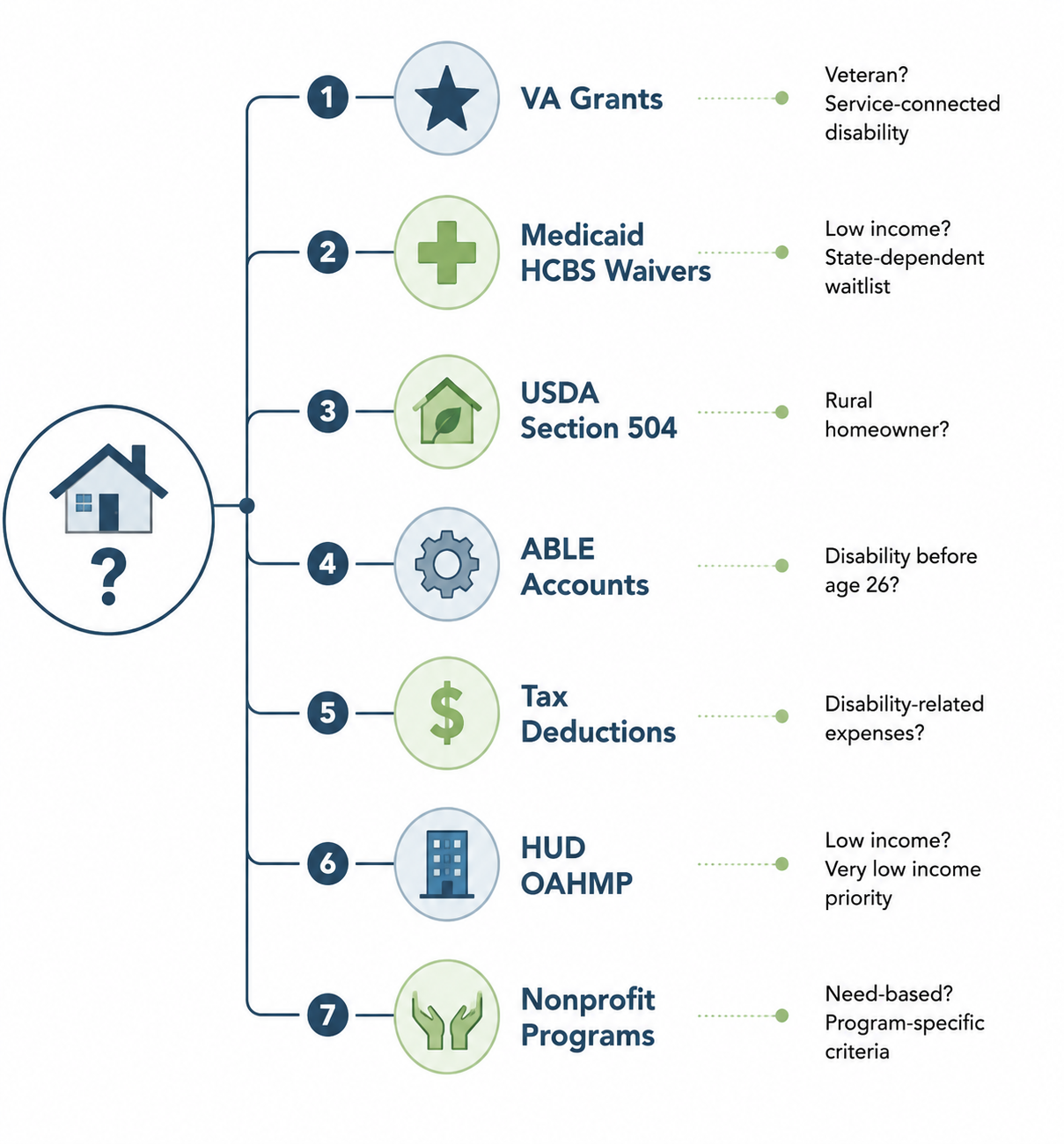
A working map of seven funding sources when Medicare will not pay for home modifications.
Funding source
2026 amount or limit
Who it can help
What it may pay for
Delay or restriction to expect
VA Specially Adapted Housing and related grants
SAH grant maximum of $126,526 in FY2026
Veterans with qualifying service-connected disabilities
Major accessibility modifications, adapted housing, ramps, widened access, bathroom or entry changes when tied to the grant rules
High potential value, but not for veterans whose disability is not service-connected
Medicaid HCBS waivers
No single national dollar limit; coverage varies by state waiver
Low-income seniors or disabled adults who meet state Medicaid and waiver rules
Home and community-based supports, which may include accessibility modifications depending on the state
Available across 46 states plus DC, but more than 607,000 people are on waitlists averaging 32 months
USDA Section 504 Home Repair program
Loans up to $40,000 at 1% fixed interest; grants up to $10,000
Very-low-income rural homeowners; grants are for homeowners age 62+ who cannot repay a loan
Repairs and improvements that remove health and safety hazards, including accessibility-related work
Only for eligible rural properties and income-qualified homeowners
ABLE accounts
2026 annual contribution limit of $20,000
People whose disability began before age 46 under the 2026 expansion
Qualified disability expenses, which can include housing-related accessibility costs when the rules are met
Not useful for seniors whose disability began after age 46
Medical expense tax deduction
Deductible only to the extent qualified medical expenses exceed 7.5% of adjusted gross income
Taxpayers who itemize deductions and have qualifying medical expenses
IRS-recognized home modifications such as ramps, grab bars, and widened doorways when medically necessary
It lowers taxes after the fact; it does not produce cash before the contractor is paid
HUD Older Adults Home Modification Program
HUD awarded $109 million in FY2024 to serve more than 5,000 households
Older adults served through local grantees, depending on area availability
Low-cost, high-impact safety and accessibility modifications
Not a direct national application for every homeowner; availability depends on local grantees
Nonprofit repair and accessibility programs
No single national cap
Older adults, low-income homeowners, disabled residents, or disaster-affected households depending on the organization
Ramps, minor repairs, fall-prevention changes, volunteer labor, or coordination with other funds
Local capacity varies; programs may have income limits, waitlists, and project-size limits
Start With the Fastest Eligibility Screen, Not the Longest Application
The first call should not be random. It should be based on the fact pattern that is hardest to change: veteran status, Medicaid eligibility, rural location, disability age of onset, homeownership, and timeline. A family can waste weeks asking the wrong office a perfectly reasonable question.
If the senior is a veteran with a disability connected to military service, screen VA housing grants first. The possible 2026 grant amount is too large to leave until later, but the service-connected disability requirement must be confirmed immediately.
If the senior is low-income and may qualify for Medicaid, call the state Medicaid waiver office or Area Agency on Aging next. Ask specifically about HCBS waivers and home modifications, not just “Medicaid help.”
If the senior owns a home in a rural area and has very low income, check USDA Section 504 before assuming a private loan is the only option.
If the person’s disability began before age 46, ask whether an ABLE account can be used or opened under the 2026 age-of-onset expansion.
If the work has to happen before any agency can approve funding, preserve receipts, doctor letters, and contractor invoices for possible tax treatment or reimbursement through another program.
If the project is modest, such as grab bars, railings, a threshold change, or a small ramp, call local nonprofit repair programs early. They may move faster than a waiver, even when they cannot fund a full remodel.
This order is not about which program sounds best on paper. It is about avoiding the common caregiver trap: spending a month on a program that was never available to this household while the unsafe step, tub wall, or doorway remains exactly where it was.
VA Grants: Large Help, Narrow Door
For a qualifying veteran, VA housing grants belong near the top of the list because the dollar amounts can match the scale of real construction. The Specially Adapted Housing grant has a FY2026 maximum of $126,526.[2] That is the kind of number that can change the conversation from “Can we afford one ramp?” to “Can the home actually be made usable?”
The catch is not small print; it is the doorway into the program. These grants are tied to qualifying service-connected disabilities. Being older, being a veteran, having mobility decline, or needing a safer bathroom does not by itself establish eligibility. Before gathering contractor estimates, the family should confirm the veteran’s disability rating and whether the condition meets the VA grant criteria.
When the service-connected requirement is met, ask the VA contact which grant category applies, whether the proposed modification must be preapproved, whether the home must be owned, and whether prior use of a housing grant affects the remaining amount. The wrong sequence matters here. Paying first and asking later can put reimbursement at risk.
Medicaid HCBS Waivers: The Program That May Cover It, Eventually
Medicaid home and community-based services waivers are one of the main places families should look when Medicare says no. These waivers can help people remain at home instead of moving into an institution, and home accessibility modifications may be part of that support depending on the state waiver.
The reach is broad but not simple. HCBS waivers are available in 46 states plus DC, yet more than 607,000 people are on waiting lists, with an average wait of 32 months.[3] That average is not a planning detail to tuck away at the end. If someone needs a ramp before winter or cannot safely step into the shower this week, a waiver application may be necessary and still not be the immediate solution.
The right question is not “Does Medicaid pay for ramps?” It is “Does this state’s waiver cover environmental accessibility adaptations, does this person qualify financially and functionally, is there a waitlist, and can the modification be approved before work begins?” State terminology varies. One office may call the same work home modifications, environmental adaptations, assistive technology, or home accessibility changes.
Families should also separate Medicaid eligibility from waiver enrollment. A person may qualify for Medicaid and still wait for a waiver slot. A person may receive other Medicaid services while the home modification request remains subject to a separate assessment, cap, or prior authorization process. None of that makes the program useless. It just means it cannot be the only plan when the safety risk is immediate.
USDA Section 504: Strong for the Right Rural Homeowner
USDA Section 504 is easy to overlook because it sounds like a farm or rural development program, not a caregiver solution. For the right household, it can be one of the most practical sources in the stack. The program offers loans up to $40,000 at a 1% fixed interest rate, and grants up to $10,000 for homeowners age 62 or older who cannot repay a loan.[2]
The program is not a general senior home improvement fund. It is limited to eligible rural areas and very-low-income homeowners. The grant side is narrower still: the homeowner must be at least 62 and unable to repay a loan. For a rural homeowner on a fixed income, though, Section 504 may fit the exact kind of health and safety work that keeps a person in the house.
Call the local USDA Rural Development office before assuming the address is or is not rural enough. Program maps and local determinations matter. Ask whether the planned work qualifies as removing a health or safety hazard, whether a grant, loan, or combination is possible, and what documentation is needed from a medical provider or contractor.
ABLE Accounts: Useful Only If the Disability Timeline Fits
ABLE accounts can help pay qualified disability expenses without the same treatment as ordinary savings for certain benefit purposes. In 2026, the age-of-onset rule expands to disabilities that began before age 46, and the annual contribution limit is $20,000.[2] That expansion matters for people whose disability began in adulthood but before the new cutoff.
For many older adults, the age-of-onset rule is the limiting fact. A parent whose mobility decline began at 78 generally will not qualify just because the home now needs a ramp. But for someone with a long-standing disability who is now aging into additional access needs, an ABLE account may help pay for modifications without waiting on a grant cycle.
Tax Deductions Help Later, Not Before the Contractor Arrives
The medical expense deduction is not a funding source in the same way a grant or loan is. It does not send money before the work begins. But it can reduce the after-tax cost for families who itemize and have enough qualified medical expenses.
IRS Publication 502 allows certain medically necessary home modifications, including ramps, grab bars, and widened doorways, to count as medical expenses when they meet the rules. Medical expenses are deductible only to the extent they exceed 7.5% of adjusted gross income.[4] That threshold matters. A family should not count on a deduction until a tax professional or tax software has run the numbers.
The paperwork is still worth preserving. Keep the doctor’s note, assessment, contractor invoice, proof of payment, and a description that separates accessibility work from cosmetic upgrades. If a bathroom project includes a roll-in shower and new decorative finishes, the medical portion may need to be distinguished from the part that simply improves the home.
HUD and Local Nonprofits: Smaller Projects, Local Availability
HUD’s Older Adults Home Modification Program is aimed at helping older adults remain safely at home through practical modifications. HUD awarded $109 million in FY2024 to serve more than 5,000 households.[4] That figure shows real federal investment, but it does not mean every family can apply directly to HUD and get a bathroom rebuilt.
The useful path is local. Ask the Area Agency on Aging, city housing department, county community development office, or local disability resource center whether a HUD-funded home modification provider serves the address. These programs may focus on lower-cost interventions: grab bars, handrails, lighting, minor repairs, transfer supports, or other fall-prevention changes.
Nonprofit programs can be equally local and uneven. Rebuilding Together reported an 86% reduction in falls among homeowners who received modifications, which is a strong reminder that small changes can have real safety consequences.[4] But a nonprofit may have volunteer labor limits, income screens, seasonal build schedules, or a cap on project size. The question to ask is not only “Can you help?” but “Can you help with this specific modification, at this address, on this timeline?”
How to Stack Funding Without Losing the Thread
One program rarely lines up perfectly with the whole project. A family may need a temporary railing now, a waiver application for larger bathroom work, a nonprofit ramp crew if one exists locally, and tax documentation for whatever ends up being paid out of pocket. Stacking is not clever accounting; it is usually what happens when the house is unsafe faster than the paperwork can move.
Practical ways families may combine funding sources without assuming one program will cover everything.
Situation
First move
Possible stack
Qualifying service-connected veteran needs major access changes
Confirm VA housing grant eligibility before work begins
VA grant plus nonprofit help for interim safety items while approval is pending
Low-income senior may qualify for Medicaid but needs help soon
Apply for the state HCBS waiver and ask about waitlist status
Temporary nonprofit repair, family-paid urgent work with receipts, later waiver-funded approved modifications if available
Very-low-income rural homeowner age 62+
Call USDA Rural Development about Section 504 grant and loan eligibility
USDA grant or loan plus tax deduction documentation for qualified medical portions
Senior has a disability that began before age 46
Check ABLE eligibility and qualified disability expense rules
ABLE withdrawal for eligible costs plus Medicaid or nonprofit support if separately qualified
Project is small but urgent
Call local nonprofit repair programs and the Area Agency on Aging
Nonprofit labor or materials plus medical expense deduction records for any out-of-pocket costs
Before combining funds, ask each program whether other funding affects eligibility, reimbursement, or project approval. Some programs require approval before construction. Some will not reimburse completed work. Some may cover labor but not materials, or a ramp but not a broader porch repair. A contractor estimate should be itemized enough that one source can pay for one part without confusing the rest.
The Calls to Make Next
Use the same short script with each office, then adjust the details. The goal is to get past a vague “maybe” and find out whether this household should apply, wait, or move on.
Hello, I’m calling about a home modification for an older adult who is having trouble safely using the home. The needed change is [ramp / grab bars / widened doorway / bathroom modification / stair access].

Can you tell me:
1. Does your program cover this type of modification?
2. What are the eligibility rules for income, age, disability, veteran status, homeownership, or location?
3. Is there a waitlist, and what is the current estimated wait?
4. Does the work need to be approved before we hire a contractor?
5. What documents should we gather: doctor letter, assessment, proof of income, deed, lease, VA rating, Medicaid number, contractor estimate, photos?
6. Is there a dollar cap or a limit on what parts of the project you will cover?
7. Can your funds be combined with Medicaid, VA grants, USDA, nonprofit help, ABLE funds, or family payment?
8. If you are not the right office, who handles home accessibility modifications for this address?
For the Area Agency on Aging, ask for home modification programs, caregiver support, fall-prevention services, and Medicaid waiver contacts. For the Medicaid waiver office, ask about environmental accessibility adaptations, functional eligibility, financial eligibility, prior authorization, and the waitlist. For VA benefits, ask first about qualifying service-connected disability and the correct housing grant category. For USDA Rural Development, ask whether the address and income qualify for Section 504. For nonprofits, ask what they can do this month, not just what they support in general.
If the first answer is no, ask why. A denial because the person is outside the service area is different from a denial because the project type is excluded, and both are different from a denial because the application lacked a medical note. The next call depends on that reason.
References
KFF 2026 report on Medicare Advantage structural home modification coverage, KFF.
Harmar blog on 2026 home modification funding, VA SAH grants, USDA Section 504, and ABLE accounts, Harmar.

Comments
Join the discussion with an anonymous comment.