
Caregiver decision guide
The Coordination Problem: How to Orchestrate Multiple In-Home Services Into a Functioning Care Team
For family caregivers managing three or more in-home providers, the hardest part isn't finding services — it's getting them to work together. This guide provides a practical framework for coordinating schedules, reconciling medications, and communicating across providers without professional training.

The Hidden Coordination Burden
If you have successfully identified and arranged multiple in-home services for a parent — a home health aide three mornings a week, meal delivery on Mondays and Thursdays, a physical therapist coming twice weekly, and a medical alert system installed — you have already accomplished something difficult. But a new, less visible challenge has likely emerged: making those services actually work together.
This is the coordination problem, and it is far more common than most families expect. According to a 2022 analysis of the Health and Retirement Study (HRS), approximately 42% of older adults in the United States perceive poor care coordination among their providers, and 14.8% report receiving seemingly conflicting advice from different providers. The same study found that only about one-third of older adults (32.2%) had ever met with a formal care coordinator, meaning the vast majority of families are navigating this fragmented system on their own.
With more than 50 million family caregivers in the United States as of 2025 (according to the AARP/NAC Caregiving in the U.S. report), who spend an average of 22.8 hours per week on caregiving duties, the coordination burden is not a minor inconvenience — it is a structural feature of how home-based care is delivered. The problem is not that individual providers are bad at their jobs. It is that no single entity owns the full picture of your parent's care.
This guide is for families who have already moved past the question of which services to arrange. If you are still evaluating whether your parent needs in-home help, start with our decision guide on when in-home services are needed. But if you already have a multi-provider team in place and are feeling the strain of keeping everything running, read on.
Why Coordination Fails for Families Managing Multiple Providers
Coordination failures in home care are not usually caused by bad intentions. They are caused by structural gaps in how care is organized. A 2023 theoretical framework published in PMC on home healthcare coordination identifies two distinct types of coordination mechanisms: explicit ones (plans, schedules, roles, routines, and formal communication channels) and implicit ones (shared mental models, mutual trust, situation awareness, and common understanding). In most home care situations, the explicit mechanisms are weak or absent, and the implicit ones never develop because providers rarely interact with each other.
Here is what that looks like in practice:
- Providers communicate in silos. The home health aide reports to the agency, the physical therapist documents to the referring physician, and the meal delivery service has its own scheduling system. None of these entities automatically share information with each other.
- No single entity owns the full picture. Your parent's primary care doctor may know about the medications they prescribed, but not about the supplements the physical therapist recommended or the dietary changes the meal service is following.
- The family caregiver becomes the default coordinator — without training, tools, or authority. You are expected to notice changes, reconcile conflicting instructions, manage schedules, and decide who needs to know what, all while holding a job and managing your own household.
The HRS data confirms that this burden is not evenly distributed. Older adults with three or more chronic conditions are twice as likely to receive conflicting advice from different providers (odds ratio 1.90, 95% CI: 1.12–3.21) and twice as likely to have met with a care coordinator — yet most still have not. The families that need coordination the most are the least likely to have it.
Five Coordination Tools Every Family Caregiver Needs
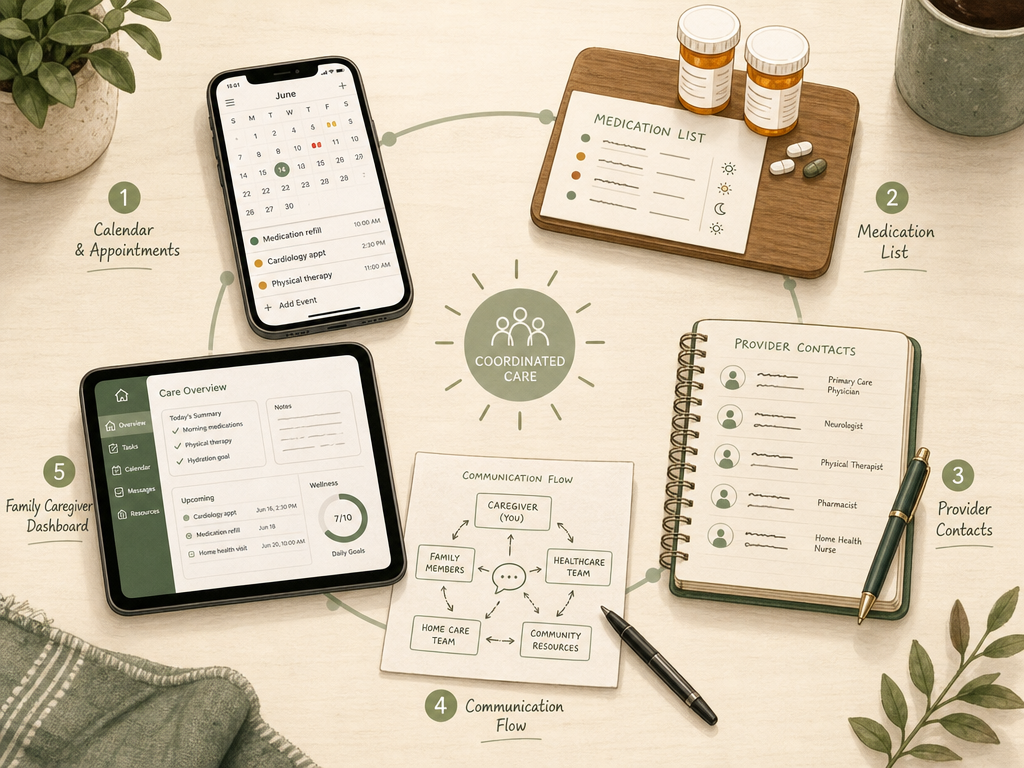
The following five tools form the backbone of a family-led coordination system. They do not require professional training, expensive software, or anyone's permission to implement. They simply create the explicit coordination mechanisms that are missing from the typical home care arrangement.
1. Centralized Information Hub
Create a single physical binder or a shared digital folder (or both) that contains every piece of information any provider might need. This is your single source of truth. Include:
- Full contact information for every provider, including after-hours numbers
- Current care plans from each provider
- Insurance cards, Medicare/Medicaid information, and any VA or waiver documentation
- Emergency protocols — who to call, in what order, for different types of incidents
- A copy of the healthcare power of attorney and any other legal documents
Keep the physical binder in an obvious, accessible location in the home. If you use a digital version, ensure it is accessible to all family members and, with permission, to key providers.
2. Shared Calendar System
A shared calendar — color-coded by provider type — prevents the most common coordination failure: scheduling conflicts. When the meal delivery arrives during the physical therapy session, or the aide's shift overlaps with the nurse visit, someone's time is wasted and care is disrupted.
Use a digital calendar that all family members can view and edit. Assign a color to each provider type (blue for home health, green for therapy, orange for meal services, red for medical appointments). Include travel time, setup time, and a buffer between appointments. Share view-only access with providers who are willing to use it.
3. Medication Master List
When multiple prescribers are involved, medication discrepancies are not just possible — they are predictable. Create one reconciled list of every prescription, over-the-counter medication, and supplement your parent takes, including dosage, frequency, and the prescribing provider. Review this list at every provider visit and update it immediately after any change.
Keep a printed copy in the centralized hub and a digital version that can be shared with any new provider. The single most effective practice is the "brown bag review": bring every medication bottle to every appointment, even if the appointment is not with the prescribing doctor.
4. Provider Contact Directory
Beyond a simple list of names and phone numbers, build a directory that includes:
- Each provider's full name, role, agency or practice name, and license number if applicable
- Primary phone, after-hours phone, and email
- Preferred communication method (phone call, text, secure message, email)
- Best times to reach them
- Who to contact if they are unavailable
Post a printed version near the phone or on the refrigerator. In an emergency, the last thing you want to do is search through email threads for a phone number.
5. Communication Protocol
The most important tool is also the one most families overlook: a clear agreement about who needs to know what, and how they will be told. Without this, information falls through the cracks. The home health aide notices a change in appetite but does not know whether to tell the family, the primary care doctor, or the meal service. The physical therapist adjusts an exercise but the aide does not get the update.
A simple protocol might look like this: the aide reports daily observations to the family coordinator (you), who then determines whether to notify the primary care provider, the physical therapist, or both. The key is that one person owns the decision about where information goes.
Building a Care Team Communication Plan
A communication plan turns the abstract idea of "keeping everyone informed" into a concrete system. The goal is to ensure that the right information reaches the right person at the right time, without requiring you to be the constant messenger.
The table below provides a simple framework for categorizing information by urgency and determining who needs to know.
| Information Type | Examples | Who Needs to Know | Communication Channel |
|---|---|---|---|
| Routine updates | Daily mood, appetite, sleep quality; completed exercises; meals eaten | Family coordinator (you); documented in daily log for future reference | Shared log or notebook; brief text or message to coordinator |
| Change notifications | New or worsening pain, fall without injury, medication side effect, change in appetite or weight | Family coordinator + relevant provider (PCP, PT, or specialist) | Phone call or secure message to coordinator, who notifies provider within 24 hours |
| Escalation triggers | Fall with injury, sudden confusion, chest pain, difficulty breathing, signs of stroke | 911 first, then family coordinator, then primary care provider | Call 911 immediately; call coordinator after emergency services are en route |
| Medication changes | New prescription, dosage change, discontinued medication, OTC or supplement addition | All providers who prescribe or administer medications; family coordinator | Coordinator updates medication master list and notifies all relevant providers within 48 hours |
| Scheduling changes | Provider cancellation, rescheduled appointment, new service start date | Family coordinator + all affected providers + other family members | Update shared calendar; coordinator confirms with affected parties |
Many families find it helpful to designate one person as the primary point of contact for all providers. This reduces confusion — providers always know who to call, and the family avoids the situation where an important message is left on one sibling's voicemail while another sibling is at the house making decisions.
For families who need additional navigation support, Area Agencies on Aging (AAAs) offer free care coordination services that can complement this family-led toolkit. AAAs are particularly helpful for families who are struggling with the initial setup of services or who need a professional to help mediate between providers.
Practical Strategies for Common Coordination Pain Points
Even with good tools in place, certain situations will test your coordination system. Here are three of the most common pain points and concrete strategies for handling them.
Scheduling Conflicts
When the meal delivery arrives during the physical therapy session, or the home health aide's shift overlaps with the nurse's visit, someone's time is wasted and your parent may be left without coverage during a gap. The solution is a combination of time-blocking and staggered scheduling.
- Establish a "do not schedule" window. Identify a 60–90 minute block each day (or on specific days) when no appointments or visits are scheduled. This gives your parent a reliable rest period and creates a buffer for schedule changes.
- Stagger provider types. If possible, schedule hands-on care (bathing, therapy) in the morning and passive services (meal delivery, companion visits) in the afternoon. This reduces the likelihood of overlap.
- Use the shared calendar to identify conflicts before they happen. Review the upcoming week every Sunday and proactively reschedule any overlaps.
Medication Discrepancies Across Multiple Prescribers
When a primary care doctor, a cardiologist, and a physical therapist are all recommending treatments, conflicting instructions are common. The HRS study found that 14.8% of older adults receive conflicting advice from different providers, and the risk doubles for those with three or more chronic conditions.
Three strategies reduce this risk:
- Use a single pharmacy. When all prescriptions are filled at the same pharmacy, the pharmacist can flag potential interactions and duplicate therapies before they become problems.
- Conduct a brown bag review at every appointment. Bring every medication bottle — prescription, OTC, and supplement — to every provider visit. Ask the provider to review the full list, not just the medications they prescribed.
- Update the medication master list immediately after any change. Do not wait until the next appointment. A 48-hour rule works well: any medication change must be documented and shared with all relevant providers within two days.
Information Gaps Between Providers
The home health aide notices that your parent has been more tired than usual for three days. The aide does not know whether this is a normal fluctuation, a medication side effect, or a sign of something more serious — and does not know who to tell. This is the most common information gap in home care.
The fix is a simple change-reporting form or log. Create a one-page template with three columns: date, observation, and who was notified. Train every provider to use it. When an aide notices a change, they document it in the log and notify the family coordinator (you). You then decide whether to escalate to the primary care provider, the physical therapist, or both. The log becomes a running record that you can review at the monthly coordination check-in.
When to Bring In a Professional: Geriatric Care Managers and Case Managers
The family-led coordination system described in this guide works for most situations. But some families reach a point where the coordination burden exceeds what can reasonably be managed without professional help. This is where a geriatric care manager (GCM) becomes valuable.
A GCM is typically a licensed nurse or social worker who specializes in coordinating care for older adults. They conduct home visits, assess the full care situation, develop care plans, communicate with all providers, and adjust the plan as needs change. According to Keystone Health, GCMs charge by the hour, typically $75 to $200 per hour. Medicare does not cover these costs, and most private insurance plans do not either.
Consider bringing in a GCM when:
- Persistent scheduling conflicts continue despite your best efforts with the shared calendar
- Provider-to-provider communication repeatedly breaks down — for example, the physical therapist's recommendations are not being implemented by the home health aide
- The medical regimen is complex, involving multiple specialists, multiple medications, and frequent changes
- Family members disagree about care decisions and need an objective third party to help mediate
- You are experiencing signs of caregiver burnout and cannot sustain the coordination workload
For families whose coordination challenges include managing payments across multiple funding sources — such as combining Medicaid HCBS waivers, VA benefits, and private pay — our guide to layering funding sources for home services in 2026 provides detailed guidance on how to structure payments without creating coverage gaps.
For seniors who qualify financially and medically, the Program of All-Inclusive Care for the Elderly (PACE) offers an all-in-one alternative to managing multiple separate providers. PACE provides all Medicare and Medicaid-covered care plus additional services through a single interdisciplinary team, with no copays, deductibles, or coverage gaps. According to the National PACE Association, 97% of PACE participants continue living in the community, and 95% of family caregivers would recommend the program.
Technology Tools That Support Coordination
Technology cannot replace a good coordination system, but it can make one much easier to maintain. The key principle is: pick one tool and use it consistently. Switching between multiple apps and platforms creates more confusion than it solves.
Consider these categories of tools:
- Shared caregiver apps. These allow you to create task lists, maintain daily logs, send messages to family members, and sometimes share photos or notes with providers. The specific app matters less than the fact that everyone uses the same one.
- Patient portals. Most healthcare systems now offer portals where you can view provider notes, test results, and appointment summaries. The HRS study found that 70.1% of older adults have access to a patient portal, but only 47.2% use it frequently. Make a habit of checking the portal after every provider visit.
- Medication management apps. These can send reminders, track doses, and flag potential interactions. Some also allow you to share the medication list with family members and providers.
- Shared digital calendars. Google Calendar, Apple Calendar, or any platform that allows color-coding, sharing, and event notifications. The calendar is the single most important coordination tool you can implement.
Remember: the tool is not the system. A shared calendar only works if everyone agrees to use it. A medication app only helps if someone keeps it updated. Invest your energy in building the habit of using the tool, not in finding the perfect tool.
The Monthly Coordination Check-In: A Review Template
The most effective habit you can build is a monthly coordination check-in. Set aside 30 minutes at the same time each month to review how the care team is functioning. This prevents small problems from becoming crises and ensures that your coordination system evolves as your parent's needs change.
Use the following template as your agenda:
| Question | What to Look For | Action If Yes |
|---|---|---|
| Did any provider miss a scheduled visit or arrive more than 15 minutes late? | Pattern of lateness or missed visits may indicate a scheduling or communication problem | Contact the provider's agency or office; review the shared calendar for conflicts |
| Were there any medication changes or discrepancies this month? | New prescriptions, dosage changes, or conflicting instructions from different providers | Update the medication master list; notify all relevant providers within 48 hours |
| Did any provider report a change in your parent's condition? | Weight loss, increased confusion, changes in appetite or mobility, new pain | Document the change; notify primary care provider; adjust care plan if needed |
| Are all providers still the right fit for your parent's current needs? | A provider who was a good fit three months ago may no longer match the current care level | Consider whether a different level of care or a different provider type is needed |
| What one thing would improve coordination this month? | A recurring frustration, a communication gap, or a tool that is not working | Implement one small change — update the communication protocol, add a new tool, or schedule a team meeting |
Document the answers to these questions each month in a simple log. Over time, this log becomes a record of how your parent's needs have evolved and how your coordination system has adapted. It is also invaluable if you ever need to bring in a geriatric care manager or transition to a higher level of care — you will have months of documentation about what has been tried and what has worked.
The coordination problem is real, but it is solvable. The families who succeed are not the ones with the most resources or the most professional help. They are the ones who build a system — even a simple one — and use it consistently. Start with one tool from this guide this week. Add another next month. Over time, you will transform a fragmented collection of providers into a functioning care team.
Questions to bring to a clinician or OT
This is not medical, legal, or a family's final decision — only a framework. Bring these questions to a clinician, occupational therapist, or your local Area Agency on Aging.
Find Local HelpRelated reading
Noticed something outdated or inaccurate on this page? Flag a correction. We review every report against CDC, NIA, and AARP HomeFit guidance before updating a page.