Parkinson's Home Safety Checklist: A Room-by-Room Guide for Caregivers
📄 PrintableReviewed: 2026-07-05
Parkinson's Home Safety Checklist: A Room-by-Room Guide for Caregivers
This room-by-room checklist helps Parkinson's caregivers identify and fix hazards that general senior fall checklists miss — including freezing triggers, medication timing risks, and bathroom transfer dangers.
By Editorial Team
new caregiver
experienced caregiver
long-distance caregiving
spousal caregiver
working caregiver
daily routines
medication management
personal hygiene
care coordination
first steps
ADLs
IADLs
📄
A printable version of this guide is available. Use your browser's print function (Ctrl+P / ⌘P) to save or print.
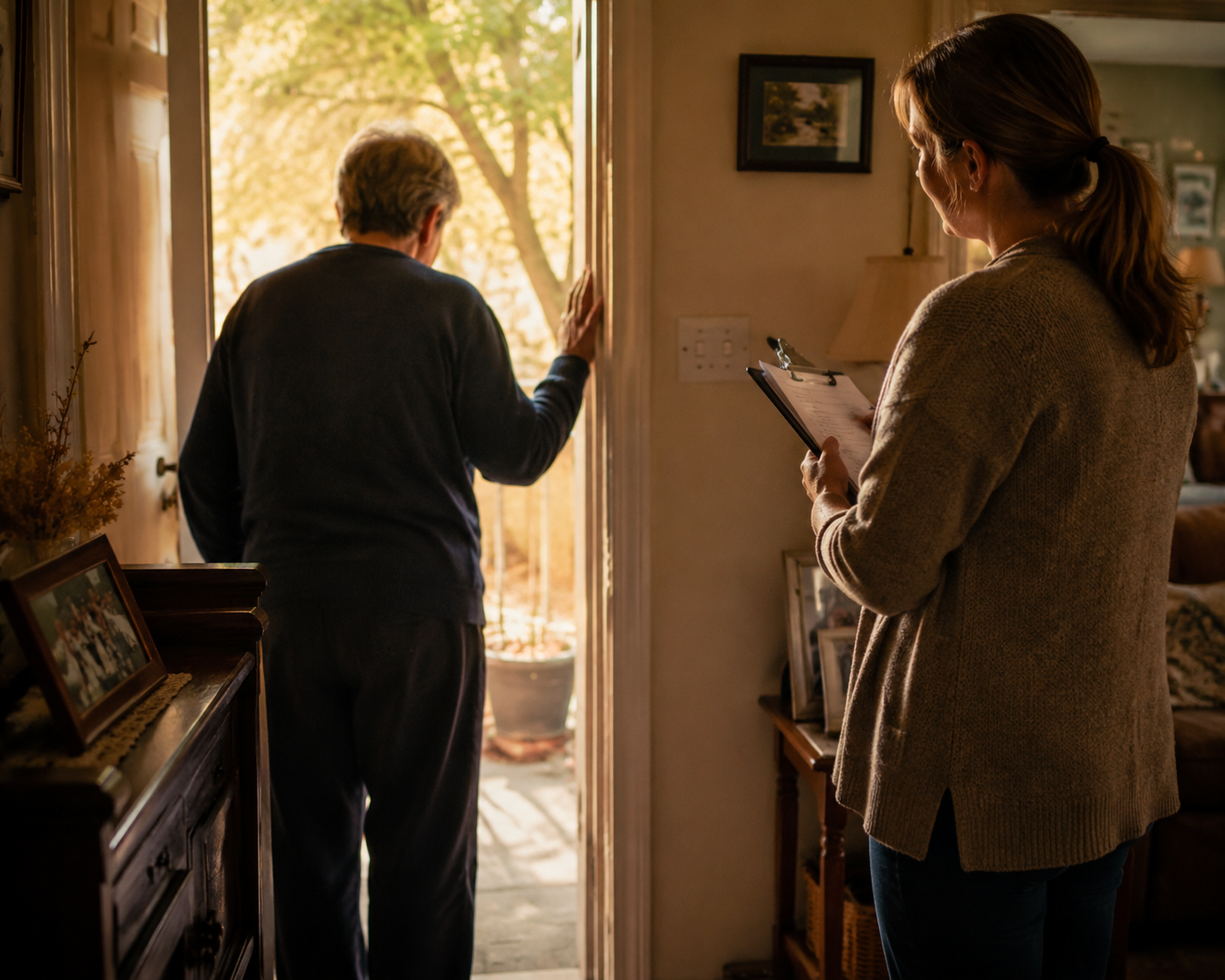
Do the walkthrough when Parkinson’s is showing up, not when your loved one is having their best hour.
That usually means choosing a time when medication is wearing off, fatigue is visible, freezing is more likely, or the evening bathroom trip has already become tense. A standard senior safety checklist may catch loose rugs and poor lighting. A home safety checklist for a Parkinson’s caregiver has to catch the pause at the doorway, the half-turn in a narrow hall, the rushed toilet transfer, the patterned rug that looks like a step, and the moment someone tries to carry laundry while also thinking about where to place their feet.
The bathroom deserves first attention because Parkinson’s Foundation home safety guidance identifies it as one of the highest-risk areas in the home, with special concern around toilet transfers and tub or shower entry and exit.[1] The rest of the house still matters, but many serious near-falls begin on the route to the bathroom, at the bathroom threshold, or during the transfer itself.
The scale of the problem is not small. Parkinson’s Foundation reports that about 38% of people with Parkinson’s fall each year and that falls are a leading cause of emergency room visits and hospitalizations for people with Parkinson’s.[2] Reviews of Parkinson’s fall prevention research report that people with Parkinson’s fall an average of 4 to 6 times per year, about double the rate of age-matched older adults without Parkinson’s.[3] Other studies report higher annual fall rates, depending on the population and measurement method, so the point is not to settle on one universal percentage. The point is to inspect the home as if falls are a recurring risk, not a freak event.
Before You Start: Walk the House During an Off Period
Medication timing changes what you will see. During “off” periods, freezing, slower movement, and postural instability can become more noticeable. If the walkthrough happens only when medication is working well, the house may look safer than it is at 7:10 p.m., during a nighttime bathroom trip, or after a long appointment day.
For this first pass, pick one high-risk route and watch it closely: favorite chair to bathroom, bed to bathroom, kitchen to table, or front door to car. Do not ask your loved one to perform unsafe movements for the sake of the checklist. Observe the movements that already happen in daily life, and stop if fatigue, dizziness, or freezing makes the activity unsafe.
Mark
Meaning
What to do next
Urgent
A fall or near-fall has already happened here, or the person needs to grab furniture, walls, towel bars, or another person to stay upright.
Fix immediately and ask the care team, PT, or OT for help if the transfer or route still feels unsafe.
Soon
The hazard appears during off periods, fatigue, turning, rushing, or dual-tasking.
Schedule the change this week and recheck during the same difficult time of day.
Watch
The area is currently manageable but could become risky as symptoms progress.
Revisit after medication changes, a fall, a new assistive device, or a change in mobility.
Write down where freezing happens, not just where clutter exists. In one prospective analysis summarized in a Parkinson’s fall-prevention review, 61% of recorded Parkinson’s falls were freezing-related.[3] A 2023 study of freezing triggers found that turning accounted for 28% of freezing episodes, doorways for 14%, and dual-tasking for 10%.[4] Those numbers should change how the walkthrough is done: the danger is often in the transition.
Quick-Use Parkinson’s Home Safety Checklist
Use this as the printable pass, then read the room notes that follow for the hazards most caregivers miss.
Area
Check during the walkthrough
Mark
Bathroom
Toilet transfer, shower or tub entry, grab bars, towel bars, wet floor, bath mat, night lighting, door swing, space for walker or caregiver assistance.
Urgent / Soon / Watch
Bedroom-to-bathroom route
Clear path, bed height, footwear, nightstand clutter, cords, lighting before standing, freezing at doorway, rushed nighttime walking.
Urgent / Soon / Watch
Doorways and thresholds
Freezing at entry points, raised thresholds, color changes that look like steps, narrow turns, walker clearance.
Thresholds, weather mats, uneven surfaces, lighting, hand support, space to pause before walking.
Urgent / Soon / Watch
Bathroom: Treat Transfers as the First Safety Test
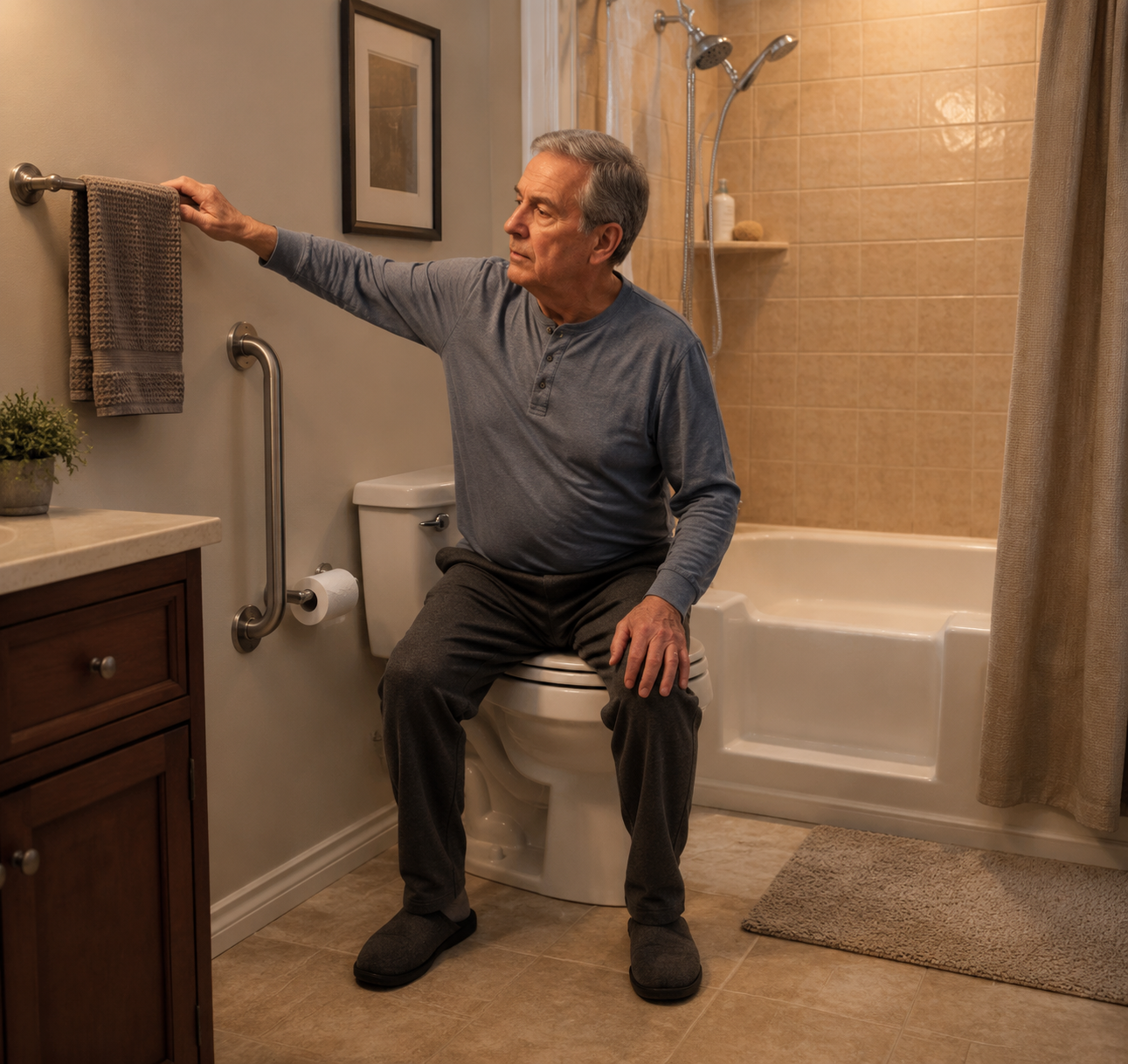
Start at the toilet, not the towel rack. Watch how the person turns, backs up, lowers, rises, adjusts clothing, and reaches for support. If the hand automatically goes to a towel bar, that is an urgent fix. Towel bars are not grab bars and are not designed to support body weight; Parkinson’s Foundation bathroom safety guidance recommends properly installed grab bars near the toilet and in the shower or tub area.[1]
Check whether the toilet is too low for a controlled sit-to-stand transfer.
Install properly anchored grab bars where the person naturally reaches, not where they look neat on the wall.
Remove unstable bath mats; use non-slip surfaces that do not bunch, slide, or create a lip.
Make sure the person can turn with enough room for their feet, walker, cane, or caregiver assistance.
Put night lighting on the route and inside the bathroom so the person is not stepping into a dark, high-risk room.
Then inspect the tub or shower as a separate transfer. A person may manage walking across the bathroom but freeze or lose balance when stepping over a tub wall, turning toward a shower chair, or reaching for shampoo. Michael J. Fox Foundation home safety guidance also emphasizes bathroom fall hazards, including shower safety, lighting, and removal of throw rugs.[5]
If the person needs hands-on help to enter or exit the tub, if the caregiver is bracing them by the arm, or if freezing happens while one foot is inside and one foot is outside the tub, the checklist has reached its limit. That is a referral moment for an occupational therapist, physical therapist, or clinician who can assess transfers, equipment, and caregiver technique.
Bedroom to Bathroom: The Route That Changes After Dark
A daytime hallway can become a different route at night. The person may be groggy, medication may be wearing off, urgency may make them rush, and lighting may be poor. Walk from the bed to the bathroom exactly as it happens at night: from lying down, to sitting, to standing, to finding glasses or a walker, to reaching the bathroom.
Place a lamp, phone, glasses, water, and mobility aid where they can be reached without twisting or leaning far out of bed.
Clear cords, shoes, laundry baskets, pet beds, and low furniture from the route.
Check whether the bed height allows both feet to contact the floor before standing.
Use motion-activated or easy-reach lighting before the first step, not halfway down the hall.
Keep footwear consistent; loose slippers can become a fall hazard during shuffling or freezing.
Orthostatic hypotension can also contribute to falls in Parkinson’s, especially when someone stands up and feels lightheaded; APDA’s discussion of balance and falls includes this among Parkinson’s-related fall mechanisms.[6] If dizziness, faintness, or sudden weakness appears when standing, do not treat it as a furniture problem. Bring it to the clinician.
Doorways, Thresholds, and Tight Turns
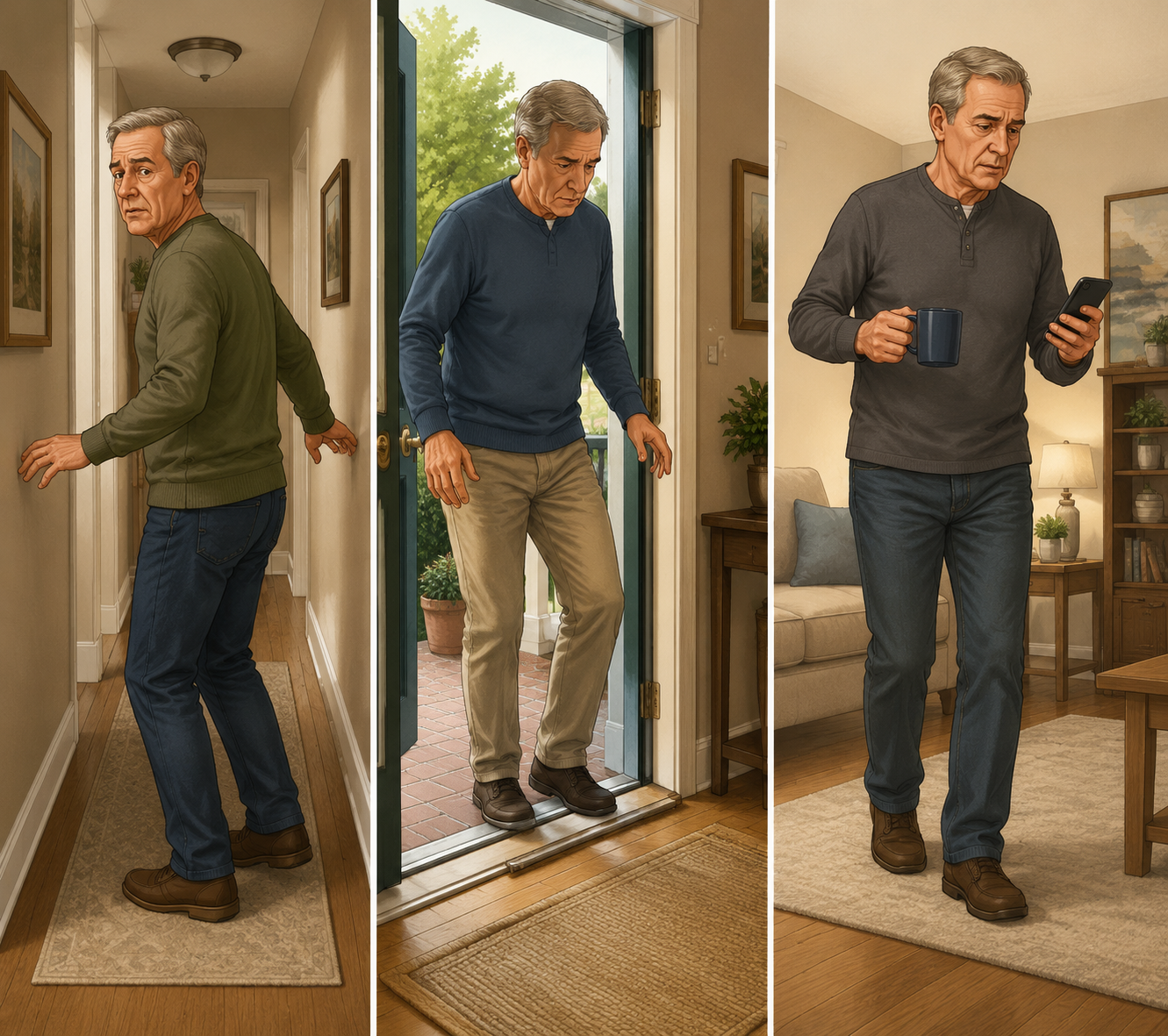
Doorways deserve more respect in a Parkinson’s home than they usually get. Freezing can appear at a doorway even when open floor walking looks steady. Watch the feet as the person approaches the doorway: do they shorten steps, hesitate, rock in place, reach for the frame, or turn their shoulders before their feet are ready?
Remove raised threshold strips when possible, or make them visually clear and easy to cross.
Move small tables, baskets, plants, and decorative items away from both sides of the doorway.
Check whether a walker can pass through without catching on trim, rugs, or furniture.
Avoid high-contrast patterned rugs near thresholds if they make the floor look uneven.
Create a pause point before the doorway so the person can reset rather than rush through.
For freezing, the environment and the movement strategy belong together. Parkinson’s Foundation describes cueing strategies and the 4S approach: Stop, Sigh, Shift, Step.[7] In the home, that may mean clearing the doorway, adding a visual cue on the floor if recommended by a therapist, and practicing a calm reset instead of pulling the person forward.
Laser cueing devices may help some people restart movement during freezing, but they should not be treated as a substitute for fixing the doorway, widening the path, or getting professional gait assessment when freezing is frequent.
Hallways and Turning Spaces
A hallway is not just a path. It is where people turn into rooms, avoid pets, carry objects, answer questions, and try to move faster when someone is waiting. Since turning and dual-tasking are documented freezing triggers, this area needs more than a quick clutter scan.[4]
Remove hallway runners unless they are truly secured and do not create edges.
Create enough turning space at bedroom, bathroom, kitchen, and living room entries.
Keep frequently used items at destination points so the person does not carry multiple objects while walking.
Improve contrast between walls, floors, furniture, and steps without adding busy patterns.
Listen for caregiver habits: calling from another room, asking questions mid-walk, or handing over items during movement can add a dual-task load.
One useful rule: finish the walk before starting the conversation. That does not infantilize the person with Parkinson’s. It protects attention during a movement task that already asks more of the brain and body.
Stairs: Check the First Step, Last Step, and Lighting
Stairs often look acceptable until you watch the first step down, the turn at the landing, or the tired climb at the end of the day. Inspect handrails, lighting, surface contrast, and what the person is carrying. If there is only one rail, check whether the stronger side changes depending on going up or down.
Make sure handrails are secure, continuous, and easy to grip.
Remove objects from steps, including folded laundry waiting to be carried upstairs.
Improve lighting at the top and bottom, not only in the middle of the staircase.
Mark step edges if depth is hard to judge, using a simple contrast rather than a busy pattern.
Watch for freezing before the first step or at the landing; do not hurry the person through it.
If stairs are becoming unsafe, the answer may be a change in room use, assistive equipment, therapy input, or a broader home modification plan. APDA’s home modification guidance emphasizes room-by-room changes that support safety and function as Parkinson’s symptoms change.[8]
Kitchen: Reduce Carrying, Reaching, and Turning With Hot Items
The kitchen combines hard flooring, spills, heat, cabinets, turning, and carrying. It is also a room where independence matters deeply. The goal is not to remove every task. The goal is to make chosen tasks safer.
Move daily items between shoulder and waist height so they do not require a step stool or deep bend.
Remove or secure floor mats, especially near the sink and stove.
Create a clear route from counter to table with no tight pivot around chairs.
Use trays, carts, or caregiver setup to reduce carrying multiple items while walking.
Wipe spills immediately and keep cleaning supplies easy to reach.
If the person freezes while holding a hot drink or pan, the hazard is no longer just the floor. Change the task: pour at the table, use lighter containers, sit for prep, or have someone else carry hot items while preserving safer parts of the routine.
Living Room: Watch the Chair Transfer
Many living room falls happen around ordinary furniture: a favorite chair, a coffee table, a footrest, the phone across the room. Watch the full chair transfer. Does the person need several attempts to stand? Do they fall backward into the chair? Do they reach for a rolling table, lamp, or caregiver’s arm?
Choose a stable chair with firm arms and a seat height that allows controlled standing.
Move coffee tables, ottomans, and footstools out of the walking path.
Keep the phone, remote, tissues, water, and glasses within easy reach.
Manage cords from lamps, chargers, and medical devices so they do not cross a path.
Check whether rugs create edges, wrinkles, or visual confusion.
Fear of falling can shrink a person’s movement over time, and APDA notes that balance problems and fear of falling can affect activity and confidence in Parkinson’s.[6] Safety changes should make useful movement more possible, not quietly turn the room into a place where the person is expected to sit all day.
Entryway, Porch, and Garage
The entry is where people hurry: appointments, visitors, weather, packages, pets, keys, and car doors all compete for attention. Inspect it at the time it is actually used. Morning clinic trips and evening returns may reveal different hazards.
Secure or remove weather mats that slide, curl, or create a raised edge.
Add lighting outside the door, at steps, and in the garage.
Create a place to pause while someone else manages keys, bags, and doors.
Check threshold height and whether a walker, cane, or foot catches on it.
Keep packages, shoes, umbrellas, and pet supplies out of the landing area.
If car transfers are difficult, include the driveway or garage in the safety plan. A home checklist that stops at the front door may miss the place where the caregiver is most likely to rush and the person with Parkinson’s is most likely to be tired.
When a Checklist Is Not Enough
Some findings should trigger help rather than another round of rearranging furniture. Ask for an occupational therapy, physical therapy, or clinician assessment if falls continue, freezing is frequent, the person needs physical lifting during transfers, dizziness occurs when standing, stairs are becoming unsafe, or the caregiver is afraid to let the person walk to the bathroom alone.
Stanford Medicine’s Parkinson’s fall-prevention guidance points caregivers toward fall-risk screening and professional assessment, including occupational therapy evaluation when home safety is a concern.[9] That kind of assessment can match the person, the disease stage, the medications, the mobility device, and the actual layout of the home.
Exercise also belongs in the larger fall-prevention plan, but it should not be used to excuse an unsafe bathroom or a freezing trigger at the bedroom door. A Parkinson’s fall-prevention review reports that exercise may reduce fall rates by about 35% when fully supervised, while unsupervised exercise did not show the same fall-rate reduction.[3] That is useful evidence, and it is also a reminder to be precise: the home still needs to be inspected, and the exercise plan should be appropriate to the person’s current balance and mobility.
Recheck After Falls, Medication Changes, and New Freezing
A Parkinson’s home safety checklist is not a one-time document. Rewalk the highest-risk route after a fall or near-fall, after a medication change, when a new assistive device is introduced, when freezing appears in a new place, or when the caregiver starts saying, “He was fine this morning.”
Print the checklist, start with the bedroom-to-bathroom route or the bathroom itself, mark urgent hazards separately, and fix the items that involve transfers, freezing, thresholds, lighting, and unsupported reaching first. If the same route still feels unsafe after those changes, bring the notes to the Parkinson’s care team, PT, or OT and ask for an individualized home and mobility assessment.

Comments
Join the discussion with an anonymous comment.