
Caregiver decision guide
The Hidden Economics of Long-Term Care: What Families Don't Know About Costs, Coverage, and Financial Risk Until It's Too Late
Most American families enter long-term care with three dangerous misconceptions: that Medicare will pay, that costs are manageable, and that they have time to plan. This guide exposes the financial reality — from the true cost of care and who actually pays to the Medicaid path, LTC insurance pitfalls, and practical steps to protect your family's savings.

The Three Myths That Derail Long-Term Care Planning
Most American families enter the long-term care conversation carrying three dangerous assumptions. Each one is wrong. And each one, left uncorrected, can drain a lifetime of savings in a matter of years.
The first myth is that Medicare will pay for custodial care. It will not. Medicare covers skilled nursing care only — and only for a limited time after a hospital stay. The daily help that most older adults need — bathing, dressing, eating, toileting — is classified as custodial care, and Medicare explicitly excludes it. The National Institute on Aging states this plainly: Medicare does not cover long-term custodial care. Yet families routinely assume otherwise until the bills arrive.
The second myth is that costs are manageable. A 2024 survey found that 56% of respondents believed assisted living costs less than $4,000 per month. The actual national median in 2025 was $6,200 per month — a gap of more than $2,000 per month. For a private nursing home room, the annual cost now exceeds $129,000. The gap between expectation and reality is not small; it is catastrophic.
The third myth is that there is time. The National Institute on Aging reports that 70% of adults turning 65 will need some form of long-term care. The U.S. Department of Health and Human Services (ASPE) projects that 1 in 5 Americans turning 65 will face more than $200,000 in lifetime long-term care costs. The need often arrives suddenly — after a fall, a stroke, or a dementia diagnosis — and by then, the financial options have narrowed dramatically.
The Real Numbers: What Long-Term Care Actually Costs in 2026
The table below uses the most recent data from the CareScout 2025 survey, as reported by SingleCare. These are national medians. Your actual costs will vary by location, level of care needed, and the specific facility or agency you choose.
| Care Type | Monthly Cost (2025) | Annual Cost (2025) |
|---|---|---|
| Homemaker services (light housekeeping, errands) | $5,600 | $67,200 |
| Home health aide (personal care + light medical) | $6,677 | $80,124 |
| Adult day care | $2,058 | $24,696 |
| Assisted living | $6,200 | $74,400 |
| Semi-private nursing home room | $9,581 | $114,975 |
| Private nursing home room | $10,798 | $129,575 |
The year-over-year increases are not slowing. Assisted living costs rose 5% in 2025 alone. A family that assumes a $4,000 monthly budget for assisted living is off by more than $2,000 per month — a $26,400 annual miscalculation. Over five years, that gap exceeds $130,000.
For a more detailed financial roadmap comparing home care, assisted living, and nursing homes, see our companion guide: The True Cost of Assisted Care: A Financial Roadmap for Families.
Why Location Matters: State-by-State Cost Variation
National averages obscure a critical reality: long-term care costs vary dramatically by state. A family in Mississippi pays roughly half of what a family in Wyoming pays for the same level of care.
| State | Average Daily Cost (Nursing Home, Semi-Private) |
|---|---|
| Mississippi | $150 |
| Alabama | $165 |
| Texas | $180 |
| Florida | $210 |
| California | $245 |
| New York | $260 |
| Wyoming | $288 |
This variation has two practical implications. First, if you are considering relocating a parent to a lower-cost state, the savings can be substantial — but must be weighed against the disruption to social networks, access to family caregivers, and state-specific Medicaid eligibility rules. Second, if you live in a high-cost state, you cannot rely on national averages to budget. A family in New York paying $260 per day for a semi-private nursing home room is spending $94,900 per year — nearly $20,000 more than the national median.
Who Actually Pays? The Truth About Funding Sources
The single most important financial fact about long-term care in the United States is this: families pay far more than they expect, and the government program they assume will cover them — Medicare — covers almost none of it.
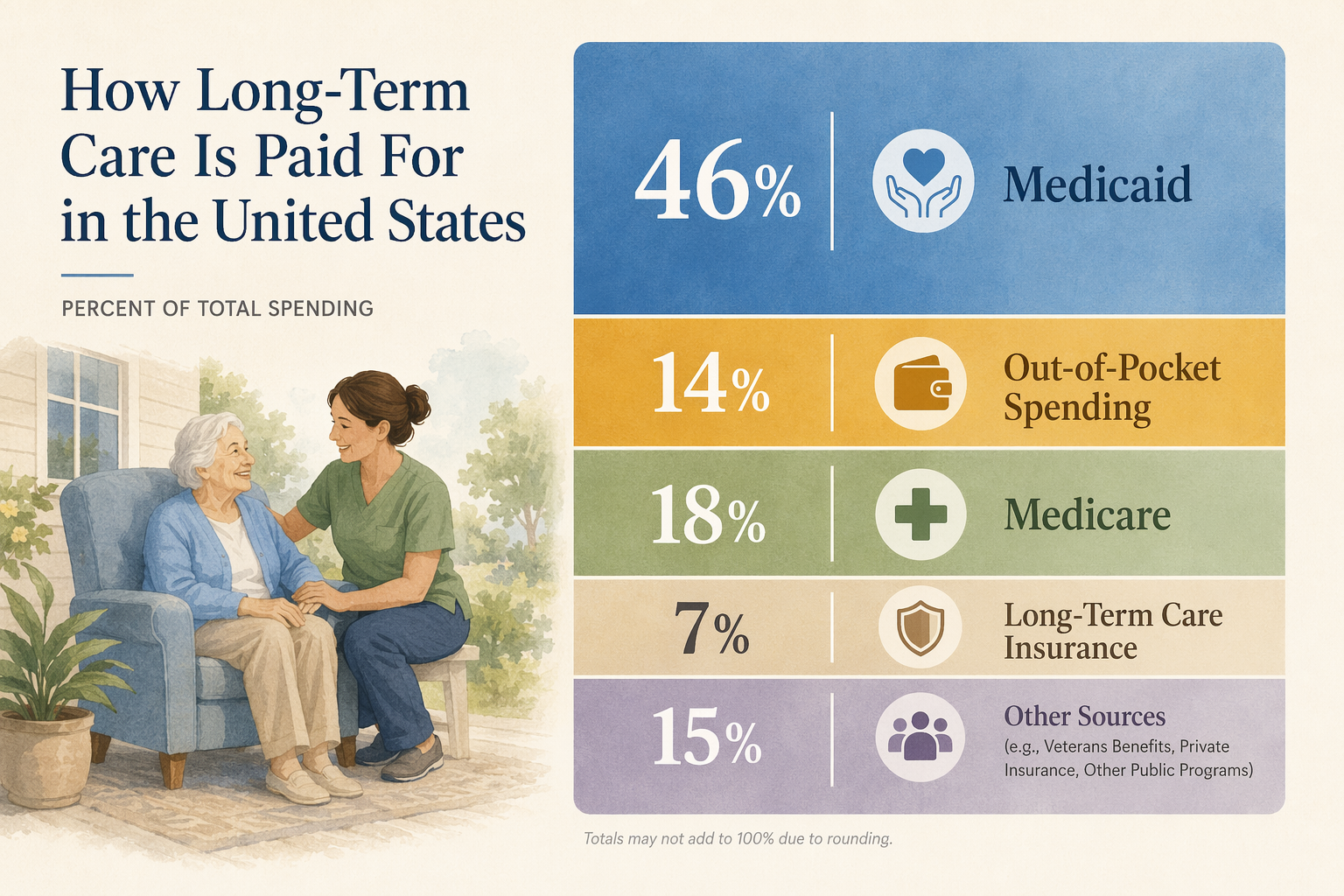
Here is how long-term services and supports (LTSS) are actually paid for in the United States, according to the Congressional Research Service (CRS) as cited by SingleCare:
| Payer | Share of LTSS Spending | Key Detail |
|---|---|---|
| Medicaid | 46% | Largest single payer; covers 63% of nursing home residents |
| Out-of-pocket (families) | ~14% ($81 billion in 2023) | Families cover about half of all LTC costs directly |
| Medicare | 18% | Covers only skilled nursing, not custodial care |
| Other (VA, private insurance, etc.) | ~22% | Includes LTC insurance, which covers only ~7 million Americans |
The out-of-pocket figure — $81 billion in 2023 — is the number that should alarm every family. That is money paid directly from personal savings, retirement accounts, and home equity. It is not reimbursed. It is not tax-deductible in most cases. It is simply gone.
The Medicaid Path: What It Takes to Qualify
Medicaid is the primary payer for long-term care in America, covering 63% of nursing home residents. But qualifying for Medicaid is not simple, and it almost always requires depleting most of a family's assets first.
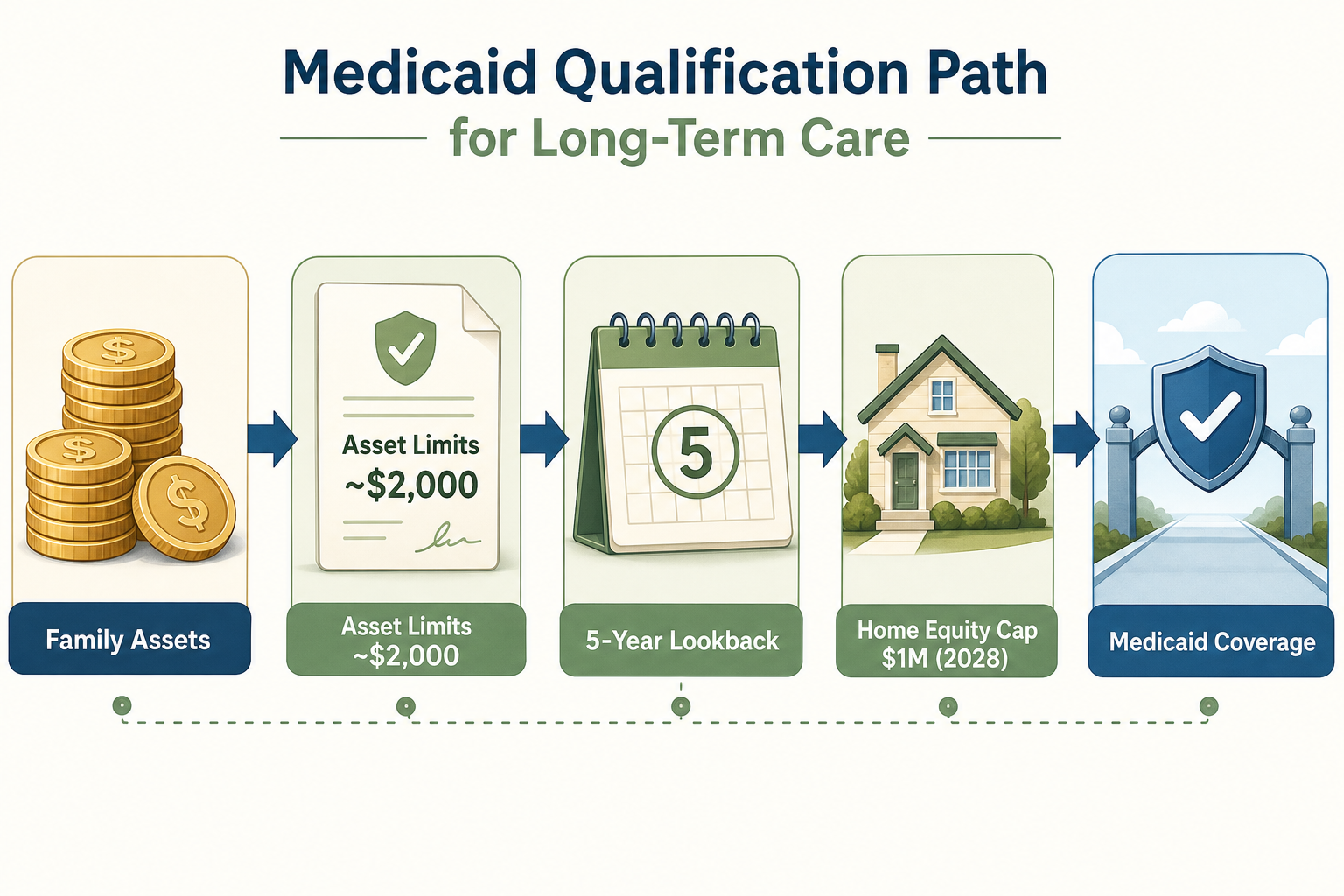
The key eligibility requirements for Medicaid long-term care coverage include:
- Asset limits: To qualify for nursing home Medicaid, an individual's countable assets must generally be $2,000 or less. This excludes a primary home (up to a new $1 million home equity cap starting in 2028), one vehicle, and certain personal belongings.
- Income limits: Most states require that most of the individual's monthly income (Social Security, pensions) go toward the cost of care, with a small personal needs allowance retained.
- The 5-year lookback period: Medicaid reviews all financial transactions made in the five years prior to application. Any asset transferred for less than fair market value during that period triggers a penalty period during which Medicaid will not pay for care.
- Spend-down: If you have assets above the limit, you must "spend down" to the threshold before qualifying. This often means paying for care out of pocket until assets are depleted.
The 2025 reconciliation law introduced significant changes. The Kaiser Family Foundation (KFF) reports that the law freezes the home equity limit at $1 million starting in 2028, and is expected to reduce federal Medicaid spending by $911 billion over 10 years. These changes will make it harder for middle-class families to qualify for Medicaid without first exhausting significant assets.
The Long-Term Care Insurance Reality Check
Long-term care insurance sounds like the obvious solution — a policy that pays for the care you need, protecting your savings from being drained. In practice, the market is far more limited than most people realize.
| Factor | Data Point | Source |
|---|---|---|
| Annual premium range | $900 – $7,225 | SingleCare (2025) |
| Americans covered by LTC insurance | ~7 million | AHIP via Amplify Life |
| Best age to purchase | 50–69 (78% of policies) | AALTCI via Amplify Life |
| Denial rate for applicants aged 70+ | 47% | AALTCI via Amplify Life |
The denial rate for applicants aged 70 and older — 47% — is the statistic that matters most. Waiting until you are older to purchase a policy means you are nearly as likely to be denied as accepted. Most denials are due to pre-existing health conditions: diabetes, heart disease, arthritis, cognitive impairment, or a history of stroke.
The window for purchasing LTC insurance is narrow. The American Association for Long-Term Care Insurance (AALTCI) reports that 78% of policies are purchased between ages 50 and 69. Buy too early (in your 40s) and you pay premiums for decades before you might need coverage. Buy too late (after 70) and you face high denial rates and premiums that can exceed $7,000 per year.
The Hidden Cost of Family Caregiving
The financial toll of long-term care does not begin when a family member enters a facility. It begins the moment a family member becomes a caregiver.
According to AARP data cited by SingleCare, 59 million Americans provide unpaid care to an adult loved one. The value of that unpaid care reached $1 trillion in 2026. Nearly half of family caregivers report a major financial impact from lost wages, reduced retirement savings, and out-of-pocket care expenses.
The Center to Advance Palliative Care (CAPC), as cited by Amplify Life, reports that 55% of family caregivers handle medical tasks — wound care, medication management, operating medical equipment — without any formal training. And 64% report high emotional stress. The financial and emotional costs compound each other: caregivers who reduce their work hours to provide care lose income, reduce their Social Security benefits, and deplete their own retirement savings, all while facing higher stress and worse health outcomes.
For a deeper look at the costs of keeping a loved one at home, see our related guide: The Hidden Costs of Aging in Place in 2026: Why Families Underestimate the True Price Tag.
Practical Financial Planning Steps for Families
The goal of this guide is not to alarm you — it is to arm you with the information you need to make decisions before a crisis forces them on you. Here are actionable steps, organized by where you are in the caregiving journey.
For families in their 50s (planning ahead)
- Have the conversation early. Talk to your parents — and your own partner — about long-term care preferences, financial resources, and who will make decisions. The conversation is uncomfortable. It is also essential.
- Get a realistic cost estimate for your state. Use the state-by-state data above as a starting point, then research specific facilities and agencies in your area. Do not rely on national averages.
- Evaluate long-term care insurance in your 50s. The window for affordable, approvable coverage is ages 50–69. If you are in your 50s and in good health, this is the time to compare policies.
- Consult an elder law attorney. An attorney who specializes in elder law can help you understand Medicaid eligibility rules in your state, asset protection strategies, and the legal documents you need (power of attorney, healthcare proxy, living will).
For families in their 60s and 70s (approaching care needs)
- Understand your state's Medicaid eligibility rules. If you have not already done so, learn the asset limits, income rules, and lookback period in your state. The rules vary significantly, and the 2025 reconciliation law has introduced new changes.
- Protect retirement savings. If you have significant retirement assets, work with a financial advisor who understands long-term care planning. Strategies such as Medicaid-compliant annuities, irrevocable trusts, and spousal asset transfers may be options — but they must be implemented well before the 5-year lookback window.
- Explore home modification funding. If aging in place is the goal, structural modifications can reduce the need for paid care. See our guide on How to Pay for Aging in Place Home Modifications for information on grants, loans, and tax deductions.
For families in crisis (immediate care needs)
- Get a clear diagnosis and care plan. Before making financial decisions, understand the level of care needed. Our guide on Independent Living vs. Assisted Living vs. Nursing Home can help you match needs to the right level of care.
- Apply for Medicaid immediately if assets are limited. Do not wait. The application process can take months, and coverage is not retroactive.
- Do not transfer assets without professional guidance. The 5-year lookback penalty can leave you without coverage for months or years. Consult an elder law attorney before making any transfers.
- Explore all available options. For a broader overview of senior living options, see our guide: Beyond 'Senior Citizen Home': A Family Guide to 6 Senior Living Options in 2026.
Questions to bring to a clinician or OT
This is not medical, legal, or a family's final decision — only a framework. Bring these questions to a clinician, occupational therapist, or your local Area Agency on Aging.
Find Local HelpRelated reading
Noticed something outdated or inaccurate on this page? Flag a correction. We review every report against CDC, NIA, and AARP HomeFit guidance before updating a page.