
Caregiver decision guide
Personal Care for Elderly Parents: A Caregiver's Guide to Bathing, Dressing, Grooming, and Hygiene with Dignity
A practical, evidence-based guide for family caregivers helping a parent or spouse with intimate personal care tasks. Learn techniques for bathing, dressing, oral care, toileting, and skin care that preserve dignity, reduce resistance, and prevent common health complications.
Why Personal Care Is the Hardest Part of Caregiving
Helping a parent or spouse with bathing, dressing, toileting, and grooming is rarely discussed in the abstract conversations about aging. It is intimate, repetitive, and emotionally layered in ways that managing medications or scheduling appointments is not. For the person receiving care, these tasks can feel like a loss of privacy and competence. For the caregiver, they can stir feelings of awkwardness, guilt, and grief — sometimes all at once.
The stakes are not just emotional. Inadequate personal care directly contributes to skin infections, urinary tract infections, dental disease, foot problems, and falls. The American Academy of Dermatology notes that skin infections are among the most common infections in older adults, and many of these are preventable with consistent hygiene routines. When a senior stops bathing regularly or refuses oral care, the health consequences compound quickly — and the caregiver is left wondering how to help without causing distress.
This guide is written for the family caregiver who is doing this work without formal training. It draws on recommendations from the National Institute on Aging, the Alzheimer's Association, HealthInAging.org, and professional caregivers to provide task-specific techniques that prioritize safety, dignity, and the preservation of the senior's autonomy wherever possible.
Bathing: Frequency, Safety, and Step-by-Step Techniques
Bathing is often the first personal care task that becomes difficult, and it is the one that caregivers report as most stressful. The senior may resist undressing, fear the water temperature, or feel unsteady on wet surfaces. The caregiver may worry about falls, modesty, or causing embarrassment. Both parties are navigating a situation neither expected to be in.
How Often Should an Older Adult Bathe?
The National Institute on Aging recommends bathing a person with Alzheimer's two or three times a week, with sponge baths on the other days if full bathing is too upsetting or tiring. For older adults without dementia, a full shower or bath twice a week is typically sufficient unless incontinence accidents occur, according to professional caregiver guidance cited by A Place for Mom. Between full baths, sponge baths using warm water and a soft cloth keep the skin clean without the strain of a full shower.
This schedule is not about cutting corners. Older skin is thinner, less elastic, and more prone to dryness than younger skin. Bathing too frequently strips natural oils and increases the risk of cracking and infection. The goal is to keep the skin clean and moisturized without over-washing.
| Bathing Frequency | When to Use | Key Consideration |
|---|---|---|
| Full shower or bath twice a week | General routine for most older adults | Increase to daily sponge baths if incontinence is present |
| Sponge baths on non-shower days | Between full baths to maintain hygiene | Focus on face, underarms, groin, and skin folds |
| Bathing 2–3 times per week | Person with Alzheimer's or dementia | Use sponge baths if full bathing causes agitation (NIA recommendation) |
Safety Modifications for the Bathroom
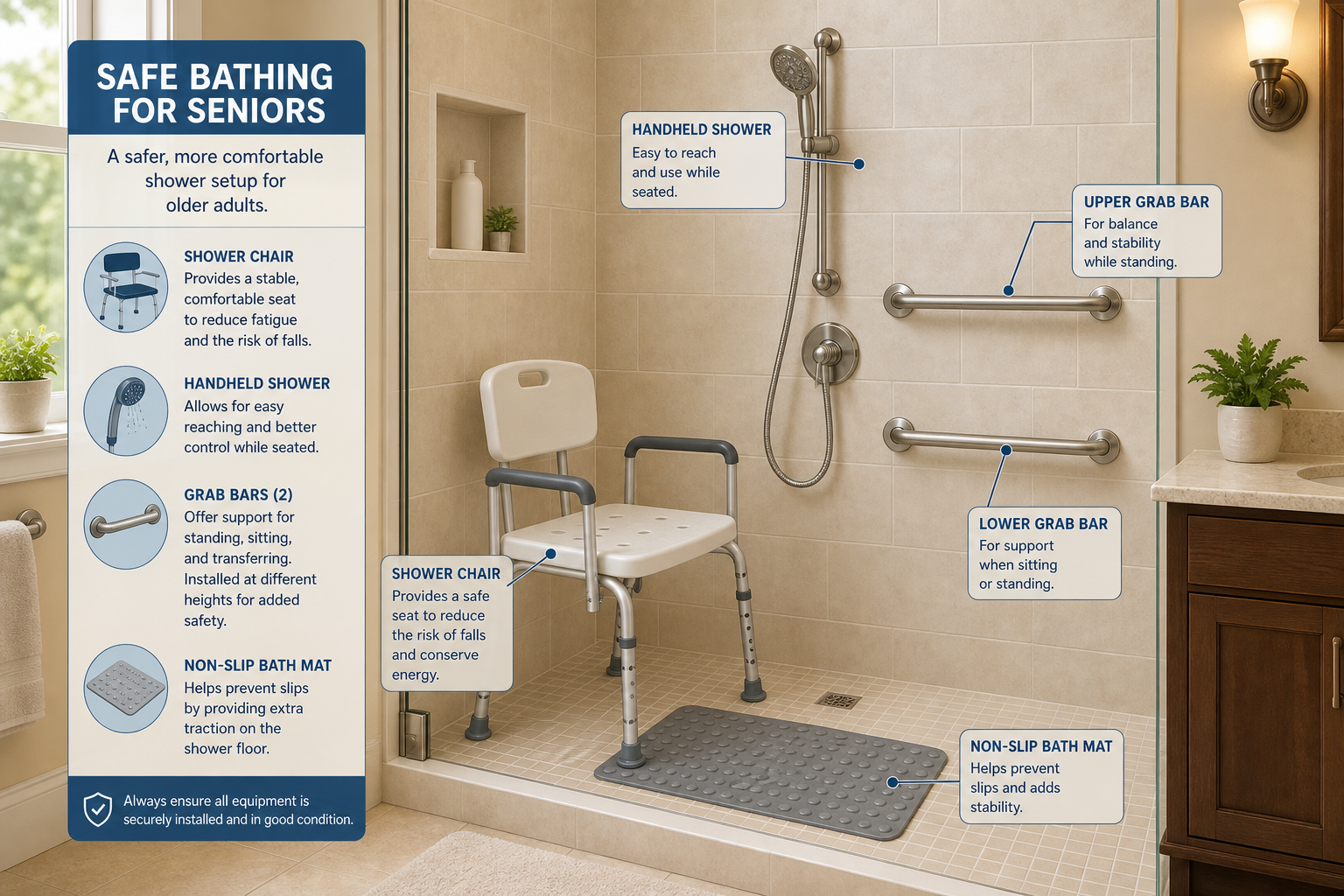
Before the first bath, assess the bathroom for fall risks. The combination of water, soap, hard surfaces, and limited mobility makes this the most dangerous room in the house for an older adult. The following modifications are recommended by the NIA and HealthInAging.org as standard safety measures:
- Install grab bars inside and outside the shower or tub — not suction-cup models, but bars anchored into wall studs.
- Place a shower chair or bath bench inside the tub or shower so the person can sit while bathing.
- Use a handheld shower sprayer so water can be directed precisely without requiring the person to move into the stream.
- Apply non-slip adhesive strips or a rubber mat to the shower or tub floor.
- Keep the bathroom warm before and during the bath — cold air can cause shivering and increase fall risk.
- Avoid baby oil in the tub, as it makes surfaces dangerously slippery.
Step-by-Step Bathing for a Person with Dementia
Bathing a person with dementia requires a different approach. The person may not understand why they need to bathe, may feel threatened by the water, or may perceive the caregiver's help as an intrusion. The NIA provides a detailed sequence that reduces resistance and maintains calm:
- Gather all supplies before bringing the person into the bathroom: towel, washcloth, mild soap, shampoo, clean clothes, and any grooming items. Once the bath begins, you should not leave the person alone.
- Warm the room and the water beforehand. Check the water temperature with your wrist or elbow — older skin burns more easily.
- Use a calm, matter-of-fact tone. Say, "It's time for a bath now," rather than asking, "Do you want to take a bath?" which invites refusal.
- Offer limited choices to preserve a sense of control: "Would you like a bath or a shower?" or "Do you want to bathe now or in 15 minutes?"
- Allow the person to hold a washcloth or shampoo bottle during the bath. This provides a sense of security and participation.
- Wash the least-threatening areas first — hands or feet — before moving to more sensitive areas. Demonstrate each action or gently guide the person's hand: "Put your feet in the tub. Sit down now."
- Place a towel over the person's shoulders or lap during the bath to maintain modesty and warmth.
- Never leave a person with Alzheimer's alone in the tub or shower, even for a moment.
Dressing: Reducing Choices and Making It Easier
Dressing is a sequence of fine-motor tasks that becomes progressively harder with arthritis, reduced range of motion, or cognitive decline. Buttons, zippers, and pullover garments that require raising arms overhead can turn a five-minute task into a frustrating ordeal for both parties.
Clothing Choices That Reduce Friction
The HealthInAging.org caregiver guide recommends avoiding pullover shirts and clothing with back zippers, as these are difficult to put on and remove. Instead, choose cardigan sweaters, blouses, or shirts with large buttons or front zippers. Elastic waistbands on pants and skirts eliminate the need to manage buttons or snaps. Slip-on shoes with hook-and-loop fastener straps (Velcro) are easier than lace-up shoes.
Special adaptive clothing is available through home care catalogs and online retailers. These garments use magnetic closures, Velcro fastenings, and open-back designs that allow dressing without lifting or twisting the person. While not always necessary, they can be a practical solution when standard clothing becomes too difficult.
| Clothing Type | Best Choice | Avoid |
|---|---|---|
| Shirts and tops | Cardigans, front-zip shirts, large-button blouses | Pullover shirts, back-zip garments |
| Pants and skirts | Elastic waistbands, Velcro-side closures | Button-fly pants, zipper-front pants |
| Shoes | Slip-on with hook-and-loop straps | Lace-up shoes, buckle shoes |
| Socks | Use a sock aid or grabber tool to reach feet | Tight compression socks without assistance |
Dressing Techniques That Preserve Independence
The NIA recommends laying out clothes in the order they should be put on — underwear first, then pants, then shirt, then socks, then shoes. Hand one item at a time with a simple instruction: "Put your arm through this sleeve." Giving step-by-step directions is more effective than handing over a pile of clothes and expecting the person to sequence the task independently.
Limit choices to one or two outfits. Keeping only a few options in the closet reduces decision fatigue and prevents the person from becoming overwhelmed. For a person with dementia, too many choices can trigger confusion or agitation.
For socks, HealthInAging.org suggests using a grabber tool to reach the feet and pull socks over the heel and up the leg. This avoids the need for the person to bend forward, which can cause balance loss. If the person can participate, allow them to do as much as they can — even if it takes longer or the result is imperfect. The goal is not a perfect outfit; it is preserving the person's sense of capability.
Grooming and Oral Care: Safety and Comfort
Grooming tasks — shaving, nail care, hair care, and oral hygiene — are often overlooked in caregiving guides, but they have a direct impact on the senior's physical health and emotional wellbeing. Poor oral hygiene can lead to tooth loss, difficulty eating, and systemic infections. Unkempt hair or untrimmed nails can affect how the person feels about themselves and how they are perceived by others.
Shaving and Nail Care
The NIA recommends using an electric razor for safety. Wet shaving with a blade increases the risk of cuts, which can be slow to heal on older skin and may become infected. Electric razors are also easier for a person with hand tremors or limited dexterity to use independently.
Keep nails clean and trimmed. Use nail clippers with a magnifier attachment if vision is poor, or file nails straight across to prevent ingrown toenails. If the person has diabetes or poor circulation in the feet, consult a podiatrist for nail care — even a small cut can lead to serious complications.
Oral Hygiene for Seniors
Oral care is one of the most frequently neglected personal care tasks in caregiving, yet it has profound health implications. The American Dental Association recommends using rotating toothbrushes and high-fluoride toothpaste for seniors. A long-handled or electric toothbrush makes the task easier for both the caregiver and the person receiving care. If the person tends to bite down on the toothbrush, the NIA suggests trying a child-size toothbrush, which is smaller and less likely to trigger the bite reflex.
Dry mouth is a common side effect of many medications taken by older adults, including blood pressure drugs, antidepressants, and antihistamines. Saliva protects teeth from decay, so a dry mouth significantly increases cavity risk. Encourage sipping water throughout the day, and talk to the person's doctor or dentist about saliva substitutes or prescription treatments for dry mouth.
Toileting: Equipment, Positioning, and Incontinence Care
Toileting is the personal care task that most directly affects the senior's dignity and the caregiver's daily workload. Difficulty getting on and off the toilet, urgency, and incontinence are common as mobility and bladder control decline. The right equipment and a consistent routine can prevent falls, protect skin health, and reduce the emotional strain on both parties.
Assistive Devices for Safer Toileting
The HealthInAging.org caregiver guide recommends several modifications to make toileting safer and more accessible:
- A raised toilet seat (three to four inches deep) reduces the distance the person must lower themselves, making it easier to sit and stand.
- Grab bars installed next to the toilet provide stable support for lowering and rising. Do not rely on a towel rack or toilet paper holder — these are not load-bearing.
- A bedside commode placed next to the bed eliminates the need to walk to the bathroom during the night, when fall risk is highest.
- A toilet frame (a freestanding metal frame that fits around the toilet) offers grab-bar support without requiring wall installation.
| Device | Best For | Key Feature |
|---|---|---|
| Raised toilet seat (3–4 inch) | Reducing sit-to-stand distance | Adds height without replacing the toilet |
| Grab bars (wall-mounted) | Stable support for lowering and rising | Must be anchored into wall studs |
| Bedside commode | Nighttime toileting without walking to bathroom | Portable; can be placed next to bed |
| Toilet safety frame | Support without wall installation | Freestanding metal frame around toilet |
Managing Incontinence with Dignity
Incontinence is one of the most common reasons families consider a move to assisted living, but it can be managed at home with the right approach. The key is to treat it as a medical condition, not a personal failure. Blame and shame have no place in incontinence care.
Establish a toileting schedule: take the person to the bathroom every two to three hours during the day, even if they do not ask. This proactive approach reduces accidents and gives the person more control. Use absorbent briefs or pads as a backup, not as a replacement for the schedule. Change incontinence products promptly — prolonged contact with urine or stool causes skin breakdown and increases the risk of pressure injuries.
After each incontinence episode, clean the skin gently with a soft cloth or perineal cleanser, pat dry (do not rub), and apply a barrier cream to protect the skin. If the person wears incontinence pads, frequent sponge baths are important to avoid infections, as noted by professional caregiver guidance.
Skin Care: Preventing Infections and Maintaining Health
Older skin is fragile. It loses collagen and elasticity over time, heals more slowly, and is more susceptible to tears, infections, and pressure injuries. The American Academy of Dermatology identifies skin infections as among the most common infections in older adults, and the majority are preventable with proper hygiene and moisturizing routines.
Professional caregiver guidance from A Place for Mom outlines a skin care routine specifically for aging skin:
- Pat the skin dry with a soft towel after bathing — do not rub, as friction can damage fragile skin.
- Apply moisturizer to damp skin immediately after bathing to lock in moisture. Dry skin cracks easily, creating entry points for bacteria.
- Keep baths and showers to around 10 minutes. Use warm water, not hot water, which strips natural oils.
- Use a soft cloth for washing. Avoid loofahs, scrub brushes, or rough washcloths.
- Clean under every skin fold and wrinkle — breasts, neck, stomach folds, and genitalia — and rinse soap completely. Residual soap can cause irritation.
- Avoid bubble bath liquids, powders, or crystals. HealthInAging.org warns that these can irritate the skin and may cause urinary tract infections.
When to Seek Professional Help
There is a limit to what one family caregiver can safely provide, and recognizing that limit is not a failure — it is an act of responsibility. Personal care tasks become unsafe when the caregiver lacks the physical strength to transfer or support the person, when the senior's resistance escalates to aggression that cannot be managed with behavioral techniques, or when the caregiver's own health is suffering from the physical and emotional demands.
The following signs suggest that professional support may be needed:
- You have injured your back or shoulder while transferring or supporting the person.
- The person has fallen during a transfer or while on the toilet.
- Skin breakdown, pressure injuries, or recurrent urinary tract infections are occurring despite consistent care.
- The person is consistently refusing care and becoming agitated or aggressive during personal care tasks.
- You are experiencing symptoms of caregiver burnout — exhaustion, irritability, changes in sleep or appetite, or feelings of hopelessness.
Options for professional support include: a home health aide who can assist with bathing and dressing for a few hours per week; an occupational therapist who can assess the home environment and recommend equipment or techniques to make personal care safer; adult day programs that provide supervised care during the day, giving the caregiver a break; and, when home care is no longer sufficient, a conversation about assisted living or skilled nursing. These are not all-or-nothing decisions. Many families use a combination of family care and paid support to sustain aging at home for as long as possible.
Having the conversation about bringing in help is difficult. Frame it around your own limitations, not the senior's decline: "I want to make sure I can keep helping you safely, and I think we need some extra support to do that." This approach preserves the senior's dignity and positions the additional help as a resource for both of you, not as a judgment of anyone's capabilities.
Questions to bring to a clinician or OT
This is not medical, legal, or a family's final decision — only a framework. Bring these questions to a clinician, occupational therapist, or your local Area Agency on Aging.
Find Local HelpRelated reading
Noticed something outdated or inaccurate on this page? Flag a correction. We review every report against CDC, NIA, and AARP HomeFit guidance before updating a page.