
Caregiver decision guide
Prevent dehydration from Cyclospora in older adults at home
This article provides family caregivers with a calibrated home protocol to manage hydration during Cyclospora-related diarrhea in older adults, including specific fluid targets, objective monitoring signs, and clear escalation thresholds for emergency care — because standard advice is dangerously insufficient due to age-related physiological changes.
The first problem with Cyclospora-related diarrhea in an older adult is that the person may look calmer than the situation deserves. A parent can have repeated watery diarrhea, leave a half-full glass on the bedside table, and still say, “I’m fine.” That answer is not enough information. With Cyclospora, especially during the 2026 outbreak, the safer question is not whether they feel thirsty. It is what you can measure before dehydration starts pulling on the kidneys, blood pressure, balance, and chronic conditions.
As of mid-July 2026, CDC outbreak reporting described 1,645 confirmed Cyclospora cases, with 9% hospitalized; CDC’s Health Alert Network notice said hospitalizations were primarily for dehydration-related complications.[1] That 9% is an overall outbreak figure, not an older-adult-only rate. The age-specific warning comes from a broader CDC foodborne-illness risk frame: nearly half of adults 65 and older with lab-confirmed foodborne illness are hospitalized.[2] Put together carefully, those facts do not mean every older adult with Cyclospora will need the hospital. They do mean that home care needs to be more structured than “offer water and wait.”

Cyclospora can also trick a household into relaxing too soon. Cleveland Clinic describes cyclosporiasis as an intestinal infection that can cause watery diarrhea, cramping, bloating, nausea, fatigue, and symptoms that may seem to improve and then return if untreated.[3] That waxing-and-waning pattern matters at home. A quieter afternoon after a rough morning is welcome, but it is not proof that fluid losses have stopped or that the older adult’s body has caught up.
Start With a Hydration Order, Not a Thirst Check
Older adults are more vulnerable to dehydration partly because the usual warning system is weaker. The American Geriatrics Society’s HealthInAging caregiver guidance notes that older adults may have a decreased sense of thirst, so caregivers should watch for signs of dehydration rather than waiting for the person to ask for fluids.[4] Aging kidneys also have less reserve for conserving water, and many older adults take medications that affect blood pressure, urination, potassium, glucose, or kidney function. In practice, the person who says they are not thirsty may still be losing more fluid than they are replacing.
The home goal is steady replacement. If a clinician has given a fluid target because of heart failure, kidney disease, dialysis, low sodium, or another condition, use that individualized limit. If no limit has been given, call the primary care office, urgent care line, or pharmacist early and ask for a daily fluid target while diarrhea is active. The question is not vague: “How much total fluid should we aim for in 24 hours, and are oral rehydration drinks appropriate with this person’s diagnoses and medications?”
Until you have that guidance, avoid relying on large glasses set down beside the chair. Offer small, frequent amounts and record what is actually swallowed. Water helps, but diarrhea also carries away electrolytes, so an oral rehydration solution or clinician-approved electrolyte drink may be more useful than plain water alone. Broth, diluted beverages, ice chips, and gelatin may help some people keep fluids down, but they still need to count toward an observed intake plan rather than becoming a hopeful assortment on the nightstand.
| Caregiver action | What to write down | Why it matters |
|---|---|---|
| Offer fluids on a schedule while awake | Time, type of fluid, and approximate amount swallowed | A full glass nearby does not mean the older adult drank it |
| Pair fluids with each loose stool when tolerated | Number of watery stools and whether extra fluid stayed down | Diarrhea losses can outpace casual sipping |
| Use electrolyte fluids if approved for this person | Brand or type, amount, and any nausea or swelling | Fluid loss can involve salts as well as water |
| Call for a personalized target when chronic illness is present | Who gave the instruction and the 24-hour limit or goal | Some heart, kidney, and electrolyte conditions make generic advice unsafe |
The Caregiver Dashboard: What to Monitor
A good home record does not need to be beautiful. It needs to be honest enough that a nurse, doctor, or emergency clinician can see the trend. Write down the time diarrhea happens, the amount of fluid taken, urination, temperature, blood pressure if you can measure it safely, pulse, mental status, dizziness, weakness, and any fall or near-fall. The value is not in catching one perfect number. It is in noticing when the body is losing ground.

Urine output tells you what thirst may hide
Urine is one of the most useful home clues because it reflects what the body is conserving. Track when the older adult urinates, whether the amount seems much smaller than usual, and whether the color is getting darker. Very dark urine, very little urine, or long stretches without urination are more useful warnings than “I’m not thirsty.” If the person uses incontinence briefs, check whether they are staying unusually dry. If they use a bedside commode, note the time and approximate amount.
Mental status changes are not just fatigue
Cyclospora can leave a person tired, but dehydration can make an older adult suddenly more confused, sleepy, irritable, or unlike themselves. A person who normally manages the television remote but now cannot follow simple conversation has crossed into a different kind of concern. Write down the change in plain language: “new confusion after dinner,” “hard to wake for fluids,” “did not recognize bathroom direction,” or “more agitated than baseline.” Those notes are more useful than trying to diagnose the cause at home.
Pulse, blood pressure, dizziness, and standing
If you already have a home blood pressure cuff and know how to use it, measure at consistent times and whenever the person feels faint, unusually weak, or unsafe standing. A rising heart rate, lower-than-usual blood pressure, dizziness when sitting up or standing, or needing more help to walk can all fit with volume loss. Do not turn the bathroom trip into a test of independence. Diarrhea, weakness, urgency, and nighttime walking are a fall setup.
AARP’s reporting on the 2026 Cyclospora outbreak quoted Dr. Luis Marcos of Stony Brook Medicine warning that older adults can develop dehydration complications including acute kidney injury, electrolyte problems, weakness, dizziness, falls, and worsening chronic conditions.[5] That list is worth taking literally. The danger is not only the intestine. It is the chain reaction that starts when fluid loss reaches an older adult with less reserve.
Chronic conditions may announce the dehydration first
For some older adults, dehydration first shows up as worsening of an existing problem: more shortness of breath, chest discomfort, severe weakness, worse blood sugar control, new swelling after aggressive fluids, less urine in someone with kidney disease, or blood pressure that no longer behaves like usual. The caregiver’s job is not to decide which organ system is responsible. It is to notice that the person is no longer following their ordinary pattern and to get help before the pattern becomes a crisis.
| Metric | Watch for | Caregiver note |
|---|---|---|
| Stool pattern | Repeated watery stools, return of diarrhea after seeming improvement | Cyclospora symptoms can wax and wane |
| Fluid intake | Less swallowed than offered, nausea, vomiting, refusal, sleepiness through scheduled fluids | Record actual intake, not intention |
| Urination | Much less than usual, very dark urine, unusually dry briefs | This is often more reliable than thirst |
| Mental status | New confusion, unusual sleepiness, agitation, trouble following simple directions | Treat as a deterioration sign |
| Mobility | Dizziness, new weakness, unsteady walking, fall or near-fall | Do not let bathroom urgency create a second injury |
| Vitals if available | Fever, fast pulse, lower-than-usual blood pressure, concerning blood sugar changes | Share trends with the clinician |
When Home Care Is No Longer Enough
Escalation should not wait until the older adult looks dramatically ill. Call the treating clinician, urgent care line, or local nurse advice line promptly if diarrhea is continuing and intake is falling behind, if urination is decreasing, if dizziness or weakness is increasing, or if chronic conditions are becoming harder to control. If you are debating whether the pattern is serious at 10 p.m., the written record can keep the call focused: number of watery stools, amount of fluid swallowed, last urination, temperature, blood pressure and pulse if available, medication list, and what has changed from baseline.
Seek emergency care now if the older adult has fainting, a fall with injury or inability to get up safely, severe weakness, new or worsening confusion, signs of shock such as clammy skin or extreme lightheadedness, very little or no urine, inability to keep fluids down, chest pain, trouble breathing, or any symptom that makes you feel they cannot be safely monitored at home. Fever or bloody stool also changes the situation; it should trigger medical contact and caution with any medication meant to slow diarrhea.
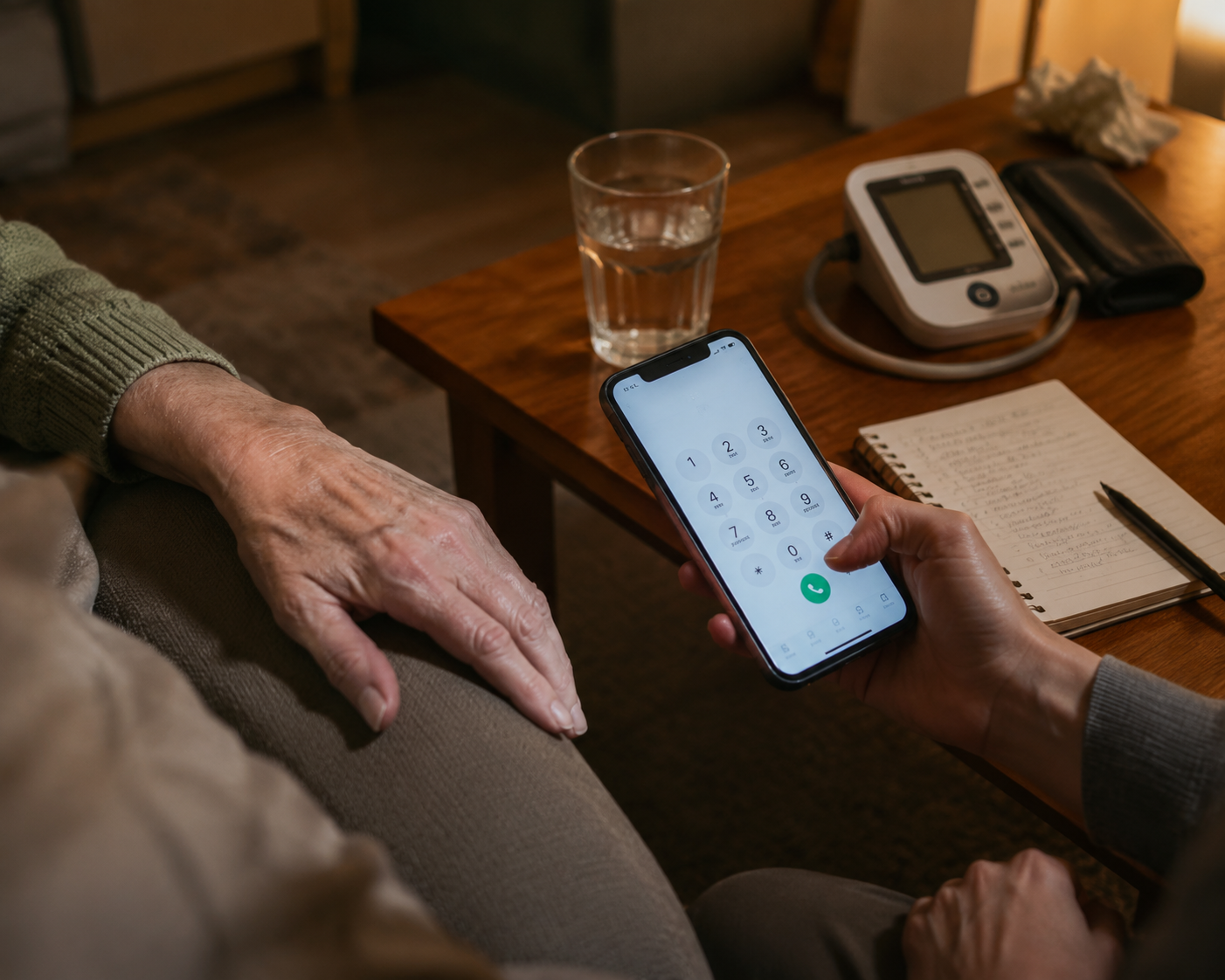
The hard part is that “not drinking much” can sound mild until it is paired with the rest of the picture: six bathroom trips, darker urine, a shaky walk, a pulse running higher than usual, and a person who is too tired to sit up for fluids. That is not a character flaw or stubbornness. It is a body with less margin. Home care has failed when the caregiver cannot replace losses safely, cannot keep the person upright and alert, or cannot tell whether the kidneys, blood pressure, or chronic conditions are holding steady.
Medication Questions to Raise Early
Cyclospora is treatable, but treatment decisions belong with the clinician. CDC clinical care guidance identifies trimethoprim-sulfamethoxazole, often known by brand names such as Bactrim or Septra, as the treatment of choice for cyclosporiasis; CDC lists 160/800 mg twice daily for 7 to 10 days for adults and notes that options for people with sulfa allergy are less effective.[6] A caregiver does not need to manage that prescribing decision. The caregiver does need to make sure the prescriber sees the older adult’s full medication list.
Ask specifically about warfarin or other blood thinners, diabetes medications, potassium-affecting drugs, diuretics, ACE inhibitors, angiotensin receptor blockers, blood pressure medicines, kidney-related restrictions, and supplements. Diarrhea changes fluid and electrolyte balance; treatment can add interaction concerns; and older adults often take several medicines that were safe in ordinary weeks but need review during acute illness. Do not stop or change chronic medications on your own unless a clinician tells you to. Do make the medication review impossible to miss.
Anti-diarrheal medicine deserves a separate call. Loperamide or similar products may be discussed in some diarrhea situations, but fever or bloody stool can change the risk calculus because slowing the gut may be unsafe in certain infections. In an older adult with suspected or diagnosed Cyclospora, especially one with dehydration risk, ask the clinician or pharmacist before giving an anti-diarrheal rather than treating it as an automatic comfort measure.
Testing and Diagnosis Should Not Delay Hydration Care
Johns Hopkins Medicine’s Cyclospora Q&A notes that diagnosis can require specific stool testing, and testing gaps can affect whether cases are recognized.[7] That matters if an older adult has compatible symptoms during an outbreak but has not yet received a confirmed diagnosis. Still, the hydration protocol does not need to wait for the lab result. Repeated watery diarrhea in an older adult deserves intake tracking, urine monitoring, fall precautions, medication review, and a clear plan for when to call or go in.
If Cyclospora has already been diagnosed and treatment has started, expectations about how symptoms may change over time belong in a recovery timeline. During the acute home-care window, the priority is narrower: keep fluid losses from becoming kidney injury, electrolyte trouble, dangerous weakness, or a fall.
A Practical Home Routine for the Next 24 Hours
Set up the room before the next urgent bathroom trip. Put fluids within reach, but keep the intake log where the caregiver can mark what was actually consumed. Place a nightlight on the route to the bathroom. Keep the phone, medication list, thermometer, blood pressure cuff if used, and insurance or clinic information together. If the person is weak or dizzy, use a bedside commode or assistive plan rather than making them hurry down a hall.
- At the start of the day or shift, write the older adult’s usual baseline: alertness, walking ability, urination pattern, blood pressure range if known, and chronic conditions that tend to worsen with illness.
- Each time diarrhea occurs, note the time and whether it was watery, urgent, or accompanied by fever, blood, vomiting, dizziness, or severe pain.
- After each episode, offer small amounts of fluid as tolerated and record the amount swallowed within the next hour.
- Every few hours while awake, check urination, alertness, weakness, dizziness, and whether walking to the bathroom is still safe.
- Before evening, decide whether the trend is stable enough for overnight home care or whether you need clinician guidance while offices and pharmacies are still reachable.
The evening decision is often the one that protects the older adult. If the notebook shows less drinking, less urination, more weakness, and a harder trip to the bathroom, do not let a polite “I’m fine” overrule the evidence. Cyclospora diarrhea is not dangerous only because it is unpleasant. It is dangerous when fluid loss quietly outruns an older body’s ability to compensate.
References
- HAN Archive - 00531 | Cyclosporiasis Outbreaks — United States, 2026, CDC Health Alert Network, July 14, 2026; Cyclosporiasis Outbreak Investigations - United States, 2026, CDC, July 16, 2026, https://www.cdc.gov/cyclosporiasis/outbreaks/2026/
- People at Increased Risk for Food Poisoning, CDC
- Cyclosporiasis, Cleveland Clinic
- Caregiver Guide: Diarrhea, HealthInAging.org, American Geriatrics Society
- Cyclospora Outbreak Sickens More Than 1,000: What to Know, AARP, July 17, 2026
- Clinical Care of Cyclosporiasis, CDC
- Cyclospora: What to Know About the Foodborne Illness, Johns Hopkins Medicine, July 17, 2026
Questions to bring to a clinician or OT
This is not medical, legal, or a family's final decision — only a framework. Bring these questions to a clinician, occupational therapist, or your local Area Agency on Aging.
Find Local HelpRelated reading
Noticed something outdated or inaccurate on this page? Flag a correction. We review every report against CDC, NIA, and AARP HomeFit guidance before updating a page.