
Caregiver decision guide
How Keytruda's Patent Expiration Could Lower Cancer Costs for Older Adults
Keytruda's primary patent expires in 2028, but secondary patents, Medicare price negotiation, and a new subcutaneous formulation complicate the timeline. This guide helps family caregivers understand what to expect and how to prepare for cost and access changes between now and 2030.
The short answer for caregivers
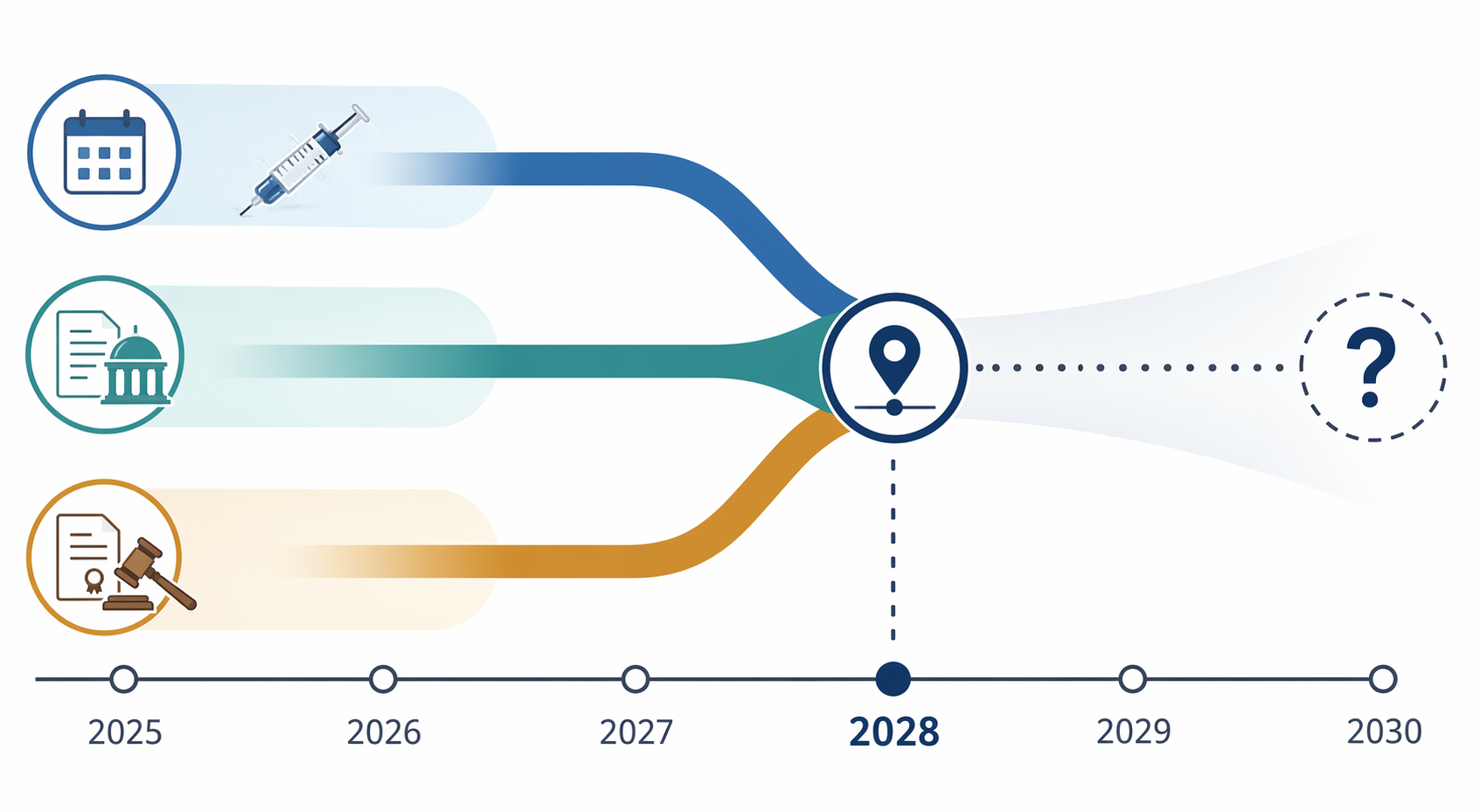
If your parent is on Keytruda, the simple version is wrong: the U.S. primary patent expires in November 2028, but that does not mean costs fall on one clean date, because pricing pressure, patent disputes, and a newer subcutaneous version are all moving at once.[1][2] For a family trying to plan around Medicare, transportation, and infusion visits, that means 2028 is a pressure point, not a finish line.

| Time window | What changes | What it means for families |
|---|---|---|
| 2025-2027 | Keytruda Qlex, the subcutaneous version, is already available; biosimilars are still in development.[2][3] | Some patients may move to a faster injection before any IV biosimilar arrives. |
| 2028 | Medicare negotiated pricing takes effect in January, and the U.S. primary patent expires in November.[1] | Price relief may start, but it is unlikely to be automatic or uniform. |
| 2029-2030 | If biosimilar litigation clears and products launch, competition could begin to matter more.[1][3][4] | Savings may appear unevenly, especially if most patients have already shifted to the subcutaneous formulation. |
Why 2028 is a pressure point, not a finish line
Merck is not defending one patent. The company has more than 50 active U.S. patents around pembrolizumab and has filed nearly 300 patent applications, with some protections stretching to about 2042, so biosimilar entry in 2028 is not guaranteed and will depend on litigation outcomes.[1] That matters because the company has a lot to lose: Keytruda brought in $29.5 billion in 2024, about 40% of Merck's pharma revenue, and analysts have projected a peak near $33 billion to $34 billion in 2028 before a decline as competition arrives.[5]
That patent picture sits next to a different kind of move. Merck's Keytruda Qlex, the subcutaneous formulation, was approved in 2025; it can be given in about 1 to 2 minutes instead of the roughly 30-minute IV infusion, and Merck has said it reduces healthcare professional time by 46%.[2] For a frail older adult, that shorter visit can be a real improvement. It can mean less time in the clinic chair, less fatigue from travel, and less strain on the caregiver who is arranging the day around the infusion center.

The catch is that convenience can also change the savings story. If oncology practices shift patients to the subcutaneous version before IV biosimilars are able to compete, some of the price pressure that families hope to see from biosimilar entry may be delayed or muted.[2][3] That is why the practical question is not only whether Keytruda gets cheaper, but which formulation the oncology team expects your parent to stay on and how that choice is billed.
What to check before costs shift
The most useful work for a caregiver happens before a new bill arrives. If you need a broader map for the insurance side, our guide on How to Pay for Senior Health Care Services can help with the Medicare pieces, and the broader Government Benefit Programs for Seniors and $58 Billion Left on the Table pieces are useful when you start looking for assistance, but the oncology office still needs to stay in the loop on treatment decisions.
- Ask the billing office whether your parent is being billed for IV Keytruda or Keytruda Qlex, and whether a change in route changes the coinsurance, facility fee, or infusion-center charge.
- Review the Medicare coverage details before open enrollment or a plan switch, including prior authorization, specialty pharmacy rules, and whether the plan treats the newer formulation differently.
- Check whether the cancer center has financial counselors, manufacturer assistance, or charity-care screening, especially if your parent has fixed income and other oncology medications at the same time.
- If the route changes, ask for a new estimate instead of relying on the old one; IV and subcutaneous administration can land in different billing buckets.
- Keep treatment decisions anchored with the oncology team; financial planning should follow the plan, not replace it.
For price context, Keytruda's list price was about $12,272 per 3-week dose in May 2026, or roughly $150,000 a year, and WHO modeling suggests pembrolizumab costs could fall by as much as 60% after biosimilar entry; those are modeled projections, not confirmed family bills.[4] Historical examples point in the same direction but still do not guarantee the same result here: oncology biosimilars such as trastuzumab and rituximab entered at 50% to 70% discounts in the U.S., while Humira biosimilars drove roughly 80% reductions in Europe.[4]
No one should plan around a clean, immediate drop in out-of-pocket costs. The more realistic expectation is uneven savings through 2030: some families may see relief from negotiated pricing sooner, some may benefit from a shorter subcutaneous visit, and others may wait for biosimilar competition that is still blocked by patents and litigation.[1][3][4] The safest move is to document coverage now, ask about formulation changes at every treatment transition, check assistance options before the next plan year starts, and recheck the numbers whenever the route of administration or insurance coverage changes.
References
- Keytruda's evergreening patents and Merck's patent thicket, ICIJ, April 2026, https://www.icij.org/investigations/cancer-calculus/keytruda-evergreening-patents-merck/
- Merck's Scheme to Product-Hop Keytruda, I-MAK, May 5, 2025, https://www.i-mak.org/2025/05/05/mercks-scheme-to-product-hop-keytruda/
- Biosimilars of pembrolizumab, GaBI Online, https://www.gabionline.net/biosimilars/general/biosimilars-of-pembrolizumab
- A.22 PD-1/PD-L1 ICIs financial impact report, WHO, 2025, https://cdn.who.int/media/docs/default-source/2025-eml-expert-committee/addition-of-new-medicines/a.22-pd1-pdl1-icis_financial-impact-report.pdf
- Merck, SyneticX, https://www.syneticx.com/blog/merck.html
Questions to bring to a clinician or OT
This is not medical, legal, or a family's final decision — only a framework. Bring these questions to a clinician, occupational therapist, or your local Area Agency on Aging.
Find Local HelpRelated reading
Noticed something outdated or inaccurate on this page? Flag a correction. We review every report against CDC, NIA, and AARP HomeFit guidance before updating a page.