Many spousal caregivers provide care entirely alone, even when adult children live nearby. This article explains the psychological and structural reasons behind solo caregiving and how to find support without feeling like you're failing your role.
By Editorial Team
new caregiver
experienced caregiver
long-distance caregiving
spousal caregiver
working caregiver
daily routines
medication management
personal hygiene
care coordination
first steps
ADLs
IADLs
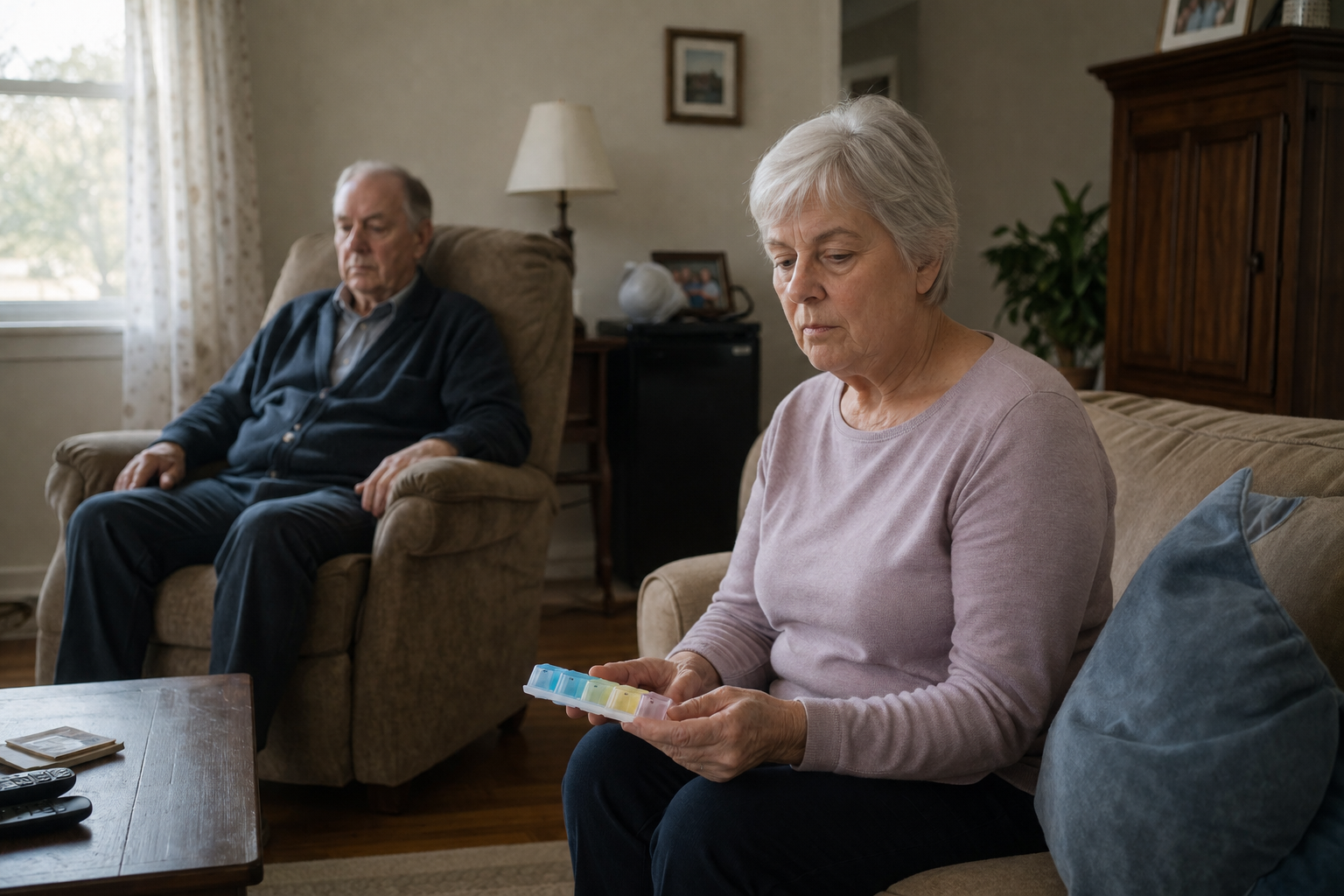
The strange thing about being the only caregiver for your spouse is that you may not be alone in any ordinary sense. There may be an adult daughter ten minutes away, a son who calls every Sunday, neighbors who wave from the driveway, a church list somewhere, a home care brochure still unopened on the counter. Yet at 2:00 a.m., when your husband needs help getting to the bathroom, or when your wife is frightened by a medication change, the room has only two people in it.
That gap between available people and actual help is not a small misunderstanding. In a nationally representative study of spouses caring for a disabled partner near the end of life, 55% received no paid or unpaid help. Those solo spousal caregivers averaged 43 hours of care per week, close to a full-time job before counting the emotional vigilance that does not fit neatly into hours.[1]
The same study found something that should make every easy family-advice sentence pause: among solo spousal caregivers, 59% had children either living with them or within 10 miles.[1] So the question is not simply, “Where is everyone?” Sometimes everyone is nearby. The harder question is why nearby people do not become useful help.
Why Nearby Family Still May Not Become Help
Spousal caregiving has a gatekeeper built into it. The spouse doing the work is not just managing tasks. They are protecting a marriage, a household rhythm, and often the dignity of the person who once shared every private part of life with them as an equal.
That protection can look like refusal from the outside. “We’re fine.” “Your father doesn’t need anyone else.” “I know how she likes it done.” Sometimes those sentences mean exactly what they say. Sometimes they mean, “I cannot bear to make our private life a project managed by our children.” Sometimes they mean, “If I admit I need help, I will have to admit how much has changed.”
Adult children can misread this. They may wait to be assigned a task because they do not want to intrude. They may assume that a parent who says “we’re managing” would say something different if things were truly bad. They may know, in a vague way, that appointments and medications are happening, but not see the lifting, toileting, bathing, meals, bills, reassurance, and broken sleep that fill the day.
This is why proximity is such a poor measure of support. A person can live close enough to bring groceries and still not know that the caregiving spouse has not slept through the night in months. A child can be emotionally devoted and operationally useless. A spouse can be surrounded by people who would help if asked, while still carrying the whole week alone.
The Private Code of Spousal Care
Caregivers for seniors are often discussed as if the role is interchangeable: one family member coordinates, another drives, someone hires help, everyone shares the load. Spousal care does not work that cleanly. The person giving care may also be the person who knows which cup feels right in a trembling hand, which joke still lands, which kind of help embarrasses their partner, and which silence means pain.
That knowledge is valuable. It is also a trap when it becomes proof that no one else can do anything. The spouse may be right that no aide, child, or neighbor can replace them. But replacement is the wrong standard. The useful standard is narrower: what can someone else do without taking away the spouse’s authority?
Many spouses do not resist help because they are stubborn in some simple way. They resist because help can feel like exposure. Bathing, toileting, dressing, incontinence, confusion, and nighttime fear are not errands. They are intimate losses. To invite another person into those moments can feel like revealing a partner’s frailty without permission.
There is also pride, but pride is not always vanity. Sometimes pride is the last remaining structure around a marriage that illness has already rearranged. A husband who promised to take care of his wife may hear “get help” as “you cannot keep your promise.” A wife who has spent decades running the household may hear it as “someone else should now supervise you.” Advice that ignores this will be politely rejected, and probably should be.
The Burden Is Real, Even When the Meaning Is Real
Forty-three hours a week does not sound like a metaphor because it is not one. It is time spent on transfers, meals, wound care, medication reminders, appointment logistics, laundry, transportation, emotional reassurance, and the small corrections that keep a day from falling apart.[1] For many older spouses, those hours are delivered by someone with their own pain, fatigue, prescriptions, and fear of becoming ill.
Broader caregiver-health data gives some context, though it should not be used to flatten every spousal story into the same distress pattern. In 2022 Behavioral Risk Factor Surveillance System data, 25.6% of caregivers reported a lifetime diagnosis of depression.[2] That figure covers caregivers broadly, not only spouses, but it belongs in the same room as the 43-hour week because strain is not only emotional; it accumulates through the body.
The temptation is to describe solo spousal caregiving as automatically damaging. The evidence is more complicated. In the same Ornstein study, solo caregivers had higher burden before bereavement, yet they did not show elevated depression after bereavement compared with caregivers who had support.[1] That does not make the care period harmless. It means the suffering and the meaning may be intertwined in ways outsiders should not simplify.
A spouse may look back and feel they did what they needed to do. They may not regret keeping care close. They may even find comfort in having protected their partner through the final stretch. None of that proves the arrangement was safe while it was happening.
Help That Does Not Take Over the Marriage
The most useful support for a solo spouse usually starts smaller than “let us know what you need.” That sentence transfers the work of diagnosis, planning, and asking back onto the tired person. A better offer names a task, a time, and a boundary.
Instead of
Try
Why it works better
“Call me if you need anything.”
“I can take the car for an oil change Tuesday morning or pick up prescriptions Thursday. Which helps?”
It removes the need to invent a task.
“You need an aide.”
“Could someone come two mornings a week for laundry, breakfast cleanup, and standby help while you shower?”
It frames paid help as support for the spouse, not replacement.
“You can’t keep doing this.”
“Which part of the day is heaviest right now: mornings, bathing, appointments, or nights?”
It starts with the actual pressure point.
“We should manage this as a family.”
“You stay in charge. I’ll handle the calendar and pharmacy refills unless you want it changed.”
It gives help without seizing authority.
This kind of help respects the spousal role because it does not ask the caregiver to surrender the center. It asks which load-bearing pieces can be moved off their body and mind.
Ask for Tasks, Not Rescue
If you are the spouse, it may feel unnatural to assign work to adult children, siblings, neighbors, or friends. Start with tasks that do not expose your partner’s most private care. Pharmacy pickup. A weekly grocery order. Sitting in the house during your medical appointment. Driving to the lab. Calling the insurance company. Taking the trash bins out and back. Handling one recurring bill.
A specific task is easier for others to accept and harder for them to misunderstand. It also lets you test reliability before handing over anything sensitive. If someone cannot manage a refill pickup, they are not ready to manage a hospital discharge conversation.
Use Respite as Maintenance
Respite care can sound like leaving. For many spouses, that is the wrong frame. Respite is maintenance: time for sleep, your own appointment, a walk without watching the clock, or one meal eaten while seated. If the word itself feels too large, define the smallest useful version first.
For some couples, respite begins with a trusted person staying in the home for an hour. For others, it may mean an adult day program, a short in-home aide shift, or a temporary stay. The right option depends less on what sounds generous and more on which part of the caregiving week is breaking down. If you need a fuller map of options, this guide to respite care for seniors explains the common forms without treating respite as one single service.
When exhaustion has already turned into irritability, numbness, dread, or a sense that you cannot recover between demands, matching the pressure to the type of break matters. A short errand break may not touch nighttime collapse. A social visit may not solve unsafe transfers. This resource on matching caregiver burnout symptoms to respite options is useful when “I need a break” has become too vague to act on.
Let Technology Cover Gaps, Not Replace People
Monitoring technology is delicate inside a marriage. Used badly, it can feel like surveillance. Used carefully, it can be a safety net that allows the caregiving spouse to sleep in another room, take a shower, step outside, or let an adult child notice a missed routine without hovering in the house.
The question is not whether technology is modern or clever. The question is what problem it is being asked to solve. Fall detection, door sensors, medication reminders, and passive activity alerts all carry different privacy tradeoffs. A spouse who would reject cameras may accept a less intrusive alert system. A partner with cognitive changes may need a different discussion than a partner who is physically frail but mentally clear. For that decision, start with privacy-friendly elder monitoring rather than with the most feature-heavy device.
Give Adult Children a Lane
Adult children do not need to become managers of the marriage in order to be useful. In fact, making them managers may be exactly what the caregiving spouse fears. A lane is different from control. One child can handle pharmacy calls. Another can take over transportation every other Wednesday. Someone out of town can manage insurance paperwork, order supplies, or make reminder calls before appointments.
If the adult child lives nearby but has not stepped in, the first conversation should be concrete, not accusatory. “I need you to come every Saturday from 10 to noon so I can sleep, shop, or sit outside” is clearer than “I need more help.” If the child lives farther away, the work still may not be impossible; it just has to be assigned differently. This long-distance caregiving guide is written for adult children, but a spouse can use it to decide what can be delegated without giving up the household.
When You Truly Want No Outside Involvement
Some spouses do not want paid help, family help, monitoring tools, or formal respite. That preference deserves more respect than it usually receives. There are marriages where outside involvement would feel more distressing than useful, especially when the person receiving care is private, ashamed, suspicious, or easily unsettled.
Even then, no outside involvement should not mean no backup plan. A private plan can still exist. Who enters the home if you fall? Who knows the medication list? Who can take over for one day if you are sent to the emergency room? Where are the legal documents, insurance cards, and physician names? Who has permission to speak if you cannot?
This is not a demand to open the marriage to a committee. It is a way of preventing one emergency from becoming two. A spouse can remain the primary caregiver and still name a second person who knows enough to keep the day from collapsing.
Watch the Caregiver, Not Only the Care Plan
Care plans tend to follow the person with the diagnosis: medication changes, fall risk, diet, bathing, mobility, memory, pain. The spouse’s condition may receive a polite question at the end of the appointment, if that. “How are you holding up?” is not an assessment. It is often just a doorway to saying “fine.”
The signs worth watching are practical before they are dramatic. Missed meals. A spouse skipping their own medications. No backup driver. Unsafe lifting. Bills piling up. A calendar with no blank spaces. Anger that arrives faster than it used to. A body that hurts every morning. Sleep broken so often that thinking becomes slow.
If you need language for what is happening, a careful review of caregiver burnout patterns and warning signs may help separate ordinary fatigue from a pattern that needs intervention. If you are still early enough to prevent a crash, a caregiver self-care checklist can be more useful than vague encouragement to “take care of yourself.”
The point is not to turn every spouse into a patient. It is to admit that the caregiving arrangement depends on the spouse’s continued functioning. If one person is the whole system, that person’s sleep, strength, and attention are not luxuries. They are infrastructure.
The Question to Ask Before Things Break
A useful question is not “Can I keep doing this alone?” Most devoted spouses will answer yes long after the honest answer has become no. A better question is: “Which parts of this must be done by me, and which parts only need to be done?”
Your presence may be irreplaceable during fear, confusion, pain, or intimate decision-making. Your hands may not be irreplaceable for every load of laundry. Your judgment may be essential at medical visits. Your time may not be essential for every insurance call. Your love may be the center of the day. It does not have to be the only labor in the day.
Solo spousal caregiving can be loyal, meaningful, and chosen. The evidence does not justify treating every spouse who cares alone as someone making a tragic mistake. But the care period itself is heavy enough to deserve intervention before collapse, not admiration afterward. Support is not proof that the spouse has failed. It is how the spouse keeps enough strength to remain a spouse, not only a caregiver.


Comments
Join the discussion with an anonymous comment.