UnitedHealthcare for Seniors in 2026: What Family Caregivers Need to Know About the Major Changes
UnitedHealthcare remains the largest Medicare Advantage carrier, but 2026 brings significant changes including service-area cuts, rising premiums, and benefit reductions. This guide helps adult children understand what's changing, what's staying the same, and how to help a parent decide whether to stay or switch during open enrollment.
By Editorial Team
Medicare
Medicare Advantage
UnitedHealthcare
open enrollment
care coordination
📄
A printable version of this guide is available. Use your browser's print function (Ctrl+P / ⌘P) to save or print.
Helping a parent navigate Medicare plan changes requires understanding what's shifting and what's not.
Why This Matters Now for Family Caregivers
If you are helping a parent choose or review their Medicare coverage, the next few months are the most consequential window of the year. Medicare Open Enrollment runs from October 15 through December 7. Any changes you make during this period take effect on January 1 of the following year. For 2026, that window is especially critical because UnitedHealthcare — the largest Medicare Advantage carrier in the country — is making its most aggressive service-area retrenchment in recent history.
UnitedHealthcare serves roughly 1 in 5 Medicare beneficiaries, with over 13 million people enrolled in its Medicare Advantage plans. But 2026 marks a turning point. The company is exiting 109 counties and one full state, cutting over-the-counter (OTC) benefits for non-special-needs plans, and shifting toward narrower HMO networks. For the first time in roughly two decades, overall Medicare Advantage enrollment is projected to decline — and UnitedHealthcare alone expects to lose between 1.3 and 1.4 million members.
This guide is written for adult children in their 40s and 50s who are helping a parent navigate these changes. We will walk through exactly what is changing, what is staying the same, how to check if your parent's plan or doctors are affected, and a clear framework for deciding whether to stay with UnitedHealthcare or switch to another option.
What's Changing in UnitedHealthcare's 2026 Medicare Advantage Plans
UnitedHealthcare's 2026 plan changes are not minor tweaks. They represent a strategic pullback after years of aggressive expansion. Here are the key shifts, supported by company statements, CMS data, and independent analyses.
Service-Area Reductions: 109 Fewer Counties and One Fewer State
The most dramatic change is geographic. For 2026, UnitedHealthcare is offering plans in 109 fewer counties and one fewer state compared to 2025, according to an analysis of CMS data by Morgan Stanley reported by Healthcare Dive. This means that in certain areas, a parent who has been enrolled in a UnitedHealthcare Medicare Advantage plan for years may find that their plan is simply no longer available.
Projected Membership Loss: 1.3–1.4 Million Members
During its Q4 2025 earnings call on January 27, 2026, UnitedHealth Group projected Medicare Advantage membership losses of 1.3 to 1.4 million in 2026, according to Becker's Payer Issues. This is higher than the previously anticipated 1 million. At the end of 2025, UnitedHealthcare had 8.4 million MA members. The broader market is also contracting: the Trump administration projects overall MA enrollment will drop to roughly 34 million from about 35 million, marking the first year-over-year decrease in roughly two decades.
UnitedHealthcare CEO Tim Noel said the company may pull back further on MA plans from a benefits and geography perspective if proposed 2027 MA rates are finalized as proposed — a 0.09% increase, which the industry considers unfavorable.
Premium Increases: Weighted-Average Rise of ~22% ($2.84)
While many UnitedHealthcare plans advertise $0 monthly premiums, the weighted-average monthly premium for general enrollment MA plans is increasing by $2.84 — almost 22% — compared to 2025, according to the Morgan Stanley analysis of CMS data cited by Healthcare Dive. This does not mean every plan's premium is rising by $2.84; it means the average across all plans is moving upward. Some plans may see larger increases, while others may hold steady.
OTC Benefit Cuts for Non-SNP Plans
UnitedHealthcare has materially cut allowances for over-the-counter health and wellness items for non-Special Needs Plans (non-SNP), according to TD Cowen research cited by Healthcare Dive. For a parent who relies on their OTC allowance for items like pain relievers, vitamins, first-aid supplies, or cold medications, this reduction could mean a meaningful out-of-pocket increase.
Shift Toward Narrower HMO Networks
Major payers, including UnitedHealthcare, are prioritizing HMO plan designs with more limited provider networks. According to a UnitedHealthcare press release, the company has expanded HMO plan access to 92% of eligible beneficiaries. While this means more people can access an HMO plan, it also means that the network of available doctors and hospitals may be narrower than in previous years. If a parent's preferred specialists or hospital are not in the new HMO network, they may face higher out-of-network costs or need to switch providers.
Medical Cost Trends Are Rising
UnitedHealth Group reported that the medical cost trend for Medicare Advantage was approximately 7.5% in 2025, and the company reaffirmed a 10% trend for 2026. This means the cost of providing care is rising faster than premiums, which puts pressure on insurers to reduce benefits or narrow networks to maintain margins. MA margins are expected to improve by roughly 50 basis points from 2025 levels, but that improvement comes from the cost-cutting measures described above.
What's Staying the Same: The Core Benefits That Remain
Despite the significant changes, UnitedHealthcare remains the largest Medicare Advantage carrier for a reason. Many of the core benefits that make its plans attractive are still in place for 2026. Understanding what has not changed is just as important as understanding what has — it prevents an overreaction and helps you make a balanced decision.
Broad access: UnitedHealthcare's 2026 MA plans are available to 94% of Medicare-eligible individuals, according to a company press release. Even with the county and state exits, the vast majority of beneficiaries still have access to a UHC plan.
$0 premium plans: Most beneficiaries have access to $0 premium plans. This remains a core feature of the UHC MA offering.
$0 copays for primary care and preventive visits: Most plans include $0 copays for primary care visits, preventive care, lab work, and many commonly used prescriptions.
$0 Tier 1 prescriptions: Nearly all members keep $0 copays on Tier 1 prescriptions at network retail pharmacies and $0 copays on Tier 2 prescriptions when using Optum Home Delivery.
Dental, vision, and hearing coverage: Most plans include some level of dental, vision, and hearing benefits, though coverage varies significantly by plan and location.
Renew Active fitness program: The free gym membership program remains available to most members.
Large provider network: Members have access to a network of nearly 1 million providers.
Dual Special Needs Plans (D-SNPs): Available to nearly 80% of dual-eligible beneficiaries, with combined OTC, food, and utilities credit.
HouseCalls program: The free annual in-home preventive visit by a nurse practitioner continues to be available.
How to Check If Your Parent's Plan or Doctors Are Affected
The most important thing you can do as a caregiver is verify whether your parent's specific situation is affected by the 2026 changes. Do not assume that because your parent has been happy with UnitedHealthcare for years, nothing has changed. Here is a step-by-step action plan.
Step 1: Check if Your Parent's County Is Still in UnitedHealthcare's 2026 Service Area
Use the Medicare Plan Finder at Medicare.gov. Enter your parent's ZIP code and select "2026" as the plan year. If no UnitedHealthcare plans appear, their county is likely one of the 109 being dropped. You can also call UnitedHealthcare directly or check the company's provider directory online.
Step 2: Verify Whether Doctors and Hospitals Are In-Network for 2026
Even if a plan is available in your parent's area, the network may have changed. This is especially important given UnitedHealthcare's shift toward narrower HMO networks. Log into your parent's UnitedHealthcare online account or use the provider directory on the UHC website. Search for each of your parent's primary care doctor, specialists, and preferred hospital. Confirm they are listed as in-network for the specific 2026 plan your parent would be enrolled in. Pay special attention to whether the plan is an HMO (which typically requires referrals and has no out-of-network coverage except emergencies) or a PPO (which offers more flexibility at higher cost).
Step 3: Review the Annual Notice of Change (ANOC) Letter
Every Medicare Advantage plan sends an Annual Notice of Change letter to members in September. This document details all changes to the plan for the following year, including premium changes, benefit reductions, network changes, and drug formulary changes. If your parent has received this letter, read it carefully. If they have not received it by late September, contact UnitedHealthcare or check their online account.
Step 4: Check OTC Allowances and Drug Tiers
Even if the premium and network look the same, the OTC allowance may have been reduced, and drug tiers may have changed. Log into the plan's online portal and review the 2026 Evidence of Coverage document. Compare the OTC allowance amount and the list of covered medications against the 2025 version. A drug that was previously Tier 1 ($0 copay) may have moved to Tier 2 or Tier 3, which means a higher copay.
Decision Framework: When to Stay vs. When to Switch
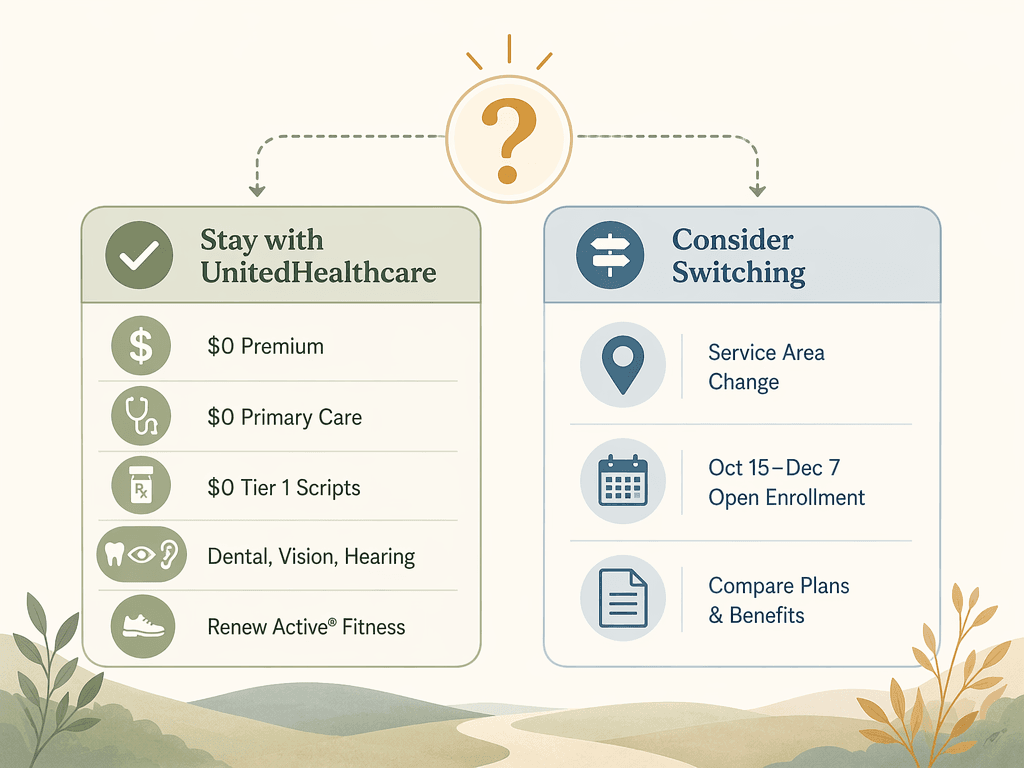
Once you have gathered the information about your parent's specific situation, use this framework to decide whether to stay with UnitedHealthcare or explore other options. The decision depends on how the 2026 changes affect your parent's individual circumstances.
Decision framework for staying with UnitedHealthcare vs. switching plans in 2026.
Factor
Stay with UnitedHealthcare
Consider Switching
Service area
Your parent's county is still served by UHC in 2026
Your parent's county is one of the 109 being dropped
Doctor network
All key doctors and hospitals are in-network for the 2026 plan
One or more key doctors or the preferred hospital are out-of-network
Monthly premium
Premium is $0 or an acceptable amount
Premium has increased significantly or is no longer $0
OTC benefits
OTC allowance is still sufficient for your parent's needs
OTC cuts mean your parent will pay more out-of-pocket for essentials
Drug coverage
All regular medications are covered at acceptable tiers
Key medications have moved to higher tiers or are no longer covered
Plan type preference
HMO network is acceptable and includes preferred providers
Parent prefers PPO flexibility but only HMO is available in their area
Satisfaction with UHC
Parent is satisfied with customer service and claims experience
Parent has had negative experiences with UHC customer service or claims
Star rating
Plan has 4+ stars (qualifies for quality bonus payments)
Plan has below 3.5 stars or has dropped significantly from previous year
If most factors point toward staying, your parent can likely remain enrolled without action — though you should still verify that the plan is still the best option by comparing it against other available plans on Medicare.gov. If multiple factors point toward switching, start comparing other Medicare Advantage plans or consider whether Original Medicare with a Medigap supplement and Part D drug plan might be a better fit.
Use this decision framework to evaluate whether your parent should stay with UnitedHealthcare or explore other options.
Key Dates and Action Steps for Caregivers
Missing the Medicare Open Enrollment window means your parent will be automatically re-enrolled in their current plan — or, if that plan is no longer available, they may be assigned to a different plan without your input. Do not let that happen. Here is the timeline and checklist for action.
September 2025: Annual Notice of Change (ANOC) letters are mailed. Watch for this document and review it carefully. It contains all the changes to your parent's plan for 2026.
October 1, 2025: Medicare Plan Finder for 2026 plans becomes available at Medicare.gov. Start comparing plans.
October 15 – December 7, 2025: Medicare Open Enrollment. This is the window to enroll in, switch, or drop a Medicare Advantage plan. Any changes take effect January 1, 2026.
January 1, 2026: New plan coverage begins for anyone who made changes during Open Enrollment.
January 1 – March 31, 2026: Medicare Advantage Open Enrollment Period. If your parent is already enrolled in an MA plan, they can switch to a different MA plan or return to Original Medicare once during this period.
Here is a concrete action checklist to work through with your parent:
Find and read the 2025 ANOC letter. If you cannot find it, call UnitedHealthcare at the number on your parent's membership card or check their online account.
Log into Medicare.gov and use the Plan Finder to see all plans available in your parent's ZIP code for 2026.
Verify that your parent's doctors and hospital are in-network for any plan you are considering.
Compare total estimated costs — not just the monthly premium, but also deductibles, copays, and the OTC allowance.
Check the drug formulary to ensure all regular medications are covered at acceptable tiers.
If switching, help your parent enroll by December 7. Enrollment can be done online at Medicare.gov, by calling 1-800-MEDICARE, or through a licensed insurance agent.
After enrolling, confirm the new plan is active by checking the online account or calling the new plan directly.
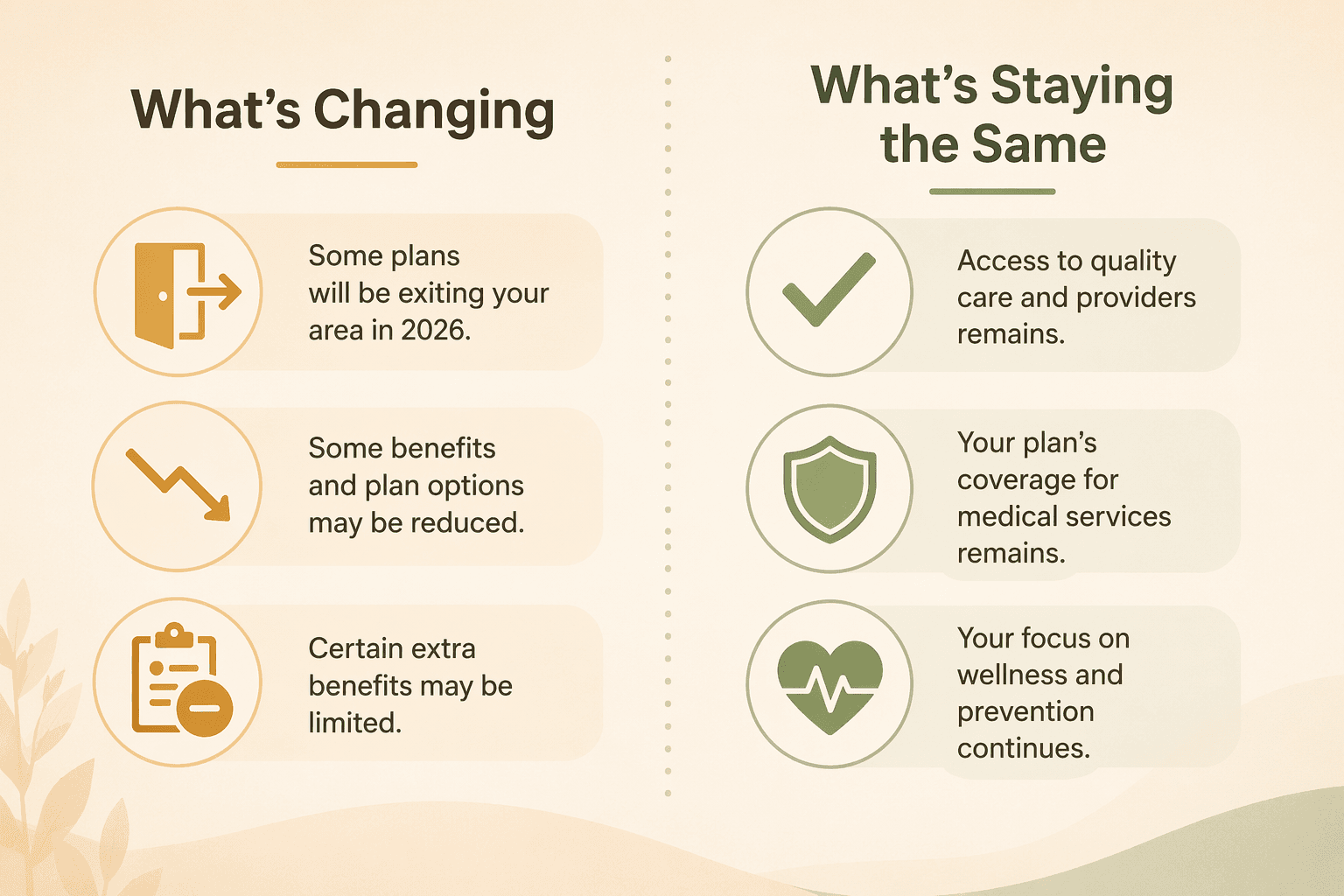
UnitedHealthcare's 2026 plans involve significant cuts in some areas while core benefits remain intact in others.
The Bottom Line for Caregivers
UnitedHealthcare is not going away. It remains the largest Medicare Advantage carrier, with plans available to 94% of Medicare-eligible individuals, $0 premium options, and a broad set of core benefits. But 2026 is a year of significant retrenchment. The company is pulling out of 109 counties and one state, cutting OTC benefits, raising weighted-average premiums by nearly 22%, and prioritizing narrower HMO networks.
For family caregivers, the message is clear: do not assume that your parent's current plan will be the right choice for 2026. Take the time to verify the service area, network, benefits, and costs. Use the Medicare Open Enrollment window from October 15 to December 7 to make any needed changes. Your parent's health and financial security depend on getting this right.
If you found this guide helpful, bookmark it and return to it as you work through the decision process. And if you have questions about how UnitedHealthcare's 2026 changes affect your parent's specific situation, consult a licensed insurance agent or call 1-800-MEDICARE for personalized assistance.



Comments
Join the discussion with an anonymous comment.