
Caregiver decision guide
When Your Parent Needs a Sitter but Not a Nurse: How to Recognize the Signs and Take Action
Many family caregivers wait too long to hire a sitter because they normalize gradual decline. This guide provides a three-signal framework — social withdrawal, home environment decline, and nutritional neglect — to help you recognize when companion care is needed, plus conversation tips and a one-week trial plan.

Why Most Families Wait — and Why Waiting Is Risky
You notice things. Your mother hasn't answered the phone in three days. The milk in her refrigerator expired two weeks ago. The stack of unopened mail on the counter keeps growing. But you tell yourself she's just getting older. She's entitled to slow down. It's not bad enough to hire someone.
This is the normalization barrier, and it is the single most common reason families delay getting help. Gradual decline is hard to see in real time. The person you visit every week looks about the same as they did last month. The changes are so incremental that your brain categorizes them as normal variation rather than warning signals.
The problem is that these small, normalized changes accumulate into real risk. Consider this: more than 1 in 4 older adults in the U.S. is malnourished or at risk of malnutrition, according to the Administration for Community Living. That statistic does not come from a sudden crisis. It comes from weeks and months of skipped meals, forgotten grocery trips, and the slow erosion of the daily habits that keep a person healthy.
Guilt also plays a role. Many adult children interpret the idea of hiring a sitter as "giving up" or outsourcing their responsibility. Fear of cost compounds the hesitation. A companion sitter typically runs $20–$35 per hour — a real expense, but one that often costs less than a single emergency room visit or the financial fallout from a preventable fall. If the emotional barrier is the louder voice in your head, the article on Overcoming Guilt, Fear, and Trust Issues addresses those feelings directly.
The Three-Signal Framework: When to Consider a Sitter
Rather than guessing whether your parent's situation is "bad enough," use this three-signal framework. Each signal represents an observable, concrete pattern that indicates a need for non-medical support. If you see one signal consistently, it is worth investigating. If you see two or three, it is time to act.
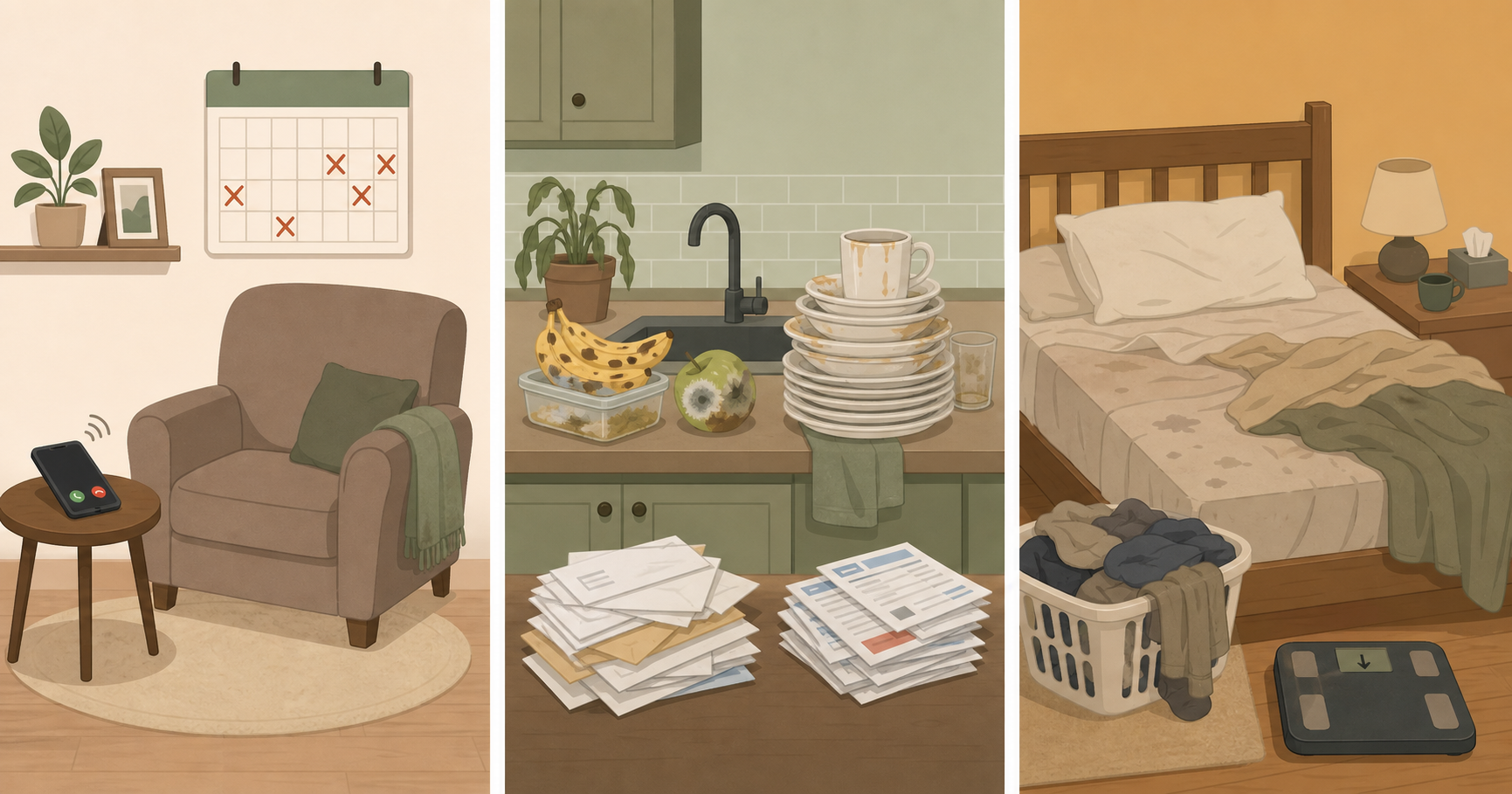
Signal 1: Social Withdrawal
Social withdrawal is often the first observable signal, but it is also the easiest to rationalize. Your parent may have always been somewhat private. They may have a legitimate reason for canceling plans. The key is to look for a pattern, not an isolated event.
- Not answering the phone or returning calls for multiple days
- Frequently canceling social plans or making excuses to avoid visitors
- Expressing sadness, apathy, or a lack of interest in hobbies they used to enjoy
- No regular visitors — neighbors, friends, or family members report that they rarely see your parent
The health stakes here are significant. Research cited by the National Institute on Aging indicates that loneliness and social isolation in older adults are linked to an approximately 50% increased risk of dementia, a 29% increased risk of heart disease, and a 32% increased risk of stroke. These are not abstract risks — they are the downstream consequences of chronic isolation. For a deeper look at this specific signal, see our guide
When It's Time for a Companion, which covers the health consequences of loneliness in detail.
Signal 2: Home Environment Decline
The condition of your parent's home is one of the most objective indicators of their functional status. A home that was always tidy but is now cluttered, dirty, or unsafe is not a lifestyle preference — it is a signal that daily tasks have become overwhelming.
- Spoiled food in the refrigerator or pantry, indicating infrequent grocery trips or forgotten meals
- Piles of dirty dishes, unwashed laundry, or overflowing trash that would have been handled previously
- Unpaid bills or unopened mail accumulating on counters or tables
- Cluttered floors with tripping hazards — loose rugs, cords, boxes — that create a fall risk
Environmental neglect is dangerous because it creates a compounding safety risk. A cluttered floor increases fall risk. Spoiled food increases the risk of foodborne illness. Unpaid bills can lead to service shutoffs. A sitter can address these issues directly by tidying the kitchen, doing laundry, and helping organize mail — tasks that do not require medical training but significantly improve safety and quality of life.
Signal 3: Physical Self-Neglect and Nutritional Decline
This is the signal that families often notice last, because it requires close observation. Physical self-neglect includes changes in personal hygiene, clothing, and eating habits that indicate a person is no longer able or motivated to care for themselves.
- Unwashed hair, body odor, or wearing the same clothes repeatedly
- Sheets and bedding that have not been changed in weeks or months
- Noticeable weight loss or clothing that fits loosely — a potential sign of malnutrition
- Empty refrigerator or cabinets with only non-perishable, low-nutrition items
The malnutrition statistic bears repeating: more than 1 in 4 older adults is at risk. This is not a niche problem. It is a widespread, under-recognized consequence of living alone without support. A sitter who prepares a meal and eats with your parent addresses this risk directly. Research from the National Library of Medicine shows that eating meals with others is strongly associated with improved happiness and well-being among older adults, with an even stronger effect among those who live alone.
The Check-In Test: How to Assess Your Parent's Isolation
Before you decide whether to hire a sitter, take a week to run this simple check-in test. It is not a clinical assessment — it is a practical tool to help you see past the normalization barrier and get an honest picture of your parent's daily reality.
- Call at three different times of day (morning, afternoon, evening) on three different days. How often does your parent answer? How do they sound — alert and engaged, or flat and distracted?
- Ask a neighbor or nearby relative to stop by unannounced once during the week. What does the home look like? Is there evidence of recent meals — dirty dishes, food in the sink, a recently used stove?
- During your next visit, open the refrigerator and pantry. Look for fresh produce, unexpired dairy, and evidence of regular cooking. If you find mostly frozen dinners, expired items, or empty shelves, that is a signal.
- Ask directly: "When was the last time you had a meal with someone else?" The answer may surprise you. Many older adults go days or weeks without sharing a meal.
What a Sitter Would Actually Do for Each Signal
One reason families hesitate is that they do not have a clear picture of what a sitter does. The term "elderly sitting services" can sound vague or even clinical. In practice, a companion sitter provides non-medical support that directly addresses the three signals above.
| Signal | What a Sitter Would Do | Why It Helps |
|---|---|---|
| Social withdrawal | Engage in conversation, play cards or a board game, accompany on a walk or to a community event | Reduces isolation and provides regular social contact that breaks the withdrawal pattern |
| Home environment decline | Tidy the kitchen, wash dishes, do laundry, help organize mail and bills, identify tripping hazards | Restores a safe, clean living environment and reduces fall risk and stress |
| Physical self-neglect and nutritional decline | Prepare a meal and eat together, go grocery shopping, remind about hydration, help with light laundry | Addresses malnutrition risk directly and provides the social eating benefit documented by the National Library of Medicine |
Critically, a sitter does not provide medical care. They do not administer medications, change wound dressings, or perform clinical assessments. If your parent needs that level of support, a home health aide or skilled nurse is the appropriate resource. The distinction matters because it affects cost, training requirements, and insurance coverage. The National Institute on Aging provides a clear overview of the difference between home health services and companion services.
How to Start the Conversation with a Resistant Parent
This is often the hardest part. Your parent may interpret the suggestion of a sitter as a criticism of their independence or a sign that you think they are failing. The way you frame the conversation determines whether it becomes a conflict or a collaboration.
Frame It as a Benefit to You, Not a Loss for Them
The most effective framing is honest and self-referential: "I worry about you when I'm at work and can't reach you. Having someone check in a few times a week would help me focus and stop worrying so much." This positions the sitter as a solution to your anxiety, not a judgment of their capabilities.
Use Specific, Observable Examples
Avoid general statements like "I'm worried about you." Instead, use the three-signal framework to point to something concrete: "I noticed the milk in your fridge was expired, and I know you wouldn't want to drink that. Would it be okay if someone helped you with grocery shopping once a week?" Concrete examples are harder to dismiss as overreaction.
Handle Common Objections
- "I don't need a stranger in my house." Respond with: "I understand. How about we try someone for just two short visits, and if it doesn't feel right, we stop. You're in control."
- "It costs too much." Respond with: "It's about $20 to $35 an hour. Let's try it for a week and see if it helps. If it doesn't, we'll stop. The cost of a single emergency room visit is much higher."
- "I'm fine. You're overreacting." Respond with: "You're probably right that I'm being overly cautious. But I'd rather be overly cautious than miss something. Would you humor me for a week?"
The One-Week Trial: A Low-Commitment Way to Test If Sitting Helps
The best way to overcome both your hesitation and your parent's resistance is to treat the decision as a low-commitment experiment rather than a permanent change. A one-week trial gives you concrete data to evaluate without the pressure of a long-term commitment.
How to Set Up the Trial
- Hire a companion sitter for 3–4 hour visits, 2–3 times in one week. This is enough contact to observe changes without overwhelming your parent.
- Schedule the visits at different times of day — one morning visit, one lunchtime visit, one afternoon visit — to see which time works best for your parent's energy and mood.
- Ask the sitter to focus on one or two specific activities: preparing and sharing a meal, tidying the kitchen, or going for a short walk. This gives you clear outcomes to evaluate.
What to Watch For During the Trial
| What to Observe | Positive Signal | Neutral or Negative Signal |
|---|---|---|
| Mood after the visit | Your parent seems more animated, engaged, or mentions the visit positively | No change in mood, or they express irritation or discomfort |
| Eating patterns | They ate a full meal during the visit and may have leftovers for later | They refused to eat or ate very little |
| Home cleanliness | The kitchen is tidier, dishes are done, or laundry has been started | No visible change, or the sitter reports that your parent refused help |
| Engagement with the sitter | They talked, played a game, or went on an outing together | They sat in separate rooms or the sitter reports minimal interaction |
After the trial week, sit down with your parent and ask two questions: "How did it feel?" and "Would you be open to trying it again?" Even if the answer is hesitant, the trial gives you a shared reference point for the conversation. You are no longer arguing about an abstract idea — you are discussing a concrete experience.
Next Steps After the Trial
If the trial went well — your parent was more engaged, ate better, or the home was noticeably cleaner — the next step is to establish a sustainable routine. Most families start with 2–3 visits per week and adjust based on need and budget. The cost of companion care typically ranges from $20 to $35 per hour. For a detailed breakdown of what to expect in 2026, see our In-Home Senior Care Cost Breakdown. If cost is a concern, our guide on How to Pay for In-Home Care in 2026 covers seven funding sources that may help.
If the trial was neutral or negative, do not give up entirely. The resistance may be about the specific sitter, the time of day, or the activities offered. Try a different sitter, a different schedule, or a different set of activities. Sometimes the first match is not the right one.
Once you have established that companion care is helpful, the next step is to build a broader caregiving foundation. Our First 30 Days as a Family Caregiver guide walks you through the essential steps for organizing care, communicating with providers, and protecting your own well-being as you take on this new role.
Questions to bring to a clinician or OT
This is not medical, legal, or a family's final decision — only a framework. Bring these questions to a clinician, occupational therapist, or your local Area Agency on Aging.
Find Local HelpRelated reading
Noticed something outdated or inaccurate on this page? Flag a correction. We review every report against CDC, NIA, and AARP HomeFit guidance before updating a page.