Walker vs Rollator for Balance Problems: Which Mobility Aid Is Safer?
10 minutesReviewed: 2026-07-05
Walker vs Rollator for Balance Problems: Which Mobility Aid Is Safer?
Learn how to choose between a walker and a rollator when balance is the primary concern, including which device is safer for moderate-to-severe balance deficits and which is appropriate for mild balance problems.
By Editorial Team
new caregiver
experienced caregiver
long-distance caregiving
spousal caregiver
working caregiver
daily routines
medication management
personal hygiene
care coordination
first steps
ADLs
IADLs
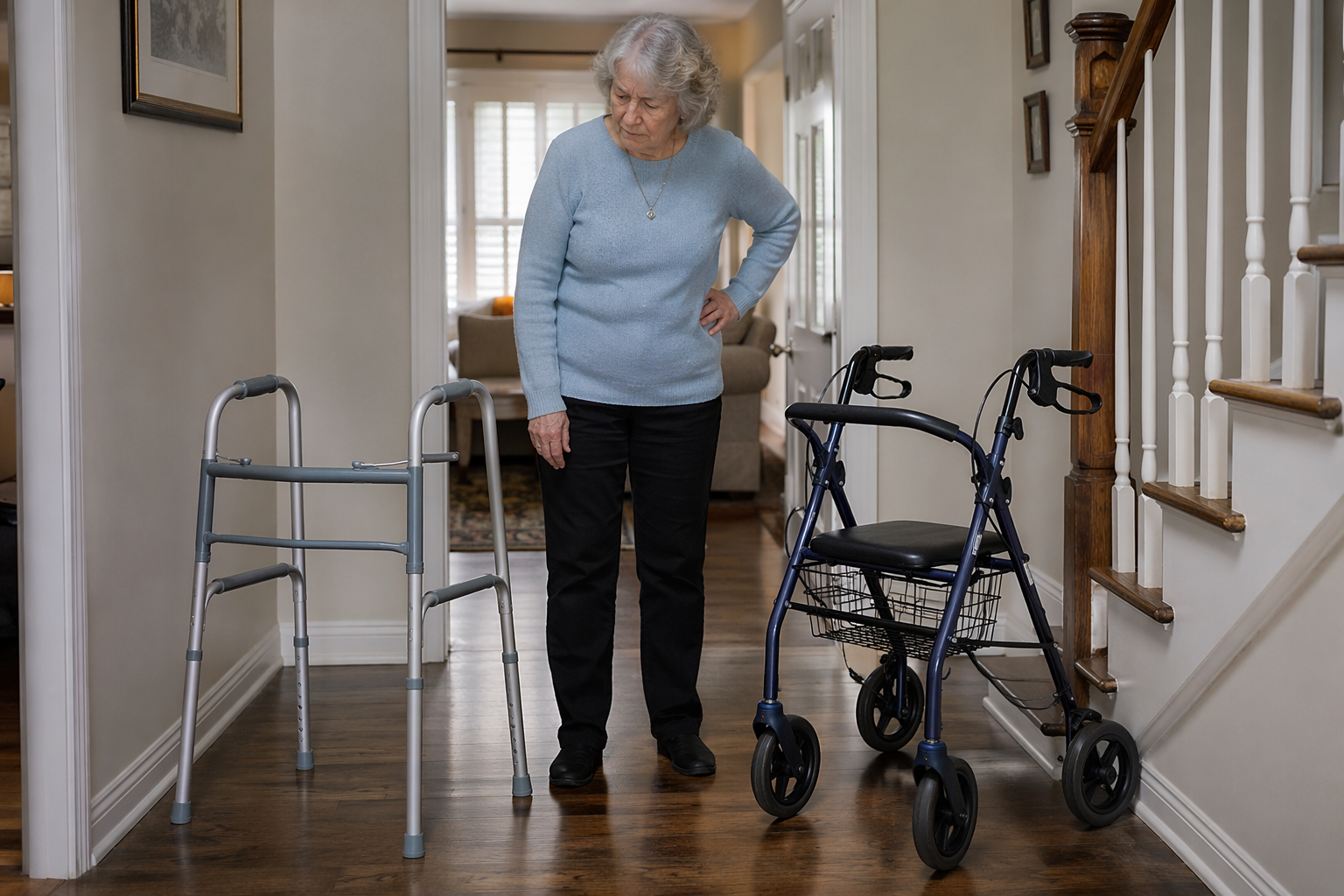
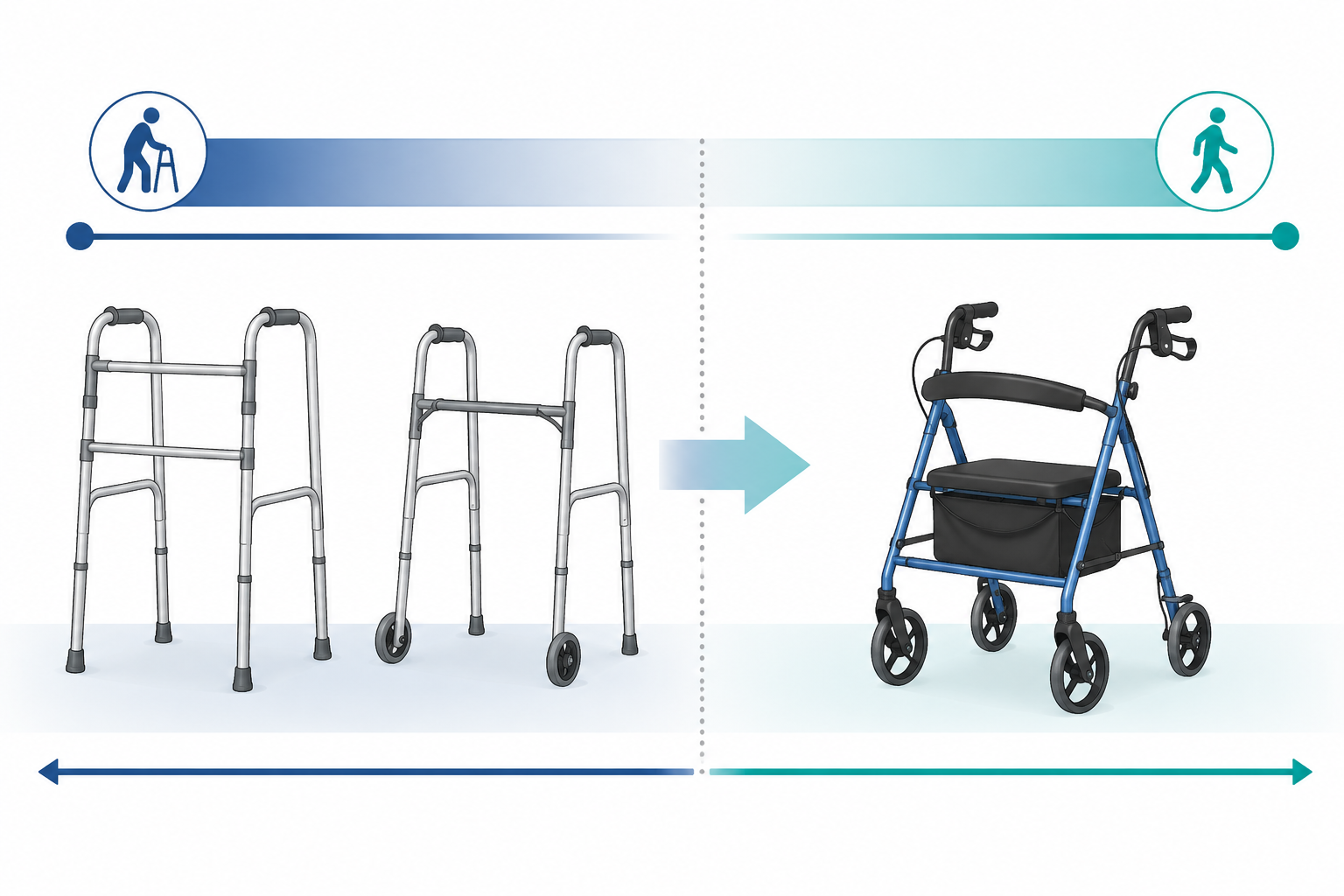
When the question is walker vs rollator for balance problems, the safer choice usually depends on one thing before everything else: how much balance support the person actually needs. If balance is moderate to severe, or if your parent needs to put meaningful weight through their arms to stay upright, a standard walker or two-wheel walker is generally the safer category. If balance is only mildly impaired and the bigger problem is endurance, a rollator may be appropriate.
That distinction matters because a rollator can feel safer than it is. It has hand brakes, a seat, a basket, and wheels that make movement smoother. Those features can be genuinely useful for someone who tires easily. But a rollator is not meant to be a weight-bearing device, and for a person who loses balance suddenly, it can move away at exactly the moment the body needs something solid to lean on. The American Academy of Family Physicians' 2021 device-selection table places standard walkers and two-wheel walkers in the category for moderate-to-severe balance impairment, while rollators fit mild-to-moderate balance problems when endurance is the main limitation.[1]
The Short Safety Rule
A standard walker has four legs with rubber tips and no wheels. The user lifts it, places it ahead, then steps into it. A two-wheel walker has wheels on the front legs and rubber tips or glides on the back legs. A rollator usually has three or four wheels, hand brakes, a seat, and often a storage pouch or basket.
Those design differences are not cosmetic. They decide how the device behaves when balance fails. A standard walker is the most stable but can be tiring because it has to be lifted. A two-wheel walker gives some forward motion while still resisting runaway movement. A rollator moves easily, which is helpful for endurance and outdoor distance, but that same easy movement can become a hazard when the user tries to catch themselves.
Device fit based on the AAFP 2021 clinical device-selection table.[1]
Device
Best fit when balance is the main concern
Weight-bearing role
Approximate cost range
Standard walker
Moderate-to-severe balance impairment
Can support up to about half of body weight through the upper extremities
$20-$60
Two-wheel walker
Moderate-to-severe balance impairment, especially when lifting a standard walker is difficult
Can support up to about half of body weight through the upper extremities
$35-$60
Rollator
Mild-to-moderate balance impairment when endurance is the main limitation
Not intended as a weight-bearing device
$50-$100
The cost ranges are useful, but they should not drive the choice. The important line in that table is the weight-bearing line. If your parent steadies themselves by pressing down hard through the handles, or if they would fall without that support, the device has to stay under them when their balance goes. A rollator is built for movement, not for catching significant body weight.[1]
Why the Rollator Can Be the Wrong Upgrade
A rollator often wins the family argument at first glance. It looks less clinical. It turns easily. It lets the person sit down in a store aisle or at the end of the driveway. For an older adult who already feels watched and corrected all day, that seat can feel like dignity instead of equipment.
But convenience features do not answer the balance question. If your parent needs to lean, push down, or transfer weight through the device, the rollator's wheels and brakes become part of the safety problem. A geriatrician interviewed by AARP made the same practical point: two-wheel walkers are often best for significant balance problems because they cannot simply roll away from the user.[2]
That does not mean rollators are unsafe for everyone. It means the reason for using one has to be the right reason. A person who walks fairly steadily but tires after a short distance may do well with a rollator after proper fitting and instruction. A person who sways backward while standing from a chair, grabs furniture during transfers, or cannot keep the device close while stepping is asking the rollator to do a job it was not designed to do.
What Real Falls Show
The most useful fall evidence is not dramatic. It is ordinary: turning, standing up, shifting weight, approaching a threshold. A 2023 video analysis by Nickerson and colleagues reviewed 34 real-life falls involving 16 individuals who used walkers or rollators. The sample was small, so it should not be treated as a universal prediction of how all users fall. Still, the patterns are worth noticing because they match what families often see at home.[3]
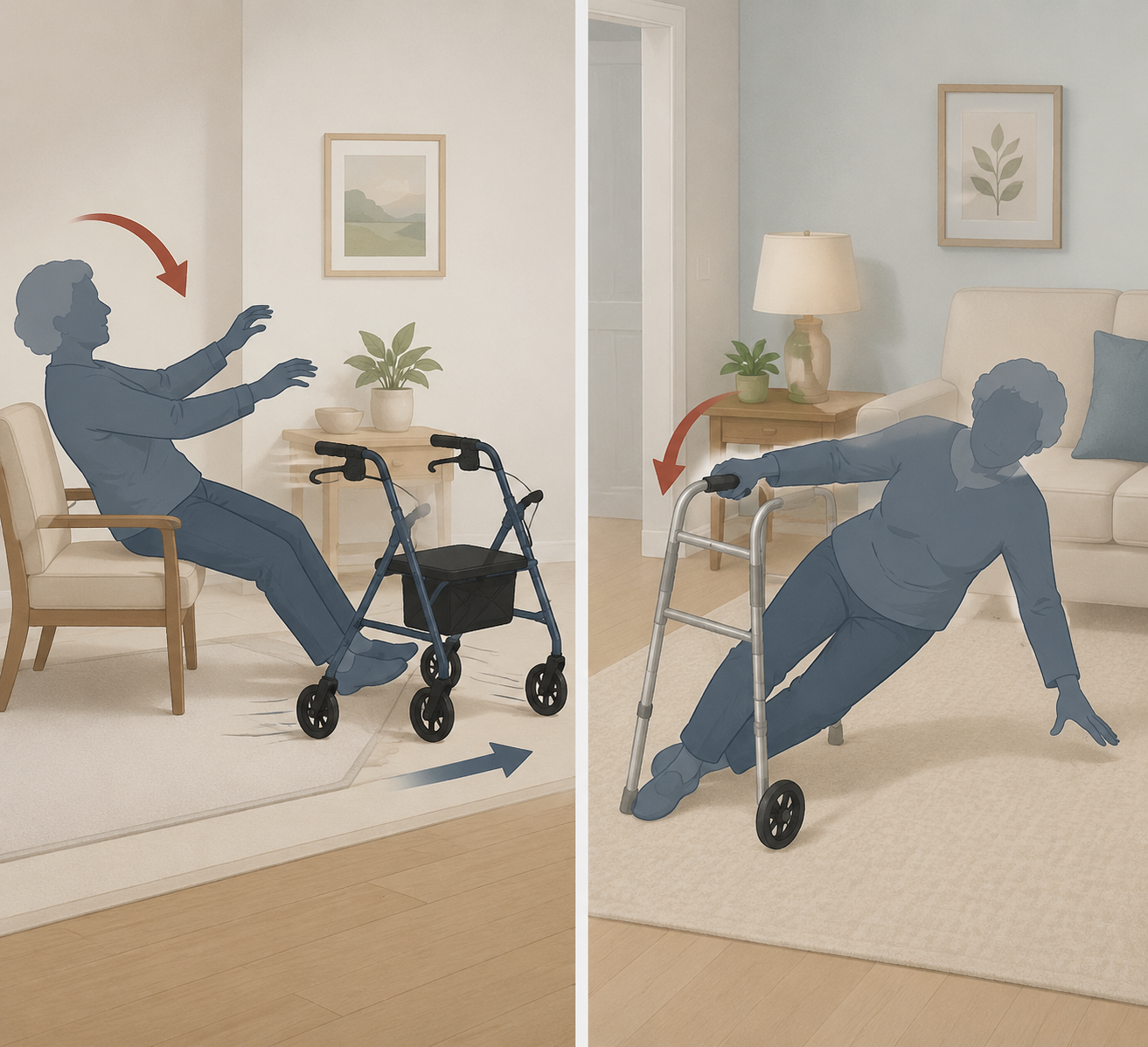
In that analysis, rollator users most often fell backward during weight-transfer activities, which accounted for 44.4% of rollator-user falls. Two-wheel walker users most often fell sideways while turning, which accounted for 42.9% of two-wheel walker-user falls.[3]
That is the kind of evidence that should change what a caregiver watches for. With a rollator, the dangerous moment may be standing up, sitting down, backing up, or shifting weight while the wheels are not fully controlled. With a two-wheel walker, the dangerous moment may be a turn in a narrow kitchen, a pivot beside the bed, or a sideways step around a rug edge. Different devices fail in different ways.
This is also why the answer cannot be reduced to “walkers are safer” or “rollators are safer.” A two-wheel walker that is too tall, too far ahead, or awkward in a tight hallway can create its own fall risk. A rollator used by someone with mild balance issues, good brake habits, and enough judgment to sit only when the brakes are locked may preserve more daily independence. The fit is clinical before it is personal.
What to Watch at Home Before You Decide
The home gives you clues that a clinic visit may miss. Nobody performs quite the same way in a hallway with laundry baskets, a bathroom threshold, a dog bowl, and a favorite chair that is a little too low. Watch the device during normal movement, not just during the few steps your parent takes while everyone is paying attention.
Rollator rolling ahead: the rollator moves forward while your parent’s body lags behind, especially during standing, sitting, or stepping over a threshold.
Heavy downward pressure: your parent pushes down hard through the handles to stay upright, suggesting they need a weight-bearing device rather than a rollator.
Brake non-use: your parent forgets to lock the brakes before sitting, standing, reaching, or turning.
Forward-stooped posture: the device is too low, too far ahead, or being used as something to chase rather than something to stand within.
Arm fatigue from lifting: a standard walker may be stable but too tiring, which can make a two-wheel walker worth discussing with a therapist.
Sideways instability while turning: the walker stays mostly put, but the body pivots outside the frame or the feet tangle during a turn.
Hesitation at thresholds: the device catches, tilts, or changes speed at door saddles, rug edges, bathroom entries, or uneven flooring.
A device can be the right category and still be wrong in the house because it is set to the wrong height or used with the wrong posture. Mayo Clinic’s fitting guidance is simple enough to check at home: when the user stands inside the walker with arms relaxed, the top of the walker grip should line up with the crease on the inside of the wrist; when holding the grips, the elbows should bend about 15 degrees.[4]
If the walker is too low, your parent may hunch forward and push the device ahead. If it is too high, the shoulders rise and the arms cannot bear weight efficiently. Either problem can make the person look weaker than they are, or make the device look less helpful than it could be.
It is worth being fussy about this. AARP reported that 70% of canes are used incorrectly or are the wrong height, and the same practical concern applies to walkers and rollators: ownership is not the same as safe use.[2] Families often relax once a mobility aid is in the house. That is the risky moment. The device is not doing its job just because it is parked by the recliner.
When a Rollator Makes Sense
A rollator makes the most sense when the person’s balance problem is mild and the main limitation is stamina. That might look like someone who can stand without leaning heavily, walks with a steady rhythm, understands and uses the brakes, and needs a seat because longer distances are tiring. In that situation, the rollator’s smoother movement and built-in rest option can support independence rather than substitute for missing stability.
The seat should not be the deciding feature by itself. A seat is helpful only if the person can stop, lock the brakes, turn safely, and sit with control. If your parent backs toward the seat while the rollator shifts, forgets the brakes, or uses the handles to pull themselves up, the seat has become part of the transfer risk.
Online reviews can reveal real frustrations, but they are not a clean measure of device safety. A 2023 review of Amazon US comments on mobility aids described user complaints and preferences, but that kind of evidence has self-selection bias: people who post reviews are not a representative sample of all users, and a review cannot tell you whether the device matched the person’s clinical needs.[5]
When to Bring in a Physical Therapist
A physical therapist is the right person to assess gait, balance severity, weight-bearing need, turning, transfers, and device height together. That matters especially after a fall, hospitalization, stroke, Parkinson’s diagnosis, neuropathy progression, medication change, or a new pattern of freezing, shuffling, dizziness, or near-falls.
Ask for PT input if your parent leans heavily on the device or furniture.
Ask if there has been a fall, near-fall, or sudden loss of confidence while walking.
Ask if your parent wants a rollator mainly because lifting a standard walker is tiring.
Ask if the device catches at thresholds, rugs, bathroom entries, or uneven outdoor surfaces.
Ask if family members disagree about whether the current device is helping or hiding risk.
If this decision comes after a fall, the device question belongs inside a bigger 72-hour review: injury signs, medication changes, new weakness, home hazards, and follow-up appointments. Use Your Parent Just Fell: A Caregiver's Guide to the First 72 Hours before treating a new walker or rollator as the whole solution.
If your parent refuses the safer aid because it looks medical, feels embarrassing, or slows them down, that is a real barrier. It still does not make the less stable device safer. The conversation may need to shift from “you have to use this” to “let’s make the safer option less humiliating and easier to live with.” For that, see Why Your Parent Resists Fall Prevention After the Hospital — and What Works Instead.
The Decision Boundary
Choose a standard walker or two-wheel walker when balance is moderate to severe, when your parent needs to bear weight through the arms, or when the device has to stay put if balance fails. Consider a rollator when balance impairment is mild, endurance is the main problem, and the person can reliably control the brakes, turns, transfers, and seat use.
Do not upgrade to a rollator just because it is easier to move. Match the aid to balance severity, check the fit, watch how it behaves in the actual home, and involve PT when weight-bearing, falls, or uncertainty are part of the picture.
References
AAFP 2021 clinical table on mobility assistive device selection, American Academy of Family Physicians, 2021.
AARP interview with geriatrician Helen Hoenig on canes and walkers, AARP.
Nickerson et al. 2023 video analysis of real-life falls among walker and rollator users, 2023.
Mayo Clinic walker fitting guidance, Mayo Clinic.
Mali et al. 2023 review of Amazon US mobility aid reviews, 2023.

Comments
Join the discussion with an anonymous comment.