
Caregiver decision guide
The First 30 Days as a Caregiver for an Elderly Parent: An Actionable Roadmap for New Family Caregivers
A structured, evidence-based three-phase plan for adult children who have just become caregivers after a parent's fall, hospitalization, or diagnosis. This roadmap helps you stabilize safety and medical care in the first week, organize legal and care coordination in weeks two and three, and build sustainable systems for the long journey ahead.

Why the First 30 Days Matter Most
You did not ask for this role. It arrived with a phone call from the emergency room, a neurologist's quiet explanation, or a slow accumulation of small worries that suddenly became impossible to ignore. And now you are a caregiver for an elderly parent — a title that carries no training, no orientation, and no manual.
You are not alone in feeling unprepared. A 2025 survey of over 1,000 family caregivers found that only about 1 in 4 felt completely prepared when caregiving began, and 30% reported feeling mostly or completely unprepared. More striking: 54% said they wish they had started planning sooner.
This roadmap is built around a simple thesis: the first month of caregiving should follow three distinct phases — Stabilize, Organize, and Sustain. Each phase has a clear focus, specific day-bracketed actions, and a single goal: prevent the most common catastrophic errors first, build a legal and coordination framework second, and create systems that will last for the long road ahead.
If you are reading this in the hours or days after a specific event — a fall, a hospitalization, a new diagnosis — start with the companion guide for the first 24 hours, then return here for the full 30-day plan.
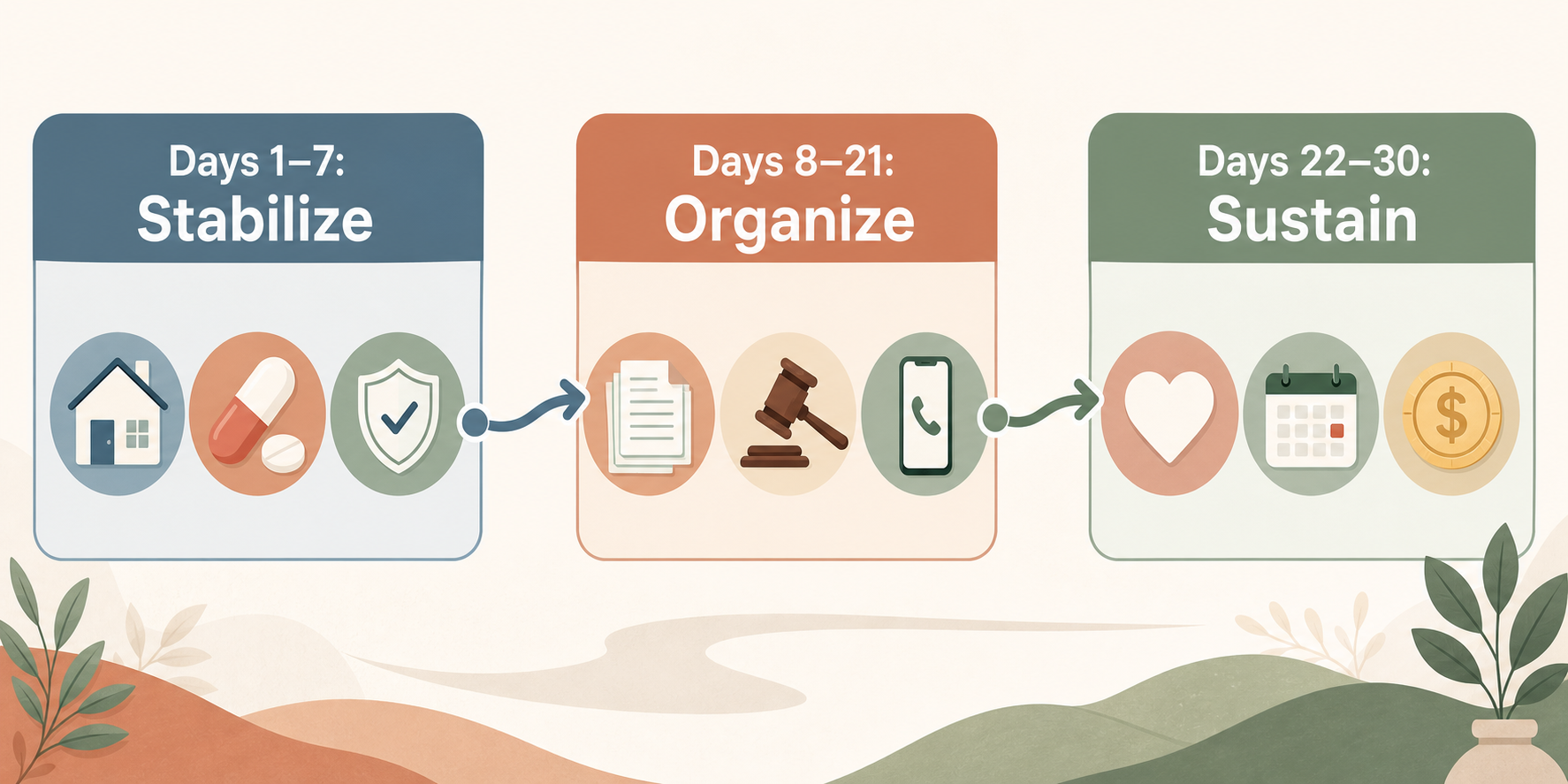
Phase 1 (Days 1–7): Stabilize — Immediate Safety and Medical Care
The first week is about preventing the most common and most dangerous events: a fall, a medication error, or a delayed response to a medical emergency. According to the Family Caregiver Alliance, 57% of family caregivers perform complex medical or nursing tasks — yet most receive zero formal training. The first week is when errors most commonly occur.
Conduct a Room-by-Room Fall Hazard Audit
Falls are the leading cause of injury among older adults, and most falls happen at home. Use the CDC STEADI model — Screen, Assess, Intervene — to identify hazards in every room before an accident happens.
Start with the bathroom (wet floors, low toilets, lack of grab bars), the bedroom (path to the bathroom at night, loose rugs), and the stairs (handrails, lighting, clutter). The NIA's home safety checklist provides a printable room-by-room worksheet you can complete in one pass through the house.
Perform Medication Reconciliation
Medication errors — wrong dose, wrong time, dangerous interactions — are among the most preventable causes of hospitalization in older adults. In the first week, you need a complete, accurate list of every medication and supplement your parent takes.
Gather all prescription bottles, over-the-counter medications, vitamins, and herbal supplements. Use the NIA's medication management worksheet to record: medication name, dosage, frequency, prescribing doctor, and the reason it was prescribed. Then schedule a medication review with the primary care provider or a pharmacist within the first week.
| Medication | Dosage | Frequency | Prescriber | Purpose |
|---|---|---|---|---|
| Lisinopril | 10 mg | Once daily | Dr. Chen | Blood pressure |
| Metformin | 500 mg | Twice daily | Dr. Patel | Type 2 diabetes |
| Atorvastatin | 20 mg | Once daily at bedtime | Dr. Chen | Cholesterol |
| Vitamin D3 | 1000 IU | Once daily | Self-prescribed | Bone health |
For a deeper guide on building and maintaining medication systems, see our Medication Management for Older Adults.
Set Up an Emergency Alert System
The NIA recommends emergency medical alert systems for older adults living at home, especially those with fall risk or chronic conditions. These systems — often called PERS (Personal Emergency Response Systems) — allow your parent to call for help with the press of a button, even if they cannot reach a phone.
Key considerations in the first week:
- Choose between a wearable pendant, wristband, or wall-mounted unit based on your parent's mobility and likelihood of remembering to wear a device.
- Verify whether the system has automatic fall detection — this is critical if your parent lives alone or has a history of falls.
- Note that Medicare does not pay for these systems, though Medicaid and some private insurance plans may. The NIA provides guidance on evaluating options.
Phase 2 (Days 8–21): Organize — Legal Groundwork and Care Coordination
Once the immediate safety risks are addressed, the second phase shifts from crisis response to structured planning. This is where you build the legal and coordination infrastructure that will support every decision you make in the months and years ahead.
Gather Essential Documents
The NIA provides a checklist of essential documents every caregiver should locate and organize. Without these, you cannot make medical decisions, manage finances, or apply for benefits.
- Medical records: primary care contact, specialist contacts, hospital discharge summaries, medication list (from Phase 1), and immunization records.
- Legal documents: will, living trust, advance directive (living will), durable power of attorney for healthcare, and durable power of attorney for finances.
- Financial documents: bank accounts, retirement accounts, Social Security statements, pension information, property deeds, and insurance policies (health, life, long-term care).
- Benefit documents: Medicare card, Medicaid information (if applicable), VA benefits documentation, and any long-term care insurance policies.
Use the NIA's important documents checklist to track what you have and what is missing. Store everything in a single, secure location — a fireproof file box or a secure digital folder — and share access with one other trusted family member.
Establish Power of Attorney and Advance Directives
If your parent has not already done so, this is the most important legal step you will take in the first month. A durable power of attorney for healthcare allows you to make medical decisions if your parent becomes unable to do so. A durable power of attorney for finances allows you to manage bank accounts, pay bills, and handle insurance claims.
An advance directive (living will) documents your parent's wishes for end-of-life care. Without these documents, you may need to go to court to obtain guardianship — a process that can take months and cost thousands of dollars.
Create a Care Coordination Worksheet
Caregiving rarely involves just one person. You need a system for tracking who is doing what, when, and how to reach them. The NIA's coordinating caregiving responsibilities worksheet is designed to be shared with other family members and healthcare providers.
Your care coordination worksheet should include:
- Primary care provider and all specialists (with phone numbers, addresses, and fax numbers)
- Pharmacy name, address, and phone number
- Home health agency or visiting nurse contact (if applicable)
- Family members and their roles (who handles medications, who handles finances, who provides weekend respite)
- Emergency contacts and backup contacts for every role
The Pew Research Center found that 42% of caregivers for a parent manage their healthcare — appointments, medications, and communication with providers. A shared worksheet prevents the common problem of critical information living in one person's email or memory.
Phase 3 (Days 22–30): Sustain — Building Systems That Last
The first two phases addressed the urgent and the essential. The third phase is about you and the long-term sustainability of the caregiving role. The data is sobering: 78% of caregivers report experiencing burnout, and 68% report at least some financial strain from caregiving. The average caregiver spends 22.8 hours per week providing care, and 25% have been caregiving for more than five years.
Plan for Respite Before You Need It
Respite care — short-term care for your parent that lasts from a few hours to several weeks — is not a luxury. It is a structural necessity for sustainable caregiving. The NIA notes that respite services are available through home health agencies, adult day centers, and short-term residential facilities.
In Phase 3, your goal is not to arrange respite immediately (unless you are already experiencing burnout). Your goal is to identify options, understand costs, and have a plan ready so that when you need a break, you can take one without scrambling.
Build a Self-Care Protocol — Even If You Think You Do Not Have Time
The 2025 caregiver survey found that 72% of caregivers report making time for self-care at least weekly. That figure is not a luxury benchmark — it is a survival benchmark. Caregivers who neglect their own health are more likely to make medical errors, experience relationship strain, and develop chronic health conditions themselves.
A self-care protocol does not need to be elaborate. In Phase 3, commit to three specific actions:
- Schedule one non-negotiable 30-minute block each day that is yours — no caregiving tasks, no phone calls, no guilt.
- Identify one person you can call or text when you feel overwhelmed. Name them now, not when you are in crisis.
- Set a boundary: one evening per week when you are not the primary caregiver. Arrange backup coverage in advance.
For a deeper framework, see our Self-Care Framework for Family Caregivers.
Explore Long-Term Care Funding Early
Family caregivers spend an average of $7,200 per year out of pocket on caregiving costs, according to AARP data cited by the National Council on Aging. The financial strain is real: 68% of caregivers report at least some financial impact, and 40% reduce work hours or leave jobs to provide care.
In Phase 3, you are not expected to master every funding program. Your goal is to identify which options might apply to your situation and gather the information needed to pursue them later.
| Funding Source | What It Covers | Key Eligibility | Action for Phase 3 |
|---|---|---|---|
| Medicaid HCBS Waivers | In-home care, adult day care, respite | Income limits ($914–$2,742/month depending on state) | Check your state's waiver program online |
| VA PCAFC | Monthly cash benefit, training, respite | Veteran with service-connected disability; caregiver must be family member | Contact your local VA medical center |
| Paid Family Leave | Partial wage replacement during caregiving leave | Available in 11 states + DC (as of 2026); 4 more pending | Check your state's labor department website |
| Long-Term Care Insurance | In-home care, assisted living, nursing home | Policy must be in place before care is needed | Review existing policies; do not purchase new one now |
For a comprehensive guide to these programs, including step-by-step application guidance, see our Hidden Money for Family Caregivers guide. If you are considering hiring paid help, our 8-Step Action Plan for Setting Up Home Assistance walks through the process.

Your 30-Day Checklist: A Quick Reference
Use this consolidated checklist to track your progress through the first 30 days. Print it, keep it on your refrigerator, and check off each item as you complete it. You are not expected to do everything perfectly — the goal is to make progress, not to achieve perfection.
| Phase | Days | Action Items | Resources |
|---|---|---|---|
| 1: Stabilize | 1–7 | Conduct room-by-room fall hazard audit; Complete medication reconciliation; Set up emergency alert system; Schedule primary care visit | NIA Home Safety Checklist; NIA Medication Worksheet; Fall Prevention Checklist |
| 2: Organize | 8–21 | Gather all essential documents; Establish power of attorney and advance directives; Create care coordination worksheet; Identify care team members | NIA Important Documents Checklist; NIA Care Coordination Worksheet; Elder law attorney consultation |
| 3: Sustain | 22–30 | Identify respite options; Build self-care protocol (3 commitments); Explore funding sources (Medicaid, VA, paid leave); Review long-term care insurance | ARCH Respite Locator; Self-Care Framework; Hidden Money Guide; State labor department |
What Comes After Day 30
Completing this 30-day roadmap does not mean you have figured everything out. It means you have built a foundation — a safer home, a legal framework, a coordination system, and the beginning of a sustainable rhythm. That is more than most caregivers have after a year.
After Day 30, your caregiving journey will evolve. Your parent's needs will change. Your own capacity will fluctuate. The key is that you now have a system that can adapt.
Here is where to go next:
- Explore our Caregiver Guides section for deeper resources on daily routines, long-distance caregiving, and working caregiver challenges.
- Visit Caregiver Wellbeing for ongoing emotional support, burnout prevention, and guidance on difficult conversations.
- Bookmark the Eldercare Glossary for quick reference when you encounter unfamiliar terms like HCBS, PCAFC, or DME.
- Use the FAQs section for quick answers to common questions about Medicare coverage, fall risk, and home modifications.
You did not choose this role, but you are showing up for it. That matters. The first 30 days are the hardest — and you are getting through them. One room, one document, one conversation at a time.
Questions to bring to a clinician or OT
This is not medical, legal, or a family's final decision — only a framework. Bring these questions to a clinician, occupational therapist, or your local Area Agency on Aging.
Find Local HelpRelated reading
Noticed something outdated or inaccurate on this page? Flag a correction. We review every report against CDC, NIA, and AARP HomeFit guidance before updating a page.