
Caregiver decision guide
When Is It Time for 24-Hour Home Care? A Family Decision Guide
Wondering if your aging parent needs 24-hour home care? This guide helps families recognize when the convergence of physical decline, nighttime risks, and caregiver burnout signals that it's time, and provides a framework for comparing the two care models—24/7 shift care vs. live-in care—along with costs, alternatives, and how to make the decision before a crisis forces it.
Families usually do not start asking about 24-hour care at home for an elderly parent because of one clean, obvious turning point. More often, the evidence gathers in pieces: a fall that was brushed off, a hospital discharge that left everyone nervous, missed medications, food going untouched, confusion after dinner, a spouse who has quietly stopped sleeping through the night. The hard question is not simply “Does Mom need help?” It is whether the risks now run through so much of the day and night that the family’s current patchwork can no longer safely hold.
That distinction matters because many older adults strongly prefer to remain at home. In AARP’s 2024 Home and Community Preferences Survey, 75% of adults age 50 and older said they want to age in place, while only about 44% felt their current home could accommodate aging needs.[1] That gap is where many family decisions live: home may still be the right goal, but the care plan has to be honest about stairs, bathrooms, nighttime confusion, caregiver fatigue, and money.
The real question: who is awake when the risk happens?
A parent who needs help throughout the day is not automatically a parent who needs an awake caregiver all night. This is one of the first distinctions families need to make, because it changes both the care model and the cost.
Some older adults need someone nearby for meals, bathing, dressing, transfers, errands, medication reminders, and companionship. They may be mostly settled overnight. Others become more vulnerable after dark: they get up unassisted to use the bathroom, wander, become agitated or disoriented, mistake nighttime for morning, or fall when no one is awake to hear them. TheKey identifies nighttime safety issues, including wandering, sundowning, and frequent overnight needs, as central reasons families consider 24-hour home care rather than lighter support.[2]
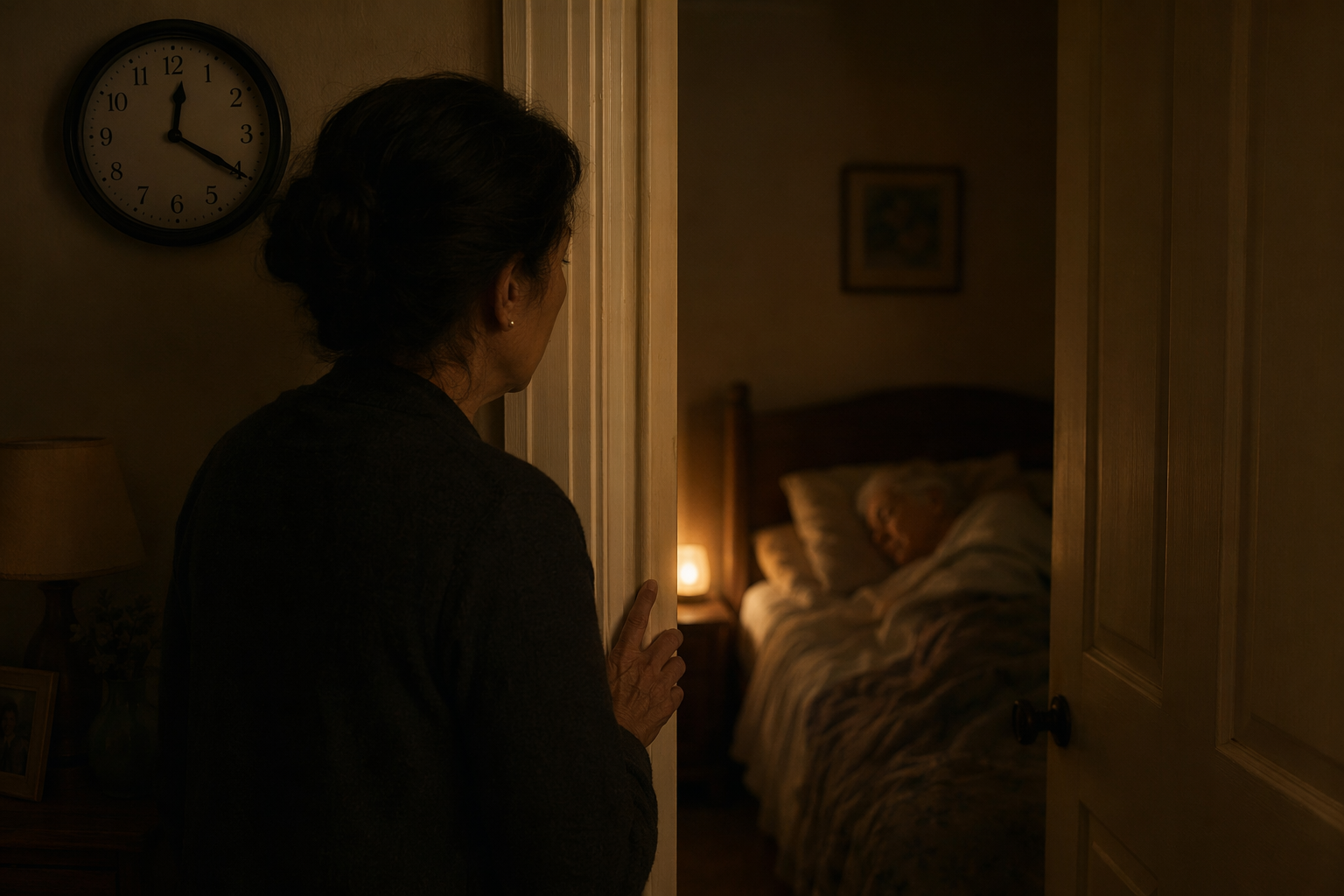
This is where many family plans quietly break. A daughter says she is “just keeping the phone on.” A spouse says the nights are fine, but has not left the house alone in weeks. A son installs a camera and still wakes up every time it sends an alert. If the only reason the plan works is that one unpaid person is half-awake every night, the plan is already using 24-hour coverage. It just is not being named, scheduled, or paid for.
Nighttime signs that change the decision
The strongest warning signs are not vague. They are the specific moments when an older adult is unsafe unless someone responds quickly.
- They get out of bed at night without remembering to use a walker, cane, or call button.
- They need help toileting or transferring overnight and cannot wait safely.
- They wander, try to leave the house, or become more confused after dark.
- They have fallen at night or have been found on the floor without knowing how long they were there.
- They wake a spouse or adult child repeatedly, and that caregiver is no longer able to function during the day.
A sleeping live-in caregiver may be appropriate when the older adult is generally safe overnight and occasional help is enough. It is a poor fit when the care need is active, unpredictable, or safety-critical at 2 a.m. In those cases, the question is not whether someone is in the home. It is whether someone is awake, alert, and allowed to work through the night.
“24-hour care” can mean two very different things
Families often hear or use “24-hour care,” “24/7 care,” and “live-in care” as if they were interchangeable. Agencies do not always use the terms consistently either. Before anyone compares prices, the family has to pin down the staffing model.

| Care model | What it usually means | Best fit | Main caution |
|---|---|---|---|
| 24/7 shift care | Multiple caregivers rotate shifts so someone is awake and available at all times. | Nighttime wandering, frequent overnight toileting, high fall risk, advanced dementia behaviors, or unpredictable needs. | Much higher monthly cost because every hour is staffed. |
| Live-in care | One caregiver stays in the home for an extended period and has sleep/rest periods. | Daytime help plus general overnight presence when the older adult usually sleeps safely. | Not appropriate if the caregiver must be awake or repeatedly interrupted overnight. |
TheKey describes 24-hour care as continuous coverage by caregivers working in shifts, while live-in care involves a caregiver residing in the home with required rest and sleep time.[3] That difference is not a technicality. It decides whether someone is expected to be awake at night, how many caregivers are needed, and whether the plan can legally and practically cover repeated overnight needs.
Some states also restrict the live-in model. Care.com notes that California prohibits live-in care arrangements because of labor law interpretations, which can force families who want round-the-clock in-home support into shift-based coverage instead.[4]
The cost difference is large enough to change the decision
This is the part families should discuss before they have chosen an agency, not after the first invoice arrives. A Place for Mom’s 2026 cost data estimates 24/7 shift-based home care at about $24,733 per month, based on a $34 hourly median rate multiplied across 168 hours per week. The same source reports median live-in care at about $10,646 per month.[5]
Those are not two quotes for the same service. They are two different care designs. The shift model is roughly 2.3 times the monthly cost of live-in care using those figures, because it pays for continuous awake coverage rather than a caregiver who is allowed to sleep.
The monthly number also understates the decision if the family thinks only in 30-day increments. AgingCare reports that a typical in-home care engagement lasts 15 to 20 months, citing Todd Austin of Activated Insights; at 24/7 shift-care rates, that can put total spending into the $250,000 to $500,000 range.[6] That estimate is not a promise that every round-the-clock case lasts that long. It is a warning that families should not approve a plan they can only afford for a few weeks unless the need is clearly short term.
Medicare is another common place for false hope. AgingCare explains that Medicare does not cover 24/7 nonmedical home care and generally covers only short-term, part-time skilled home health care under qualifying conditions, up to 28 hours per week.[6] Families may still use long-term care insurance, Veterans benefits, Medicaid home- and community-based services where available, private savings, home equity strategies, or a combination of sources, but those are separate eligibility and timing questions. For a deeper payment breakdown, use a dedicated guide such as How to Pay for In-Home Care in 2026 rather than assuming one benefit will cover continuous supervision.
Be careful when a doctor says “24/7 care”
After a hospitalization, a family may hear, “They need 24/7 care,” and understandably treat it as a permanent prescription. Sometimes it is. Sometimes the clinician means the first few days after discharge, when weakness, medication changes, confusion, or fall risk are highest. AgingCare cautions that a physician’s recommendation for 24/7 care after hospitalization may refer to short-term transitional supervision, such as two or three days, rather than indefinite around-the-clock care.[6]
The family should ask plain follow-up questions before building an expensive plan around an ambiguous phrase:
- Do you mean awake supervision every hour, including overnight?
- Is this recommendation for a few days after discharge, a few weeks of recovery, or an ongoing need?
- Which risks require supervision: falls, medication errors, dementia behaviors, transfers, wounds, oxygen, nutrition, or something else?
- Can the need be reassessed after home health therapy, medication adjustment, or a safer home setup?
- Would sleeping overnight presence be enough, or must someone remain awake?
Good professional advice should become more specific as the family asks better questions. If it stays vague, the family is left to buy the most expensive interpretation of the phrase.
A practical decision framework for families
The decision becomes clearer when the family stops asking whether the parent is “bad enough” and starts mapping the actual care load. The goal is not to win an argument around the kitchen table. It is to see whether the risks can be safely covered without breaking the people doing the covering.
1. List the recurring safety risks
Write down what has happened more than once, not only the worst incident. Falls, near-falls, stove use, missed medications, dehydration, unsafe driving, leaving doors open, or being unable to call for help all matter. A single fall may lead to a temporary care increase. Repeated falls plus confusion, poor mobility, and a caregiver who cannot safely lift or transfer the person point toward a different level of supervision.
2. Separate daytime help from overnight risk
Make a simple 24-hour log for several days. Note when the older adult needs help, what kind of help is needed, and what would happen if no one responded. Daytime tasks may be heavy but schedulable. Nighttime needs are different because they interrupt sleep, increase fall danger, and often depend on someone noticing quickly.
| If the pattern is... | The family should examine... |
|---|---|
| Mostly daytime needs, calm nights | Part-time care, extended daily shifts, adult day programs, or live-in care |
| Occasional overnight reassurance but no urgent safety issue | Live-in care, respite, home modifications, or monitoring technology |
| Repeated nighttime toileting, wandering, falls, or confusion | 24/7 awake shift care or a residential setting with overnight staffing |
| One family caregiver sleeping lightly every night | Whether the current plan is already unsustainable unpaid care |
3. Measure the caregiver system, not just the parent
A plan that depends on one exhausted spouse is not the same as a plan supported by three local adult children, reliable respite, and paid help. Families need to name who is doing each task: bathing, laundry, transportation, medication setup, meal preparation, nighttime monitoring, bill review, medical appointments, and emergency calls. If no one can take a full night off, the care system is failing even if the parent has not had the next fall yet.
4. Check whether the home can support the plan
Aging in place requires more than affection for the house. The bathroom may need grab bars, a shower chair, better lighting, or a different toileting setup. The bedroom may need to move to the first floor. Walkways may need clearing. If caregivers are coming in shifts, the home also needs workable space for supplies, documentation, and safe movement around the older adult. For a risk-based approach, families can pair this step with an aging-in-place home modifications guide.
5. Put the monthly cost next to the likely duration
Do not price “24-hour care” until the model is named. Ask every agency whether the quote is for awake 24/7 shift care or live-in care with sleep periods. Ask how many caregivers are assigned, what happens if the older adult wakes repeatedly, whether overtime applies, and whether the model is legal in the state. Then decide how many months the family could sustain that plan without assuming a quick improvement that no clinician has promised.
6. Include the parent’s preference, but do not let preference erase risk
Wanting to remain at home is not stubbornness. Home carries identity, privacy, routines, neighbors, pets, memories, and control. That deserves respect. It does not make nighttime wandering safe or make an exhausted spouse stronger. The useful question is: What would have to be true for home to remain safe enough? If the answer is awake overnight care, home modifications, and a budget the family cannot sustain, then the family has to compare home with other settings honestly.
When alternatives may fit better than full 24/7 shift care
Not every family that worries about round-the-clock care needs to buy the most intensive version immediately. The right alternative depends on where the risk sits.
| Option | When it may fit | When it may not be enough |
|---|---|---|
| Adult day program | The parent needs daytime structure, supervision, meals, or social engagement while family caregivers work. | Nights are unsafe or the parent cannot be safely transported. |
| Part-time care plus monitoring technology | Risks are predictable, the parent can still follow some routines, and alerts reduce unnecessary paid hours. | The parent removes devices, ignores alerts, wanders, or needs hands-on help quickly. |
| Live-in care | The parent benefits from steady presence and daytime help but usually sleeps safely. | The caregiver would be repeatedly awakened or expected to remain alert overnight. |
| Assisted living or memory care | The home cannot be made safe, the budget cannot support shift care, or dementia behaviors require a staffed setting. | The parent’s needs exceed what the setting can provide or the family has not compared actual service levels. |
| Home modifications with scheduled care | The main barriers are environmental, such as bathroom safety, stairs, lighting, or transfer setup. | Cognitive or overnight risks continue even after the home is safer. |
Technology can be useful when it reduces uncertainty rather than shifting responsibility back onto an exhausted relative. Motion sensors, passive monitoring, medication dispensers, and fall detection may help some families delay or reduce paid hours. They do not replace a person who must physically guide someone back to bed, prevent an exit, or help with toileting. If the issue is that a parent will not wear a device, a comparison of passive versus wearable monitoring can help families avoid buying equipment that will sit unused.
A clear threshold for acting before the next crisis
It is time to seriously arrange 24-hour home care when risks are recurring, nights are unsafe, and the current caregiver system only works because one or two people are absorbing every gap. The decision becomes more urgent when cognitive changes make judgment unreliable, when bathroom trips or wandering happen overnight, when a family caregiver is losing sleep night after night, or when the older adult cannot safely be alone for even short stretches.
The next step is not to ask for “24-hour care” as a vague product. Name the model first: awake 24/7 shift care, live-in care with sleep periods, extended daytime coverage, or a non-home alternative. Then price that exact model, ask what happens overnight, and test whether the family can sustain it longer than the first month.
Home can still be a legitimate goal. But it has to be a real plan, not a hope resting on a daughter’s phone, a spouse’s broken sleep, or an invoice no one understood until the month was already over.
References
- New AARP Report: Majority of Adults 50-plus Want to Age in Place — AARP, 2024
- When Is It Time for 24-Hour Home Care? — TheKey
- What's the Difference Between Live-In Care and 24-Hour Care? — TheKey
- Live-in Home Care vs. 24/7 In-Home Care — Care.com, 2026
- How Much Does 24/7 Home Care Cost? — A Place for Mom, 2026
- How Much Does 24/7 Home Care Cost? — AgingCare.com
Questions to bring to a clinician or OT
This is not medical, legal, or a family's final decision — only a framework. Bring these questions to a clinician, occupational therapist, or your local Area Agency on Aging.
Find Local HelpRelated reading
Noticed something outdated or inaccurate on this page? Flag a correction. We review every report against CDC, NIA, and AARP HomeFit guidance before updating a page.