
Caregiver decision guide
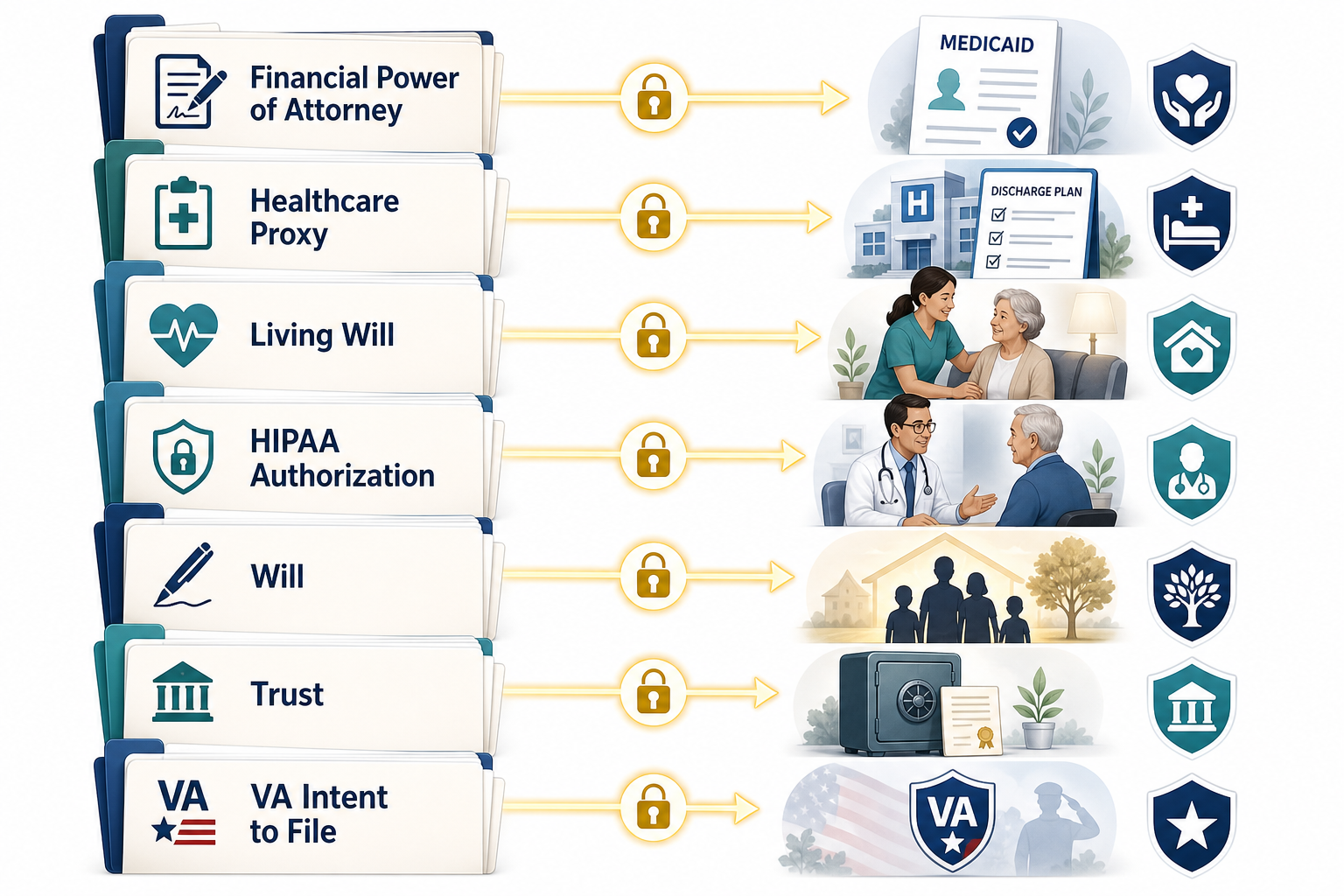
The Legal Gatekeepers: 7 Documents You Need Before You Can Access Senior Living Assistance
Many families discover too late that they cannot enroll in Medicaid, access VA benefits, or even discuss a parent's hospital discharge because essential legal documents were never put in place. This article explains the seven documents that unlock access to care and provides a crisis-prevention checklist for adult children.

The Crisis That Didn't Have to Happen: When You Can't Help Because You Can't Sign
Your mother falls and breaks her hip. You rush to the hospital. The social worker says she needs rehabilitation followed by home care, and that she may qualify for a Medicaid Home and Community-Based Services (HCBS) waiver to help pay for it. You're ready to help. Then the hospital asks you to sign the admission paperwork, and you realize you can't. You have no legal authority to act on her behalf.
This scenario plays out in emergency rooms and discharge planning offices every day. The problem isn't that families don't want to help — it's that they lack the legal documents that authorize them to do so. Without a durable financial power of attorney, you cannot manage bank accounts or apply for Medicaid. Without a healthcare proxy, you cannot discuss treatment plans with doctors. Without a HIPAA authorization, hospital staff cannot even tell you your parent's diagnosis.
Below are the seven documents that act as gatekeepers to care. Each one is tied to a specific access barrier. If any is missing, a critical path to assistance may be blocked.
Document 1: Durable Financial Power of Attorney — The Key to Paying for Care
A durable financial power of attorney (POA) names someone to manage another person's financial affairs. Without it, you cannot legally access your parent's bank accounts, pay their bills from their funds, sell property, or — critically — apply for means-tested programs like Medicaid on their behalf.
The National Institute on Aging explains that a durable POA remains in effect even after the person becomes incapacitated. This is what makes it useful for caregiving. If your parent is still mentally competent, they can sign a durable POA today, and you can hold it in reserve until it is needed.
The AARP legal checklist reinforces that a durable financial POA allows you to step in and manage finances immediately. This is essential for accessing programs like Medicaid HCBS waivers, which require detailed financial documentation and an authorized representative to submit the application.
Document 2: Healthcare Power of Attorney (Health Care Proxy) — The Key to Medical Decisions
A healthcare power of attorney — also called a health care proxy, medical POA, or surrogate — names someone to make medical decisions when the patient cannot speak for themselves. This document is required before a family member can discuss treatment options with doctors, authorize surgeries, or make decisions about discharge planning.
The National Institute on Aging notes that the proxy can make decisions about types of medical care, identify providers, oversee health information, and even make decisions about autopsy and organ donation. Most states require the proxy to be at least 18 years old.
The AARP checklist adds that a healthcare POA gives authority to talk with doctors and review medical records. Without it, hospital staff are legally obligated to defer to the patient — even if the patient is confused, sedated, or unable to communicate.
Document 3: Living Will / Advance Directive — The Key to Treatment Preferences
A living will — sometimes called an advance directive — tells doctors how a person wants to be treated if they cannot communicate their wishes. It covers decisions about life-sustaining treatment, resuscitation, feeding tubes, and pain management.
The NIA checklist describes a living will as a document that tells doctors how you want to be treated if you cannot make your own decisions about emergency treatment. It works alongside a healthcare POA — the proxy makes decisions, and the living will provides guidance for those decisions.
While a living will does not directly unlock a care program, it is often required by hospitals and nursing homes before they will accept a patient for certain types of care. Without it, medical providers may default to aggressive treatment that the patient would not have wanted, or they may delay discharge planning while they seek clarity on the patient's wishes.
Document 4: HIPAA Authorization — The Key to Talking to Doctors
HIPAA authorization is a separate document that explicitly permits healthcare providers to share medical information with named individuals. Even with a healthcare POA in place, some hospitals require a standalone HIPAA authorization before they will discuss a patient's condition with family members.
This is the document that unlocks communication. Without it, doctors cannot tell you what is wrong, what treatments are being considered, or when your parent can be discharged. This creates a cascade of delays: you cannot plan for home care, you cannot coordinate with the Area Agency on Aging, and you cannot advocate for the services your parent needs.
The Medicare home health coverage gap is a common example of why this matters. Many families discover only after discharge that Medicare does not cover the full cost of home care. Without HIPAA authorization, you cannot discuss the discharge plan with hospital staff to understand what is covered and what is not.
Document 5: Will — The Key to Asset Distribution
A will specifies how a person's estate is distributed after death and names guardians for any dependents. The NIA checklist lists a will as a core document for getting affairs in order.
A will does not directly help with accessing care during your parent's lifetime. However, it is essential for estate planning and can affect Medicaid eligibility. If a parent dies without a will, state intestacy laws determine who inherits assets, which can complicate the surviving spouse's ability to qualify for benefits.
Document 6: Trust (If Applicable) — The Key to Asset Management and Medicaid Planning
A living trust instructs a trustee to hold and distribute property when the person can no longer manage their affairs. The NIA notes that a trust can help manage assets and may reduce tax liabilities. The Caregiver Action Network adds that trusts can also protect assets for Medicaid eligibility purposes.
A trust is not necessary for every family. It is most relevant for families with significant assets who want to avoid probate, reduce estate taxes, or structure assets to meet Medicaid's resource limits. An elder law attorney can advise whether a trust makes sense for your situation.
Document 7: VA Form 21-0966 (Intent to File) — The Key to Veterans Benefits
For veterans and surviving spouses, VA Form 21-0966 (Intent to File) establishes an effective date for VA pension and Aid and Attendance benefits. Filing this form preserves the earliest possible benefit start date while you gather the required medical and financial documentation.
The VA Aid and Attendance benefit provides monthly payments — up to $11,589 per year for a single veteran and $6,998 for a surviving spouse in 2026 — to help cover the cost of home care, assisted living, or nursing home care. Despite this, industry estimates suggest that only about one-quarter of eligible seniors apply.
VA Form 21-0966 is only relevant for veterans and surviving spouses. If your parent did not serve in the military, this document does not apply. For those who are eligible, filing the Intent to File early can save months of retroactive benefit payments.
For a full overview of funding sources, including VA benefits, Medicaid waivers, and other programs, see our guide on how to pay for in-home senior care.
The Critical Timing Trap: Springing vs. Durable Power of Attorney
Not all powers of attorney are created equal. The distinction between a "springing" POA and a "durable" POA has major practical implications for crisis response.
| Feature | Durable POA | Springing POA |
|---|---|---|
| Effective date | Immediately upon signing | Only after physician-certified incapacity |
| Crisis response | You can act immediately | You must wait for incapacity determination |
| Proof required | None beyond the signed document | Physician's certification of incapacity |
| Risk | None — you hold authority but do not have to use it | Delay in crisis — you cannot act until incapacity is proven |
| AARP recommendation | Recommended | Not recommended — 'If something happens, you want to be able to act quickly' |
The AARP legal checklist explicitly advises against springing POAs: "If something happens, you want to be able to act quickly." The problem with a springing POA is that it only takes effect when a physician certifies that the person is incapacitated. By the time that certification is obtained — which can take days or weeks — critical decisions may have already been made without your input.
State-by-State Variability: What You Need to Know
Document requirements and forms vary by state. The NIA notes that "most states provide the forms for free, and you can complete them yourself." However, the specific forms, witnessing requirements, and notarization rules differ.
The AARP provides state-specific advance directive forms and legal checklists. Some states recognize a single combined advance directive that includes both a living will and healthcare POA. Others require separate documents. A few states have specific requirements for HIPAA authorization forms.
The safest approach is to consult an elder law attorney in your parent's state of residence. They can confirm which forms are required, ensure they are properly executed, and advise on any state-specific nuances.
The Costly Backup Plan: Guardianship and Conservatorship
If a parent becomes incapacitated without the essential documents in place, the only remedy is a court-supervised guardianship or conservatorship. This is not a simple fix — it is a legal proceeding that can take three to six months and cost between $2,000 and $5,000 or more in legal fees, according to Rocket Lawyer.
During that waiting period, no one has legal authority to manage the parent's finances, make medical decisions, or apply for assistance programs. Bills go unpaid. Care decisions are delayed. The parent may remain in a hospital or nursing home longer than necessary because no one can authorize discharge.
The Lawyer for Seniors article captures the urgency: "Incapacity, especially if brought on suddenly by an injury, stroke or other acute event, can strike without warning." If the parent is already incapacitated, they cannot sign a POA — the window of opportunity has closed.
Action Checklist: Get These Documents in Place Now
The time to act is before the crisis. Use this checklist to ensure the essential documents are in place.
- Talk to your parent about the importance of these documents. Frame it as protecting their wishes, not taking control.
- Gather any existing documents — wills, trusts, POAs, advance directives — and review them for completeness and currency.
- Consult an elder law attorney who specializes in your parent's state of residence. They can advise on which documents are needed and ensure they are properly executed.
- Complete a durable financial POA (not springing) that names a trusted person to manage finances.
- Complete a healthcare POA (health care proxy) that names someone to make medical decisions.
- Complete a living will / advance directive that documents treatment preferences.
- Complete a HIPAA authorization that permits healthcare providers to share information with named individuals.
- Create or update a will to specify asset distribution and guardians for dependents.
- Consider a trust if your parent has significant assets or complex Medicaid planning needs.
- If your parent is a veteran or surviving spouse, file VA Form 21-0966 (Intent to File) to establish an early effective date for benefits.
- Store the original documents in a safe, accessible location. Give copies to the named agents, the primary care physician, and the local Area Agency on Aging.
Questions to bring to a clinician or OT
This is not medical, legal, or a family's final decision — only a framework. Bring these questions to a clinician, occupational therapist, or your local Area Agency on Aging.
Find Local HelpRelated reading
Noticed something outdated or inaccurate on this page? Flag a correction. We review every report against CDC, NIA, and AARP HomeFit guidance before updating a page.