
Caregiver decision guide
From Overwhelmed to Sustainable: A Practical Self-Care Framework for Family Caregivers
Family caregivers often neglect their own health, but self-care is a prerequisite for sustainable caregiving. This article provides a concrete, tiered framework — from 5-minute micro-practices to weekly structures and systemic changes — grounded in evidence from the NIA, Harvard Health, and the Stress-Busting Program.
The Problem: Why Caregivers Neglect Their Own Health
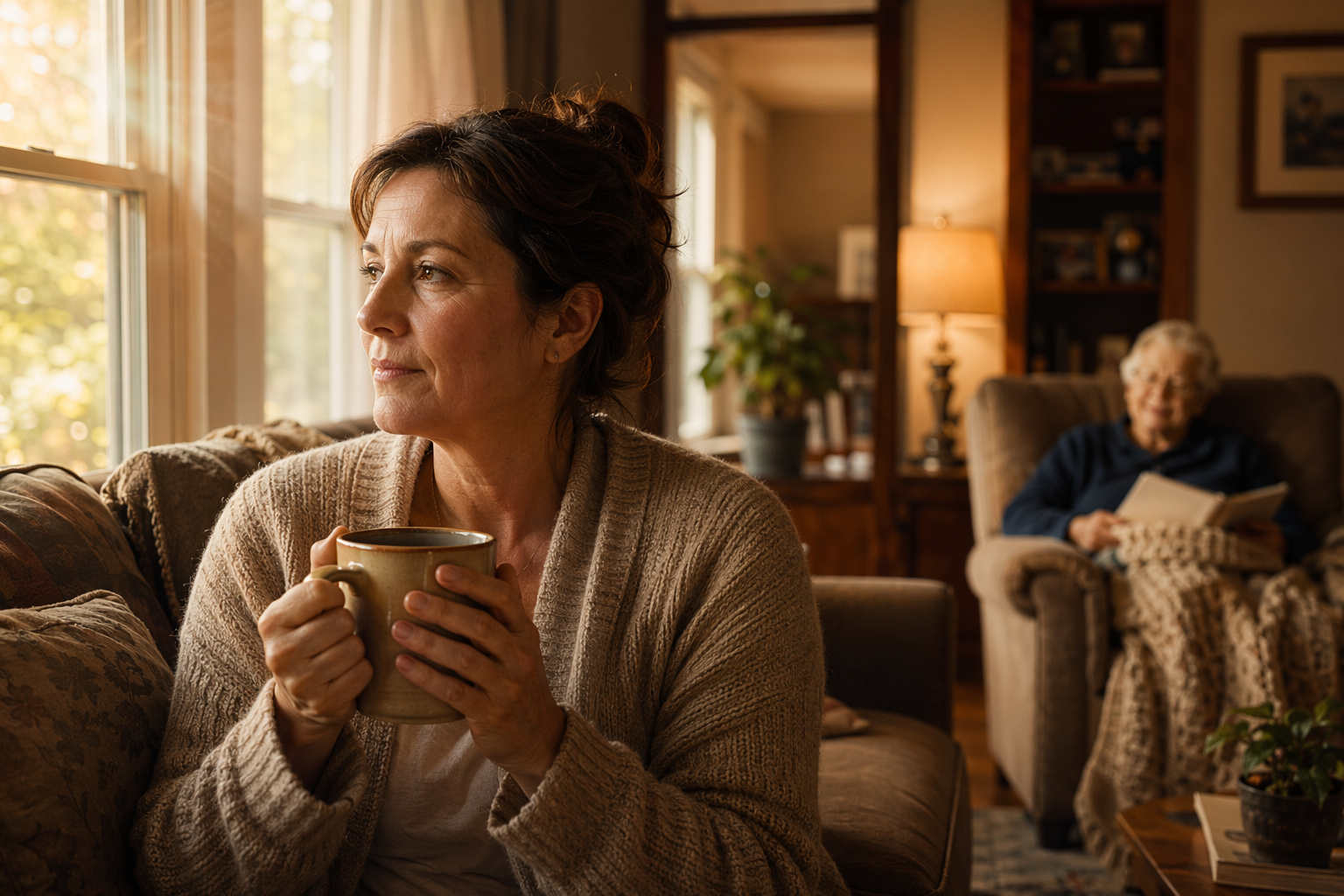
When you are responsible for someone else's meals, medications, appointments, and safety, your own health checkup can feel like an optional luxury. The data suggests this is not just a feeling — it is a pattern. According to the National Institute on Aging, family caregivers are less likely than the general population to get preventive health services like annual checkups. They also tend to have a higher risk of sleep problems, chronic conditions such as high blood pressure, and even an increased risk of premature death.
The reasons are not mysterious. When your day starts with helping someone else get dressed and ends with managing their nighttime anxiety, there is little room left for a walk, a balanced meal, or a full night's sleep. What makes this harder is the guilt that often follows any attempt to step away. The internal voice says that taking time for yourself means you are failing the person you care for.
Why Self-Care Is Not Optional — It’s a Prerequisite for Sustainable Caregiving
The word "self-care" has been diluted by marketing into bubble baths and scented candles. In the context of family caregiving, it means something far more concrete: the deliberate actions you take to maintain your own physical and emotional capacity to provide care over the long term.
A 2025 survey by A Place for Mom (n=1,029) found that 72% of family caregivers say they make time for self-care at least weekly. Yet 41% of all caregivers still report low overall well-being — a rate 32% higher than non-caregivers, according to a 2023 Guardian Life study cited by Caregiver Action Network. This gap between effort and outcome suggests that the type and structure of self-care matter more than the frequency.
Evidence-based programs demonstrate that structured self-care produces measurable results. The Stress-Busting Program for Family Caregivers, developed by the National Council on Aging (NCOA), is a 9-week program with 1.5-hour sessions per week that has been proven to improve quality of life and help caregivers manage stress through problem-solving skills and stress management techniques. Originally designed for dementia caregivers, it now has adaptations for chronic illness and is available in Spanish.
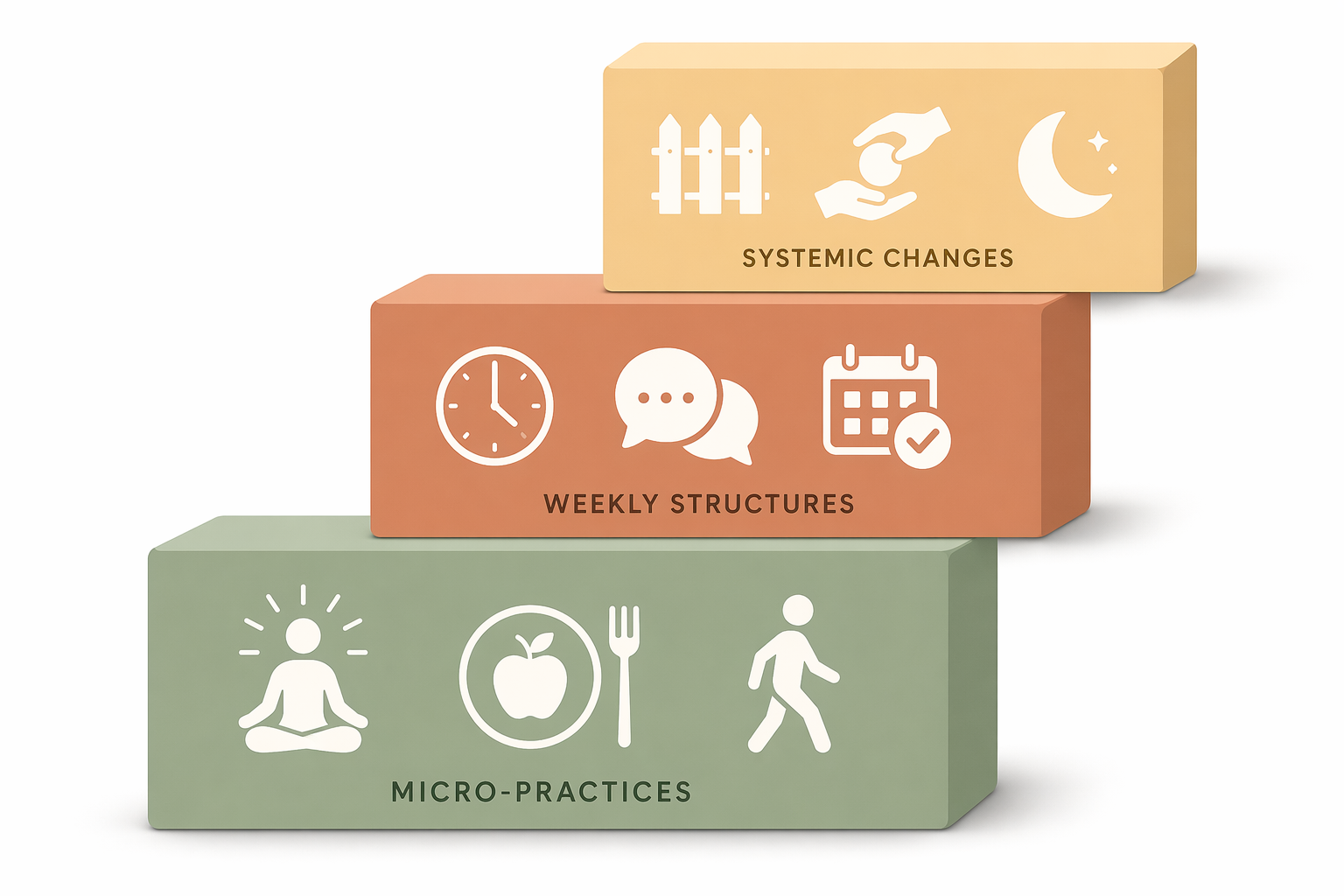
Tier 1: Micro-Practices You Can Start in 5 Minutes
When you are in the thick of daily caregiving, carving out an hour for yourself can feel impossible. That is where micro-practices come in. These are actions that take five minutes or less but provide a genuine reset for your nervous system. They are not placebos — they are grounded in physiological evidence.
Harvard Health recommends a simple breath awareness technique that takes about 10 minutes per day but can be effective even in shorter bursts. The technique is straightforward: breathe in for a count of five, pause for a count of five, and breathe out for a count of five. This pattern activates the parasympathetic nervous system, which counteracts the stress response. Even two or three cycles during a tense moment can shift your physiological state.
- One intentional meal. Instead of eating whatever is left over while standing at the counter, sit down for five minutes with a plate that includes protein, vegetables, and a whole grain. The NIA emphasizes that eating well is a core self-care practice for caregivers.
- A five-minute walk. Step outside, walk to the end of the block and back. The NIA recommends regular physical activity as a stress reducer and a way to improve sleep quality. You do not need a gym membership to get the benefit of movement.
- Mind-body micro-practices. Harvard Health notes that practices like yoga, tai chi, and meditation activate the relaxation response. A single sun salutation or three minutes of seated stretching counts.
Tier 2: Weekly Structures That Build Resilience
Micro-practices keep you going day to day. Weekly structures build the resilience that prevents burnout from taking hold in the first place. These require planning, but they deliver compounding returns.
The Stress-Busting Program's 9-week structure works precisely because it is scheduled and consistent. You do not wait until you feel like attending — you attend because it is on the calendar. The same principle applies to your weekly self-care.
| Weekly Structure | What It Looks Like | Why It Works |
|---|---|---|
| One hour of personal time | A fixed, non-negotiable block on your calendar. Read, walk, call a friend, or sit in a coffee shop alone. | Creates a predictable boundary that your brain can rely on. Reduces the feeling that caregiving is consuming your entire identity. |
| Caregiver support group attendance | In-person or online group. The Alzheimer's Association National Helpline study found that even a single supportive call can meaningfully reduce caregiver distress. | Provides validation, reduces isolation, and offers practical tips from people who understand your situation. |
| Respite scheduling | Arrange for someone else to provide care for a few hours. Options include in-home respite, adult day centers, or short-term nursing home stays (Mayo Clinic). | Gives you a predictable window of time when you are not on duty. Essential for preventing the slow accumulation of exhaustion. |
For a deeper look at how adult day programs can provide reliable weekly respite, see our guide on how adult day care supports your health and wellbeing.
Tier 3: Systemic Changes for Long-Term Sustainability
Micro-practices and weekly structures will keep you afloat. Systemic changes are what allow you to thrive over months and years. These are the hardest to implement because they often require confronting deeply held beliefs about your role as a caregiver.
Setting Boundaries
Boundaries are not walls — they are agreements about what you can and cannot do. The NIA provides a Worksheet: Coordinating Caregiving Responsibilities that helps you map out who does what. This is a practical tool for delegating tasks to other family members, friends, or paid providers. If you are a spousal caregiver, boundary-setting carries unique emotional weight. Our stage-based guide for spousal caregivers offers strategies tailored to that relationship.
Establishing a Sleep Hygiene Routine
The NIA recommends 7 to 9 hours of sleep per night for caregivers. This may sound impossible, but sleep deprivation is not a badge of honor — it is a risk factor for accidents, illness, and impaired decision-making. A sleep hygiene routine includes a consistent bedtime, no screens for 30 minutes before sleep, and avoiding caffeine after 2 p.m. If your loved one wakes at night, consider a shift-based approach where another family member or overnight respite provider handles nighttime needs.
Delegating Without Guilt
Delegation is not abandonment. It is the recognition that you cannot be the sole provider of every type of care. The Mayo Clinic advises caregivers to ask for and accept help, set reachable goals, and get connected to caregiving resources. Start with one task you can hand off this week — picking up a prescription, preparing one meal, or handling one medical appointment.
Addressing the Guilt Barrier: Reframing Self-Care as Caregiving Competence
The most common reason caregivers give for not practicing self-care is guilt. The thought process goes: "If I take time for myself, I am neglecting my loved one." This belief is not only painful — it is also inaccurate.
Harvard Health frames it directly: "Practicing self-care allows the caregiver to remain more balanced, focused, and effective, which helps everyone involved." Self-care is not a detour from caregiving — it is a core competency of caregiving. A caregiver who is exhausted, sick, or emotionally depleted cannot provide safe, consistent care. A caregiver who is rested and supported can.
The Penn LDI research team found that when caregiver self-care improved through an online health coaching program, patient hospitalizations decreased by 67%. This is not a coincidence. When the caregiver is healthier, the care recipient benefits directly.
For a deeper exploration of these emotional challenges and how to work through them, read The Emotional Realities of Caring for Aging Parents.
Your Self-Care Resource Roundup
You do not need to build your self-care framework from scratch. The following resources provide structured support, evidence-based programs, and practical tools you can use today.
- NIA Caregiver Handbook: The National Institute on Aging offers a comprehensive guide with tips on exercise, nutrition, sleep, stress reduction, and a coordinating responsibilities worksheet. Available at nia.nih.gov.
- Harvard Health Self-Care Guide: Practical advice on breath awareness, mind-body practices, and maintaining social connections. Read it at health.harvard.edu.
- NCOA Stress-Busting Program Locator: Find a 9-week evidence-based program near you or online. Details at ncoa.org.
- Mayo Clinic Caregiver Stress Guide: Tips on managing stress, asking for help, and exploring respite care options. Available at mayoclinic.org.
Questions to bring to a clinician or OT
This is not medical, legal, or a family's final decision — only a framework. Bring these questions to a clinician, occupational therapist, or your local Area Agency on Aging.
Find Local HelpRelated reading
Noticed something outdated or inaccurate on this page? Flag a correction. We review every report against CDC, NIA, and AARP HomeFit guidance before updating a page.